Posts Tagged ‘photowalk’
subsidiary impression

– photo by Mitch Waxman
You see it all the time, here at your Newtown Pentacle. The Bayonne Bridge, deemed an archaic impediment to navigation by those scions of NY harbor whose hidden machinations are confined to secretive board room meetings at Port Authority and the NYC EDC, is often used as a frame for tugboat shots by your humble narrator. Othman Amman’s second masterpiece (after Hellgate), the bridge is destined to be altered shortly. Accordingly, a group of enthusiasts, antiquarians, and weirdos were gathered one fine September morning to walk across it.
from a Newtown Pentacle posting of June 26, 2009
The fourth largest steel arch bridge on Earth with a height of 150 feet over the water, it connects Bayonne, New Jersey’s Chemical Coastline with Staten Island. It’s primary mission is to allow vehicular traffic access to Manhattan via the Holland Tunnel…
The Bayonne Bridge was designed by a man who helped design the Hell Gate rail bridge on the East river- and was principal designer for the Verrazano bridge over the Narrows, The George Washingston Bridgeover the Hudson River, the Bronx Whitestone Bridge over the East River, the Throgs Neck Bridge over the East River. He was brought in to simplify the design of mighty Triborough– which is actually a bridge and highway complex spanning multiple waterways and islands. A swede Swiss, Othmar Amman worked for Gustavus Lindenthal (designer of the the Queensboro and Hell Gate Bridges), and took over as head bridge engineer at the New York Port Authority in 1925. He also directed the planning and construction of the the Lincoln Tunnel.
He was Robert Moses’s “guy”.

– photo by Mitch Waxman
We came to… Staten Island… via the ferry, and accessed a bus which took us to a less than savory section of the forgotten borough adjoining the bridge. There, the walkway was gained and off we went. Amongst our number was Kevin Walsh of Forgotten-NY fame, my aide de camp and far eastern correspondent Armstrong, as well as our railroad expert, and a certain lady who knows that all that glitters is gold. Stairway to heaven, indeed.
from panynj.gov
Initially, the bridge was planned for motor vehicles, bicycles, and pedestrians only. Accordingly, a suspension bridge design was developed since this type of bridge offered the most economical way to engineer a single span across the Kill Van Kull for motor vehicles. However, the suspension scheme was abandoned when the Port Authority commissioners insisted that considerations be made for at least two rail transit tracks to be added at some future date. (Studies showed that adapting a suspension design for rail traffic would be cost-prohibitive.) With rail traffic in mind, the bridge’s chief designer, Othmar H. Ammann, began developing a scheme that spanned the Kill Van Kull with a single, innovative, arch-shaped truss. As with the suspension bridge scheme, Ammann worked on the arch design in partnership with architect Cass Gilbert. The arch bridge that emerged promised to be a remarkably efficient solution, well suited to the site from both an engineering and aesthetic standpoint.

– photo by Mitch Waxman
Like the thrice damned Kosciuszko Bridge over my beloved Newtown Creek, Bayonne Bridge is a relict of an earlier age with a less than bright future. Public fortunes will be spent on reengineering it to fit the needs of private commercial interests. Government sources describe a scenario in which the arch itself will remain unaltered, but that the road which it carries will be obliterated and replaced. Increasingly important to accomplish the walk before this happened, we ignored the signs along the walkway adjuring against suicide and left… Staten Island… for New Jersey to see what could be seen. More to come…
Also- Upcoming tours…

for an expanded description of the October 13th Kill Van Kull tour, please click here

for an expanded description of the October 20th Newtown Creek tour, please click here
paradis artificiels

– photo by Mitch Waxman
Sorry for the lack of a real post today, lords and ladies. Hopefully this shot of the loquacious Newtown Creek will satiate your desires for more, more, more. Back tomorrow with something a bit more substantial, have been occupied developing literally thousands of shots for the last few days, and working on setting up a few more interesting diversions with which to finish out 2012.
Also- Upcoming tours…
for an expanded description of the October 13th Kill Van Kull tour, please click here
for an expanded description of the October 20th Newtown Creek tour, please click here
fantastic notions

– photo by Mitch Waxman
One observes a lot of things during the long scuttles around the loquacious Newtown Creek for which your humble narrator has developed a certain reputation. More often than not, it’s some relict architecture or a keystone to some long forgotten industrial saga. Sometimes, it’s just an opportunity to watch the machinery of the great human hive at work- other times, it’s just some bitch.

– photo by Mitch Waxman
Not too long ago, on Greenpoint Avenue in Brooklyn, at the house of the estimable engine 238- it was this enigmatic canid which drew my attention. An old girl, one wasn’t sure if she was the mascot or resident dog of the house- an FDNY tradition. Let’s face it, anyplace which doesn’t have a resident dog isn’t really worth visiting, and firefighters spend an awful lot of time at work. Didn’t have time to stop and inquire, and this girl was too busy enjoying a late summer afternoon to answer questions put to her by some wandering mendicant.

– photo by Mitch Waxman
Can’t tell you if she was rescued from a blaze, or just wandered into the place- unfortunately. Dogs don’t need context, after all, as they mainly worry about “the now” and don’t think about “before” or “then”. Normally, a Saturday posting would concern itself with a “Project Firebox” subject, but today a shout is sent out to “Project Firedog” and this beautiful bitch in Greenpoint.
limned delicately
– photo by Mitch Waxman
One has always enjoyed strange interests and pastimes, even as a child. Vivid, memories of a next door neighbor (who owned a commercial vessel which was part of the Sheepshead Bay fishing fleet) displaying a captured deep sea creature- the sort whose teeth are transparent, skin is shiny black, and bearing a bioluminescent lantern protruding from its forehead- persist decades after viewing it dying in a bucket. Joy is found wandering about cemeteries and wasted heaths, or anyplace shunned by the common gentry.
from “Beyond Good and Evil” by Friedrich Nietzsche, Chapter IV. Apophthegms and Interludes
Wer mit Ungeheuern kämpft, mag zusehn, dass er nicht dabei zum Ungeheuer wird. Und wenn du lange in einen Abgrund blickst, blickt der Abgrund auch in dich hinein.
Translation: He who fights with monsters might take care lest he thereby becomes a monster. And when you gaze long into an abyss the abyss also gazes into you.

– photo by Mitch Waxman
Early experience has led one to appreciate, seek, and cultivate interest in the macabre. Hidden truths, occultist fantasy, the lure of the “real”- all have carried your humble narrator to bizarre locales in search of thrills. Delight is found in jars of formaldehyde cured anatomies, displays of skeletonized life forms, and the arcana of the mortician and police scientist. One thing which bizarre experience has taught me is that there are certain things which cannot be “unseen”, which will alter your perceptions of the normal.
from wikipedia.org
The original Maelstrom (described by Poe and others) is the Moskstraumen, a powerful tidal current in the Lofoten Islands off the Norwegian coast. The Maelstrom is formed by the conjunction of the strong currents that cross the straits (Moskenstraumen) between the islands and the great amplitude of the tides.
In Norwegian the most frequently used name is Moskstraumen or Moskenstraumen (current of [island] Mosken).
The fictional depictions of the Maelstrom by Edgar Allan Poe and Jules Verne describe it as a gigantic circular vortex that reaches the bottom of the ocean, when in fact it is a set of currents and crosscurrents with a rate of 18 km/hr.

– photo by Mitch Waxman
During my student years, a part time job at a photo developing company provided me with visions of horror normally reserved for the world weary gendarme. A certain police command in Brooklyn utilized our services to process evidentiary photographs and videotapes, and the horrors witnessed in these scraps of visual data imparted a real and lasting sympathy for the men and women who operate on the front lines of society. A child half consumed by zoo animals, bodies clad in the proverbial “cement overcoat” hauled from long residency in Jamaica Bay, the hapless victims of vehicular accidents. If you know a cop or ambulance driver, buy them a drink, as they have seen too much.
from The Shadow Over Innsmouth by H. P. Lovecraft
Complaints from many liberal organizations were met with long confidential discussions, and representatives were taken on trips to certain camps and prisons. As a result, these societies became surprisingly passive and reticent. Newspaper men were harder to manage, but seemed largely to cooperate with the government in the end. Only one paper – a tabloid always discounted because of its wild policy – mentioned the deep diving submarine that discharged torpedoes downward in the marine abyss just beyond Devil Reef. That item, gathered by chance in a haunt of sailors, seemed indeed rather far-fetched; since the low, black reef lay a full mile and a half out from Innsmouth Harbour.
People around the country and in the nearby towns muttered a great deal among themselves, but said very little to the outer world. They had talked about dying and half-deserted Innsmouth for nearly a century, and nothing new could be wilder or more hideous than what they had whispered and hinted at years before. Many things had taught them secretiveness, and there was no need to exert pressure on them. Besides, they really knew little; for wide salt marshes, desolate and unpeopled, kept neighbors off from Innsmouth on the landward side.
 – photo by Mitch Waxman
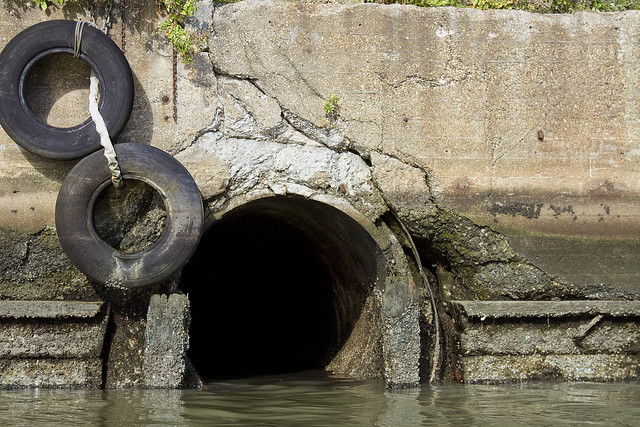
Perhaps this is why, whenever I am on Newtown Creek (which is rather frequently, after all) insistence on getting close to the open intestines of the cruel megalopolis is insisted on by your humble narrator. Miasmal, these pipeways contain the hidden and truly occult unknowable. Darkness shrouds and shelters unknowable realities in this system of engineered horror, whose construction largely dates back to a time in which a Kaiser still ruled Germany. An extensive urban mythology exists which speculates upon what might be found in this kingdom of the rat, along those weirs and subterranean grottoes fed by decay, filth, and all that which might be discarded by the sunlit world above.
Truly- who can guess, all that there is, that might be buried down here?
from “The Divine Comedy by Dante Alighieri“, translated by Henry Wadsworth Longfellow Inferno, Canto III
“Through me the way into the suffering city,
Through me the way to the eternal pain,
Through me the way that runs among the lost.
Justice urged on my high artificer;
My maker was divine authority,
The highest wisdom, and the primal love.
Before me nothing but eternal things were made,
And I endure eternally.
Abandon every hope, ye who enter here.”
old manor

– photo by Mitch Waxman
It may have been noticed, lords and ladies, that several shots of the loquacious Newtown Creek from an odd angle have appeared at this- your Newtown Pentacle- in the last few days. Your humble narrator recently found himself coerced into a bird watching expedition, by canoe, by certain powers and potentates of the Newtown Creek Alliance. It should be explained, as it has been mentioned in the past, that if the leadership of NCA can be analogized as the “Super Friends“- your humble narrator plays the role of Gleek the super monkey in the group.
Accordingly, when they ask me to go bird watching on Newtown Creek in a canoe with the North Brooklyn Boat Club, I go.
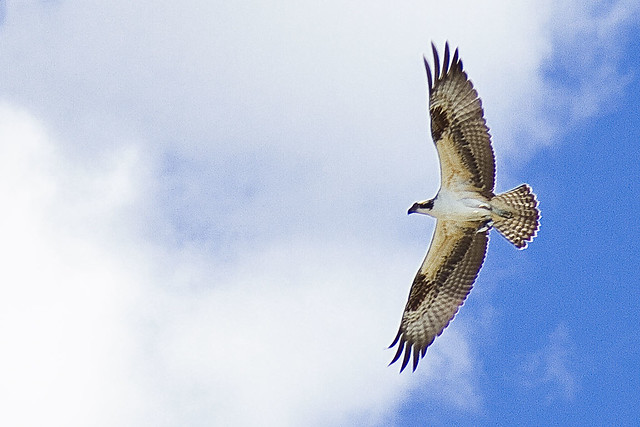
Hey, look, we saw an Osprey.
from wikipedia
The Osprey (Pandion haliaetus), sometimes known as the sea hawk, fish eagle or fish hawk, is a diurnal, fish-eating bird of prey. It is a large raptor, reaching more than 60 cm (24 in) in length and 180 cm (71 in) across the wings. It is brown on the upperparts and predominantly greyish on the head and underparts, with a black eye patch and wings.
The Osprey tolerates a wide variety of habitats, nesting in any location near a body of water providing an adequate food supply. It is found on all continents except Antarctica although in South America it occurs only as a non-breeding migrant.
As its other common name suggests, the Osprey’s diet consists almost exclusively of fish. It possesses specialised physical characteristics and exhibits unique behaviour to assist in hunting and catching prey. As a result of these unique characteristics, it has been given its own taxonomic genus, Pandion and family, Pandionidae. Four subspecies are usually recognised. Despite its propensity to nest near water, the Osprey is not a sea-eagle.

– photo by Mitch Waxman
Personal preference for motorized transport on the water aside, the folks from the North Brooklyn Boat House took great care of us and the afternoon went pretty well. Aside from the Osprey, we witnessed several other avian critters- including the Great Blue Heron which I’ve been chasing around the Creek all year. Unfortunately, the camera rig I carry isn’t purpose built for this sort of thing. The images in today’s post are pretty close to “actual pixels”, a 100% crop of a larger image, and look a bit rougher than my normal photos accordingly.
Bird photography, done properly, requires a powerful and expensive lens to get right.
from nytimes.com
Ospreys — large birds with dramatic brown and white markings and four-foot wing spans — occupy the top of the food chain, eating all kinds of fish, and are thus important indicators of the health of their environment. Along with other birds of prey, they were decimated by the widespread use of the pesticide DDT in the 1950s and ’60s, which led to a thinning of eggshells. Once DDT was banned in 1972, however, ospreys began a remarkable comeback, especially in the Northeast.
– photo by Mitch Waxman
Even those of us familiar with the Creeklands have been startled by the diversity of specie observed during these surveys. Your humble narrator, as an omnivore consumer of visual data, has little to no expertise in such matters- but those well versed with ornithological endeavors have been left slack jawed at the thriving ecosystem observed around the so called “dead sea” of the Newtown Creek.
from dec.ny.gov
The osprey is probably the longest studied and monitored raptor in New York. The New York State Department of Environmental Conservation (NYSDEC) monitors the status and productivity of the majority of New York’s population. Each year, both ground and aerial surveys are conducted by NYSDEC to document osprey nests in the state.
From 1980-1987, the NYSDEC released 36 young ospreys taken from nests on Long Island in an attempt to establish a third or “satellite” population in southwestern New York. During the seven years of the project, 30 young ospreys were released into the wild. This has lead to successful nests in the area, including nine nesting pairs in 1998. There are also close to a dozen breeding pairs in central New York and one in Southeastern New York in Sullivan County.


