Posts Tagged ‘photowalk’
nature transmutes

– photo by Mitch Waxman
A humble narrator just can’t get enough of the Long Island Railroad yard in Long Island City.
Back in January of this year, while “wondering uneasily“, we established that the LIRR station in Long Island City accomplishes tasks which it would take some 30,000 horses to accomplish on a daily basis. Last year, in October- these very tracks were visited in “Deeply Hidden“.
Simply put, I’m kind of drawn to this spot.
from wikipedia
This station has 13 tracks, two concrete high-level island platforms, and one wooden high-level island platform. All platforms are two cars long and accessible from Borden Avenue just west of Fifth Street. The northernmost one, adjacent to tracks 2 and 3, is the only one used for passenger service. The other concrete platform adjacent to tracks 6 and 7 and the wooden one adjacent to tracks 8 and 9 are used for employees only. All tracks without platforms are used for train storage. The southernmost four tracks are powered by third rail while the remaining tracks are used only by diesel-powered trains.

– photo by Mitch Waxman
Once upon a time, street grade rail crossings were pretty common in Western Queens, but these days there are only a few that I know about. As always, never will I claim to be an expert on this subject, as there’s too many alphanumeric terms involved for me to remember. As mentioned in the past, mathematics isn’t my strong suit, and I’ve always been cursed by a sort of numbers based dyslexia. I’m all ‘effed up.
from wikipedia
The Long Island Rail Road owns an electric fleet of 836 M7 and 170 M3 electric multiple unit cars, and 134 C3 bilevel rail cars powered by 23 DE30AC diesel-electric locomotives and 22 DM30AC dual-mode locomotives.
In 1997 and 1998, the LIRR received 134 double-decker passenger cars from Kawasaki, including 23 cab control cars, and 46 General Motors Electro-Motive Division diesel-electric locomotives (23 diesel DE30ACs and 23 dual-mode DM30ACs) to pull them, allowing trains from non-electric territory to access Penn Station for the first time in many years, due to the prohibition on diesel operation in the East River Tunnels leading to Penn Station.

– photo by Mitch Waxman
Arithmetic challenged, in a Jewish family, this marks one as worse than an idiot. The stereotype which opines that Jews are possessed of a certain aptitude for mathematics is fairly accurate (or at least it generally is in my family), and black sheep status was assigned me as early as second grade when they rolled out long division. Consistently low scores on the math section of standardized testing always betrayed my inadequacies to scholastic authorities, and was a great cause of concern to my parents. Reports from teachers fed their dire suspicions that I would someday end up “a bum on da bowery” or “shovelin shit on da street”.
from wikipedia
The DE30AC and DM30AC locomotives replaced aging GP38s, Alco FA1/FA2s, F7As and F9As, and MP15AC and SW1001 locomotives, with GP38s used to push and pull diesel trains and other locomotives used to provide HEP for the trains. The bodies of the DE30AC and the DM30AC are similar; the difference is the ability of the DM30AC to use electric third rail while the diesel engine is off, enabling the locomotive to use the East River Tunnels into New York Penn Station. DM30ACs have third rail contact shoes, permitting direct service from non-electrified lines in eastern Long Island via the western electrified main lines all the way to Penn Station. A few such trains a day run on the Port Jefferson, Oyster Bay, and Montauk Branches. The engines’ naming scheme: DM = Dual Mode, DE = Diesel Engine, 30 = 3000 hp, AC = Alternating Current traction motors.

– photo by Mitch Waxman
I’m told that people suffering from several different cognitive disorders spend their time memorizing train schedules and details about the rail system, and that they find some solace in the purely numerical language which governs the subject. Me, I just wander around aimlessly, and get the giggles when I’m lucky enough to randomly come across a train passing so close by. My major malfunction is taking too many pictures of trains and boats, it would seem.
from 1877′s “Long Island and where to go!!: A descriptive work compiled for the Long R.R. Co.“, courtesy google books:
Long Island City is the concentrating point upon the East river, of all the main avenues of travel from the back districts of Long Island to the city of New York. The great arteries of travel leading from New York are Thomson avenue, macadamized, 100 feet wide, leading directly to Newtown, Jamaica and the middle and southern roads on Long Island, and Jackson avenue, also 100 feet wide, and leading directly to Flushing, Whitestone and the northerly roads.
Long Island City is also the concentrating point upon the East river, of the railway system of Long Island.
The railways, upon reaching the city, pass under the main avenues of travel and traffic, and not upon or across their surface.
unreasonable impulse

– photo by Mitch Waxman
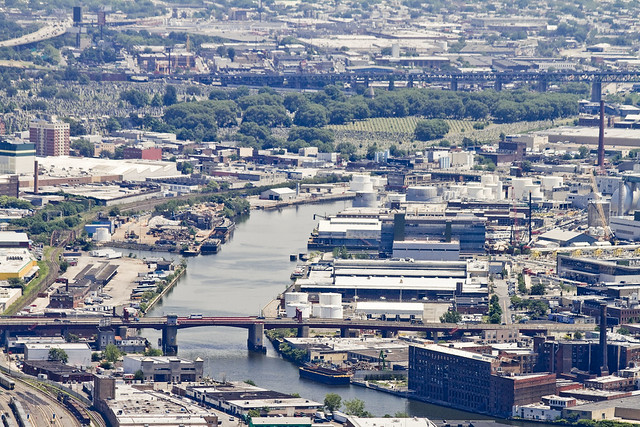
Occasion called for your humble narrator to find himself one thousand and fifty feet above Manhattan recently, staring down at the much maligned Newtown Creek. Kryptonian perspective notwithstanding, it was strange to see how small all of it seemed, stretching back a mere four miles from the East River. Always lost in the hidden minutia of the place, it was very odd to see all of it laid out so neatly for inspection.

– photo by Mitch Waxman
The big construction job at Hunters Point South, just getting underway, looks like a child’s sandbox from this height- with an adorable little rail yard next to it. Across the water in Greenpoint, an itsy bitsy sewer plant with its gleaming digester eggs shining in the light of the burning thermonuclear eye of god itself. Others may see only what’s there now, but I see Jack Frost Sugar and Chelsea rope and Newtown Creek Towing Company.
– photo by Mitch Waxman
That green patch is Calvary, with the thrice damned Kosciuszko framing it. Dutch Kills and the SimsMetal Newtown Creek Dock would be at the “9” position were the above shot a clock face, with Pulaski Bridge at the bottom. The Petroleum District in Greenpoint is about where the three would be, and you can just make out the Greenpoint Avenue Bridge. About where the “5” would be- notice the barge at TNT scrap metal on Manhattan Avenue?

– photo by Mitch Waxman
Dizzying, the extreme altitude began to work on my delicate constitution and the shooting session had to be cut short. Additionally, all I was able to think about was the Newsboy Governor and the Knickerbocracy’s Four Hundred for some reason.

– photo by Mitch Waxman
This is the sort of view of the Newtown Creek which I prefer, up close and personal, rather than from atop the world’s fourth largest building. The biggest problem with the Empire State Building’s observation deck, after all, is that you can’t see the Empire State Building.
____________________________________________________________________________
Click for details on Mitch Waxman’s
Upcoming boat tours of Newtown Creek
July 22nd, 2012 NEXT SUNDAY- There are Just a few tickets left, don’t miss out
Working Harbor Committee Newtown Creek Boat Tour

clearing sky

– photo by Mitch Waxman
While scuttling across the Greenpoint Avenue Bridge recently, enroute to a Newtown Creek Alliance meeting featuring a presentation by the DEC’s head oil spill man -Randall Austin, this fellow was observed hard at work by one unused to such exertion. As a zoom lens was already affixed to my camera, I decided to see what might be captured, and realized that I knew almost nothing about the process of welding.
Of course, what I do know about is Newtown Creek.
from wikipedia
Welding is a fabrication or sculptural process that joins materials, usually metals or thermoplastics, by causing coalescence. This is often done by melting the workpieces and adding a filler material to form a pool of molten material (the weld pool) that cools to become a strong joint, with pressure sometimes used in conjunction with heat, or by itself, to produce the weld. This is in contrast with soldering and brazing, which involve melting a lower-melting-point material between the workpieces to form a bond between them, without melting the workpieces.

– photo by Mitch Waxman
On a basic level, I understand the process, but having never undertaken the task- am largely ignorant of its mores. Something I do know of welding, however, it that a welded tank is preferred to a riveted one for bulk storage of petroleum- which was once the industry “standard”.
Incontrovertibly, if one is at Newtown Creek, and the word “Standard” comes up- only one meaning can be gleaned.
from wikipedia
A rivet is a permanent mechanical fastener. Before being installed a rivet consists of a smooth cylindrical shaft with a head on one end. The end opposite the head is called the buck-tail. On installation the rivet is placed in a punched or drilled hole, and the tail is upset, or bucked (i.e., deformed), so that it expands to about 1.5 times the original shaft diameter, holding the rivet in place. To distinguish between the two ends of the rivet, the original head is called the factory head and the deformed end is called the shop head or buck-tail.

– photo by Mitch Waxman
The facility that this torch bearing fellow was at work in is either the Lukoil or Metro depots, but I’m never certain about the property lines in the petroleum district- and given the generally paranoid atmosphere loosed roughly upon society and caused by the ongoing Terror Wars- it’s probably best not to speculate too long about the subject of whose fence begins or ends and where the property lines are.
What’s more interesting about this spot along Newtown Creek, to me at least, is that this laborer was at work in a very special spot- historically speaking.
from wikipedia
Oil depots are usually situated close to oil refineries or in locations where marine tankers containing products can discharge their cargo. Some depots are attached to pipelines from which they draw their supplies and depots can also be fed by rail, by barge and by road tanker (sometimes known as “bridging”).
Most oil depots have road tankers operating from their grounds and these vehicles transport products to petrol stations or other users.
An oil depot is a comparatively unsophisticated facility in that (in most cases) there is no processing or other transformation on site. The products which reach the depot (from a refinery) are in their final form suitable for delivery to customers. In some cases additives may be injected into products in tanks, but there is usually no manufacturing plant on site. Modern depots comprise the same types of tankage, pipelines and gantries as those in the past and although there is a greater degree of automation on site, there have been few significant changes in depot operational activities over time.

– photo by Mitch Waxman
This was right across the street from an early (1840) Kerosene refinery- Sone and Fleming, which was later acquired by John D Rockefeller’s Standard Oil Trust and transformed into an oil refinery. This facility has been mentioned before, in connection with an armageddon like blaze which Greenpoint suffered through in 1919. Such disasters were fairly common occurrences in the early days of oil refining and storage depots, and often were caused or made worse by weaknesses in petroleum tanks that were defectively riveted.
Today, there are no refineries along the Creek, it’s all about distribution and temporary storage.
from nytimes.com
TWENTY ACRES OF OIL TANKS ABLAZE; BIG FACTORIES BURN; Flames Cross Newtown Creek from Standard Yards Storing 110,000,000 Gallons of Oil. LOSS RUNS TO MILLIONS Each Fresh Explosion Fills the Sky, as from a Volcano, with Flame and Smoke. 1,200 FIREMEN AT THE SCENE Blaze Spreads for Blocks–Two City Fireboats Catch Fire and Two of Crew Reported Missing. TWENTY ACRES OF OIL TANKS ABLAZE Burned in 1883. Crowd All But Engulfed.
also- check this photo at cah.utexas.edu out, it’s from 1919, showing the fire’s aftermath.

– photo by Mitch Waxman
Welded joins are an order of magnitude better than riveted ones in such structures. Owing to my ignorance of this industrial art, a quick check was made with a neighbor who was formerly a member of a steam fitting trade union. He instructs that a perfect weld should look like a series of quarters overlapping each other seamlessly, and that an x-ray spectrum radiological photograph can be inspected to confirm a firm and lasting fit- something which cannot be obtained with rivets.
See, you learn something new every day- here in heart of the Newtown Pentacle- along the loquacious and utterly provocative Newtown Creek..
from 1921’s Welding engineer, Volume 6, courtesy google books
____________________________________________________________________________
Click for details on Mitch Waxman’s
Upcoming boat tours of Newtown Creek
July 22nd, 2012 NEXT SUNDAY- There are Just a few tickets left, don’t miss out
Working Harbor Committee Newtown Creek Boat Tour
Project Firebox 49

– photo by Mitch Waxman
Forgotten by all save I, this lonely node of a far flung network hangs forlornly in ancient Maspeth. Alongside a gargantuan parcel delivery yard, and not too far from either the Long Island Rail Road nor Maspeth Creek, it waits… and waits… should trouble pass it by.
ordered terraces
– photo by Mitch Waxman
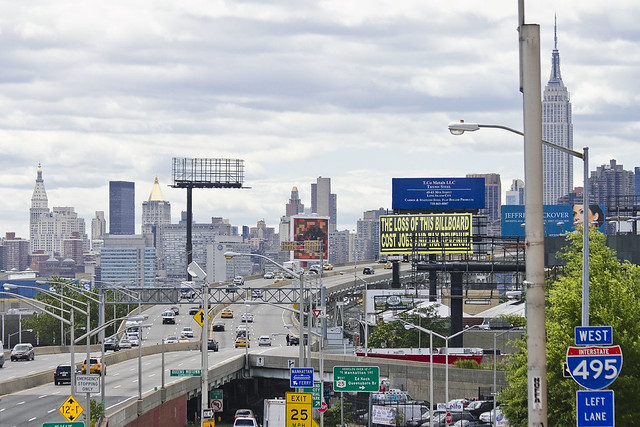
The blasted heaths of Western Queens, which the art of engineering have conquered fully, must have once been quite lovely. What exists at the dawn of the second millennia, however, represent obeisance to the motor vehicle and “flow”. Gaze in horror upon the Queens Midtown Expressway section of the Long Island Expressway, a 1939 expression of the seeming ennui felt by Robert Moses for the ancient villages and communities of Long Island City.
Your humble narrator is often struck dumb and blind when doing so.
from wikipedia
Symptoms of acute stress reaction
The symptoms show great variation but typically include an initial state of “daze”, with some constriction of the field of consciousness and narrowing of attention, inability to comprehend stimuli, and disorientation.
This state may be quickly followed by either further withdrawal from the surrounding situation (to the extent of a dissociative stupor), or by agitation and overactivity, anxiety, impaired judgement, confusion, detachment, and depression. Autonomic signs of panic anxiety (tachycardia, sweating, flushing) are also commonly present.
The symptoms usually appear within minutes of the impact of the stressful stimulus or event, and disappear within 2–3 days (often within hours). Partial or complete amnesia for the episode may be present.

– photo by Mitch Waxman
At its apex over the Dutch Kills tributary of the languid Newtown Creek, which climbs to some one hundred and six feet over the water, the steel roadway begins a precipitous change in declination which carries vehicular traffic to the subaqueous Queens Midtown Tunnel and into Manhattan. The roadway was elevated to this altitude for no reason other than allow ocean going vessels egress to the turning basin of the Degnon Terminal at the head of Dutch Kills, and the blighting effect it had on Long Island City was quite unintentional. The industrial center became something to be ignored, driven over, forgotten, and quite irrelevant- seemingly by design.
If this is not the case, why are there no entrance or exit ramps between Greenpoint and Vernon Avenues?
from wikipedia
Depersonalization disorder (DPD) is a dissociative disorder (ICD-10 classifies the disorder as an anxiety disorder) in which the sufferer is affected by persistent or recurrent feelings of depersonalization and/or derealization. A diagnosis is made when the dissociation is persistent and interferes with the social and occupational functions necessary for everyday living. Diagnostic criteria include persistent or recurrent experiences of feeling detached from one’s mental processes or body. “Dissociation is defined as a disruption in the usually integrated functions of consciousness, memory, identity and perception, leading to a fragmentation of the coherence, unity and continuity of the sense of self.

– photo by Mitch Waxman
The complicated snare of vehicular access to Manhattan as it all compacts in Long Island City has often caused me to fall into a stupor when contemplated. Subway lines, railroads, passenger and freight vehicles- all form a tight fist gripping the heart of this formerly vital center. Storm water flows freely from exhausts onto local streets, causing temporary lagoons of sooty liquids to agglutinate about garbage choked sewers. Many of these sewers bear the screed “no dumping, drains into waterway” embossed directly on the iron grates.
Perhaps one is entangled in some waking nightmare, and all of what may be observed is merely some fevered ideation?
from wikipedia
Oneirophrenia is a hallucinatory, dream-like state caused by several conditions such as prolonged sleep deprivation, sensory deprivation, or drugs (such as ibogaine). From the Greek words “ὄνειρο” (oneiro, “dream”) and “φρενός” (phrenos, “mind”). It has some of the characteristics of simple schizophrenia, such as a confusional state and clouding of consciousness, but without presenting the dissociative symptoms which are typical of this disorder.
Persons affected by oneirophrenia have a feeling of dream-like unreality which, in its extreme form, may progress to delusions and hallucinations. Therefore, it is considered a schizophrenia-like acute form of psychosis which remits in about 60% of cases within a period of two years. It is estimated that 50% or more of schizophrenic patients present oneirophrenia at least once.
____________________________________________________________________________
Click for details on Mitch Waxman’s
Upcoming boat tours of Newtown Creek
July 22nd, 2012- Working Harbor Committee Newtown Creek Boat Tour


