Posts Tagged ‘photowalk’
hewn rudely

– photo by Mitch Waxman
Recently, your humble narrator was onboard a speeding vessel as it hurtled down the River of Sound (or East River as it’s known to modern residents). Turning from the jewel like facade of the Shining City called Manhattan, my thoughts turned to Long Island City and it’s burgeoning Tower Town neighborhood, known to ancient residents as Ravenswood and Hunters Point.
High above and distant from the water I was traveling across, an impression nevertheless grew in my mind that the monocular thing which cannot possibly exist in the spire of that Sapphire Megalith turned and fixed its gaze upon our tiny craft- an intuition of which of I am certain.
from “Laws of the State of New York, Volume 2“, 1870, courtesy google books
AN ACT to incorporate Long Island City.
Passed May 6, 1870; three-fifths being present
The People of the State of New York, represented in Senate and Assembly, do enact as follows:
TITLE I.
Section 1. All that part of the town of Newtown in city the County of Queens, included within the following boundaries, to wit: Beginning at the mouth of Newtown creek, on the east side of the East river, running thence easterly along the center line of said Newtown Creek to the westerly side of the Penny bridge (so called); thence northerly along the westerly side of the Bushwick and Newtown turnpike to the road on the southerly side of Calvary cemetery, known as the road to Dutch Kills; thence along the center of said last-named road on the southerly and westerly sides of Calvary cemetery as far as the boundaries of said cemetery extend; thence northerly along sajd cemetery to the center of the road leading to Green Point, on the northerly side of said cemetery; thence along said last-mentioned road to the intersection of the same with the road leading from Calvary cemetery to Astoria; thence easterly to the center of Woodside avenue ; thence northerly along the center line of said avenue to Jackson avenue; thence northeasterly along the center of the Bowery Bay road to low water mark in Bowery bay; thence westerly along low water mark to the East river; thence southerly along low water mark in the East river, to the place of beginning, shall be a city known as Long Island City; and the citizens of this State, from time to time inhabitants within the said boundaries, shall be a corporation by the name of “Long Island City,” and as such may sue and be sued, complain and defend, in any court, make and use a common seal and alter it at pleasure; and may receive by gift, devise, grant, bequest or purchase, and hold and convey, such real and personal property as the purposes of said corporation may requite.

– photo by Mitch Waxman
The reputation endured by Long Island City in the 19th and most of the 20th centuries can hardly be described as desirable, as the historical record displays. The ancient home of graft, as it has been called, the hybrid assemblage of distant villages and towns into a single municipality which occurred in 1870 spawned a seemingly lawless community.
Tales of gambling dens, vice ridden hotels and inns, foreign born highwaymen, and an endless series of corrupt political organizations abound in contemporaneous accounts of the place.
from “Wallace’s monthly, Volume 8 By John Hankins Wallace“, 1882, courtesy google books
Ever since the enactment of the law against pool selling the police and judicial authorities of this city have been more or less persistent and successful in their attempts to suppress this form of gambling. Whatever charges of negligence and connivance may be brought against them, their services have been valuable and in a measure successful. This is evident from the fact that this particular form of gambling has been driven across the river into Queens County, Long Island, where the dirty scoundrels and their victims congregate to transact their nefarious business. Their protection there, by the local authorities, has been so thoroughly and even fiercely exposed by the daily press that an honest man don’t like to be seen crossing the ferry to Hunter’s Point, or Long Island City, as it is called. In the public estimation the place has become a moral lazaretto and in a choice of residence a man would not have much to choose between that and a smallpox hospital. But why should all this odium lie cast upon poor little tax ridden and rogue ridden Long Island City?

– photo by Mitch Waxman
It is said that when Manhattan outlawed bare knuckle boxing, barges with rings and bleachers upon them appeared at Hunters Point and ferries would carry crowds from the larger city to so called “pugilist exhibitions”. Additionally, according to Comstock and other guardians of the public good, when horse parlors and pool betting (the modern day numbers racket) were similarly banned in the Shining City- a flurry of such activity began across the river at what we moderns would call Long Island City. All of this increasingly organized crime was nourished and populated by the transient customers of the Long Island Railroad and a concurrent Ferry station- again, I’m owing this to period reports from reliable (and multitudinous) sources.
Of course, in LIC, it was the mayor, coroner, police chief, and fire department who both (personally) owned and operated the back room casinos, whorehouses, and dens of iniquity. The LIRR bosses cared little, as long as local government did not get in their way, and the payoff demands were reasonable. It was only during the era of Patrick Gleason that things got out of hand and the LIRR finally had enough of it.
from Wikipedia
Gantry Plaza State Park is a state park on the East River in the Hunter’s Point section of Long Island City, in the New York City borough of Queens.
The 10-acre (4.0 ha) park first opened in May 1998 and was expanded in July 2009. The southern portion of the park is a former dock facility and includes restored gantry cranes built in the 1920s to load and unload rail car floats that served industries on Long Island via the Long Island Rail Road tracks that used to run along 48th Avenue (now part of Hunter’s Point Park). The northern portion of Gantry Plaza State Park was a former Pepsi bottling plant.

– photo by Mitch Waxman
The days of the Rail bosses secretly pulling the strings here are long gone, their proudest achievements reduced to show pieces for the slavering pet of that thing which cannot possibly persist in the Megalith. Cherished and nurtured beneath the unblinking and fire sheathed eye of that which does not breath, nor sleep, yet hungers- this coagulation of industry and greed which it nurtures here is a tangled knot of labor unions, land speculators, and ambitious politicians. This pet- a drooling hound of limitless appetite and vainglorious aspiration has no name- but its malice and cold desire is clearly manifest in Tower Town and will soon spread along the waterfront south across Hunters Point and then into Brooklyn and beyond…
Allegorical references to “Fenrir the Wolf” would seem appropriate, but would be inaccurate- an ancient nomen for a modern threat…
For now, can we just refer to the force trapped behind the black gates of Western Queens as the “Real Estate Industrial Complex“?
from “A history of Long Island: from its earliest settlement to the present time, Volume 1” 1902, courtesy google books
It is noticeable that some of the deeds in the early part of the last century conveying lots at Hunter’s Point call it Long Island City. It continued to be a straggly, dreary, povertystricken place, with few settlers and these of the poorest class, until the Long Island Road, because it could not make the necessary arrangements in Brooklyn, selected it as the main terminus of the road. Since then it has steadily increased in population, and as the First Ward of Long Island City it rapidly assumed the lead in the destinies of that now happilv departed shade. Railway and manufacturing interests have steadily built up its population and added to its material resources, most of which, however, were mercilessly squandered by political intriguers.
frightful pull

– photo by Mitch Waxman
During the hot part of the summer of 2011, Kevin Walsh was planning one of his Second Saturday tours, and as your humble narrator had agreed to assemble the tour booklet for the outing- I was along for the ride, which is how I ended up in in Brooklyn (the “lands of my boit”). My mom used to refer to this intersection of Flatbush and Church Avenues at “flatboosh and choich” when I was a kid, spoke in hushed tones about “the shawpping dat uzed to be dere”, and my dad avoided it like the plague because of the traffic.
The highlight of my trip to Brooklyn that day was that I was going to Lovecraft Country.
Here’s what Mr. Kevin Walsh of forgotten-ny said about the place
Flatbush Dutch Reformed has had three incarnations: a wood structure built on orders from Governor General Peter Stuyvesant in 1654, a stone building in 1699, and the current one built from Manhattan schist dating to 1798. The churchyard goes back to the church’s very beginnings and contains stones inscribed in both English and Dutch. Among the many stained glass windows are a few by Louis Comfort Tiffany. The tower contains a clock and bell that are dated 1796, plus a 10-bell chime that was cast by the Meneely Foundry of Troy, N.Y., and installed in 1913.

– photo by Mitch Waxman
For those of you who are not enormous nerds, H.P. Lovecraft was a writer who lived in Brooklyn for awhile, but he always longed for his New England homeland. Weird Fiction was his bag, and his work survived him. H.P was a dedicated long distance walker, and an amateur historian who made the best of his time in New York visiting significant and historically interesting sites all over the City.
“Lovecraft Country” is a fan term for the fictional locations and mythic locales described so vividly by the author, and refers to coastal Massachusetts more often than not. In Brooklyn though, things are real, and so is “Lovecraft Country”.
from wikipedia
Flatbush Dutch Reformed Church Complex, also referred to more simply as the Flatbush Reformed Church, is a historic Dutch Reformed church (now a member of the Reformed Church in America) at 890 Flatbush Avenue and 2101-2103 Kenmore Terrace in Flatbush, Brooklyn, New York. The complex consists of the church, church house, parsonage, and cemetery. The congregation was founded in 1654. The 2 1⁄2-story stone church building was constructed in 1796 and features a stone tower with stone belfry. The stained glass windows are by Tiffany studios and commemorate the descendants of many early settlers of Flatbush. The church house is a 2 1⁄2-story red brick and limestone building. The parsonage is a 2 1⁄2-story wood-frame house moved to its present site in 1918. The cemetery is the last resting place of most of the members of the early Dutch families of Flatbush. The earliest legible grave marker dates to 1754.

– photo by Mitch Waxman
While exploring the place for myself, as Kevin (and Newtown Pentacle’s Far Eastern Correspondent Armstrong) was dying from heat exhaustion and taking cover in the shade of a venerable oak, one thing that gained my attention were the names on the stones. Suydam, Martense… These are character names from some of Lovecraft’s stories. Lovecraft saw evil in New York City, and was terrified by the tight quarters and crowded streets which distinguished the immigrant era. (He was of course, kind of a racist, very much a product of his time- don’t forget how common such tribalism was, and how novel and new the non ethnocentric and very all inclusive “progressive politique and so called meritocracy” is).
Kevin and Armstrong both guzzled water, but I was not parched and required only further explorations.
H.P. Lovecraft said
My coming to New York had been a mistake; for whereas I had looked for poignant wonder and inspiration in the teeming labyrinths of ancient streets that twist endlessly from forgotten courts and squares and waterfronts to courts and squares and waterfronts equally forgotten, and in the Cyclopean modern towers and pinnacles that rise blackly Babylonian under waning moons, I had found instead only a sense of horror and oppression which threatened to master, paralyse, and annihilate me.
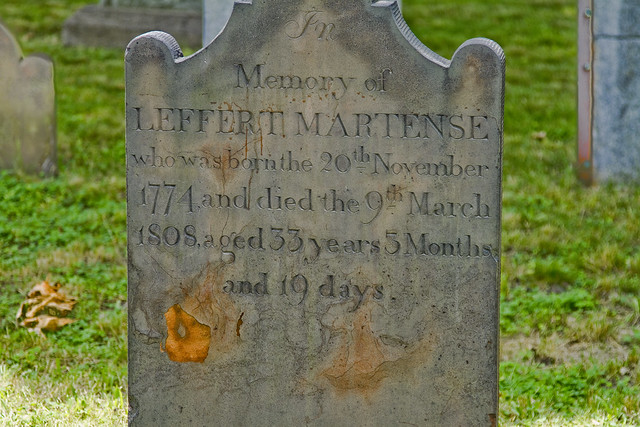
– photo by Mitch Waxman
One of the places which comes up again and again in his writings is this very churchyard, apparently it left quite the impression upon Lovecraft, and inspired his story “The Hound”. He confessed to desecrating this graveyard, incidentally, which is strictly against Newtown Pentacle policy.
This is also why I don’t guzzle water while in graveyards, as such quaffing will inevitably result in the need for urination, which might lead to desecration.
(First Calvary in Queens has two well maintained and world class public lavatories at the entrance gates, btw.)
H.P. Lovecraft was actually here in 1922
On September 16, 1922, Lovecraft toured the Flatbush Reformed Church in Brooklyn with his friend Rheinhart Kleiner, writing about the visit in a letter:
Around the old pile is a hoary churchyard, with internments dating from around 1730 to the middle of the nineteenth century…. From one of the crumbling gravestones–dated 1747–I chipped a small piece to carry away. It lies before me as I write–and ought to suggest some sort of horror-story. I must place it beneath my pillow as I sleep… who can say what thing might not come out of the centuried earth to exact vengeance for his desecrated tomb? And should it come, who can say what it might not resemble?[

– photo by Mitch Waxman
This particular parcel of “Lovecraft Country” has an awful lot of New York City history associated with it, Peter Stuyvesant and the “Degenerate Dutch” and all that. Road extensions of a toll road called Flatbush Avenue past a watch tower… Frankly, the sort of “historian history” which your humble narrator always bolloxes up. I’ve had the pleasure of meeting Rob Schweiger, Brooklyn’s borough historian, and he can offer a far more cogent history of this place than I can. So can the oft mentioned Kevin Walsh.
I can tell you a lot about Newtown Creek and it’s locale, but this part of colonial Brooklyn ain’t my bag.
from “the Lurking Fear”, courtesy hplovecraft.com
No one outside the backwoods had believed these varying and conflicting stories, with their incoherent, extravagant descriptions of the half-glimpsed fiend; yet not a farmer or villager doubted that the Martense mansion was ghoulishly haunted. Local history forbade such a doubt, although no ghostly evidence was ever found by such investigators as had visited the building after some especially vivid tale of the squatters. Grandmothers told strange myths of the Martense spectre; myths concerning the Martense family itself, its queer hereditary dissimilarity of eyes, its long, unnatural annals, and the murder which had cursed it

– photo by Mitch Waxman
I don’t know why I’m always drawn to cemetery trees, a humble narrator will confess, but there’s always something about these vegetable growths fed by an obvious and morbid nutrition. An ominous portent, a spooky resonance, a dissonant note. For some reason, my perception leads me to see shapes in their whorls and crags, shapes which form into recognizable “things”- much like searching for the shape of a dragon in cloud formations.
The scientifically minded call it Pareidolia.
from “The Horror at Red Hook”, courtesy hplovecraft.com
Suydam was a lettered recluse of ancient Dutch family, possessed originally of barely independent means, and inhabiting the spacious but ill-preserved mansion which his grandfather had built in Flatbush when that village was little more than a pleasant group of colonial cottages surrounding the steepled and ivy-clad Reformed Church with its iron-railed yard of Netherlandish gravestones.

– photo by Mitch Waxman
I don’t think I get enough sleep, that’s what it is. It renders me highly suggestible, and perhaps I should drink some more water, and follow Mr. Walsh’s example when visiting “Lovecraft Country“.
from wikipedia
Oneirophrenia is a hallucinatory, dream-like state caused by several conditions such as prolonged sleep deprivation, sensory deprivation, or drugs (such as ibogaine). From the Greek words “ὄνειρο” (oneiro, “dream”) and “φρενός” (phrenos, “mind”). It has some of the characteristics of simple schizophrenia, such as a confusional state and clouding of consciousness, but without presenting the dissociative symptoms which are typical of this disorder.
Persons affected by oneirophrenia have a feeling of dream-like unreality which, in its extreme form, may progress to delusions and hallucinations. Therefore, it is considered a schizophrenia-like acute form of psychosis which remits in about 60% of cases within a period of two years. It is estimated that 50% or more of schizophrenic patients present oneirophrenia at least once.
loose and displaced

– photo by Mitch Waxman
Recent activities had carried your humble narrator to… Staten Island… A friend’s photography was included in a gallery exhibit at the venerable Snug Harbor, and wishing to both show support for another photographer and to witness his work in print form- I began the long journey from Astoria in Queens to the outermost of boroughs. After exiting the ferry, I was titillated by the sudden appearance of the gargantuan “Hanjin Lisbon” being guided toward the Kill Van Kull by two Moran tugs.
from marinetraffic.com
- Hanjin Lisbon Vessel’s Details
- Ship Type: Cargo
- Year Built: 2003
- Length x Breadth: 278 m X 40 m
- DeadWeight: 67979 t
- Speed recorded (Max / Average): 21 / 20.6 knots (20.6 knots = 23.7060566 mph)

– photo by Mitch Waxman
Like all the ocean going vessels of its type, the Lisbon is a lumbering monster of a ship. Nearly 1,000 feet in length, the cargo ship was most likely headed to the Port facilities at Newark Bay, and requires the use of tender boats to navigate the relatively narrow and hazard fraught coastal leg of its journey to New York harbor from some impossibly foreign port. It’s titan engines and onboard electronics can propel the ship through open ocean with great accuracy, of course, but the giant cargo ship can’t exactly “stop on a dime”.
from marinetraffic.com
MARION MORAN Vessel’s Details
- Ship Type: Tug
- Year Built: 1982
- Length x Breadth: 39 m X 12 m
- DeadWeight: 10 t
- Speed recorded (Max / Average): 14.5 / 8.9 knots
- Flag: USA [US]
- Call Sign: WRS2924
- IMO: 8121812, MMSI: 366941020

– photo by Mitch Waxman
Tugboat and towing services of the modern era, like Moran towing, are inheritors of centuried wisdom passed down from generations of mariners. The complex currents, mores, and eddies of the harbor are well known to the crews of these vessels and their job includes guiding such massive visitors to the port into safe harborage. Two tugs were observed at work, the Marion Moran and the Gramma Lee T. Moran.
Moran Towing began operations in 1860 when founder Michael Moran opened a towing brokerage, Moran Towing and Transportation Company, in New York Harbor. In 1863, the company was transformed from a brokerage into an owner-operator of tugboats when it purchased a one-half interest in the tugboat Ida Miller for $2,700. Over time Moran acquires a fleet of tugboats. It was Michael Moran who painted the first white “M” on a Moran tugboat stack, in 1880.

– photo by Mitch Waxman
Iconic, Moran tugs are distinguished their large white “M” logo and the white and maroon “color way” which allows them to be identified at great distances across the harbor. Like all tugs, they are built with highly reinforced steel superstructures and powerful engines that allow them to pursue an occupation which requires the ability to precisely handle tonnages which are clumsy and thousands of times their own weight.
from morantug.com
The LEE T. MORAN is an expression of brute power and utility that belies the refinements of technical engineering below her waterline. There, twin ports are cut into the steel hull to make room for the tug’s Z-drive units. On the floor of the shop they look like the lower units of giant outboard engines. Made by Ulstein, a subsidiary of Rolls-Royce, the Z-drive functions much like an outboard. Imagine two outboards extending straight down through the hull, each having the ability to rotate 360 degrees. That makes even a heavy, 92-foot tug with a 450-ton displacement very maneuverable. “It can turn on a dime,” says Doughty. “The hull bottom is slightly flatter to adjust to the two drive units. By turning each drive out 90 degrees, the captain can go from full-ahead (14 knots) to a dead stop in no time.”

– photo by Mitch Waxman
Containerized shipping is what makes the modern world tick, of course, and has enabled the business model of “just in time delivery” to take hold. The steel boxes which adorn the Lisbon’s decks will be unloaded by Gantry Crane at the dock and will find their way onto either rail or truck for delivery to the final consignee. What isn’t commonly known about these cargo ships is that ordinary people can book passage onboard, finding accommodation in a variety of staterooms, and cruise the world on a proverbial “slow boat to china”.
from hanjin.com
Hanjin Shipping (http://www.hanjin.com President& CEO Young Min Kim) is Korea’s largest and one of the world’s top ten container carriers that operates some 60 liner and tramper services around the globe transporting over 100 million tons of cargo annually. Its fleet consists of some 200 containerships, bulk and LNG carriers.

– photo by Mitch Waxman
The mind reels at such suggestions, and your humble narrator is both titillated at the notion of meeting and interacting with the sailors onboard (undoubtedly Koreans, Tagalog, and Chinese- citizens from all over the manufacturing hubs of the Pacific) and terrified by the lore and knowledge they must carry with them about the true nature of the world. Often these cargo ships will encounter pirates, terrorists, and other malingering forces on both the open sea and in coastal waters. Perhaps they have other experiences, of the sort which sailors do not discuss with outsiders, which only a hip pocket flask of raw whiskey might pry out of them.
from wikipedia
The Port Authority of New York and New Jersey was formed in 1921 and the Newark Bay Channels were authorized by the Rivers and Harbors Acts in 1922. Shipping operations languished after the war, and in 1927, the City of Newark started construction of Newark Airport (now known as Newark Liberty International Airport) on the northwest quadrant of the wetlands which lay between Port Newark and the edge of the developed city. Port Authority took over the operations of Port Newark and Newark Airport in 1948 and began modernizing and expanding both facilities southward. In 1958, the Port Authority dredged another shipping channel which straightened the course of Bound Brook, the tidal inlet forming the boundary between Newark and Elizabeth. Dredged materials was used to create new upland south of the new Elizabeth Channel, where the Port Authority constructed the Elizabeth Marine Terminal. The first shipping facility to open upon the Elizabeth Channel was the new 90-acre (36 ha) Sea-Land Container Terminal, which was the prototype for virtually every other container terminal constructed thereafter.
The building of the port facility antiquated most of the traditional waterfront port facilities in New York Harbor, leading to a steep decline in such areas as Manhattan, Hoboken, and Brooklyn. The automated nature of the facility requires far fewer workers and does not require the opening of containers before onward shipping.
mighty temples

– photo by Mitch Waxman
The neo gothic handiwork of architect Morrell Smith is hard to miss as one moves about Queens Plaza, and it is known to all as the former Bank of Manhattan Tower. Formerly the tallest structure in the borough of Queens at 14 stories (roughly 210 feet), the 1927 vintage building has since been dwarfed by the Citibank Megalith at Court Square. Smith was a noted architect of the early 20th century and had his hands in more than one landmarked structure in Queens (and Manhattan), and his projects also included the notable Jamaica Savings Bank which is found further east.
Crenellated, its spire carries a clock.

– photo by Mitch Waxman
Personal observation has revealed that these clocks are seldom if ever accurate, and often they do not match up with each other. My understanding, gleaned from municipal and real estate industrial complex propaganda, is that the hidden mechanisms which drive these clocks are undergoing some sort of restoration as is the rest of the building- although specific detail remains elusive. The building itself is another one of the “black holes” in the historical record which distinguish western Queens- a noteworthy structure erected to serve a high profile company sited in a prominent location which is nevertheless relegated to an architectural footnote because its location is outside of Manhattan.

– photo by Mitch Waxman
Your humble narrator acknowledges that, as always, whenever the subject of Queens Plaza and it’s locale comes up one must refer to the hierophants at the Greater Astoria Historical Society– however- one does not wish to stand on the shoulders of others forever and I have resisted making inquiries with them about the place. Unfortunately, independent research has offered little surcease to my curiosity about the clock tower or offered the deeper story and meaning of this building. Rumors of late 20th century bacchanals and Astorian apocrypha about certain rites conducted in its lofty heights during the thunder crazed nights of the the second world war era notwithstanding, there is a dearth of information available for me to share with you about the place. An open call is therefore made to you, Lords and Ladies of Newtown, for any information which might serve to inform your fellow citizenry on this enigmatic structure.
metempsychoses and shudders

– photo by Mitch Waxman
Abjurations of fealty to self interest aside, your humble narrator is suffering some sort of delirium these days. Wandering thoughts and an inability to maintain focus plague my waking hours, and certain hallucinatory visions experienced during the nocturne haunt. Conversation has become difficult to follow or respond to, and paranoid imaginings or unheralded agitations at obviously minor issues color my days with fear, aggression, and anxiety. All I can see lying before me is devastation, hopelessness, and a slouching path leading to destruction.
I’m all ‘effed up.

– photo by Mitch Waxman
Were it possible that I could just be like the humans who infest this great hive, satisfied with loping along the streets whilst spouting colorful aphorisms, pronouncing vainglorious affirmations of personal worth. If only adorning myself with gaudy baubles or tailored garments, reflecting the height of current taste and fashion, could allow surcease from the diabolical internal dialogues which torment and disabuse. Such adolescent fury and desire is unacceptable in an adult, let alone one whose beard has gone white.
The waste meadows are where I belong, their devastating loneliness and abandonment mirror my own.

– photo by Mitch Waxman
Apotheosis finds a home here, along the tributaries of the Newtown Creek. Artifice is struck down by the concretized reality of hubris, and the shape of the future can be discerned in studying the past. Notions such as this force me into a separate form of existence which is ruled by the dark emotions of fear, resentment, and anger. Such is my lot then, to exist as the broken, the barren, and at the dazed and disappointed edge of man’s world.
I must find contentment in my role as Outsider, it would seem.


