Posts Tagged ‘photowalk’
crooked boughs

– photo by Mitch Waxman
This Tug, the Gramma Lee T. Moran, was mentioned in a Newtown Pentacle posting of November 26- “loose and displaced“. As it’s one of my favorite tugs in New York Harbor to shoot, I felt a little bad that the starring role in that posting had gone to a cargo ship- and that Gramma Lee T. Moran had to share the second banana position with another Moran Tug- the estimable Marion Moran.
Can’t tell you why I like the esthetics of this ship so much, nor can I say why exactly it always reminds me of the Millennium Falcon (from the Star Wars movies) as it slides along the Kill Van Kull.
from wikipedia
The Kill Van Kull is a tidal strait approximately 3 miles (4.8 km) long and 1,000 feet (305 m) wide separating Staten Island and Bayonne, New Jersey, USA. The name kill comes from the Middle Dutch word kille, meaning “riverbed” or “water channel.”
Kill Van Kull connects Newark Bay with Upper New York Bay. The Robbins Reef Light marks the eastern end. Historically it has been one of the most important channels for the commerce of the region, providing a passage for marine traffic between Manhattan and the industrial towns of New Jersey. Since the final third of the 20th century, it has provided the principal access for ocean-going container ships to Port Newark-Elizabeth Marine Terminal, the busiest port facility in the eastern United States and the principal marine terminal for New York Harbor.

– photo by Mitch Waxman
These two shots are from just a few months ago, captured in the fall of 2011. It’s always odd seeing a tugboat operating without a barge, or tending a larger vessel which can be hundreds of times larger than itself. The majesty of these ships, and their crews, come alive when they are tasked with bearing such sisyphean burdens.
Can you imagine what it must be like guiding a fuel tanker into the narrow Kill Van Kull or down the East River? It must take nerves of steel to muster the confidence needed to Captain such tasks.
from tugboatenthusiastsociety.org
Tugs are “displacement” hull vessels, the hull is designed so water flows around it, there is no consideration for having the vessel “plane”. Because of this the hull form is limited to a maximum speed when running “free” that is about 1.5 times the square root of the waterline length. As the tug approaches this speed when running “free” it is perched between the bow wave and the stern wave. Since the hull cannot plane, application of additional power when approaching maximum hull speed only results in a larger bow wave, with the tug “squatting” further into the trough.

– photo by Mitch Waxman
The shot above, and the one below are from earlier in 2011- April to be exact.
Moran is a well established company which operates tugs all over North America. A century and a half old, the company’s fleet can be found on the USA’s Pacific and Atlantic coasts and within the Great Lakes, both along the west coast of- and in the Gulf of- Mexico, and within the inland waters of the eastern United States. They’ve been known to operate periodically as far away as the Caribbean Sea and South American waters.
from morantug.com
The LEE T. MORAN is an expression of brute power and utility that belies the refinements of technical engineering below her waterline. There, twin ports are cut into the steel hull to make room for the tug’s Z-drive units. On the floor of the shop they look like the lower units of giant outboard engines. Made by Ulstein, a subsidiary of Rolls-Royce, the Z-drive functions much like an outboard. Imagine two outboards extending straight down through the hull, each having the ability to rotate 360 degrees. That makes even a heavy, 92-foot tug with a 450-ton displacement very maneuverable. “It can turn on a dime,” says Doughty. “The hull bottom is slightly flatter to adjust to the two drive units. By turning each drive out 90 degrees, the captain can go from full-ahead (14 knots) to a dead stop in no time.”

– photo by Mitch Waxman
Perhaps it’s the low slung aspect of the wheelhouse, or the gentle curves observed in its hull… I can’t say, but there is just something pleasing about the design of this boat. A big toot goes out from this, your Newtown Pentacle, to one of my favorite citizens of the NY Harbor- the Gramma Lee T. Moran.
Moran Towing began operations in 1860 when founder Michael Moran opened a towing brokerage, Moran Towing and Transportation Company, in New York Harbor. In 1863, the company was transformed from a brokerage into an owner-operator of tugboats when it purchased a one-half interest in the tugboat Ida Miller for $2,700. Over time Moran acquires a fleet of tugboats. It was Michael Moran who painted the first white “M” on a Moran tugboat stack, in 1880.
An Oil spill… in Queens

– photo by Mitch Waxman (February 16, 2009)
Sadly, oil is seeping out of a bulkhead on the Queens side of the Newtown Creek.
Famously, the Greenpoint Oil Spill (click here for a link to newtowncreekalliance.org for more) occurred just across the water from this spot, but every indication points to this as being a separate event. The former site of Charles Pratt’s Queens County Oil Works, which was an approximately 18 acre parcel which would later be called the “Standard Oil Blissville works”, the sites occupation in modernity has little or nothing to do with petroleum.
Welcome, by the way, to Newtown Creek- and to the “Blissville Oil Spill”.
Just a note: For the purposes of this posting, I’m departing from the normal formatting, and the photos are presented along with the dates upon which they were captured.

– photo by Mitch Waxman (September 14, 2008)
My practice for the last several years has been to shoot everything I see along the Newtown Creek, whether or not it seems significant at the time. This practice evolved out of the paucity of photographic documentation of the place which survived the 20th century, and the effort has been made with the notion of leaving behind something for future researchers to work with. As time has gone by, and my technological capabilities have expanded, I’ve developed quite a library of shots.
The photo above depicts the site in question during the autumn of 2008, and shows the historic condition of the bulkheads.

– photo by Mitch Waxman (September 14, 2008)
A standard codex for interpreting what one sees along the Newtown Creek states that wooden bulkheads are 19th century, reinforced concrete dates from the early to mid 20th, and steel plating is late 20th and early 21st century. This rule is not “scientific” but allows one to approximate the manufacture of these fallen docks to a relative time period. As you can observe in the shot above, the risible decay of the wooden bulkheads, and their manner of construction, speak to a long period of disuse and lack of maintenance as far as September of 2008.

– photo by Mitch Waxman (February 20, 2010)
In the winter of 2010, a crew began to install modern steel plating along this frontage, which drew my interest. Again, anything that is in a state of flux along the waterway is a point of interest for me. This project went on for several months, and was conducted from a barge with a small crane installed on it.

– photo by Mitch Waxman (February 4, 2011)
By the same period a year later, in February of 2011, the modern installation was complete. Conflicting reports on this style of bulkhead are often heard. The older wooden structures offer a structure for biological organisms to nest and shelter, but “slow” the already tepid flow of water through the narrow passages of the Creek. The steel ones “quicken” the flow, but offer no toeholds for organic life.
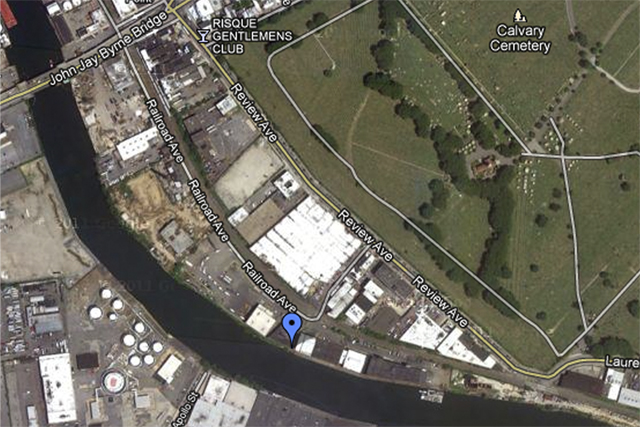
Modern day, (December 2011) google maps screen capture, click here or the image above for the dynamic google map. This is an industrial cul de sac today, accessed by a private driveway. The companies which use this space are largely waste management oriented, warehouse operations, furniture refinishing, or other truck based businesses. Despite the presence of freight tracks through the middle of the site, few of these companies utilize their sidings. Calvary Cemetery and the Kosciuszko Bridge loom large and distinguish the area.

1924 view of the area, screen capture from “NYCityMap” at nyc.gov.
The oil tanks in the center of the site betray the presence of the “Queens County Oil Works” of Charles Pratt, which were also known as the “Standard Oil Blissville Works”. Blissville, of course, is the historic name of this part of Queens which was once a residential area.

Clear plans of the area in 1936 overlaid with the 1924 aerial projection from NYCityMap. Click here to see a large version of the overlay.

Detail view of the area, click here for larger incarnation. The works were here as late as 1951, but at this point, I still haven’t been able to confirm the date they were closed down.

– photo by Mitch Waxman (August 6, 2011)
In the summer of 2011, I was tasked with photographing a “Bulkhead Survey” which members of the Newtown Creek Alliance were conducting. The good folks at Riverkeeper volunteered to take our party out on the Newtown Creek onboard their patrol boat, and when we were passing by the former Queens County Oil Works, we noticed the presence of both containment booms on the water and petroleum product flowing freely from the shoreline itself.

– photo by Mitch Waxman (August 6, 2011)
The theory which has been advanced by knowledgeable sources is that when the steel bulkheads were installed, a process in which the plating is slid down into place and then secured, and that a sealed chamber or buried pipeline was likely ruptured during the construction process which freed “the product”.
I have been asked to mention (by Newtown Creek Alliance and Riverkeeper itself) that investigation of the situation is underway, and the State and City officials responsible for policing this sort of thing are fully and enthusiastically engaged in the process.

– photo by Mitch Waxman (August 6, 2011)
The story of Charles Pratt, his “Astral Oil”, and their involvement with John D. Rockefeller’s Standard Oil Trust will be discussed in a later posting on this subject, as the lengthy history would divert attention from this otherwise serious issue. Suffice to say that the Blissville works were some 18 acres in size, and suffered several “total loss” fires in the late 19th century.
Note that this is a distinct property (and event) from the adjacent State Superfund site which is referred to as the Quanta Resources site.

– photo by Mitch Waxman (November 19, 2011)
Again onboard a Riverkeeper patrol, this time in November of 2011, the overt visual presence and subtle aroma of petroleum was encountered. The black and yellow structure is what is known as a hard boom, and is designed to contain surface contamination and “floatables”. It extends to a few inches below the surface.

– photo by Mitch Waxman (November 19, 2011)
The steel plating at the site is painted with oil, undoubtedly splashed up by wave action during storms at high tide. The white objects which are saturated with petroleum products are absorbent booms, designed to wick up the free floating product.

– photo by Mitch Waxman (November 19, 2011)
The leaves in the shot above are literally stuck into the gluey residues of the oil. You can see the high tide mark left by the water on the cleaner bulkhead which is just beyond the hard boom. Perhaps this is the source of oil, which many have reported to me over the course of the last year, which has been witnessed as it floats toward the East River.

– photo by Mitch Waxman (November 19, 2011)
It is not news that there are environmental contaminants floating freely in this troubled waterway, nor is there any revelation to be found in the fact that petroleum products are commonly observed pooling and flowing about the Newtown Creek watershed.
What is news is that this is in Queens.

– photo by Mitch Waxman (August 6, 2011)
Much of the attention, and deservedly so because of the large and growing population of Greenpoint and Williamsburg, which Newtown Creek receives is all about Brooklyn. The north shore of the Creek in Queens is often left out of discussion (and from both remediation and environmental benefits funding) because of its relatively tiny population and industrial character. One of the questions which this blog has asked since day one has been “Who can guess all there is, that might be buried down there?”.
In the case of the Blissville Oil spill, the question might as well be “How much there might be?”.

– photo by Mitch Waxman (November 19, 2011)
This is just the beginning of a new Newtown Creek story, the tale of the Blissville Oil Spill. I fear it will be the first of many such stories, as we move into the Superfund era.
missing dog

-photo by Mitch Waxman
Others have beat me to the punch on sharing this very funny bit of signage, however, it’s too funny not to share.
Spotted on Broadway and 31st street here in Astoria.

-photo by Mitch Waxman
I haven’t spotted the poor beast, but one hopes Killer will be found. Has anyone called the phone number displayed yet?
foetid darkness

– photo by Mitch Waxman
On Monday the 5th of December, the Newtown Creek Alliance had drawn me from the safety of Astoria to the wild streets of Brooklyn and far off Williamsburg’s Graham Avenue. I decided to walk, as the mists had begun to swirl. When the meeting ended, certain Greenpoint based members of the Alliance offered me a lift as far they were going and I gladly took their offer.That’s how I ended up on the Pulaski Bridge in the middle of an astounding weather event.
In the photo above, what is missing from the shot of Newtown Creek is Manhattan.
from wikipedia
Fog is a collection of water droplets or ice crystals suspended in the air at or near the Earth’s surface. While fog is a type of stratus cloud, the term “fog” is typically distinguished from the more generic term “cloud” in that fog is low-lying, and the moisture in the fog is often generated locally (such as from a nearby body of water, like a lake or the ocean, or from nearby moist ground or marshes).

– photo by Mitch Waxman
Even the nearby spires of Tower Town in Long Island City were obscured, lost in some primal soup. The sound was eerie, as well, and our Lady of The Pentacle (who is British) informs me that her countrymen would often remark that sound doesn’t travel the same way through fog as it does in clear air and great caution should be exercised when moving around in it.

– photo by Mitch Waxman
Looking toward Dutch Kills along Borden Avenue, which trails along the malefic Newtown Creek, the enormous advertising sign mounted upon the “Fresh Direct” facility (which recently was, but I’m not sure if it still is, the nations largest illuminated sign) was creating quite a lightshow in the mist.

– photo by Mitch Waxman
This thing plays through several advertisements for the Internet green grocer, and spotlights key products and offers to passing drivers on the Long Island Expressway, which it towers above. Depending on when in the repeating reel of ads you were, the mist either looked like this…

– photo by Mitch Waxman
…Or like this!

– photo by Mitch Waxman
Additionally, here’s one from earlier in the day, at Maspeth Creek, looking toward the Kosciuszko Bridge.
cherished pet

– photo by Mitch Waxman
On one of my walks, as I was crossing from Dutch Kills (the neighborhood, not the waterway) into Astoria via a disreputable corridor shunned by most area wags, these festively adorned bicycles were observed. I can’t tell you a deep story about them, describe some dire and hidden meaning, or point to some occult connection to old world evils or even jungle born horror- knowledge of which which would cause our civilization to retreat into a new and everlasting dark age of ignorance.
All I can do is congratulate the elaborate whimsy of such contrivance.

– photo by Mitch Waxman
Long has my personal palette been described as gloom ridden, dark, and wholly unsaturated. A preference for black clothes, constructed of decidedly coarse and “non shiny” fabric, has often been shown by your humble narrator. Display of such ostentatious pageantry makes me uncomfortable, breaks my confidence, and scares me just a little bit. Can’t tell you why, but it does.
Colorful pomposity might draw attention and inspection upon me from peers and passerby, something which never goes well for me, as cracks in my facade yawn wide.


