Posts Tagged ‘Pickman’
joined to
Shots from the 11103, in today’s post.

– photo by Mitch Waxman
One seems to have caught the “night shooting” bug again, and my various bits of camera support have been dusted off. The shots above was captured one recent evening during a thunderstorm, and represents a 15 second interval. NYC never looks better than it does during the rain.
Someday, a real rain will come, and wash away the iniquity and corruption which pollutes our community – which is a polite and verbose version of the sort of thing that Robert Deniro’s Travis Bickle character in the Taxi Driver movie might have said. Since officialdom in City Hall seems hell bent on recreating their romantic version of that era, let’s remember what NYC was actually like back then, as it was hardly romantic.

– photo by Mitch Waxman
The shot above is what I call “cloud porn.” It’s porn inasmuch as it doesn’t deliver anything other than a puerile thrill and doesn’t say much. It’s an interesting shot for me, technically, from the capture point of view. The evening thunderstorm which was deluging the bodega in the first shot was still building during the afternoon shot above, and controlling the light in order to build the cloud contrast was an interesting exercise.
It’s somewhat representative of my mood at the moment, btw, with all the foreboding and dire portent that our little community here in Astoria has been experiencing in recent months.

– photo by Mitch Waxman
Astoria’s Broadway has been under siege by a large group of drunks and vagrants, a group who are composed of base characters that generally represent the worst sort of individual. Inebriated hordes descend upon the neighborhood every day, drunkards and ne’erdowells who seem to be beneath the notice of law enforcement. The municipal response to them is to send in the Fire Department, rather than the Police.
“follow” me on Twitter- @newtownpentacle
Upcoming Tours –
September 20th, 2015
Glittering Realms Walking Tour
with Brooklyn Brainery, click here for details and tickets
hewing in
A few shots from the Great North River Tugboat Race, in today’s post
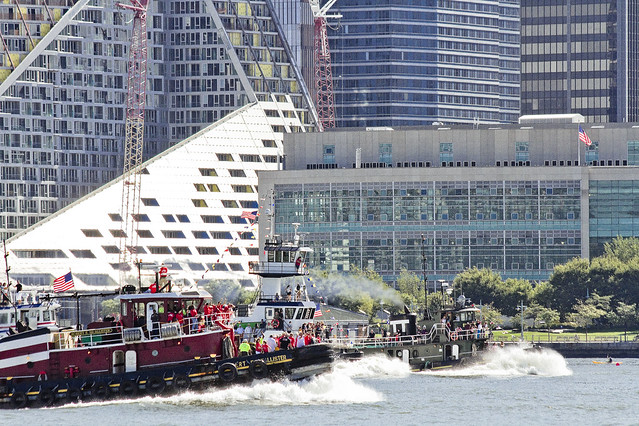
– photo by Mitch Waxman
When the wheel of the year rolls around to Labor Day weekend, a humble narrator always has plans.
The Great North River Tugboat Race, produced by the Working Harbor Committee, occurs on the Sunday of Labor Day weekend. This year, 12 tugs raced from the boat basin at 79th street (well, Pier I, technically) to 42nd street right by the Intrepid. The winner, I believe, was the red McAllister tug pictured above.
Why not swing over to working harbor to check out the official results? My colleague John Skelson also has a whole series of shots of the race running there as well.
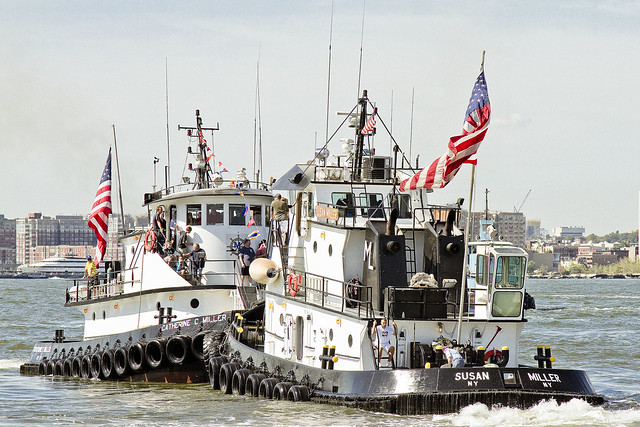
– photo by Mitch Waxman
After the race, the tugs get into a “tug of war” competition. They go nose to nose and push each other around. This contest is about a lot more than just raw horsepower, it’s about the skill of the captains and how they handle their boats.
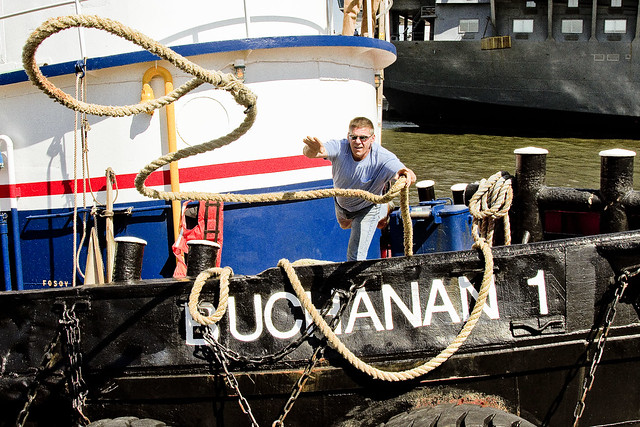
– photo by Mitch Waxman
Far and away, my favorite part of the Great North River Tugboat Race is the line toss competition. During this part of the event, the tugs come in at speed towards a bollard on the pier, and deckhands throw the heavy rope at it in an attempt to “get it in one.”
There’s also a spinach eating competition, because as every sailor knows – you’re strong to the finach if you eats your spinach.
“follow” me on Twitter- @newtownpentacle
Upcoming Tours –
September 20th, 2015
Glittering Realms Walking Tour
with Brooklyn Brainery, click here for details and tickets
impelled forward
I want one.

– photo by Mitch Waxman
That’s the Caterpillar AP 1055f Track Asphalt Paver you see in the shot above, which was adorned with stickers indicating its owner (or lessee) was the NYC DOT. One was scuttling around on Broadway on a recent afternoon, heading towards Jackson Heights via Woodside, and this baby was just sitting there waiting to be recorded.

– photo by Mitch Waxman
My instincts tell me that with just a few modifications, this would be an efficacious device to have in case of a zombie outbreak, but the pedants at the DOT was predictably using it for the purpose that it was actually engineered for – road grading and repair.
Combine this gizmo with a couple of those street trenchers I showed you last winter, you’ve got yourself a pretty formidable defense against the undead hordes – imho.

– photo by Mitch Waxman
The manufacturer of this wonderfully complex bit of kit is the Caterpillar company, who build all sorts of giant machines. Their site hosts this page which describes the capabilities, mechanical qualities, and advantages which the device offers – which includes a heated seat for the operator.

– photo by Mitch Waxman
I could not stop myself from thinking about the Cat in the Hat’s “moss-covered three-handled family gradunza” from the Dr. Seuss cartoons when I saw this puppy.
I’m all ‘effed up, of course.
“follow” me on Twitter- @newtownpentacle
Upcoming Tours –
September 20th, 2015
Glittering Realms Walking Tour
with Brooklyn Brainery, click here for details and tickets
horrors and marvels
My beloved Creek, in today’s post.

– photo by Mitch Waxman
Pictured above, Newtown Creek.
This is a section I refer to as DUGABO, or Down Under the Greenpoint Avenue Bridge Onramp. On the left side of the shot is the Allocco family’s aggregates recycling yard in Greenpoint, on the right is the SimsMetal recycling facility in Long Island City’s Blissville section. Today’s post will be taking us eastwards from DUGABO into oil country.
Technically speaking – all of the Brooklyn side of the Newtown Creek, from the Pulaski Bridge east to Meeker Avenue was once oil country, home to a series of Standard Oil (SOCONY) refineries and distribution facilities. The industry’s footprint in the area began to shrink as early as the 1950’s, and refining on the Creek literally stopped in the middle 1960’s.

– photo by Mitch Waxman
Literally “DUGABO,” the Greenpoint side on the left shows the tanks of Metro Fuel, a bio fuel company which actually performs some refinery operations in the modern day. On the Queens side, you’ll notice the Tidewater building. Tidewater was a pipeline company that challenged Standard Oil’s monopoly on shipping petroleum using the railroads. Tidewater was destroyed and taken over by Standard. The Standard Oil company then bankrupted the railroads by switching its nationwide distribution system over to pipelines rather than rail cars – despite having spent a couple of decades trying to convince Congress and everyone else that pipelines were inherently unsafe and uneconomical to operate.
You’ve really got to love John D. Rockefeller.

– photo by Mitch Waxman
A bit further east, you’ll notice the tanks of the BP Amoco yard nearby Apollo Street in Greenpoint, which sit on part of the footprint of the Locust Hill refinery.
This is roughly the dead bang center of the Greenpoint Oil Spill, the second largest such event in American History. The BP Amoco yard is a distribution hub, with its product brought in from refineries in New Jersey and beyond by articulated Tug and fuel barge combinations like the Crystal Cutler, which is pictured above. The digester eggs of the Newtown Creek Wastewater Treatment Plant are visible in the shot above as well, as is Manhattan’s iconic Empire State Building.

– photo by Mitch Waxman
A bit further back, that’s Meeker Avenue’s street end on the left or Brooklyn side, and Blissville’s Calvary Cemetery is just out of frame on the right. The former site of Penny Bridge, which looms large in the memory of long time residents of both boroughs, would have been right about the center of the Newtown Creek. Penny Bridge, of course, was replaced in 1939 by Robert Moses. Moses had to work around some pretty big land owners when building it.
On the right hand – or Queens side of the photo – that brick building is part of the former Queens County Oil Works of Standard Oil. The Petroleum facility in Blissville is actually a bit older than Standard, believe it or not. That’s where Abraham Gesner erected the first large scale petroleum refinery in the United States, the North American Kerosene Gas Light company, which imparted to “coal oil” the brand name Kerosene.
When Standard Oil bought Gesner’s operation, the company made the brand name “Kerosene” so ubiquitous that it became an American colloquialism, and it defined the product in the same way that Xerox or Kleenex define photocopies or facial tissue.
“follow” me on Twitter- @newtownpentacle
Upcoming Tours –
September 20th, 2015
Glittering Realms Walking Tour
with Brooklyn Brainery, click here for details and tickets
opprobrious language
Progress on the Kosciuszko Bridge Project, in today’s post.

– photo by Mitch Waxman
Those Open House NY tours from last week? My practice of handing the mike off to other speakers on the return part of the trip so that I can gather a few shots? Yup. Pictured above is the construction site of the NYC DOT and their contractors – principally Skanska – from the turning basin of that fabled cautionary tale of a waterway known simply as the Newtown Creek? Yup.

– photo by Mitch Waxman
The bridge project will eventually run NYS taxpayers around a billion somolians, with the first half of the epic undertaking priced at $550 million. The first phase of the project includes the extensive remodeling of local streets in both Greenpoint and West Maspeth/Sunnyside, the construction of the first (eastern) half of the new bridge, and the demolition of the 1939 Robert Moses model. The second phase will see the erection of the western section of the new bridge, which will be of the cable stay type, and during the entire project – traffic flow of the Brooklyn Queens Expressway has to be maintained.
Framed by the 1939 model in the shot above is Manhattan’s 432 Park Avenue, a residential tower taller than the Empire State Building, whose top floor penthouses have composite valuations close to $300 million bucks. The most desirable of these apartments was recently sold to a Saudi billionaire for an astounding $95 million.
When narrating on the mike, I erroneously said that the penthouses were valued at the same number as phase one of the new Kosciuszko Bridge, but mathematics has never been my strong suit. Also, if I’ve got a hundred bucks in my pocket, I feel rich so there you go. Besides, what’s $200 million to a Saudi Billionaire, anyway?

– photo by Mitch Waxman
On the Brooklyn side of the bridge project, on “used to be Cherry Street,” the support columns for the new bridge are rising steadily. The walking tour which I’ll be conducting on Sunday for Newtown Creek Alliance, which I’ve labeled as “The Poison Cauldron” used to walk right through this area, but given the amount of yuck which the project is kicking up into the air… well… we’re going to get close enough to the project to get a good view of it but not close enough to be in harms way.
The dusk shots in today’s post were gathered during the 5-7 boat tour, btw.

– photo by Mitch Waxman
Also from the Open House NY excursions, this time on the trip that went from 7-9, when post sunset darkness and dramatic lighting from the job site provided for somewhat more dramatic shots of the project. The new bridge will be noticeably lower than the current model, incidentally.

– photo by Mitch Waxman
Progress is moving a bit slower on the Queens side, but is still on schedule. This shot looks north, at the shallow valley formed by Berlin and Laurel Hills that the 1939 bridge was built into. A lost tributary of Newtown Creek was in this area, called Wolfs Creek, which spilled down from the ridge that Sunnyside (or Long Island City Heights as it was once known) was built into.
If you want to come along this weekend and check out the Poison Cauldron, which discusses the oil industry in Brooklyn as well as many other topics of interest along the Newtown Creek, click the link below. It’s a Newtown Creek Alliance tour, and since NCA is a non profit, your tickets will be a tax deductible item and you say that you helped with our efforts to “reveal, restore, and revitalize” Newtown Creek.
“follow” me on Twitter- @newtownpentacle
Upcoming Tours –
September 13th, 2015
Poison Cauldron Walking Tour
with Newtown Creek Alliance, click here for details and tickets
September 20th, 2015
Glittering Realms Walking Tour
with Brooklyn Brainery, click here for details and tickets


