Posts Tagged ‘Pickman’
roughly hemispherical

– photo by Mitch Waxman
Good news permeates the City of Greater New York, as a remedy to the various financial crises has emerged. To begin with, the Mayor and City Council have voted to eliminate the wasteful practice of running mostly empty buses during non peak hours, and replacing them with smaller and more efficient vehicles like the one pictured above. Ergonomic and comfortable, the fare has been waved for these new conveyances, in order to encourage ridership and acceptance of the new scheme. Your humble narrator looks forward to “scooping” around the borough, although calling the driver “a backhoe” will be considered a hate crime and socioeconomic slur leveled against a City employee and will be punishable by 15 years forced labor at the Ratner trash mines in Pennsylvania.
Savings- $385 million!!!

– photo by Mitch Waxman
Over in Brooklyn, the “Williamsburg Financial Corridor” has proven to be such a success that the entire Third Ward has been designated an outlying district of Manhattan. Brooklyn will miss it’s emo child, but Manhattan welcomes the “Lower, extremely East Side” (LEES) to it’s family. Win Win for the City, although Brooklyn will still have to fund the schools, hospitals, and other facets of Williamsburg’s municipal infrastructure. The good news is that Billyburgers can now report that they have a Manhattan address to their families back in the Mid-West.
Benefit to Manhattan- 3 billion in property taxes!!!

– photo by Mitch Waxman
Never let it be said, though, that Manhattan doesn’t share the load. In another daring and data driven decision, the Mayor and City Council have agreed to sell the Empire State Building to Dubai. The Sheikhs of that far off desert land have announced their plans to lift the iconic structure from its foundations via the use of a fleet of Skyhook helicoptors and dirigibles. The scheme involves transporting the luckily aerodynamic skyscraper to the shores of Arabia via the heavy lift capability of its Al-Zeppelins, all the way to their exotic Emirate just south of the Persian Gulf.
The City is the big winner in this story however, as both Mayor’s office and City Council members and staff will receive free vacations at the desert resort, during which time they can forget all about April 1st, and the fools they govern over back in New York.
little memories

– photo by Mitch Waxman
Primarily stated, I really have no idea just what it is you’re looking at right now. Was it sitting on the corner sidewalk of 43rd street and Broadway in Astoria on March 5? Yes. That’s the only factual thing which can be presented about it, along with a studied opinion that it’s some sort of ritual object.

– photo by Mitch Waxman
One of the local gentry had shown me a cell phone photograph of something similar last year, which matched the style and workmanship of this object in substantial ways. The figurines seemed to be composed of some sort of dough, which brought to mind the exquisite and artistically evolved sculptural artifices of “Dia de los muerte” or “Day of the Dead” celebrations that emanate from the near equatorial cultures of North and Central America (Mexico, Ecuador, Honduras etc.).
Those objects, however, are stylistically differentiated from this.

– photo by Mitch Waxman
What we’re looking at here, and we’ll take a closer look in the following shots, had obviously been intruded on roughly by the hustle and bustle of Broadway with its teeming multitudes. Doubt is expressed that this was the original configuration of these objects, which obscures its meaning.

– photo by Mitch Waxman
As mentioned, the obviously hand molded pieces appeared to be composed of dough. Notice the central figurine with the drawn in hair and face, and the torn lottery ticket. Notice also the grains of rice and coins.

– photo by Mitch Waxman
Isolated to specific areas, various odd components seem to contrast each other, which is a standard technique in selecting ritual offerings.
The yellow orange powder in the North East corner had the appearance of having been machine milled, and looked a great deal like a saffron powder of some sort. There’s also a bead.
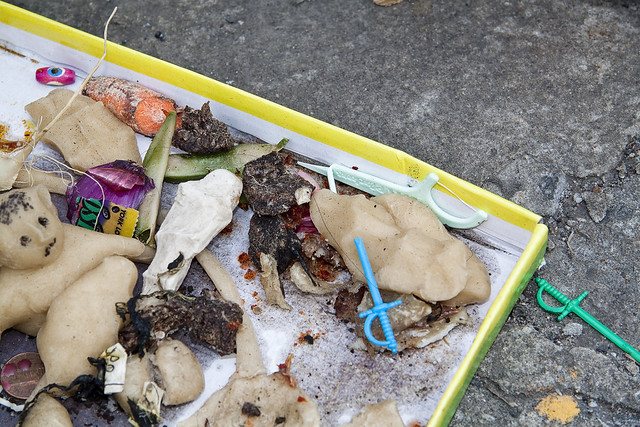
– photo by Mitch Waxman
South East featured a rough hewn clump with a cocktail sword sitting in it and some unidentifiable brown organics which might have once been fruit or flowers.

– photo by Mitch Waxman
South West had this composite clumping, with another hunk of brown mystery.

– photo by Mitch Waxman
North West featured variegation, with a bisected lime, several raw chile peppers, what appeared to be a piece of meat, coins, and rice.

– photo by Mitch Waxman
Long time readers know the ridiculous lengths normally gone to at this- your Newtown Pentacle- to explain and detail the meanings of these ritual sites and objects which may be found around the City of New York. Remember the weirding works at St. Michael’s Cemetery, the Grand Lodge of the Freemasons in Manhattan, or the witch knots at Calvary?
This one, however, has me stumped. Anybody out there have any idea what we’re looking at beyond the material and obvious?
Note: All comments are moderated (by me personally), so if you’d prefer to stay private, please indicate it and your message will not be “published” although I’ll filter out any identifying information about you.
Cool Air

– photo by Mitch Waxman
One of the many startling things about H.P. Lovecraft’s unhappy life in New York, during which he suffered dire poverty, was that his favorite pass time seemed to have been wandering the streets tracking down antiquarian treasures- and He spent quite a bit of his time looking for artifacts of times gone by. Many of the locations mentioned in his fiction remain extant to this day, and sometime over the next couple of months your humble narrator will be journeying to Brooklyn to find the “Horror at Red Hook”.
Today, however, we’re on West 14th street in Manhattan- where “Cool Air” is set.
from wikipedia
The building that is the story’s main setting is based on a townhouse at 317 West 14th Street where George Kirk, one of Lovecraft’s few New York friends, lived briefly in 1925. The narrator’s heart attack recalls that of another New York Lovecraft friend, Frank Belknap Long, who dropped out of New York University because of his heart condition. The narrator’s phobia about cool air is reminiscent of Lovecraft himself, who was abnormally sensitive to cold.

– photo by Mitch Waxman
Lovecraft scholar S.T. Joshi has christened Kirk, Lovecraft, Long and a small group of others as “The Lovecraft Circle” and this is where they would meet up and carouse late into the night. In the 1920’s, this was a “Bachelor’s Boarding House”, and from the description of the modern establishment quoted below- it still is.
from chelseapinesinn.com
Chelsea Pines Inn is located in a five story walk-up row house that was built as a private home in the 1850s. In the 1980s, the building was transformed into a charming gay owned and operated hotel, where everyone has always been welcome. All guest rooms and common areas are decorated with original film posters from the Golden Age of Hollywood. Unique stores, galleries, restaurants, and clubs are within walking distance, and the world’s largest mass transit system is just a few steps away, so you can get anywhere in the city quickly and economically.
Originally built as a private home back when 14th Street was the northern end of the city, our building has gone through many exciting changes over the years. As the City grew around us it became a fashionable rooming house and was used as the setting in Cool Air, a short story about air conditioning, written well before air conditioning was invented, by the celebrated horror author H.P. Lovecraft. (Just as a note, Chelsea Pines Inn has central air.)
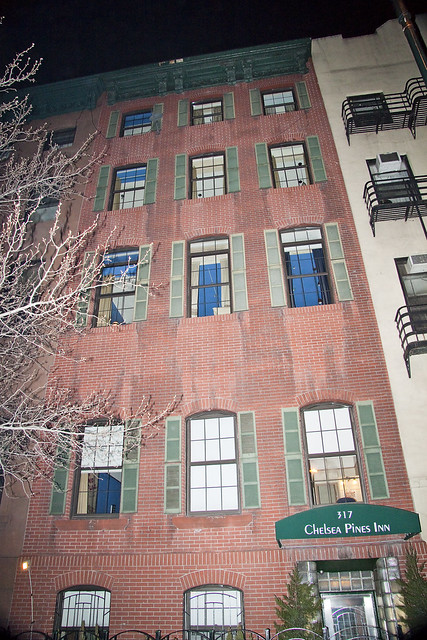
– photo by Mitch Waxman
The action in the story would have taken place on the third floor, where the narrator’s rooms were located. Dr. Muñoz would have been at the summit.
from H.P. Lovecraft’s “Cool Air”
It is a mistake to fancy that horror is associated inextricably with darkness, silence, and solitude. I found it in the glare of mid-afternoon, in the clangour of a metropolis, and in the teeming midst of a shabby and commonplace rooming-house with a prosaic landlady and two stalwart men by my side. In the spring of 1923 I had secured some dreary and unprofitable magazine work in the city of New York; and being unable to pay any substantial rent, began drifting from one cheap boarding establishment to another in search of a room which might combine the qualities of decent cleanliness, endurable furnishings, and very reasonable price. It soon developed that I had only a choice between different evils, but after a time I came upon a house in West Fourteenth Street which disgusted me much less than the others I had sampled.
The place was a four-story mansion of brownstone, dating apparently from the late forties, and fitted with woodwork and marble whose stained and sullied splendour argued a descent from high levels of tasteful opulence. In the rooms, large and lofty, and decorated with impossible paper and ridiculously ornate stucco cornices, there lingered a depressing mustiness and hint of obscure cookery; but the floors were clean, the linen tolerably regular, and the hot water not too often cold or turned off, so that I came to regard it as at least a bearable place to hibernate till one might really live again. The landlady, a slatternly, almost bearded Spanish woman named Herrero, did not annoy me with gossip or with criticisms of the late-burning electric light in my third-floor front hall room; and my fellow-lodgers were as quiet and uncommunicative as one might desire, being mostly Spaniards a little above the coarsest and crudest grade. Only the din of street cars in the thoroughfare below proved a serious annoyance.
shadowy corners

“they’re building another one?” – photo by Mitch Waxman
This is the final installment detailing my experiences in western Queens, on that day when I finally located the grave of Calvary Cemetery’s first interment (Esther Ennis, 1848), stepped in a dead rabbit, picked up a paranormal companion on my long walk, found myself in a state of “stupendous ruin“, soon realized that my perceptions had grown “bafflingly homogeneous“, and that my senses had become occluded due to “sleep filmed eyes“.

– photo by Mitch Waxman
As mentioned in yesterday’s posting, tardy delivery of content to this- your Newtown Pentacle- has been caused by a cavalcade of obligations. Both personal and professional, these obligations have placed me in a room next to personages who enjoy the highest reputation and standing, lettered academics and eidelons of “the professions” both have taken me to a private corner of the room and confessed to having had similar experiences to those which I’ve been describing in this series of postings- which is VERY interesting.
This day, I was in Tower Town, down by the East River in Long Island City… or Queens West as its proponents call it.

– photo by Mitch Waxman
Former days of grandeur, industrial might, and utility seem to be over for this part of Queens. Perhaps it is overworked and deserves a pastoral retirement as a park and residential center. Such meta-lopolitan planning is beyond the understanding of one like myself, who is cursed to wander through this infestation of the human hive but forbidden to do anything but observe. When my nervous scuttling and vast perambulations are performed, dark glasses are worn and the earbuds of my iphone are firmly in place- serving to isolate and insulate.
Of late, I like to wear my hood up, but loss of periphery can be a fatal mistake in these places I go.
Perhaps this is why I was casting two shadows.

– photo by Mitch Waxman
My companion was familiar to me somehow, an atavist and insistent presence. Definitely male, the image of a double headed ax was impossible to banish from my thoughts as I neared the bridge…

– photo by Mitch Waxman
…THE QUEENSBORO BRIDGE!!! Queensboro is its name, not 59th street nor anything else that Manhattan elites might attach to it.
CALL HUNTERS POINT SOUTH OR WILLETS POINT “KOCH CITY” instead…

– photo by Mitch Waxman
…sorry that sort of thing just blurts out of me these days…
At right about this spot that I suddenly perceived that my spectral companion was no longer present, and when I noticed my nervous shadow had returned to its altogether wholesome and expected aspect. Whatever it was… perhaps it was just the moment when “one of my states” had passed…

– photo by Mitch Waxman
It was here in the shadows of that great machine called Queensboro that the splendid isolations which your humble narrator so enjoys returned, and roamed once more alone amongst the multitudes. The disturbing vision of that double headed ax though, seemed to stay with me and caused ponderings to begin.
What connection could there be between Long Island City, a largely Irish cemetery, and a battle-ax?
sleep filmed eyes

– photo by Mitch Waxman
Altered by timidity and terror, your humble narrator continued down Borden Avenue, and crossing beneath the fecund Pulaski Bridge this totemic awaited. At first, it seemed to be material proof of certain theories and cognitive dissonances, confirmation of deep voids beneath the modern plate of cement which typifies area streets.
Who, after all, can guess what may be buried down there?

– photo by Mitch Waxman
Amongst the many things whose worried considerations are enjoyed by one such as myself is the sure knowledge that modern New York City, particularly older sections like Hunters Point in Queens or the business district in Manhattan, is the icing of a very deep layer cake. Foundations of ancient structures, with industrial pipelines, sewer connections, and still extant subterranean warehouse vaults are intricately woven into the ground.

– photo by Mitch Waxman
Often, in areas around the malediction known as the Newtown Creek in particular, the expediency required of rapid capital driven entrepreneurial growth has demanded that a property lot be cleared without any clear record left behind of what once occupied the space. This patch of the Creek was raised from the swampy morass which was its natural form sometime in 1861, for instance. The first buildings in Hunters Point were constructed near here, and Borden Avenue itself (although known as first “Ferry Road” and later as “Blissville Road”) was christened only in 1869.
Hunters Point is named for the family of Captain George Hunter, although it has also been called Mespit, Nechtanc’s Hook, Curles Hook, Dominie’s Hook, and Bennet’s Hook before it became referred to by its modern nomenclature.

– photo by Mitch Waxman
Ambitious to the point of hubris, the transformation of Hunters Point from “an industrial center which had fallen on hard times” (mainly due to meddling with its zoning by real estate interests and long retired city planners in 1960) to a neighborhood is beginning. Like it or hate it, it’s happening- and “Hunters Point South” is shaking free of the twin shackles of an economic downturn and municipal bureaucracy. The behemoth project promises to reveal much that is hidden in the ground, whether it be those venomous environmental inheritances- contamination from some long ago refinery or chemical plant- or the archaeological remains of the early colonial or aboriginal inhabitants.
In the midst of all the historical reminisce, a rustle from behind me forced remembrance of why I had come here…

– photo by Mitch Waxman
Spectral, a companion had latched onto me earlier in the day. It was that day when I finally located the grave of Calvary Cemetery’s first interment (Esther Ennis, 1848), stepped in a dead rabbit, picked up a paranormal companion on my long walk, found myself in a state of “stupendous ruin“, and soon realized that my perceptions had grown “bafflingly homogeneous“. According to occult specialists and paranormal experts, eldritch entities are somehow connected to and can access the ambient electromagnetic spectrum as evidenced by cold spots in haunted houses and the rapid draining of camera batteries in similar locations. (I can report that my Canon battery functions normally within area cemeteries, however)
Long Island City… LIC is all about power and always has been.

– photo by Mitch Waxman
In 1881, when the goody two shoe reformers in Manhattan outlawed gambling and bookmaking, the “operation” moved to Hunters Point. In 1890, things were going so well that the Queens County Bank was built on 2nd street. It wasn’t until the 20th century that the “800 pound gorilla” built its powerhouse, and it would be another 20 years until the tunnels to Manhattan were finished which allowed the new subway system to cross under the river via the miracle of electrical motility.
Under the ground here, raw electrical power exists in cascades…

– photo by Mitch Waxman
My shadowy passenger, whose identity I suspected but cannot prove, seemed to shudder at the thought of crossing the river of electrical cables which underlie this section of the waterfront. Emboldened by its trepidation, I set off down 2nd street, and headed for Tower Town where no shadow can be found. Atavist fear and horror struck panics aside, your humble narrator is no stranger to the mythologies and common tropes of the occult…
Haunt my house? I’ll fill the carpet steamer with holy water…


