Posts Tagged ‘Pickman’
sweet forgetfulness

– photo by Mitch Waxman
While wandering about the Newtown Creek, it is easy to lose faith that wholesomeness exists anywhere, and one’s thoughts turn toward the apocalyptic. Floating sewage, volatile organic chemicals, and sometimes even oil envenomate the water. Languid waves lick at and nourish shorelines whose concretized holdings of mud and soil are deeply riven with heavy metals and certain ashy residues which hint at a faded industrial grandeur, and the very air you breath is a poisonous fume.
Yet, somehow, against every possible chance, nature endures in this place.

– photo by Mitch Waxman
One of the mythologies about the Newtown Creek is that it is some sort of dead zone, destroyed and irrevocably altered by man.
While some of this is true, Dutch Kills for instance used to run all the way to Queens Plaza (ever notice the smell down in the subway station? That’s Dutch Kills, which still follows it’s ancient course through brick lined subterranean sewers, and oozes through the masonry walls of the subway. I know the specific smell of Dutch Kills, and the odor in the station is definitely it) and Maspeth Creek flowed halfway to Flushing when the Dutch found it.
The thing is, while the bird in these shots is beautiful, most of the life found in the Newtown Creek is not as esthetically pleasing.
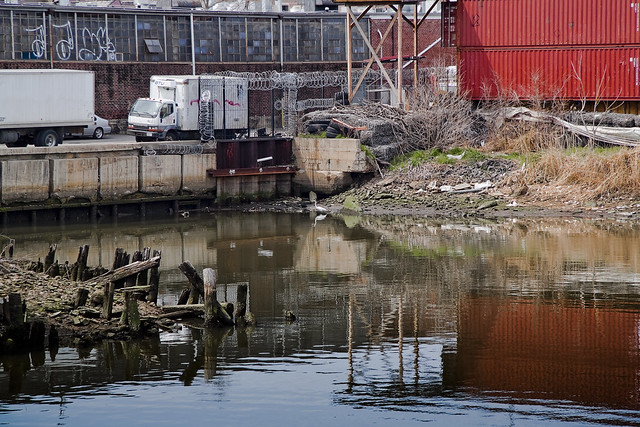
– photo by Mitch Waxman
Just the other day, a stalwart member of the Long Island City Boathouse described observing oyster colonies, obviously rendered unfit for consumption by the endemic pollution of the waterway, growing wild in English Kills. I’ve personally observed Eel fry as far back as Maspeth Creek, several higher species of the icthyan order, jellyfish. The radical LaGuardia Community College biologist Dr. Sarah Durand is in the process of collecting evidences of zooplankton and other invertebrate populations in the water column. There’s also a Heron which is known to reveal it’s wisdom, close to the Grand Street Bridge, to those wise enough to ask it the right questions.
Who can guess all there is, that might be hidden down there?
little memories

– photo by Mitch Waxman
The thing I like about walking the earth is that one moves at a slow pace, and it’s possible to notice the little things otherwise obscured by vehicular speed which line the streets of the great metropolitan city. Whether it be an altar following the precepts of some cultic faith, or the odd things which might be observed at the fence lines of area cemeteries, or just the footpath leading to a homeless camp- these small details are obscured by speed. This phenomena first became apparent to me when still a teenager, before the hellish green flame of revelation was lit in my mind.

– photo by Mitch Waxman
For many years, just where the high flying Queens Midtown Expressway returns vehicular traffic to ground at Greenpoint Avenue and it transmogrifies into the Long Island Expressway, behind one of the ramps that lead from VanDam, there was a long established and quite populous homeless camp. As an aside, I should mention that your humble narrator has a scary rapport with these often debased, dangerous, and diabolical men (few women take up residence in these places, I’ve observed) which has caused me no small amount of concern. Personal experience and the social class which I was born into (working class, there was always plenty to eat, and Dad owned a car) would normally preclude any interaction at all with such vagabonds (called Bums up till sometime in the mid 80’s), but for some reason, “the street” and I understand each other. The stories told by such men, often told in return for a hip pocket flask of cheap libation, reveal a side of our community which won’t be recorded by history.

– photo by Mitch Waxman
The camp at this location has recently been swept out, no doubt due to the attentions of the NYPD and certain policies enacted by the City Fathers in Manhattan designed to offer proper shelter to a vulnerable and often mentally ill population in need of doctoring. Such progressive policies are the responsible and “Christian” thing to do, of course, as those of us who manage to claw our way through the dark and find purchase on the socioeconomic ladder are presented with the moral quandary of helping those who cannot. My experience with the homeless, though, is that by and large it’s not “cannot” – it’s “will not”. When I lived on what is now called the “Upper West Side” in Manhattan, my pal Henry whose last address was a car parked alongside Needle Park once told me that the tramps had their own world with certain social hierarchies, and were the true New Yorkers. Another unfortunate, Raggedy Andy, described interaction with “the world” as painful for him- he preferred the life of the streets to the rote and obligations presented to him by the “do gooders”, social workers, and the nemesis gendarme.

– photo by Mitch Waxman
All that remains to indicate their morbid habitation is a cooking pan, several dog eared books, and the soiled bedding which typifies such ad hoc agglutinate communities. Encounters with these men, while dangerous for an unarmed visitor, have instead filled my mind with wonder. Tales from Latino day laborers along Broadway in Astoria about a white man with a strange mustache in a late model red van from whom you should never accept an offer of work, as those who go with him are never heard from again. Second hand reports from a mendicant on Grand Avenue in Maspeth about a thing which has been seen around the extant sections of English Kills, described as a sort of small dog which walks about on two legs, and descriptions of some enormous and shining black shape seen slithering around in Maspeth Creek during moonless nights have all been related to me. Obviously addled by liquor and narcotics and informed by madness, the witnesses are suspect at best, but as always, your Newtown Pentacle presents what is offered to it “as is” without varnish or judgement. One wonders though, about this burned out ancient house in Blissville- not far from Calvary Cemetery- and the secrets which might lie hidden in it’s worm eaten walls.
with an atomic, or molecular, motion

– photo by Mitch Waxman
Another interesting event set to occur on May 21st, which has been scheduled against my Newtown Creek Cruise- I would add, seems to be the apocalypse.
On my way to a meeting at Greater Astoria Historical Society on Sunday, the purpose of which was to discuss the upcoming Forgotten-NY tour of Staten Island’s Livingston neighborhood, I came across this pamphleteer who was proselytizing passers by to prepare for the coming tribulation and offering advice for making it through the end times which are meant to begin on a specific date not far in the future.
from wikipedia
The 2011 end times prediction is a prediction made by Christian preacher Harold Camping that the Rapture (in Christian belief, the taking up into heaven of God’s elect people) will take place on May 21, 2011 and that the end of the world as we know it will take place five months later on October 21, 2011. These predictions were made by Camping, president of the Family Radio Christian network, who claims the Bible as his source. Believers claim that around 200 million people (approximately 3% of the world’s population) will be raptured.

– photo by Mitch Waxman
This sort of millennialist doom saying is nothing new, remember the UFO people in California, the Branch Davidians in Texas, and the Solar Temple cult in Switzerland, just to refresh somewhat recent memories.
At the turn of the last century, one needed to have looked no further than the so called Millerites to find the originators of this sort of proclamation.
from wikipedia
The Great Disappointment was a major event in the history of the Millerite movement, a 19th century American Christian sect that formed out of the Second Great Awakening. William Miller, a Baptist preacher, proposed based on his interpretations of the prophecies in the book of Daniel (Chapters 8 and 9, especially Dan. 8:14 “Unto two thousand and three hundred days; then shall the sanctuary be cleansed”), that Jesus Christ would return to the earth during the year 1844. A more specific date, that of October 22, 1844, was preached by Samuel S. Snow. Although thousands of followers, some of whom had given away all of their possessions, waited expectantly, Jesus did not appear as expected on the appointed day and as a result October 22, 1844, became known as the Great Disappointment.

– photo by Mitch Waxman
Your humble narrator would hope that if the world does indeed end on the 21st of May, that you can enjoy the view of Manhattan disintegrating from those vantage points which the scenic waters of Newtown Creek offer with me. Destruction not withstanding, there is still a heck of a lot to see.
Assuming that some multi headed dragoness isn’t raining brimstone down upon us by then, I would also remind you of a Magic Lantern Show on the subject of Newtown Creek I’ll be presenting at the aforementioned Greater Astoria Historical Society on June 6th ($5- cheep).
colossal and protuberant

– photo by Mitch Waxman
There I sat, broken hearted…
Somehow that old Brooklyn Public School aphorism was on my mind as I scuttled along the street ends of Greenpoint. These shots were attained at India Street’s junction with the East River and depict the shield wall of a Shining City as viewed from the collapsing pierages of an ancient and crumbling competitor.

– photo by Mitch Waxman
It’s difficult for us to think of the Boroughs as separate cities… well, it’s hard to imagine Brooklyn, Queens, and the Bronx as separate while with Staten Island it’s quite easy… but they were. This location upon which I was standing was, until quite recently (from a historical perspective), heavily industrialized. A workshop, this section of Greenpoint is in many ways responsible for the ascendency of Manhattan over not just it’s local competition but the Nation itself.

– photo by Mitch Waxman
This is another of the zones which the City fathers has designated for whatever they call “urban renewal” these days, and plans are both afoot and underway to convert certain structures to residential use (such as the “Pencil Factory”) or to clear away the existing building stock to make way for new construction.
The good news, or bad depending on your perspective, is that a condition set forward to the real estate interests by the City is that a waterfront pedestrian concourse not unlike the one nearing completion across the Newtown Creek in Long Island City must be built in return for certain laxities of enforcement regarding the zoned height of waterfront development.
At least there’ll still be a place down by the water where the kids in Greenpoint can go and dream of an age when you needn’t have to commute to get to work.
Additionally, the following event will be happening in Greenpoint on May 4th, 2011. I’ve met Shawn Shafner and he’s got a LOT of good stuff to say about some very bad stuff indeed. I’ll be there- at the Temple of Cloacina- how about you, Citizen?
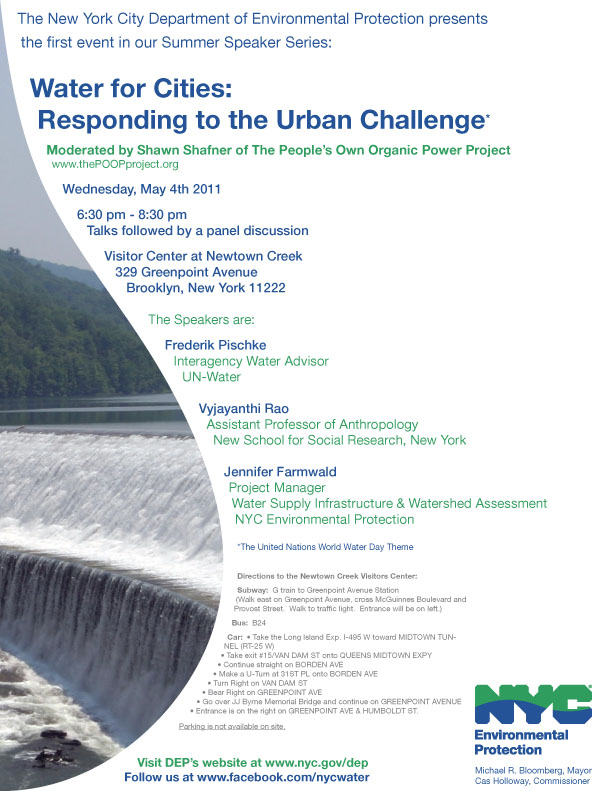
Text from the flyer with links:
Water for Cities: Responding to the Urban Challenge*
Moderated by Shawn Shafner of The People’s Own Organic Power Project www.thePOOPproject.org
Wednesday, May 4th 2011 6:30 pm – 8:30 pm Talks followed by a panel discussion
Visitor Center at Newtown Creek 329 Greenpoint Avenue Brooklyn, New York 11222
The Speakers are: Frederik Pischke Interagency Water Advisor UN-Water, Vyjayanthi Rao Assistant Professor of Anthropology New School for Social Research, New York, Jennifer Farmwald Project Manager Water Supply Infrastructure & Watershed Assessment NYC Environmental Protection.
Visit DEP’s website at www.nyc.gov/dep Follow us at www.facebook.com/nycwater
The Bowie effect

-photo by Mitch Waxman
There are those who like to tell your humble narrator that he is given to hyperbole if not outright fraud, and although I will admit to a weakness for theatrical effect, the odd subjects and situations described in these posts are not contrivances or banal set pieces. When I tell you of the odd polydactyl cats around the Grand Street Bridge or the eyeless things that wriggle in the mud during low tide at Maspeth Creek, rather than smile kindly and nod your head, shudder audibly at the terrible implications arising from their existence- which, if generally known, might herald a turning away from science by a beaten human race gladly retreating into a new dark age.
Here then is one of the curiously heterochromiatic cats found in hoary Greenpoint, which is one of the “you just make this stuff up” sore spots for a humble narrator.
from wikipedia
In anatomy, heterochromia refers to a difference in coloration, usually of the iris but also of hair or skin. Heterochromia is a result of the relative excess or lack of melanin (a pigment). It may be inherited, or caused by genetic mosaicism, disease or injury.
Eye color, specifically the color of the irises, is determined primarily by the concentration and distribution of melanin. The affected eye may be hyperpigmented (hyperchromic) or hypopigmented (hypochromic). In humans, usually, an excess of melanin indicates hyperplasia of the iris tissues, whereas a lack of melanin indicates hypoplasia. Heterochromia of the eye (heterochromia iridis or heterochromia iridum; the common wrong form “heterochromia iridium” is not correct Latin) is of two kinds. In complete heterochromia, one iris is a different color from the other. In partial heterochromia or sectoral heterochromia, part of one iris is a different color from its remainder.

-photo by Mitch Waxman
This was just one member of a colony of cats living on Commercial Street, and the rest scattered before the coloration of their ocular organs could be ascertained. Luckily this stalwart maintained a steady position, and despite the clear annoyance displayed at the horrible scuttling thing waving around a camera before it, stood it’s ground. As a fellow child of infinite Brooklyn, such tenacity did not go unnoticed. Odd eye colored Cats are special, from a symbolic point of view, and have no small amount of mythic significance – even the prized cat of the prophet, called Muezza, was odd eyed.
from wikipedia
The Cat Sìth (Scottish Gaelic: [kʰaht̪ ˈʃiː]) or Cat Sidhe (Irish: [kat̪ˠ ˈʃiː], Cat Sí in new orthography) is a fairy creature from Celtic mythology, said to resemble a large black cat with a white spot on its breast. Legend has it that the spectral cat haunts the Scottish Highlands. Some common folklore suggested that the Cat Sìth was not a fairy, but a transformed witch.
The legends surrounding this creature are more common in Scottish folklore, but a few occur in Irish as well.

-photo by Mitch Waxman
There are many odd things around the Newtown Creek, hidden away beneath the cracked cement and amongst the dripping masonry walls of those long buried and forgotten building foundations which lie just below the facade of modernity. Here you are then, the “Bowie Effect” of the Cats of the Creek is offered. Still working on getting the six toed critters in DUGSBO though…
Who can guess what other anomalous and unwholesome alterations our common urban fauna might have undergone, or are undergoing, in some runaway Darwinian reaction to those environmental stressors they have suffered over the centuries at Newtown Creek?
from wikipedia
In Irish mythology, the aos sí (Irish pronunciation: [iːs ˈʃiː], older form aes sídhe [eːs ˈʃiːə]) are a supernatural race comparable to the fairies or elves. They are said to live underground in the fairy mounds, across the western sea, or in an invisible world that coexists with the world of humans. This world is described in “The Book of Invasions” (recorded in the Book of Leinster) as a parallel universe in which the aos sí walk amongst the living.
In the Irish language, aos sí means “people of the mounds” (the mounds are known in Irish as “the sídhe”). In Irish literature the people of the mounds are also referred to as the daoine sídhe (“deena shee”), and in Scottish Gaelic literature as the daoine sìth or daoine sìdh. They are said to be the ancestors, spirits of nature, or goddesses and gods.
note: The large blue box in the background of these shots seems to have been designed to act as some sort of feral cat shelter rather than a Tardis, and bore a screed proselytizing the curious to visit the website found at neighborhoodcats.org/


