Posts Tagged ‘Pickman’
weird lyric

– photo by Mitch Waxman
After having fallen into a hole earlier in the day, and suffering from a torn knee and possibly fractured finger, your humble narrator nevertheless opted to end the day with a walk through Calvary Cemetery.
A miscalculation on my part was made by this decision, as the cemetery itself was encased in several feet of rain and ice polished snow. Never one to display good sense or reason, the encircling boundary road (which was quite clear, no doubt due to the expert ministrations of the groundskeeping crew) was avoided and a cross section path through the frozen substrate was embarked upon.
At the end of this difficult perambulation, however, I was rewarded by the company of a bird of prey (which I believe to be a juvenile Red Tail Hawk).
from wikipedia
The Red-tailed Hawk is carnivorous, and an opportunistic feeder. Its diet is mainly small mammals, but it also includes birds and reptiles. Prey varies with regional and seasonal availability, but usually centers on rodents, comprising up to 85% of a hawk’s diet.Additional prey (listed by descending likelihood of predation) include lagomorphs, shrews, bats, snakes, waterfowl, fish, crustaceans and insects. Prey range in size from beetles to White-tailed Jackrabbits, which are double the weight of most Red-tails. In captivity in winter, an average Red-tail will eat about 135 g (4-5 oz) daily.
The Red-tailed Hawk hunts primarily from an elevated perch site, swooping down from a perch to seize prey, catching birds while flying, or pursuing prey on the ground from a low flight.

– photo by Mitch Waxman
The bird was a good fifty feet above me, perched on the statuary crowning one of those mighty obelisks which typify the older and grander sections of the vast polyandrion that men call First Calvary. It seemed to be gazing at the shield wall of Manhattan- the Shining City.
The particular locale within the cemetery itself has been observed in past visits to support a population of “groundling burrowers“, any one of which would provide a good meal to the predator during these lean months of winter. Knowing that predators can sense weakness and injury at a distance, I began to carefully back away owing to my profound physical cowardice.
What if it smelled the blood trickling down my leg due to the wound incurred at the knee of my skinvelope, caused when I fell in that hole?
from animals.nationalgeographic.com
These birds of prey are also known as buzzard hawks and red hawks. By any name, they are keen-eyed and efficient hunters. Red-tails prefer open areas, such as fields or deserts, with high perching places nearby from which they can watch for prey. But these birds are adaptable and also dwell in mountains and tropical rain forests. Hawks have even embraced human habitats. They often perch on telephone poles and take advantage of the open spaces along the roadside to spot and seize mice, ground squirrels, rabbits, reptiles, or other prey.
Breeding season initiates a spectacular sequence of aerial acrobatics. Hawk pairs fly in large circles and gain great height before the male plunges into a deep dive and subsequent steep climb back to circling height. Later, the birds grab hold of one another with their talons and fall spiraling towards earth.

– photo by Mitch Waxman
In the past, I’ve mentioned that the grounds of First Calvary serve as an oasis to heterogenous forms of both migratory and quite native life forms. The “groundling burrowers” are here (as mentioned), and birds often use the arboretum as a way station on their long seasonal journeys. There are dogs and cats here, of course, and second hand rumor has suggested that Opossum, Raccoon, and other more esoteric forms of life exist within the stout iron gates.
This is the first time I’ve spotted a raptor here, though.
It was just last month that a photographer named Marcelo Barrera managed to get a shot of a Coyote in Calvary, check out the NYPost.com story here.

– photo by Mitch Waxman
It’s actually interesting that a Red Tail chose to roost here, in that psychic cauldron of squashed hope and severed ambition known as First Calvary.
Aboriginal tribesmen prized the feathers of these birds for use in ritual, and even today- the plumage of Red Tail Hawks fall under the jurisdiction of the “Eagle Feather Law“. Apparently, for those who believe in something, the presence of such a Hawk in a cemetery would be quite a profound experience.
I’d also point out that “hawk’s gifts” in the quotation below would indicate madness and megalomania if manifested in a primate, and would make great PR copy to describe a politician. As proof of this, the second quote replaces references to “hawk” with the name of the Mayor (just as an example).
from shamanicjourney.com
The hawk’s gifts include clear sightedness, being observant, long distance memory, messages from the universe, guardianship, recalling past lives, courage, wisdom, illumination, seeing the bigger picture, creativity, truth, experience, wise use of opportunities, overcoming problems, magic, focus.
Hawk is associated with the number 14, with the tarot card Temperance. The Temperance card represents the teaching of higher expressions of psychic ability and vision.
The Hawk represents a messenger in the Native American culture. It often shows up in our life when we need to pay attention to the subtle messages found around us, and from those we come into contact with. As with all messages received, it is important to recognise the messages underlying truth. We will be taught to be observant and also pay attention to what we may overlook. This could mean a talent we aren’t using, a gift or unexpected help for which we haven’t shown our gratitude for, or a message from the Universe. As there are so many hawk varieties, the messages vary and can affect all levels of our psyche.
Hawks are the protectors and visionaries of the Air. They hold the key to higher levels of consciousness. This power animal enables us to awakens vision and inspires a creative life purpose. Having Hawk as power animal means your life will be filled with responsibility, because Hawk people seek the overall view. You will most probably be aware of omens and spirit messages.
modified version
Michael Bloomberg’s gifts include clear sightedness, being observant, long distance memory, messages from the universe, guardianship, recalling past lives, courage, wisdom, illumination, seeing the bigger picture, creativity, truth, experience, wise use of opportunities, overcoming problems, magic, focus.
Michael Bloomberg is associated with the number 14, with the tarot card Temperance. The Temperance card represents the teaching of higher expressions of psychic ability and vision.
Michael Bloomberg represents a messenger in the Native American culture…

– photo by Mitch Waxman
Being scientifically minded, of course, your humble narrator rejects such fantastic interpretations of the birds presence here. A cigar, after all, is just a cigar. I would point out that a visit to “The City Birder” will reveal several spottings of similar animals all around the megalopolis, and you’ll find a few “things to do” in their recent “upcoming nature trips” posting.
The NYTimes presented this piece in 2007, which discusses the presence of Red Tail Hawks in another garden cemetery- Greenwood in Brooklyn

– photo by Mitch Waxman
Despite the great discomfort caused by my injuries, immense difficulty was found in trying to leave Calvary Cemetery on Sunday afternoon. Social obligation, however, drew me ineluctably back to Astoria to attend a party- during which a televised tournament of some kind would be exhibited that held special significance to others in my peer group.
Happily, some number of photographs of First Calvary blanketed in winter colors were captured, many of which will be gathered into future postings of this- your Newtown Pentacle.
the loved dead

– photo by Mitch Waxman
On Sunday I fell in a hole…
Literally, a pothole on 49th street (which adjoins the hideous Maspeth Creek tributary of that answer to civilization known as the Newtown Creek) swallowed your humble narrator. Banged up a bit, an injury to the left knee punctured my skinvelope and the jury was out on whether or not a finger on the right hand might have been fractured. Of all the things that can go wrong or happen to you around the Newtown Creek, falling in a hole was absolutely the last thing I worried about.
Actually, I’ve worried a lot about falling into a hole at Calvary and Mt. Zion…

– photo by Mitch Waxman
On Monday my computer died.
The funeral montage for my newly deceased G5 plays unheralded in my mind. With me for quite a number of years, the Mac was a workhorse, and despite its steadily declining capabilities (it hadn’t been able to burn a DVD for years, and recently required replacement of several internal components) it never let me down. I remember the first time we went to the park together, the long nights working on freelance jobs… sigh. If you have a Windows based machine, you don’t understand this, but Mac owners develop a certain emotional bond with their gizmo and it is painful to part with it. Luckily, I salvaged the hard drive from it, and the soul of the beast was intact. So, off to the Apple store at 1AM, back home deeper in debt than ever. The good news is that the new Mac has been able to read everything, the “migration assistant” was able to transfer my files in a fairly seamless fashion, and I seem to be back in business.
Still, bad things are supposed to happen in threes, right?

– photo by Mitch Waxman
Today, I’m living in fear of further possible torment and death.
Mental notes have been made to both back up the computer more often and to ensure sure footing before shifting my weight from one foot to the other. I saw a few interesting things on Sunday, which will be discussed in forthcoming postings of this- the winter session of your Newtown Pentacle.
Note:
The Newtown Creek Alliance meeting which was cancelled due to the recent ice storm on has been rescheduled for February 17th- here’s the details:
When: Thursday, February 17th, 6:30pm
Where: LaGuardia Community College, Building E, Room 501
The agenda as listed is:
At the meeting we will be discussing:
- The recent designation of Newtown Creek as a Superfund Site
- The Greenpoint Oil Spill Settlement Agreement between the NYS AG, Riverkeeper, and ExxonMobil
- The distribution of Newtown Creek Sewage Treatment Plant Environmental Benefit Funds
- DEP’s signage for the Newtown Creek Nature Walk
- The NYC Green Infrastructure Plan and its potential impact on Newtown Creek
- The status of Newtown Creek Alliance’s application to incorporate as a not-for-profit organization.
The “NYC Green infrastructure plan” section of the discussion promises to be VERY interesting. Come and meet some truly smart people, in Long Island City of all places.
profound discouragement

– photo by Mitch Waxman
With my favored vantage on Dutch Kills, the estimable Borden Avenue Bridge, once more accessible– I’ve been making it a point to aim my wanderings toward its general direction whenever I can summon the fortitude to brave the ice. As crazy as it sounds, and regular readers of this- your Newtown Pentacle- have become fairly accustomed to crazy, I really missed this little bridge for the nearly 2 years it had been undergoing emergency repair.

– photo by Mitch Waxman
Perhaps its because this is the first section of the Newtown Creek that I actively explored, researched, and made it a point of documenting. Maybe its simply because this is the most easily attained of the Creek’s tributaries for one who walks, or that it seems to be the most “down on it’s luck” section of the vast watershed and I’m drawn by nature to the runt of the litter.
English Kills in far off Brooklyn makes for far better cautionary tales, but there’s just something tragic about Dutch Kills that always draws me in.

– photo by Mitch Waxman
An actual “out loud gasp” escaped my food hole when I discovered that the resident Crow of the Borden Avenue Bridge had not been forced out of his shanty by the long construction project, and if anything- the fellow had been building additions to the ramshackle hut constructed from found materials.
Last time that I had pointed my lens at this character was in the February 3rd posting of 2010 titled “affordable housing development on Borden Avenue“.

– photo by Mitch Waxman
The smell of a wood fire was wafting from the Crow’s slapdash of plywood, tyvek, and sheet metal- a vague scent which crowded its way into the otherwise extant perfumes normally associated with Dutch Kills.
For those of you who haven’t been reading the Newtown Pentacle since inception- “Crow” is a term I picked up from the neighborhood in Astoria that describes the armies of itinerant scrap metal collectors who find profit in other people’s waste- “put something shiny out on the sidewalk, and the crows will show up and take it” is a common aphorism around my part of Astoria.
I’ve assigned this crow a name “Blue Crow”, but both the “red crow” and the “burgundy crow” have been mentioned previously.

– photo by Mitch Waxman
There’s a bunch of these folks I’ve been spying on, and I’ve even heard rumors of a criminal group who pilfer the white bronze monuments and copper fittings of area cemeteries to sell the valuable metals on the scrap market, but I have yet to regale you with tales of the other- and quite polychromatic- crows who hold the “Green Recycling Jobs of Tomorrow, Today”.
One has also wondered, and more than wondered, at what foul congress the Blue Crow might have had with that which cannot possibly exist in the velvet deep of the malign Dutch Kills.
disquieting effect

– photo by Mitch Waxman
There’s a strange and seemingly shunned house not far from either Queens Plaza or Court Square, a hidden relict on 43rd and Crescent which is shadowed by the Megalith. Intriguing, it’s a fairly old structure located at 25-01 43rd Avenue which is not long for this- or any other- world.

– photo by Mitch Waxman
The Department of Finance Building Classification for this lot is “V1-VACANT LAND”.
Don’t get me wrong- I’m not advocating for this structure to be saved or its owner’s plans for it to be thwarted in any way or even obliquely commenting on the rapid transformations and shocking scale of the “New Queens Plaza”– this isn’t one of those posts. Neither is it an extensive peeling back of hidden lore or sinister revelations.
Like a lot of things these days- it isn’t good, or bad- it just is.
The place does seem pretty “shunned” though.

– photo by Mitch Waxman
What’s surprising about this little building, a clapboard scatterdash, is that it’s here at all. It’s obviously destined to be swept away, may already be gone frankly, as I haven’t been down this direction in better than a month. The enormous broom of economic inevitability is sweeping through the neighborhood and replacing the idiosyncratic and odd with the generic and corporate, and structures like these have no place here any more.

– photo by Mitch Waxman
Enormous fencings, the modern kind which block the intentions of curious eyes, have been thrown up around the place. The process of clearance will eradicate traces of the former habitation, and since my self appointed mission is one of documentation, a point was made of finding a hole in said fencings large enough to fit a camera lens into. My dslr is too stout for such missions, but luckily the ever reliable Canon G10 continues to be part of my carry around kit.

– photo by Mitch Waxman
The late model car half buried in debris and detritus behind this condemned and seemingly abandoned house witnessed in this product of the G10, however, makes me wonder exactly how long and why this property has been so astonishingly shunned.
Tales of Calvary 12- The Lynch monument

– photo by Mitch Waxman
A magnificent and somewhat unique example of mortuary sculpture found at First Calvary Cemetery here in Queens is the Lynch monument. The screeds engraved on it indicate the presence of several generations of the family, and the quality of the stone work indicates that the Lynches were notable figures during their time. As mentioned in the past, however, when one is searching for information on individuals with a “common” name (particularly a common Irish surname) – things get a little hazy. There have been a lot of folks, both famous and infamous, named “James Lynch”.
Here’s what I’ve been able to positively attribute to this James Lynch, and a promising (tantalizing actually) but false lead…

– photo by Mitch Waxman
When James Lynch’s will was read, it caused quite a stir- it seems that the inheritance he left for his widow and children was in excess of 1.5 million dollars (in 1873, mind you), or so says the NYTimes.com archives. Now, 1.5 million in 1873 was a heck of a lot more money then than now- which means that this fellow was “somebody”. But who?
The archive article denoting the disposition of his will puts the family residence at 129 East 21st street in Manhattan- a tony and somewhat aristocratic address in 1873 (and today) located near Gramercy Park. Teddy Roosevelt, for instance, was born around the corner in 1858 and other neighbors included Samuel Tilden, Peter Cooper, and George Templeton Strong.

– photo by Mitch Waxman
The false lead– I suspected that this might be the same James Lynch (of Tammany) who aroused the ire of the future “paper of record” with a controversial order to the Warden of Bellevue Hospital in 1860 that remanded the bodies of the poor to scientific study (medical schools) and the inquiry of the vivisectionists (coroners).
quoth from the nytimes.com archives
All non-professional men who have ever had occasion to visit a dissecting-room, can well understand the intense loathing and horror with which even condemned malefactors shrink from that portion of the death-sentence which delivers over their bodies after execution to be dissected for the instruction of medical students. No sight can be imagined more revoltingly hideous and horrible than the scientific shambles in which human carcases are cut up, disemboweled, torn limb from limb, dissected and tossed from hand to hand by the young acolytes of surgical science. Half a dozen bodies in this way come to be mingled together in one disgusting mass of flesh, bone, tissues, hair and bowels. Different students carry off particular limbs or organs for home dissection; and then the mingled remains are placed in sacks and carted away at midnight, to be dumped out of sight in whatever sinks or holes the surgeons may have selected for this purpose.
But, alas, I was incorrect.

– photo by Mitch Waxman
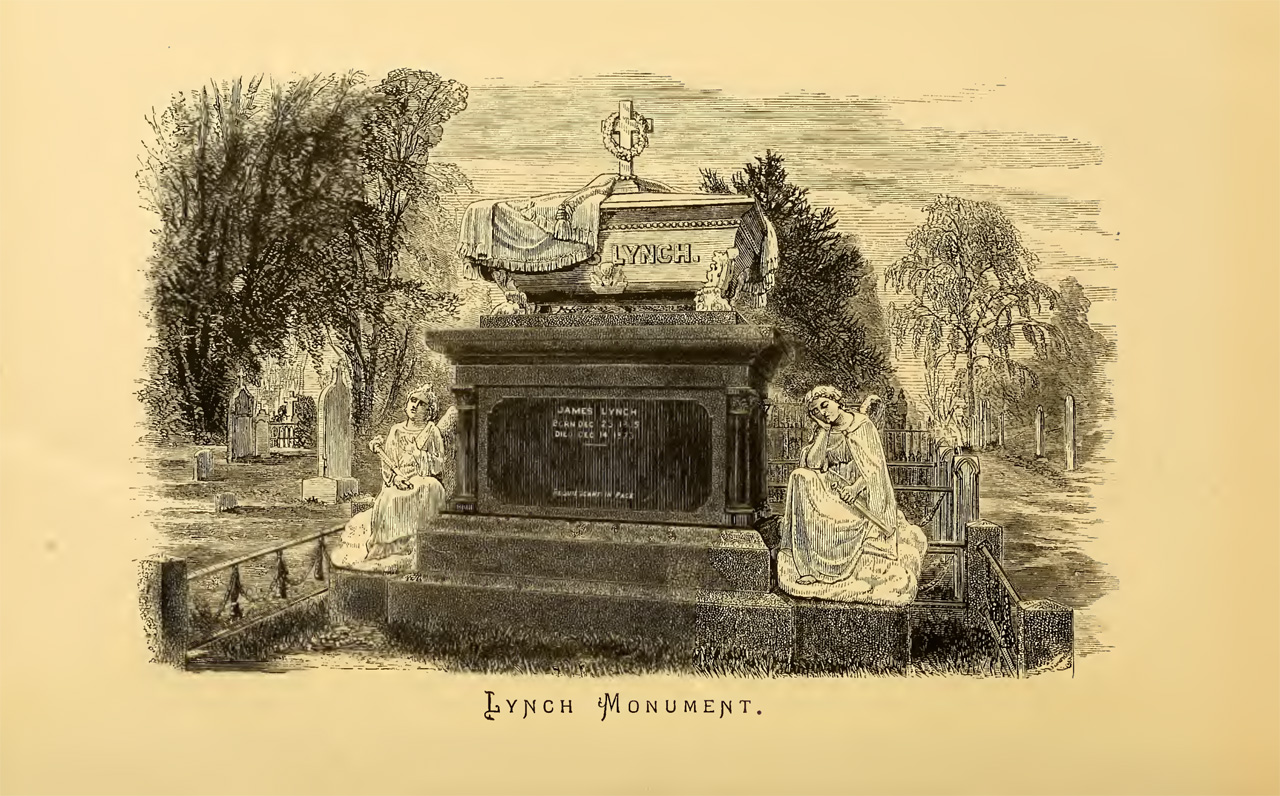
click image for a larger and more detailed incarnation
The illustration above, as well as the following text originate in John J. Foster’s “Visitor’s Guide to Calvary Cemetery” published in 1873
Plot O, Range 9, which is a little to the north of the resident clergyman’s dwelling, (and of which we give an illustration).
It is in the classic style, and consists of a superstructure of solid Quincy granite, in the form of a tomb, with polished columns supporting its entablature, surmounted by a draped sarcophagus, in one entire piece, of the finest Carrara marble. At each end of the base of the tomb, seated on clouds, is an angel, one with a trumpet, to call to judgment; the other emblematic of immortality. These figures are separate memorials. The former having been erected to the memory of the late Miss Katie Lynch, and the latter to the late Miss Agnes Lynci, his two daughters.
The whole work rests on a vault constructed after the style of the old Roman catacombs.
Mr. James Lynch was born December 23, 1805, and died December 14, I873. For nearly thirty years he devoted his attention to the grocery business on an extensive scale, in the city of New York, and retired with a competency in the year 1853. He was a favorite with all who enjoyed his acquaintance, and was well known to the public through his good offices and his manifold services in the advancement of all wise and charitable undertakings that came to his notice. The lively interest he excited in all who knew him secured for him many constant friends who now mourn his loss. His good deeds still survive him. The name of such men should be preserved.

– photo by Mitch Waxman
Clicking on the 1873 illustration, one observes that the only name on this monument when it was drawn was that of the sire of the clan. Scrutiny of the image also reveals an extensive series of footing stones, rails, and decorative plot demarkations which have not survived the century. Additionally, the entire family seems to be accounted for on the monument, with the last interment (Mary Ann) listed as 1922.
I was able to find a scant mention of Emily F. Lynch in the obituaries of the NYTimes.com archives. She lived at 405 Park Avenue, and died there as well.

– photo by Mitch Waxman
In addition to the remarkable centerpiece of the monument, one observes the presence of two weeping angels at the tomb, the presence of which are described in the quoted text as having been installed as separate monuments to Mr. Lynch’s daughters.
Like many of the fine marbles and ornate carvings extant at Calvary Cemetery, long exposure to the toxic atmospheres produced by the industries of the nearby Newtown Creek has badly damaged these sculptural elements, imparting an impression that the stone is melted or rotting away.
This isn’t far from the truth- the nearby Phelps Dodge (then called General Chemical) was actually sued by Calvary’s Board of Trustees in the late 19th century regarding the airborne exhaust of their brimstone based acid manufacturing business and its noxious effluents, and the concept of petrochemical pollution creating “acid rain” is well known to modernity.
from queenslibrary.org
On the plant grounds, General Chemical erected the tallest chimney in the United States to blow the smoke and gases from its furnace away from the neighborhood. For the past number of years neighbor surrounding the plant complained vociferously about the pollution from the factory. Only after a study found that nitric, muriatic, and sulphuric acids from the plant were destroying local cemeteries’ tombstones did the company try and alleviate the problem by building the chimney. This same year the company filed plans with the New York City’s Department of Buildings in Queens to build another 150 foot chimney, an ore breaker, a storage tank, a boiler house, and a stable.

– photo by Mitch Waxman
The NYTimes archives also present a short death notice for Peter W. Lynch, of 253 west 62nd street, whose death corresponds with the date ascribed to Peter W. Lynch on the stone. I have no way of determining if this is the same man, however.
I could find nothing on Katie, but this is not uncommon for the era, as women seldom received mention if they weren’t scandalous, married to, or the mother of a famous man.

– photo by Mitch Waxman
James D. Lynch died at a 120 West 21st street address in 1917, just down the block from the patriarch’s house. Mary Ann and E. Louise seem to have escaped notice when they passed.
Like many of the older plots at Calvary, which once sat long avenues and lanes which were meant to remain as such, the Lynch monument is surrounded by more modern graves. Such is the lot of older cemeteries, whose financial realities demand that new interments must be made in order to maintain the ongoing operations of the enterprise.
A plot purchased in the 1860’s, after all, hardly figured in the cost of 150 years of groundskeeping. This created no small amount of controversy in the past amongst the descendants of those who lie here, but in the end, Calvary prevailed. This is why you’ll often observe modern grave markers peppering around the edges of grandly august Mausolea.

– photo by Mitch Waxman
Hey, you never know what you’re going to find at Calvary Cemetery in Queens.


