Posts Tagged ‘Pickman’
Gods Gift to Pain

Please click through to Flickr and the larger incarnations of the above shot- it’s composed of 7 photos stitched together. Thats 7 fifteen megapixel shots and its HUGE – photo by Mitch Waxman
That extinction of hope called the Newtown Creek enjoys a series of canalized industrial waterways which act as tributaries to its main course. In the past we have visited Dutch Kills, Whale Creek, Maspeth Creek… today, it’s time for a visit to the vicious end of it all.
note: This post violates a number of the rules followed by this, your Newtown Pentacle, regarding rail tracks and probable trespass of private property… yet my hypocrisy knows no bounds. Realize, however, that I was with learned company- individuals overly familiar with this area, its mores, and the rail schedules. Do not come here, especially by yourself- for reasons later explained in this very post!
Welcome to the poison heartlands of New York City, where foul ichors flow freely, and English Kills bubbles in the afternoon sun.
from wikipedia
Newtown Creek is a 3.5 mi (6 km) estuary that forms part of the border between the boroughs of Brooklyn and Queens, in New York City, New York, United States. It derives its name from New Town (Nieuwe Stad), which was the name for the Dutch and British settlement in what is now Elmhurst, Queens. Channelization made it one of the most heavily used bodies of water in the Port of New York and New Jersey and thus one of the most polluted industrial sites in America, containing years of discarded toxins, an estimated 30 million gallons of spilled oil, and raw sewage from New York City’s sewer system. Newtown Creek was proposed as a potential Superfund site in September 2009.

– photo by Mitch Waxman
This is as bad as it gets, one of the few places along the Creek where exposure to the water is life threatening in the short term.
Sure, if you fall off the Grand Avenue Bridge, you’re going to experience broad spectrum antibiotics administered intravenously over the course of a week or two in the hospital- but this stuff is pure dragon blood.
Nauseous miasmas were luckily carried away by stiff breezes, but several times- your humble narrator felt one of his spells coming on.
Up until the latter part of the 20th Century, industries along the creek had free reign over the disposal of unwanted byproducts. With little-to-no government regulation or knowledge of impacts on human health and the environment, it made business sense to pollute the creek. The legacy of this history today is a 17 million gallon underground oil spill caused by Standard Oil’s progeny companies—7 million gallons more than the Exxon Valdez spill in 1989, copper contamination of the Phelps Dodge superfund site, bubbling from the creek bed in the English Kill reach due to increases of hydrogen sulfide and a lack of dissolved oxygen, and creekbeds coated with of old tires, car frames, seats and loose paper. Nearly the entire creek had the sheen and smell of petroleum, with the bed and banks slicked black.
There is no natural freshwater flow into the creek as the historic tributaries were covered over. Flow exclusively consists of contaminated stormwater runoff, carrying trash from numerous bridges, unsewered and wholly paved streets and industrial sites, waste transfer stations, and combined sewer overflows (CSOs) from the city’s sewer system. Moreover, severely toxic groundwater seeps through the bed and banks of the creek. Every year Newtown Creek receives 14,000 million gallons of combined sewage overflow, a mixture of rainwater runoff, raw domestic sewage, and industrial wastewater that overwhelms treatment plants every time it rains. There are also discharges from numerous permitted and unpermitted pollution sources. The creek is mostly stagnant, meaning all the pollutants that have entered the creek over the past two centuries have never left. The creek is also home to a federal Superfund site, several State Superfund sites and numerous brownfields that have not yet secured the attention of regulators.
All is not lost, however. Recently, life is returning to the creek. You can find blue crabs at the mouth, fish swim in its waters, and waterfowl are prevalent. Wetland plants are taking over the abandoned bulkheads and sediment piles and school children are growing oysters, which serve as natural water filters. The Newtown Creek Alliance is actively fighting to help life return to the creek by decreasing pollution and increasing the wetlands along the creek.

– photo by Mitch Waxman
The sickly vegetation, everything, was pulsing with “the colour”. Neither black nor white nor gray, but somehow “shiny”, this alien colour – like something out of space- permeates and identifies the creeklands. Nothing moved, but seemed instead to sway against the wind instead of with it.
In 1655, Director Stuyvesant being absent on an expedition against the Swedes on the Delaware, a horde of armed Indians landed at New Amsterdam, and began to break into houses for plunder. Driven back by the soldiers and armed citizens, they fell upon the unprotected Dutch farmers in the vicinity, many of whom were slain and others taken into captivity. The troubles experienced from the savages were now so alarming as to require the residents of Mespat Kills to concentrate for mutual safety. They, therefore, formed a village on “Smith’s Island,” at the English Kills. The Hon. Nicasius De Sille, who had a patent for the island, had the direction of the new settlement, and called it Aernhem after his native place.

– photo by Mitch Waxman
Dead things were observed in the filth, amongst other unidentifiable shapes and eyeless tubiforms that slithered and flopped and listened from the littoral mud. A vague sense of being watched affected my guides and I, and the loneliness of our location created a sense of certain misgivings which was both real and profound. Nevertheless, I continued my incessant photography, trying to make the best of limited access.
from The Eastern District of Brooklyn By Eugene L. Armbruster, via google books
BEYOND THE NEWTOWN CREEK
In the olden times the lands on both sides of Newtown Creek were most intimately connected. County lines were unknown, the creeks were dividing lines between the several plantations, for the reason that lands near a creek were taken up in preference to others, and the creeks were used in place of roads to transport the produce of the farms to the river, and thus it was made possible to reach the fort on Manhattan Island.
The territory along the Newtown Creek, as far as “Old Calvary Cemetery” and along the East River to a point about where the river is now crossed by the Queensboro bridge and following the line of the bridge past the plaza, was known as Dutch Kills. On the other side of Old Calvary was a settlement of men from New England and, therefore, named English Kills. The Dutch Kills and the English Kills, as well as the rest of the out-plantations along the East River, were settlements politically independent of each other and subject only to the Director-General and Council at Manhattan Island, but became some time later parts of the town of Newtown.

– photo by Mitch Waxman
This place, the very end of English Kills in East Williamsburgh, is non navigable and well beyond the containment boom that is observable from the Metropolitan Avenue Bridge. It hosts a rather large CSO (combined sewer outlet), and is crossed by a rail bridge which connects the massive Waste Management operation to infinite Brooklyn on one side and Queens on the other. The wooden structures which are so pleasingly posed, in their relict decay, are the remains of a former rail bridge which served the same purpose as the modern bridge.
The desk chair above is anybody’s guess.
from habitatmap.org
Combined Sewer Outfall – Newtown Creek 015
- Address Johnson Ave., Brooklyn, NY
- Neighborhood Newtown Creek
- Owner/Occupant NYC DEP
- Location Details Combined Sewer Overflow Outfall NC-015:
- discharges 344.4M gallons per year into English Kills
- Tier 2 outfall
- Ranked 20 out of over 400 in terms of volume
- located at Johnson Ave

– photo by Mitch Waxman
The shores were littered with death and disposal, and I spotted this sad little duck perched out on one of the rail structures. It didn’t seem to be moving very much, and its posture suggested sickness.
The City of New York has plans for this area. Check out page 29 of this PDF
DEP proposes to construct a 9 million gallon CSO storage facility to improve water quality by reducing the CSO discharged into the English Kills during rain storms when the CSO exceeds the capacity of the combined sewers. When this occurs, the CSO would be bypassed to the storage facility. At the end of the rain event the CSO would flow by gravity or be pumped back to the sewer system to be conveyed to the Newtown Creek Water Pollution Control Plant (WPCP) for treatment. This system was recommended by the Newtown Creek Water Quality Facility Planning Project (WQFP), a study that was part of the Citywide Combined Sewer Overflow abatement program.

– photo by Mitch Waxman
Here’s a close up of the duck, which is what I was shooting when my companions and I heard a series of voices and shuffling from the overgrown border of one of the warehouses that abuts the English Kills. Haste was made for a more advantageous position, as we were downhill and the water was at our backs. Strange gutterals were heard emanating from somewhere back in the forbidden brush, a sound almost reminiscent of a dog or bear attempting to speak as a man might- an imitation of speech rather than true use of language.
from epa.gov
Various sediment and surface water samples have been taken along the creek. Pesticides, metals, PCBs, and volatile organic compounds (VOCs), which are potentially harmful contaminants that can easily evaporate into the air, have been detected at the creek.
In the early 1990s, New York State declared that Newtown Creek was not meeting water quality standards under the Clean Water Act. Since then, a number of government sponsored cleanups of the creek have taken place. The New York City Department of Environmental Protection has sampled sediment and surface water at a number of locations along the creek since 1980. In 2009, EPA will further sample the sediment throughout the length of Newtown Creek and its tributaries. The samples will be analyzed for a wide range of industrial contaminants. EPA will use the data collected to define the nature of the environmental problems associated with Newtown Creek as a whole.

– photo by Mitch Waxman
2 men, whose macabre appearance and bizarre style of dress took me aback, emerged from down this trail. Something odd was happening back there, and it was decided that discretion was the best part of valor, and we prepared to exit. Allowing the two men to gain some distance from us (I did not photograph them, out of cowardice) I swung my camera back toward the water and the Waste Management fenceline just as music began to play somewhere back in this wood of suspicion and horror.
from wikipedia
Waste Management, Inc. (NYSE: WM) is a waste management, comprehensive waste, and environmental services company in North America. The company is headquartered in Suite 4000 at the First City Tower in Downtown Houston, Texas, in the United States.
The company’s network includes 367 collection operations, 355 transfer stations, 273 active landfill disposal sites, 16 waste-to-energy plants, 134 recycling plants, 111 beneficial-use landfill gas projects and 6 independent power production plants. Waste Management offers environmental services to nearly 20 million residential, industrial, municipal and commercial customers in the United States, Canada, and Puerto Rico. With 21,000 collection and transfer vehicles, the company has the largest trucking fleet in the waste industry. Together with its competitor Republic Services, Inc, the two handle more than half of all garbage collection in the United States.

– photo by Mitch Waxman
I shot this photo figuring it to be the end of this post, but that’s when I noticed it…
from wikipedia
The eastern half of East Williamsburg, roughly bounded by the Newtown Creek East and by the BQE and Flushing Avenue on the North and South, is mostly zoned for industry with some residential housing mixed among the warehouses and factories. The section is currently referred to by the city as the East Williamsburg Industrial Park (EWIP), or formally the East Williamsburg In-Place Industrial Park (EWIPIP)[8]. The western boundary runs approximately along Kinsgland Ave, then Morgan Avenue and then just East of Bushwick Avenue.
The EWIP is one of eight In-Place Industrial Parks in New York City and is managed by the East Williamsburg Valley Industrial Development Corporation (EWVIDCO), a company founded in 1982 with the goal of revitalizing East Williamsburg by attracting new businesses, providing business assistance to existing firms and grow overall job opportunities in the neighborhood
Historically, this neighboorhood was not part of the Village of Williamsburgh. In the late 1800s the region east of Smith Street (now Humboldt Street), west of the Newtown Creek, south of Meeker Avenue (now the BQE service road)), and north of Metropolitan Avenue was the 18th ward of the City of Brooklyn[10]. The north part of the EWIP is served by the Greenpoint Post Office and is considered by some to be part of Greenpoint. The portion of the EWIP to the South of Metropolitan Avenue was historically part of Bushwick and is still referred by many as being in Bushwick.

– photo by Mitch Waxman
I really have no idea what this is about, and I have read every crackpot theory that has ever been concocted. It very well could just be “ironic” hipster graffiti. I really don’t know, but it’s here at the end of English Kills, where at least two VERY odd characters are camped out. The things I noticed about these two fellows, you see, was this…
Two skinny white guys, late 40’s- early 50’s. Gray hair, both of them. They walked kind of stiff, and they had the colour on them. They lived back there, was my impression. A lot of “down on their luck” people live in these kinds of places- that’s not odd. What was odd- every item of clothing they were wearing still had price tags on them, and their shoes weren’t placed on their feet correctly- one of them had the left foot in the right shoe and so on. It was as if they weren’t used to wearing the clothing of men- or at least the men of this era.
from wikipedia
While it is generally accepted that some homeless people in large cities do indeed make use of accessible, abandoned underground structures for shelter, urban legends persist that make stronger assertions. These include claims that ‘mole people’ have formed small, ordered societies similar to tribes, numbering up to hundreds living underground year-round. It has also been suggested that they have developed their own cultural traits and even have electricity by illegal hook-up. The subject has attracted some attention from sociologists but is a highly controversial subject due to a lack of evidence.
Jennifer Toth’s 1993 book The Mole People: Life In The Tunnels Beneath New York City, [1] written while she was an intern at the Los Angeles Times, is allegedly a true account of travels in the tunnels and interviews with tunnel dwellers. The book helped canonize the image of the mole people as an ordered society living literally under people’s feet, reminiscent of the Morlocks of science fiction writer H.G. Wells.

– photo by Mitch Waxman
As the sign at English Kills says, the one with the little pitchfork in the lower left hand corner:
“In Gods Blessed Darkness Rambo Harnesses Light as Gods Gift to Pain”.
Bigskybrooklyn got some shots of the place during the defoliated winter, which shows a shack back there- check them out.
from nyc.gov
New York City has an estimated 3,306 unsheltered individuals according to HOPE 2008-a ratio of 1 unsheltered homeless individual to 2,485* of the general city population. San Francisco has a 1 in 269 ratio; followed by Seattle with 1 in 295; Miami-Dade County with 1 in 1,741; and Chicago with 1 in 1,798.
There were an estimated 1,263 unsheltered individuals in Manhattan; 279 in the Bronx; 336 in Brooklyn; 135 in Queens; and 152 in Staten Island for a total of 2,165 on the surface (meaning streets and parks). There were 1,141 unsheltered individuals in the subways. Additionally, the Single Adult Shelter Census showed a decline by 19 percent from 8,687 in 2005 to 6,998 in 2008.
strange prayers

– photo by Mitch Waxman
For the first post on this curious altar- “City of Marble and Beryl”, in Astoria’s St. Michael’s Cemetery – click here
For the second post on this curious altar- “Effulgent Valleys“, in Astoria’s St. Michael’s Cemetery – click here
for a link to a google map, showing the location as recorded by GPS, click here
As the moon waxes to full, anticipation has found a home in the heart of your humble narrator, for the ritual site in St. Michael’s beckons. These shots are from May 28, 2010, one day after the full moon- which is referred to as the “hare’s moon” by antiquarians and occultists alike.
As is usual, the photographs are “forensic in nature”, and reveal the scene exactly as found and in situ, and nothing was manipulated or even touched.
from wikipedia
It is traditional to assign special names to each full moon of the year, although the rule for determining which name will be assigned has changed over time (e.g., the blue moon). An ancient method of assigning names is based upon seasons and quarters of the year. For instance, the Egg Moon (the full moon before Easter) would be the first moon after March 21, and the Lenten Moon would be the last moon on or before March 21. Modern practice, however, is to assign the traditional names based on the Gregorian calendar month in which the full moon falls. This method frequently results in the same name as the older method would, and is far more convenient to use.
The following table gives the traditional English names for each month’s full moon, the names given by Algonquian peoples in the northern and eastern United States, other common names, and Hindu and Sinhala names.[9] Note that purnima or pornima is Sanskrit for full moon, which has also become the Malay word for full moon purnama. Full moon days are sacred according to Buddhist tradition and called Poya in Sinhala, the dominant language of the Buddhist majority of Sri Lanka.

– photo by Mitch Waxman
The big question, of course, is “how are the folks who are working this ritual site getting in?”. St. Michael’s is quite secure, surrounded by corporate office parks and highways and locked tight behind stout fences. Well, not so stout, as a little exploration of the border fences showed several apertures and obvious breaches. I guess if someone wants to, they’re going to get in.
from wikipedia
The monthly cycle of the moon, in contrast to the annual cycle of the sun’s path, has been implicitly linked to women’s menstrual cycles by many cultures, as evident in the links between the words for menstruation and for moon in many resultant languages. Many of the most well-known mythologies feature female lunar deities, such as the Greek goddesses Selene and Phoebe and their Olympian successor Artemis, their Roman equivalents Luna and Diana, Isis of the Egyptians, or the Thracian Bendis. These cultures also almost invariably featured a male Sun god.
Male lunar gods are also frequent, such as Nanna or Sin of the Mesopotamians, Mani of the Germanic tribes, the Japanese god Tsukuyomi, Rahko of Finns and Tecciztecatl of the Aztecs. These cultures usually featured female Sun goddesses.
The bull was lunar in Mesopotamia (its horns representing the crescent). See Bull (mythology) and compare Hubal. In the Hellenistic-Roman rites of Mithras, the bull is prominent, with astral significance, but with no explicit connection to the moon.
Also of significance is that many ancient pagan religions and societies are orientated chronologically by the Moon as opposed to the sun. One common example is Hinduism in which the word Chandra means Moon and has religious significance particularly during the Hindu festival Karwa-Chouth.
The moon is also worshipped in witchcraft, both in its modern form, and in Medieval times, for example, in the cult of Madonna Oriente.

– photo by Mitch Waxman
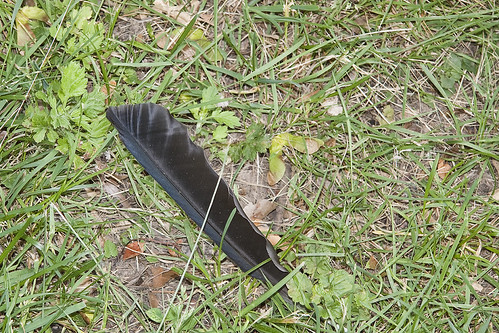
This time around, the feathers scattered around were black, and completed rather than shredded. The quills were also still attached.
from wikipedia
Madonna Oriente or Signora Oriente (Lady of the East), also known as La Signora del Gioco (The Lady of the Game), are names of an alleged religious figure, as described by two Italian women who were executed by the Inquisition in 1390 as witches.
The story which they are reported to have told is an elaborate and fantastical tale of occult religious rituals practised at the houses of wealthy individuals in Milan, Italy, where a woman known as the Madonna Oriente, possibly regarded as a goddess by her followers, performed magical acts such as the resurrection of slaughtered animals.
The two women, Sibilla Zanni and Pierina de’ Bugatis, were brought before the Inquisition first in 1384, and with their story apparently dismissed as fantasy, were sentenced only to minor penance. When they were investigated again in 1390, however, they were charged with consorting with the Devil, condemned, and executed.
While there is no evidence that the organized group described by the women actually existed, their testimonies are remarkably similar to those of several other groups in Italy and greater Europe, such as the followers of Richella and ‘the wise Sibillia’ in 15th century Northern Italy, the Benandanti of 16th and 17th century Northern Italy, the Armiers of the Pyrenees, the Romanian Căluşari, Livonian werewolves, Dalmatian kresniki, Hungarian táltos and Caucasian burkudzauta.
– photo by Mitch Waxman
The last batch of feathers observed were white, and suggested plucking. These were large and dark in color. I shot off the camera flash on the above shot, in the hope that certain ornithological enthusiasts known to be Newtown Pentacle readers might hazard an attempt at classification.
from wikipedia
The pregnancy of Coatlicue, the maternal Earth deity, made her other children embarrassed, including her oldest daughter, Coyolxauhqui. As she swept the temple, a few hummingbird feathers fell into her bosom. Coatlicue’s fetus, Huitzilopochtli, sprang from her womb in full war armor and killed Coyolxauhqui, along with her 400 brothers and sisters. He cut off her limbs, then tossed her head into the sky where it became the moon, so that his mother would be comforted in seeing her daughter in the sky every night.

– photo by Mitch Waxman
The main ritual focal remains the same, but candles and offerings have been altered from previous months. The candles are red and purple, and there are two cigars.
from wikipedia
Moon magic is the belief that working rituals at the time of different phases of the moon can bring about physical or psychological change or transformation. These rituals have historically occurred on or around the full moon and to a lesser extent the new moon. Such practices are common amongst adherents of neopagan and witchcraft systems such as Wicca. Witches in Greek and Roman literature, particularly those from Thessaly, were regularly accused of “drawing down the moon” by use of a magic spell. The trick serves to demonstrate their powers (Virgil Eclogues 8.69), to perform a love spell (Suetonius Tiberius 1.8.21) or to extract a magical juice from the moon (Apuleius Metamorphoses 1.3.1). These beliefs would seem to be consistent with many other cultures traditions, for instance; casting of the i ching is often done during the full moon’s apex.

– photo by Mitch Waxman
One cigar is approximately in the same position as the last one was, on April 30th.
this link from wikipedia actually refers to Santeria, which is not what I think we’re seeing here, but the spirit of it is correct
“The colonial period from the standpoint of African slaves may be defined as a time of perseverance. Their world quickly changed. Tribal kings and families, politicians, business and community leaders all were enslaved in a foreign region of the world. Religious leaders, their descendants, and the faithful, were now slaves. Colonial laws criminalize their religion. They were forced to become baptized and worship a god their ancestors had not known who was surrounded by a pantheon of saints. The early concerns during this period seem to indicate a need for individual survival under harsh plantation conditions. A sense of hope was sustaining the internal essence of what today is called Santería, a misnomer for the indigenous religion of the Lukumi people of Nigeria.
“In the heart of their homeland, they had a complex political and social order. They were a sedentary hoe farming cultural group with specialized labor. Their religion based on the worship of nature was renamed and documented by their masters. Santería, a pejorative term that characterizes deviant Catholic forms of worshiping saints, has become a common name for the religion. The term santero(a) is used to describe a priest or priestess replacing the traditional term Olorisha as an extension of the deities. The orishas became known as the saints in image of the Catholic pantheon.” (Ernesto Pichardo, CLBA, Santería in Contemporary Cuba: The individual life and condition of the priesthood)
As mentioned, in order to preserve their authentic ancestral and traditional beliefs, the Lukumi people had no choice but to disguise their orishas as Catholic saints. When the Roman Catholic slave owners observed Africans celebrating a Saint’s Day, they were generally unaware that the slaves were actually worshiping their sacred orishas. In Cuba today, the terms “saint” and “orisha” are sometimes used interchangeably.

– photo by Mitch Waxman
The second was inserted into the “Gran Poder” red candle.
from wikipedia
A classic Quimbanda ritual, called a trabalho, consists of several parts: a motive, dedication to a spirit, a marginal location, the metal or clay (earthy) material, an alcoholic drink, scent, and food (usually a peppered flour-palm oil mixture, sometimes called miamiami). An example of a trabalho is as follows:
Trabalho 1: ” A work of great force, under the protection of [Exu] Tranca Ruas das Almas (Block-Streets-of-the-Souls), to eliminate an enemy. “
- Go to a crossroads of Exu on a Monday or Friday near midnight, if possible in the company of a member of the opposite sex;
- greet Ogum with a bottle of light beer, a white or red candle, and a lighted cigar;
- greet Exu Sir Block-Streets-of-the-Souls by opening seven bottles of rum (cachaga) in the form of a circle, lighting seven red and black candles, and offering seven cigars;
- put inside a vase (alguidar) and mix the following: manioc flour (farinha da mesa), palm oil (azeitede-dendd), and peppers;
- put on the ground in the middle of the circle the name of the person whom one wishes to hurt, and, using a knife, stab this with violence, asking Exu to attend to one’s request.”
Depending on the purpose of the ritual, aspects of the trabalho will change. For instance, if one desires to seek justice from Exu they will use white candles, rum and a written request. Therefore, certain colors denote different motives in a ritual: white symbolizing an honest and justice-bound motive and red and black representing an aggressive and illicit motive. Other rituals substitute the harsh or spicy smell of cigars for the sweet smell of carnations, thus symbolizing the transformation between harming and helping rituals. Likewise, rituals involving female spirits (Pomba Giras) are less aggressive in their performance. A trabalho to obtain a woman is as follows:
Trabalho 7: “to obtain a woman. “
On a Monday or Friday night, go to a female crossroads (T-shaped rather than plus-shaped) and greet Pomba Gira by pouring a little rum, ” or better yet, champagne or anisette (aniz)”;
- place two pieces of cloth (pano) on the ground, one red and the other black, and on top of this put five or seven red roses in the shape of a horseshoe;
- fill a cup of good quality with champagne or aniz;
- put the name of the desired person in the cup or in the middle of the horseshoe;
- sing a ponto (song) and thank Pomba Gira.

– photo by Mitch Waxman
The purple candle had melted out, its wax incorporating into the loam.

– photo by Mitch Waxman
On the other side of the hill, flies were buzzing about this tumbled stone. There seemed to be some kind of carbonized “stuff” on it, almost a greasy smear of ash.
Crimes typically associated with ritual violence include: trespassing, vandalism, church desecration, theft, graffiti, arson, extortion, suicide, kidnapping, ritual abuse, animal sacrifice, and ritual murder. Trespassing related to ritualistic crime usually involves persons entering private areas such as woods, barns, and abandoned buildings for the purpose of having an isolated place to worship. Since most occult theologies are nature based, rituals are frequently held outdoors and altars are often constructed of natural elements. Vandalism most often associated with occult crime includes cemetery and church desecration. The most common types of cemetery desecration attributed to occult groups are digging up graves, grave robbing, and tampering with human corpses or skeletons. This is frequently motivated by religious beliefs that require human bones to fulfill specific rituals. Church desecration frequently includes destroying Bibles, urinating and defecating on holy objects and furniture, tearing crucifixes off walls, and destroying rosaries and crucifixes. It is important to note that the motivations behind such vandalism can also be attributed to hate crimes. Thefts from Christian churches, Jewish synagogues, hospitals, morgues, medical schools, and funeral homes are often linked with ritual violence. Items that are most often taken include cadavers, skeletal remains, blood, and religious artifacts that are considered sacred: crucifixes, communion wafers, wine, chalices, and so on. Frequent motivations for these thefts are that particular groups require actual holy artifacts or human organs, bones, and the like for their rituals.

– photo by Mitch Waxman
The material on its surface was vegetable in nature, but it was stuck to something whose adhesive qualities were strong enough to resist strong breezes and attract a number of largish black and green flies.
from nypost.com
Two of Queens’ largest parks are hotbeds for animal sacrifices, according to park rangers and advocates.
Longtime Parks Department ranger Joe Puleo told The Post that killing animals for ritualistic reasons in the city is widespread, but that Forest Park and Highland Park are the most common locations.
Perpetrators of the outlawed act are rarely busted because they perform their bloody rituals in the dead of night, and the two parks no longer have 24-hour patrols due to budget cuts.
“They are never caught, because they are careful, and they never do it during the day. They do it at night when no one is around,” Puleo said.

– photo by Mitch Waxman
Lords and Ladies of Newtown, there is a hidden cult at work amongst you, amongst the moon shadowed tomb legions of Astoria.
12 stations of the Newtown Pentacle
It’s wonderful to be here, It’s certainly a thrill. You’re such a lovely audience,
We’d like to take you home with us, We’d love to take you home.
I don’t really want to stop the show, But I thought that you might like to know,
That the singer’s going to sing a song, And he wants you all to sing along.
Sgt. Pepper’s Lonely Hearts Club Band (Lennon/McCartney)
Its been a fascinating 12 months, Lords and Ladies, and I believe that I’ve stayed on mission at this one year anniversary of this blog. 270 posts, in case you were wondering, some large others small. The blog itself has received a little over 43,000 views and the photos the posts are based on at flickr have been witnessed some 76,577 times. Not bad, and both sets of gross statistics are growing on a nice curve. The number 1 post, historically, is Newtown Creek Waste Water Treatment Plant .
Here’s a few of the Newtown Pentacle’s greatest hits, which are not “by the numbers”:
from the very first posting of May 29, 2009:
What is “The Newtown Pentacle”?
The colonial era towns of Greenpoint, Brooklyn and the Queens towns of Astoria, Ravenswood, Hunter’s Point, Bowery Bay, and Middletown were called Newtown in Dutch and English times. In the early 19th century, the Queens villages combined to form Long Island City. The industrial center of the area was and still is Newtown Creek. The most polluted body of water on earth, this ancient inlet was once home to the Maspaetche Indians. Dutch Orchards and English farms gave way to Yankee rail and then Standard Oil as time went by. Today, its waters are a curious shade of copper green, and the largest oil spill in history gurgles back and forth through deep subterranean channels between Green Point and Long Island City. The architecture of the place is disturbingly heterogeneous. A rough tumble of styles are represented in this area — 19th century wrought iron row houses predominate, but 18th century warehouses are still on active duty in some places. Near Hunter’s Point and in Old Astoria, Antebellum mansions abut hideous Le Corbusier-influenced modernism. To the south and the east can be found some of the most interesting stone work in New York City as one explores the cemetery belt along the Brooklyn and Queens border.
Three million New Yorkers lie in Calvary cemetery alone. In this, the Necropolis of New York City, the living population of Queens is outnumbered three to one.
After a health scare a couple of years ago, my doctors recommended a course of clean living and regimen of physical exercise as the best curative. An amateur antiquarian and connoisseur of odd information, I elected to use my prescriptive exertions as an opportunity to explore and record. I toured crumbling Long Island City, the tree lined lanes of Victorian Astoria, and rusty coastlines of foetid Newtown Creek. Headphones on, camera in hand. The journey has taken me to many odd and forgotten places, and led me to discover a fascinating group of people. Follow me on these long walks, I promise you’ll see something amazing.
from June 4, 2009
The Night Soil and Offal Docks, and Jell-O
Not Furmans Island, but pretty close by in 2008

I was seeking out some information on a shunned 1960′s religious group which had headquartered at a disused 19th century Satmar Yeshiva (which burned to ash in 1973) over on the Greenpoint side when I read about “Conrad Wessel’s noxious and pestilential night soil and offal dock on Furman’s Island, along the Newtown Creek”. This reference was connected to Gov. Flower’s “smelling committee” which traveled up Newtown Creek in a steamboat during the summer of 1894 to confirm that the waterway did, in fact, smell. The Smelling Committee placed much blame for the miasma which permeated Long Island City, Dutch Kills, and Greenpoint at the doorstep of the bone boilers on Furman’s Island.
from July 16th, 2009

-photo by Mitch Waxman
Just off the corner of Steinway is 38-13 Northern Blvd. It stands opposite the cyclopean Standard Motor Products building, and at the foot of the bridge which carries Steinway into 39th street and south to Skillman Avenue over the Sunnyside Yards. Currently, the structure houses part of the NYPD’s ESU units- the Emergency Medical Squad. The building was originally a firehouse- the Hook and Ladder 66.
The earliest volunteer fire company in Newtown was organized in 1843- the Wadownock Fire, Hook & Ladder No. 1. By 1902, there were 66 distinct volunteer fire departments in Queens. 19th century Long Island City was served by (amongst others) the Astoria Engine Co., the Hunter Engine Co., the Mohawk Hose Co., and the Tiger Hose Co. In 1890, the legislature of New York State abolished the volunteer departments, seeking to create a paid and professional force of firefighters. In Long Island City, as many as nine units were created, and then reorganized in 1894, as rampant political corruption had rendered the new units impotent against all but the smallest blazes. This corruption was centered around Long Island City’s mayor- Patrick “Battleax” Gleason- or was at least blamed on him by his enemies in the press.
The critical date for this story is 1898, when Long Island City joined in the municipality of the City of Greater New York, and its firefighters joined the FDNY.
from August 12th, 2009
The Terracotta House, or… what is that?

New York Architectural Terra-Cotta Works, LIC -photo by Mitch Waxman
After an apocalyptic fire in 1886, the New York Architectural Terra-Cotta Works needed a new headquarters. One that befit its role as the preeminent manufacturer of architectural ceramics.
Built in 1892 as an office for the company that supplied terra-cotta for Carnegie Hall and the Ansonia Hotel, among others. The company went out of business in the 1930s, and the building became vacant. It was eventually bought in 1965 by Citibank. Its ruins can be found at 42-10 – 42-16 Vernon Avenue, across the street from the sumptuous hedonism of the newly opened Ravel Hotel, and next door to the venerable and recently feted span of the Queensboro Bridge. It was landmarked in 1982.
Two and one half stories, the structure is actually the front office of an industrial complex that was once surrounded by a 12 foot high wall of brick, which enclosed an open storage yard, a 5 story factory, and the kilnworks one would expect to find at such a large endeavor. Its satisfying design was crafted by Francis H. Kimball, architect of the celebrated Montauk Club in Brooklyn, and it is in the Tudor Revival Style.
from September 12th, 2009

Grand Street – North East – photo by Mitch Waxman
Gaze upon the coils of the dragon and despair.
Scuttling like some Kafkaesque cliche’– away from those tremulous revelations manifested just up the street in DUMABO– at the Metropolitan Avenue Bridge over the English Kills- around soiled patches of broken pavement and across a sandy substrate of glittering and powderized glass- between towering fencelines whose attendant armies of guardian birds voicing their mocking cry of “Ia, IA” or “tekeli-li” – the Grand Street Bridge is suddenly risen above the Newtown Creek’s miasmic banks- and your humble narrator falls unabashedly to the tainted ground before it. This is a standing stone, an ancient artifact, and like the Greenpoint Avenue Bridge– an urban talisman of those days when the Tiger came to the Newtown Pentacle.
from October 15th, 2009
Newtown Creek Waste Water Treatment Plant
LO… Behold and tremble, for the Newtown Pentacle is back in session.

– photo by Mitch Waxman
A fitting temple has been erected to an ancient goddess by the redoubtable engineers of the DEP, a shining secular cathedral which looms over storied Greenpoint, this is the Newtown Creek Wastewater Treatment Plant (referred to as the NCWWTP from this point on), whose guarded interiors were revealed to an eager public via the auspices of the 2009 Open House New York event.
from November 13, 2009
Tales of Calvary 4- Triskadekaphobic Paranoia

– photo by Mitch Waxman
Near the crest of one of Calvary Cemetery’s hills, can be found what I’ve described in previous posts as “a tree that is fed by some morbid nutrition”.
A convenient afternoon vantage point for photographing the Johnston mausoleum and a frequent destination, a Hallowmas (nov. 1) stroll through Calvary revealed some interesting goings on beneath the swollen boughs of this loathsome landmark.
note: I returned the following Sunday (nov. 7) for further observations, to this alien vista of titan blocks and sky flung monoliths.
from December 1, 2009
Mt. Zion 1 – imps of the perverse

– photo by Mitch Waxman
What would appear to be a Jewish section of the vast funerary complex that is 2nd and 3rd Calvary Cemeteries, is actually a distinct cemetery organized as and referred to as Mount Zion.
It made a convenient hiding spot for me one day when a group of children on Maurice Avenue took notice of me and began to follow me around. The possibility of some vaguely malign intention toward me, on their part, caused a near faint and I ran away- here’s what happened.
Narrow, juvenile faces, their appearance and aspect were dominated by a toothy grimace- much wider than the usual proportion- and oddly jowled chins. The corners of their mouths stretched to mid cheek and passed well beyond the bulging center point of those widely set and unblinking milky blue eyes- which I attribute to the possibly mutagenic qualities of the chemical pollution of that nearby extinction of hope called the Newtown Creek.
A little girl amongst them, barefoot and carrying a polydactyl calico which was buzzing with attention, pointed me out and all the other odd looking children turned and stared in my direction. A vast physical coward, and unable to withstand even the thought of defending myself against a crowd of 10 year olds, your humble narrator screamed a shrill shriek and broke into a clumsy run to make an escape to hallowed ground.
from January 31st, 2010

Queensboro Bridge and associated structures- “The Great Machine” – photo by Mitch Waxman
Queensboro, whose steel has cantilevered the flow of traffic to the shining city from the fabled vastness of the Long Island since 1909, is merely the focal point of a polyglot mechanism whose works spread into the east. The backbone of New York City runs through the marshy hillocks of western Queens.
As I’ve said in the past:
Airports, railroad yards, maritime facilities, petrochemical storage and processing, illegal and legal dumping, sewer plants, waste and recycling facilities, cemeteries. The borders of the Newtown Pentacle’s left ventricle are festooned with heavy industry and the toll taken on the health of both land and population is manifest. A vast national agglutination of technologies and a sprawl of transportation arteries stretching across the continent are all centered on Manhattan- which is powered, fed, and flushed by that which may be found around a shimmering ribbon of abnormality called the Newtown Creek.
Light rail (subway) and vehicle traffic focus toward Queens Plaza, and within a three mile radius of this place can be found- the East River subway tunnels, the Midtown Tunnel, multiple ferry docks, and the titanSunnyside Rail Yard which connects to the Hells Gate Rail Bridge. This “Great Machine” is the motive engine that allows millions to enter and leave Manhattan on a daily and reliable schedule from North Brooklyn, Queens, Suffolk and Nassau Counties. The great endeavor called “The East Side Access Project” and its associated tunneling is also occurring nearby, which will terminate at a planned LIRR station sited for the corner of Queens Blvd. and Skillman Avenue.
from February 6th, 2010

Red Crow van spotted – photo by Mitch Waxman
Returning from a trip to Third Calvary Cemetery the other day (searching for Gilman) to my Astoria, I came across this red van with a disturbingly heterogeneous collection of mattresses affixed to it. This red van is a familiar sight around the neighborhood, personal conveyance of a Crow. For clarity and codification lords and ladies, this gentleman shall be referred to as “Red Crow”, here at your Newtown Pentacle.
from March 15th, 2010

– photo by Mitch Waxman
He died alone, squirming in agony, surrounded by strangers. His last friend and only true colleague had recently used a colt handgun to commit suicide, and the only woman he ever loved had left him years ago. Instead he lay there alone in the charity ward- dying in anonymity and pain as his parents had. An orphan raised by matron aunts who indulged and spoiled the strange child who came to them in their dotage- they left him unprepared for adulthood. He retreated into his letters, wrote his stories, and never knew he would live on in the dreams of the sensitive and artistic forever more.
Just 14 months previous to his death, the newspapers detailed the lurid crimes of Albert Fish- the Gray Man, the Werewolf of Wysteria, the Brooklyn Vampire, The Boogeyman– who was executed at SingSing. The good old days, indeed.
from April 3rd, 2010

– photo by Mitch Waxman
Note: One of those things that your humble narrator is guilty of is a tendency, when confronted with something alien or unknown, to “fill in the blanks” via an inexact mixing of logical supposition and impressionist reasoning. The opposite of exactitude, this can result in wild ideas and false assumptions being presented and accepted as fact. I would love to tell you which cultic group these artifacts belong to- but the fact is that I just don’t know. Certain assumptions can be hazarded, based on cursory resemblance and observed phenomena, but they will be guesses. Don’t assume my interpretation of things is correct.
Witness, then, what I observed in St. Michael’s Cemetery on the Saturday before Easter- April 3rd, 2010- right about here.
from May 22, 2010

– photo by Mitch Waxman
This is not a dead place, this Creek which forms the currently undefended border between much of Brooklyn and Queens, despite wholly inaccurate statements to the contrary recently presented by major publications. To begin with, there is the teeming human infestation, whose population is in the millions. Additionally- migratory birds, invertebrate and vertebrate water fauna, and an enormous hidden population of higher mammals lurk amongst the canalized shorelines of the Newtown Creek.
from the nytimes.com– an article that gets a lot of things completely wrong, which is surprising for the times, and seems to be shilling against “Big Oil”
People don’t often think of urban creeks as biodiverse waterways, but Newtown Creek was once a rich tidal estuary popular among hunters and fishermen. Starting in the 1870s, however, Standard Oil and other refineries began spilling or dumping excess fuels and toxic chemicals into the water or onto the soil, slowly poisoning the ecosystem.
We are just getting started, Lords and Ladies, on this very bumpy ride through the realities of the Newtown Pentacle.
Who can guess…

– photo by Mitch Waxman
Hatches abound in the Newtown Pentacle, dimly lit tunnels to another world. On the surface- logo, design, manufacturers marks- all indicate the existence of former incarnations of the City. The BSBQ identifier on the one above means that it was installed by the Bureau of Sewers, Borough of Queens, and I saw it in ancient Maspeth.
an incomplete list from wikipedia
This is a list of manhole cover markings found in New York City.
- Bell System
- BMT = Brooklyn-Manhattan Transit Corporation
- BRT = Brooklyn Rapid Transit
- BSBQ = Bureau of Sewers, Borough of Queens
- CT&ES Co. = Consolidated Telegraph & Electrical Subway Company
- ConEdison = Consolidated Edison
- Con Edison Co. = Consolidated Edison
- ECS Co. LIM = Empire City Subway Company Limited
- EDISON = Edison
- FDNY = FDNY
- GAS = Brooklyn Union Gas
- IRT = Interborough Rapid Transit
- LIC = Long Island City
- NYM = New York Municipal Railway
- QMT = Queens Midtown Tunnel
- RTS = Rapid Transit System
- NY&QEL&PCo = New York & Queens Electric Light & Power Company
- BPM = Manhattan Borough Monument

– photo by Mitch Waxman
This is the lid of a coal chute, found on Broadway in Astoria. A near identical model was shot by Kschlot1 at flickr, check it out. This kind of relict is actually the origin of one the mottos here at Newtown Pentacle- Who can guess, what else there may be, that might be buried down there?
from good.is
The Knickerbocker sewer is a 12-foot wide intestinal tract that runs beneath the streets of Brooklyn. Flashlight beams falter at 50 feet against the tunnel’s swirling vapors. Wading knee-deep through the bacterial wash, it’s difficult not to imagine what, exactly, constitutes the inches of silt between the sole of one’s rubber boot and the sewer floor. It is here, where the city breathes and belches, where Steve feels most at home.
As he wades upstream one winter night, he runs his hand along the sewer’s red masonry walls, a 120-year-old vestige of a time when New York was a city built in brick. Duncan is wearing hip-high rubber boots, a headlamp and a respirator to protect him from the fumes. He also brought his tripod, a camera bag and Shane Perez, a 26-year-old photographer with a mohawk, whose personal interest in urban exploration centers on shooting nude women in abandoned industrial plants.

– photo by Mitch Waxman
Commonly referred to as manhole covers by everyday New Yorkers, these iron plates can serve as guideposts to the hidden underworld and occluded past. Often, wonderings of this underground system and all that which might dwell in the sunless depths below our great human hive spark moments of terror in your humble narrator. This one is from Ridgewood, incidentally.
from nytimes.com
For decades, city workers and contractors who want to make any change to New York’s vast water and sewer networks have had to retrieve browning maps, drawn by draftsmen and stored away in each borough hall and the department offices in Queens. To help them find the sewer and water main maps — some dating back to the Civil War — city clerks have had to consult indexes, created by each borough before the city was unified in 1898. The maps were cataloged on 3-by-5-inch cards.
roadside shrine

– photo by Mitch Waxman
The Brooklyn Queens Expressway rudely occludes the sky at Laurel Hill Blvd. and 58th street in Queens, drowning the ancient lane in supernal shades. The Boulevard transits through the hallowed ground of Calvary Cemetery, between the second and third sections. Often I’ve wondered if the street itself is on hallowed ground.
from encarta.msn.com
hal·lowed [ hállōd ]
adjective. Definition:
- sanctified: holy or kept for religious use- buried in hallowed ground
- respected: regarded with great respect or reverence- the hallowed pages of our country’s history

– photo by Mitch Waxman
A cool and breezy place, as the eye of god itself never shines upon this asphalt, it is a route I favor when returning from sojourns in Maspeth or East Williamsburgh to the remote and troubled hillocks that my beloved Astoria is arrayed upon.
from nycroads.com
SERVING INDUSTRIAL AND DEFENSE NEEDS: In 1940, New York City arterial coordinator Robert Moses recommended that the road, which he saw as a gap in the metropolitan arterial system, “should be filled immediately as an aid to the national defense.” He went on the make the following case for the expressway:
In 1940, Robert Moses recommended that the road, which he saw as a gap in the metropolitan arterial system, “should be filled immediately as an aid to the national defense.” He further went on as follows:
With the completion of through arteries under construction in Brooklyn and Queens, more traffic will be funneled into the Williamsburg and Manhattan bridges than the streets tapping these bridgeheads can carry. The present streets are narrow and congested, with crossings at every block. The crazy quilt pattern of the streets inherited from the villages that grew together to form the present borough adds to the difficulty of travel.
This proposed artery should be built for six lanes of express traffic, separated for most of its length from service roads by malls. It is estimated that construction will cost $5,100,000. This project would require the acquisition of land assessed at approximately $7,000,000, and utilize city-owned property assessed at $345,00

– photo by Mitch Waxman
Encountering a roadside shrine is always an interesting experience, and such tributes are normally found at or near the site of a vehicular accident that claimed lives. In this case, the evidence presented would seem to indicate that 3 men in their 20’s died here- named Tommy, Arturo, and Eric according to the graffiti- although police reports differ from the scrawls on the name of the third man and call him Pedro.
Apparently, the accident occurred nearly one year ago, and made the news at NY1 and at ABC.
from forumnewsgroup.blogspot.com
Three men died last Thursday night when their car slammed into a concrete barrier on Laurel Hill Boulevard after skidding across the road. Police say the driver lost control of his 1992 Volvo while trying to pass another car at a high rate of speed.
A bottle of vodka and small amount of cocaine were later found inside the obliterated car, according to Deputy Inspector Thomas Kavanagh, commanding officer of the 108th Precinct. There was a witness to the crash, which happened at about 10:30 p.m. near 58th Street, where the boulevard runs beneath the expressway and through the cemetery.
The driver, 26-year-old Pedro Sanchez of Brooklyn, and his two passengers, Thomas Owens and Eric Sanguenette, both 27 of Woodside, were pronounced dead at Elmhurst Hospital.

– photo by Mitch Waxman
Increasingly common in the last decade, such roadside shrines have been commented on before at this- your Newtown Pentacle. Another tragic accident that snuffed out young lives due to automotive excess was discussed in the post “A shrine in Greenpoint“.
from usatoday.com
Once an occasional sight along the nation’s highways, roadside memorials have sprouted in recent years like wildflowers after spring rains. There were 42,800 traffic fatalities in the USA last year. No statistics exist on memorials, though one national survey this year by the Maryland Department of Transportation estimates markers are erected after 10% to 20% of fatal crashes.
Family and friends increasingly want to mark the spot, and that can be a problem for everything from motorist safety to road maintenance to those who oppose religious symbols on public land.

– photo by Mitch Waxman
Newtown Pentacle, on behalf of our readers, offers our sympathies to the family and friends of the occupants of the car.
from wikipedia
Roadside memorials have been placed for centuries.
The origin of roadside crosses in the United States has its roots with the early Hispanic settlers of the Southwestern United States, and are common in areas with large Hispanic populations. Formerly, in funerary processions where a group would process from a church to a graveyard carrying a coffin, the bearers would take a rest, or “descanso” in Spanish, and wherever they set the coffin down, a cross would be placed there in memory of the event. The modern practice of roadside shrines commemorate the last place a person was alive before being killed in a car crash, even if they should die in the hospital after the crash.
In the southwestern United States, they are also common at historic parajes on old long distance trails, going back to the roots of the tradition, and also marked the graves of people who died while traveling. A descanso may be decorated specially for the holidays, and for significant anniversaries in the person’s life. A descanso for a child may be decorated with special toys, even toy vignettes of family life, and votive candles may be placed there on special nights.


