Posts Tagged ‘Pickman’
City of Marble and Beryl

– photo by Mitch Waxman
Note: One of those things that your humble narrator is guilty of is a tendency, when confronted with something alien or unknown, to “fill in the blanks” via an inexact mixing of logical supposition and impressionist reasoning. The opposite of exactitude, this can result in wild ideas and false assumptions being presented and accepted as fact. I would love to tell you which cultic group these artifacts belong to- but the fact is that I just don’t know. Certain assumptions can be hazarded, based on cursory resemblance and observed phenomena, but they will be guesses. Don’t assume my interpretation of things is correct.
Witness, then, what I observed in St. Michael’s Cemetery on the Saturday before Easter- April 3rd, 2010- right about here.

– photo by Mitch Waxman
In St. Michael’s, there is a hill which faces East and whose tombstones are very old. The graves are in a state of disrepair, and the stones are found to be in a ruined state. This is no fault of the Cemetery, which maintains its grounds in a meticulous fashion, instead it is merely time and weather which have worked their havoc on the monuments. Perambulating through the grounds on Saturday with Our Lady of the Pentacle, we found this scene.

– photo by Mitch Waxman
A variety of Afro-Cuban syncretic faiths use similar iconography, but the one which most of the english speaking community is passingly familiar with is called Santeria (aka Regla de Ocha, La Regla Lucumi, or Lukumi). This appeared to be Santeria to me at first- because of the particular color scheme of the candles (red white and blue) and the co-mingling of coinage and sacrificial bones. But the Santeria folks generally do their thing indoors, in a ritual space consecrated and blessed by their own padrinos, just like the Catholics. Graveyards are usually avoided for rituals as they are negative places.

– photo by Mitch Waxman
My observation has been that the local latino populations in Astoria tend to be South rather than Central American, and the geographic heritage of Santeria is Caribbean and Central American. Afro-Cuban religion sprang up amongst the African Slaves brought to the New World to work the sugar and tobacco fields who were forced to adopt Roman Catholicism. Voodoo in Haiti and Louisiana, Hoodoo in the American South- all products of the French empire- with Santeria, Obeah, and Palo progeny of the Spanish.
The other great Catholic nation that held huge numbers of west africans as livestock was Portugal, and it did so in Brazil- where Umbanda, Candomblé, Macumba, and Quimbanda originate. Brazil is in South America, of course, and there are tremendous populations of Brazilians living nearby St. Michael’s in surrounding Astoria. This is some of that logical supposition I warned you about…

– photo by Mitch Waxman
Folk magic sites like this raise the ire of Eurasian morals, as ritual animal sacrifice is kept out of sight in our modern communities, and commoditized as Kosher or Halal or Organic meat. Blood sacrifice and submission to cultural norms, from circumcision to ear piercings to the elaborate face paint called “cosmetics”, are part of our daily lives. This sort of visceral aftereffect of some unfortunate avian’s end, however, is disturbing. No less though, than a crucifixion or any other blood ritual.

– photo by Mitch Waxman
One of the many ridiculous totems tucked away in my jacket pocket is a small magnetic compass. When I began these long walks around what I would someday call the Newtown Pentacle, it served me well, and today it revealed that this ritual space was lined up exactly on the cardinal points of my trusty little friend.
The scattering of bottles, bones, coins, and candles sits east of the stone which is aligned north south in the long dimension, and its anterior face is west facing. This will become increasingly important.
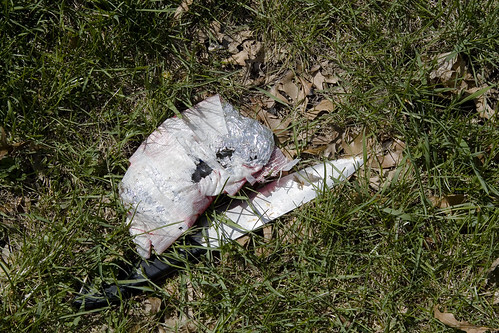
– photo by Mitch Waxman
This little package and knife are north east of the monument which I’ll be referring to as an altar. I did not open it, of course, it is against Newtown Pentacle policy to actually touch any of the odd things I come across, like the Pulaski Bridge, with bare skin. This whole neighborhood could use a good scrub, if you ask me.

– photo by Mitch Waxman
As always, if you click any of these images- a new window will open up its Flickr Page. Clicking the “all sizes” button found there will take you to progressively larger incarnations- all the way up to “actual pixels”. Check these out, I’ve spent some time trying to figure out what’s inside of the package. Do any of you sharp eyed Ladies and Lords of Newtown out there wish to hazard a guess? Use the “leave a comment” link.

– photo by Mitch Waxman
Seeing the blade and little kidney shaped package gave the whole scene a somewhat sinister air, and that’s when I remembered to check what else might be found on the cardinal meridians of the compass.

– photo by Mitch Waxman
The western facing of the altar sits at the pinnacle of a muddy ridge, which bears much subsidence. The underpinnings of the stone, and declination of the hill itself, fall away rapidly. These candles were observed.

– photo by Mitch Waxman
Nothing special about one of them, the other was unusual. Both red.

– photo by Mitch Waxman
The west facing side of the scene, from the bottom of the little hill. Note the tumbled and disorganized state of the masonry. North is to your left, south to the right.

– photo by Mitch Waxman
Moving north, a white candle .

– photo by Mitch Waxman
Back on top of the hill, directly east of the white candle above, and north of the main altar.

– photo by Mitch Waxman
A green and a pink candle on a dish of “some quality”.

– photo by Mitch Waxman
West of altar, a tumbled monument, with odd etchings on it. Can this be some sort of language?

– photo by Mitch Waxman
South of altar, west side of hill, a plastic bottle with some sort of red/brown liquid in it.

– photo by Mitch Waxman
Notice that the ground is depressed here, as if something very heavy- like a tombstone- had been moved recently.

– photo by Mitch Waxman
Just at the other end of the divot was this foil wrapped bottle which looked like it had been in the ground for a long time. Notice how the moss grows right up to it.

– photo by Mitch Waxman
Top of hill, south side, looking north across site. There are feathers scattered around the grass, mainly just north of the altar. Click here for a flickr page which shows some detail of the feathers.

– photo by Mitch Waxman
There was also this upside down cross.
Update on the Calvary Knots

– photo by Mitch Waxman
The first thing I would say is that the name on the card does not match those on the monument. The second would be to ask you to read through this posting- Tales of Calvary 4- Triskadekaphobic Paranoia from November of 2009 which describes this odd arrangement in some detail. In the comments thread at that post, please take note of a former Calvary employee’s possible explanation of what is going on here. Third, here’s the latest addition to the knots, a mass card which has appeared just at the outset of spring.

– photo by Mitch Waxman
Despite the intervening brutalities of a New York winter, the knotted cords and stick persisted in their intended places, as evinced above. Realize, of course, that the equinoxes mark special dates on the magickal calendar and cultic activity is ripe at the quarters of the solar and lunar cycle- both Passover and Easter fall near the equinox, for example. At these times of year, if you seek- ye shall find.

– photo by Mitch Waxman
I’m not certain, however, what significance a mass card carries. Not being an adherent of the Roman Catholic religion, I’ve nevertheless purchased them when friends and associates have suffered a loss, and offered them up to grieving families. My assumption has always been that they represent some sort special devotion or ceremony which will be performed by the priestly caste, but I remain ignorant of their purpose. As mentioned above, however, the names on the monument do not match the one on the mass card.
I’m keeping an eye on this “tree fed by a morbid nutrition” here at the ossified heart of the Newtown Pentacle in Calvary Cemetery.
And don’t miss tomorrow’s post, which discusses additional weirdness found at St. Michael’s Cemetery just this past weekend.
Newtown Creek, and the Mountains of Madness

– photo by Mitch Waxman
A Friday, on March 19th the Hermetic Hungarian had left his laboratory workshop (a set of rooms on Manhattan’s decadent Upper West Side where he is exploring the deeper meanings and implications of esoteric 19th century clockworks) and ventured forth to Newtown.
The Hermetic Hungarian, referred to as HH from this point on, is a pale and sickly genius who has been intrigued by the presence of certain atavist religions and the persistence of modern adherents to these sects who remain extant along the poison shores surrounding an ancient industrial center called the Newtown Creek. HH had procured an automobile for the day’s exertions- as his fragile health precludes him from the long walks favored by your humble narrator which are so pedantically detailed at this- your Newtown Pentacle.

– photo by Mitch Waxman
Returning from a day of exploration, which first described the extensive branching of the transportation network referred to as “The Great Machine“, we proceeded to the currently undefended border of Maspeth and storied Greenpoint and crossed the Grand Avenue Bridge. HH was searching for evidences of a grandiose clockwork mechanism which long hours of research and supposition have led him to believe existed in the days of Trolley and Rail. Influenced by his metaphysical beliefs, which are both Hasidic and Buddhist in nature, the HH’s itinerary required his trip to be brief- and after spending an afternoon exploring the ancient climes of Newtown, Bushwyck, and Greenpoint- and we headed back toward a transportation artery that would allow him egress back to the Shining City and his hierophant isolations.

– photo by Mitch Waxman
On our return, the bascule mechanisms of the Pulaski Bridge suddenly sprang to life, allowing egress to the Newtown Creek for shipping. The first watchtower on the Creek, the Pulaski is also the busiest of its bridges. While traffic on the Newtown Creek is a shadow of what it once was, there is still a significant industrial presence on the maritime highway that requires connection with the vast enterprises of New York Harbor- especially the petrochemical empires that line the shores of the Kill Van Kull in distant… Staten Island. Additionally the car shredders and other recycling facilities, which bless Newtown with their labor, utilize barges to move their wares to distant customers.

– photo by Mitch Waxman
In this case, it is the petrochemical shipping industry which commanded the opening of the Pulaski Bridge, as evidenced by the appearance of the DBL 28 fuel Barge, a 28,000 BBL double hull tank barge (which conforms to the Oil Pollution Act of 1990’s requirements- no mean feat) which was built in 2006 and weighs some 2,146 gross tons.
from allbusiness.com
The 28,000 bbl capacity DBL 28 measures 297.6-feet in length, with a 54-foot beam and 13-foot depth. The DBL 28 is the first of a series of eight units currently in production at BMF for K-Sea. DBL 28 is coupled with an existing K-Sea tug using the state-of-the-art Beacon JAK 200 tug/barge Push-Pin coupler system, which is designed to increase operating efficiency and enhance safety and reliability by operating as a dual mode ITB. The series of barges are manned, non self-propelled, double hulled with a raked shaped bow, with six cargo tanks. The barges are classed Lakes, Bays & Sound (Inland) Tank Barges, ABS +A1 Oil Tank Barge, and USCG certified. The barges are being constructed primarily for bunkering and harbor service in ports on the U.S. East Coast.

– photo by Mitch Waxman
The fuel Barge was being guided by the K-Sea Davis Sea, a 2,000 HP 95 gross ton, 77 foot long tug whose mast spires nearly 57 feet over the water. Online sources describe the Davis Sea as possessing 6 foot diameter propeller screws, which are powered by twin engines, and as having been built in 1982.
from k-sea.com
K-Sea Transportation Partners L.P., headquartered in East Brunswick, New Jersey, is a leading provider of marine transportation, distribution and logistics services in the U.S. From locations in New York, Philadelphia, Norfolk, Seattle and Honolulu, K-Sea operates a large fleet of tugs and tank barges that serves a wide range of customers, including major oil companies, oil traders and refiners.

– photo by Mitch Waxman
The Davis Sea, of course, is named for the oceanic area along the coast of Eastern Antarctica which abutts the Shackleton and West ice shelfs. Lying along the Indian Ocean side of the polar wasteland, it is the coldest, windiest and driest section of the southern pole. Eastern Antarctica is still largely unknown to man, except by aerial and satellite observation- although the Soviet and American hegemonies established scientific research bases as early as the 1950’s in the relatively ice free coastal areas. Today, all of the great nations are represented in scientific exploration of this final frigid frontier.

– photo by Mitch Waxman
The Gamburtsev Mountain Range as well as the prominences of the Transantarctic Mountains, and the East Antarctica Ranges are amongst the oldest ranges on Earth, although some of these great structures are quite nearly buried beneath the glaciers they have formed. Hostile to normal terrestrial life, these mountains of madness are rumored to contain and house several obscure occult constructs including “The black pit,” “the carven rim,” “the protoShoggoths,” “the windowless solids with five dimensions,” “the nameless cylinder,” “the elder Pharos,” “Yog-Sothoth,” “the primal white jelly,” “the color out of space,” “the wings,” “the eyes in darkness,” “the moon-ladder,” “the original, the eternal, the undying,” and other queer occult concepts.

– photo by Mitch Waxman
Of course, your humble narrator digresses, influenced by a day spent with the limitless intellect of the Hermetic Hungarian- and the Davis Sea pictured above is merely a tugboat making it’s way down an urban waterway, and is not the seat of some cosmic horror which would shatter our notion of civilization and man’s place in the universal order.
The HH began frantically gesturing at me as I stood on the roadway of the Pulaski Bridge just then, lost down the soda straw reality of a telephoto lens.

– photo by Mitch Waxman
Its purpose accomplished, the drawbridge had returned to its vehicular roadway duties, and traffic flow between Greenpoint and Long Island City was about to resume. Angry at the inconveniences offered by the delay, anxious drivers were about to rocket forth into Queens, and would have hardly afforded a specimen such as myself the luxury of not being ground to paste beneath their spinning wheels.

– photo by Mitch Waxman
The Davis Sea proceeded up the Creek, no paddles required or missed. She sauntered past FreshDirect and the Newtown Creek Waste Water Treatment Plant at Whale Creek, churning the languid gelatins which line the Newtown Creek as it went. This must be a difficult course, as there is so little room for error in piloting the narrow and tightly populated channel.

– photo by Mitch Waxman
That is Calvary Cemetery on the horizon, with industrial Queens occupying the left side of the image. Just beyond is the Greenpoint Avenue Bridge and the significant petrochemical facilities- recently upgraded and enlarged and enjoyed by those on the Brooklyn shore – that adjoin it.

– photo by Mitch Waxman
Forced to begin speeding up, the Hermetic Hungarian allowed me one or two last shots of the Davis Sea as it passed into that world of ancient mariners and atavist custom which typify Newtown, while angry motorists behind us employed their horns to display displeasure at our lack of enthusiasm for leaving the scene. Their horns formed a mocking chorus, an antiphonal response to our absent haste whose sound can be described only as…
“Tekeli-li! Tekeli-li!” “Tekeli-li! Tekeli-li!” “Tekeli-li! Tekeli-li!”
Driven to madness by the sound, the Hermetic Hungarian began babbling madly, repeating the names of subway stops as we drove.
One of those days

– photo by Mitch Waxman
March 25th… this is one of those days on which a random series of events lend the day a sense of odd concurrence and portentous destiny. Cherry picking any series of historical events in the name of stitching together a narrative is an easy thing to do, and its best practice is expressed by the art of propaganda. Certain patterns, moments of causality and traditional celebration, however, do seem to cluster around parts of the year. Equinoxes or traditional holidays that transcend temporal distance and cultural extinctions, the remarkable October 31–Nov. 2 period, the end of december and first week of january, middle-late march, and the last week of august all have long chains of historical events that coincide with ancient Roman feast days- which were post modern celebrations of antiquity even in their own time.
from wikipedia
At an equinox, the Sun is at one of two opposite points on the celestial sphere where the celestial equator (i.e. declination 0) and ecliptic intersect. These points of intersection are called equinoctial points: the vernal point and the autumnal point. By extension, the term equinox may denote an equinoctial point.
An equinox happens each year at two specific moments in time (rather than two whole days), when there is a location on the Earth’s equator where the centre of the Sun can be observed to be vertically overhead, occurring around March 20/21 and September 22/23 each year.

– photo by Mitch Waxman
The Roman feast of Hilaria Matris Deûm (honoring Cybele) fell to it’s apex today, and of course its the Christian Feast of the Anunciation, and the British Empire legally abolished the Slave Trade on March 25 in 1807.
Today is also the anniversary of the 1947 Centralia Mine disaster (a seminal moment in the history of the American Labor movement), the Rev. Martin Luther King’s 3rd march on the state capitol in Montgomery, and closer to home- it’s the anniversary of the Triangle Shirtwaist Factory Fire which happened in 1911.
from wikipedia
The Annunciation is the Christian celebration of the announcement to Mary by the angel Gabriel that she would become the Theotokos (God-bearer). Even though a virgin, Mary would conceive a child who would be the Son of God. Gabriel told Mary to name her son Jesus (“Yahweh delivers”). Most of Christianity observes this event with the Feast of the Annunciation on 25 March.
According to the Bible, the Annunciation occurred in “the sixth month” of Elizabeth’s pregnancy (Luke 1:26) with the child who would become known as John the Baptist. This celebration of Jesus′ incarnation falls nine months before that of his Nativity.

– photo by Mitch Waxman
Deep in our colonial past, prior to 1752- in fact all across the early British Empire – March 25th was actually New Year’s Day. Commonly called Lady’s Day, it dates from the days of the Julian Calendar, which was established by Caesar.
from wikipedia
The logic of using Lady Day as the start of the year is that it roughly coincides with Equinox (when the length of day and night is equal) and it is worthy to note many ancient cultures still utilse this time frame as the start of the new year, for example Iranian new year. In some traditions it also reckons years A.D. from the moment of the Annunciation, which is considered to take place at the moment of the conception of Jesus at the Annunciation rather than at the moment of his birth at Christmas.
Bacchanal

Astoria Back Yard – photo by Mitch Waxman
The Romans had a name for March 16th and 17th, specifically for tonight and all day tomorrow, and it was the Bacchanlia. A central holiday for the cult of a fertility and wine god called Bacchus, who was a latin interpretation of the greek Dionysos, the Bacchanal (which was originally a gathering of women, but was made co-ed in 188 BC) would take place on the Aventine Hill. Shackles of conventional morality and licentiousness would be thrown off and vast celebrations of oinoculture would be enacted.
from wikipedia
In the rites, men were said to have shrieked out prophecies in an altered state of consciousness with frenzied bodily convulsions. Women, dressed as Bacchantes, with hair dishevelled, would run down to the Tiber with burning torches, plunge them into the water, and take them out again. Their flames would not diminish as they were made of sulphur mixed with lime.
The rites gradually turned into sexual orgies, particularly among the men, and men who refused to take part were sacrificed. It is said these men were fastened to a machine and taken to hidden caves, where it was claimed they were kidnapped by the gods.
The festivities were reported to Postumius who persuaded the Roman Senate to authorize a full investigation. In 186 BC, the Senate passed a strict law (the Senatus consultum de Bacchanalibus) prohibiting the Bacchanalia except under specific circumstances which required the approval of the Senate. Violators were to be executed.required the approval of the Senate. Violators were to be executed.

Lexington Avenue, Manhattan – photo by Mitch Waxman
Just as our modern Republic seeks favorable comparison with the ancient titans of Rome, so too did the Romans see themselves as the inheritors of the advanced cultures that preceded them in dominance over the Mediterranean world, and which they conquered in the most brutal manner imaginable. The Bacchanal was a conservative Italian version of the wild Dionysian Mysteries and the Greek Bacchanal.
from wikipedia
If the Dionysus Cult first came to Greece with the importation of wine, as seems likely, then it probably first emerged around 6000 BC in one of two places, either in the Zagros Mountains, the borderlands of Mesopotamia and Persia, both with their own rich wine culture since then (arriving in Europe via Asia Minor), or from the ancient wild vines on the mountain slopes of Libya / North Africa. North Africa was the source of early Egyptian wine from around 2500 BC, and home of many an ecstatic rite involving animal possession—notably the goat and panther men of the Aissaoua Sufi cult of Morocco (though it is also possible that this was of later origin and influenced by Dionysian cults itself). Whatever the case it appears Minoan Crete was the next link in the chain of transmission, importing wine from the Egyptians, Thracians and Phoenicians and exporting it to its own colonies, such as Greece. Thus it was in Minoan Crete (c. 3000 to 1000 BC) that the basic Mysteries probably took form—certainly the name Dionysus exists nowhere else other than here and Greece.

Ia, Santorini – photo by Mitch Waxman
Even the Greeks, or “Hellenes” as they would have and do call themselves (Greek is bad latin, a derogatory term meaning short legged- Graeki). When the christians gained power and influence in the latter days of the Roman Empire, Hellenes was the term used for heathen or pagan, and so it fell out of usage.
The Hellenes themselves were late comers to the mediterranean milieu, conquering a civilization which modernity refers to as the Mycenae (which had supplanted the still earlier Minoan) some 10,000 years ago. This culture, which is believed to have traded with Pharonic Egypt and Phonecia (also modern terms), fell to ruin after the explosion of the Santorini (Thera) volcano ca. 1600 BC left them defenseless. The Bacchanal, however, was already an annual tradition by then.
from wikipedia
Cultic rites associated with worship of the Greek god of wine, Dionysus (or Bacchus in Roman mythology), were allegedly characterized by maniacal dancing to the sound of loud music and crashing cymbals, in which the revellers, called Bacchantes, whirled, screamed, became drunk and incited one another to greater and greater ecstasy. The goal was to achieve a state of enthusiasm in which the celebrants’ souls were temporarily freed from their earthly bodies and were able to commune with Bacchus/Dionysus and gain a glimpse of and a preparation for what they would someday experience in eternity. The rite climaxed in a performance of frenzied feats of strength and madness, such as uprooting trees, tearing a bull (the symbol of Dionysus) apart with their bare hands, an act called sparagmos, and eating its flesh raw, an act called omophagia. This latter rite was a sacrament akin to communion in which the participants assumed the strength and character of the god by symbolically eating the raw flesh and drinking the blood of his symbolic incarnation. Having symbolically eaten his body and drunk his blood, the celebrants became possessed by Dionysus.

Kalives, Crete – photo by Mitch Waxman
Crete, which is the true cradle of the western tradition, was an important cultic center for Dionysus- but the Cretans are known and commented on historically for their parties. Come and spend a night out in Astoria, you’ll see what I mean.
from wikipedia
The idea of a mystery religion consisted essentially of a series of initiations which benefited the individual or their society in some way. Initially associated with the passage from childhood to adulthood and maturity, they later became seen as what we might call an evolutionary rite. And it was in the form of a Mystery Religion that the Dionysus Cult was first channeled in a more civilized way, probably first in Minoan Crete.
The notion behind the Dionysian Mysteries seems to have been not only of the affirmation of the primeval bestial side of mankind, but also its mastery and integration into a civilized psychology and social culture. Given the dual role of Ariadne as the Mistress of the Minoan Labyrinth and consort of Dionysus, some have seen the Minotaur story as also partly deriving from the idea of the mastery of mankind’s animal nature, though this remains controversial. The self mastery achieved in this way was not one of domination as in similar cults, most famously preserved in contemporary culture as George and the Dragon, and perhaps the original Minotaur myth, but one of acceptance and integration. Thus while the Mysteries did much to lighten the darker aspects of the cult they often failed to reassure its perhaps excessively civilized critics and continued to be regarded by many as dangerously liberative (particularly given its egalitarian tendencies as well).

Astoria Maenads – photo by Mitch Waxman
Fascinating, the way that some traditions just will not die out. St. Patrick’s day is tomorrow, and when you raise a glass to some wee lass in a pub, or go to some drunken revel at a friends apartment, think of the Maenads and realize that you are enacting the bacchanal- and carrying out a tradition that extends back through time. Watch out for the ladies, though, they have a tendency to go a little wild on this sort of holiday, even the prim and proper ones.
from wikipedia
Carry A. Nation (November 25, 1846 – June 9, 1911) was a member of the temperance movement, which opposed alcohol in pre-Prohibition America. She is particularly noted for promoting her viewpoint through vandalism. On many occasions Nation would enter an alcohol-serving establishment and attack the bar with a hatchet. She has been the topic of numerous books, articles and even a 1966 opera by Douglas Moore, first performed at the University of Kansas.
Nation was a large woman, almost 6 feet (180 cm) tall and weighed 175 pounds (79 kg) and of a somewhat stern countenance. She described herself as “a bulldog running along at the feet of Jesus, barking at what He doesn’t like”, and claimed a divine ordination to promote temperance by smashing up bars.


