Posts Tagged ‘Pickman’
Ides

– photo by Mitch Waxman
He died alone, squirming in agony, surrounded by strangers. His last friend and only true colleague had recently used a colt handgun to commit suicide, and the only woman he ever loved had left him years ago. Instead he lay there alone in the charity ward- dying in anonymity and pain as his parents had. An orphan raised by matron aunts who indulged and spoiled the strange child who came to them in their dotage- they left him unprepared for adulthood. He retreated into his letters, wrote his stories, and never knew he would live on in the dreams of the sensitive and artistic forever more.
Just 14 months previous to his death, the newspapers detailed the lurid crimes of Albert Fish- the Gray Man, the Werewolf of Wysteria, the Brooklyn Vampire, The Boogeyman– who was executed at SingSing. The good old days, indeed.
“In relating the circumstances which have led to my confinement within this refuge for the demented, I am aware that my present position will create a natural doubt of the authenticity of my narrative. It is an unfortunate fact that the bulk of humanity is too limited in its mental vision to weigh with patience and intelligence those isolated phenomena, seen and felt only by a psychologically sensitive few, which lie outside its common experience. Men of broader intellect know that there is no sharp distinction betwixt the real and the unreal; that all things appear as they do only by virtue of the delicate individual physical and mental media through which we are made conscious of them; but the prosaic materialism of the majority condemns as madness the flashes of super-sight which penetrate the common veil of obvious empiricism.”

– photo by Mitch Waxman
Severely malnourished due to privation and poverty, cancer of the intestine was the diagnosis when he finally checked himself in to the hospital, for the pain had become unbearable. Some money had been found by cousins to bury him in a family plot, but there was no memorial to him on the stone, just his name. He lay with the parents who had disappeared into mental hospitals. Rumors and postmortem analysis of medical records support the theory of tertiary syphilis as the cause of their ruination- but for the son, though, it was failure and loneliness.
In the year same month that he was born, a genius painter– who also suffered from the madness induced by syphilis- shot himself in the chest.
“Our modern worship of empty ideals is ludicrous. What does the condition of the rabble matter? All we need do is to keep it as quiet as we can. What is more important, is to perpetuate those things of beauty which are of real value because involving actual sense-impressions rather than vapid theories. “Equality” is a joke — but a great abbey or cathedral, covered with moss, is a poignant reality. If it is for us to safeguard and preserve the conditions which produce great abbeys, and palaces, and picturesque walled town, and vivid sky-lines of steeples and domes, and luxurious tapestries, and fascinating books, paintings and statuary, and colossal organs and noble music, and dramatic deeds on embattled fields — these are all there is of life: take them away and we have nothing which a man of taste or spirit would care to live for. Take them away and our poets have nothing to sing — our dreamers have nothing to dream about. The blood of a million men is well shed in producing one glorious legend which thrills posterity and it is not at all important why it was shed.”

– photo by Mitch Waxman
For a time, he lived in New York, and took a wife. They lived in Brooklyn, and like any writer of the early 20th century, he spent a great deal of his time in Greenwich Village. The settings of several of his stories are still extant within the Shining City. Xenophobic and racially charged viewpoints, which are actually quite liberal by the standards of early 20th century America, dog his reputation to this day. However, the company he kept while in New York was a cross section of ethnicity. His wife was Jewish, after all, and his friends were shocked when they learned of his racial politics.
The New York he knew was a seething cauldron of crime and hatred, with all the tribes of man battling for their slice of the American Pie. For a bourgeois anglophile from New England, this was his first taste of fear, and when he picked up the newspapers they spoke of a sensational englishman who had proclaimed himself “the Great Beast”. This english wizard had just moved from Greenwich VIllage to Palermo to set up the “Abbey of Thelema“, after having performed a secret rite on Esopus island (in the Hudson RIver) and receiving the revelation “Do what thou wilt shall be the whole of the law”.
“I have dwelt ever in realms apart from the visible world; spending my youth and adolescence in ancient and little-known books, and in roaming the fields and groves of the region near my ancestral home. I do not think that what I read in these books or saw in these fields and groves was exactly what other boys read and saw there; but of this I must say little, since detailed speech would but confirm those cruel slanders upon my intellect which I sometimes overhear from the whispers of the stealthy attendants around me. It is sufficient for me to relate events without analysing causes.”

– photo by Mitch Waxman
The existential and celestial nature of the abyssal future mankind, as elucidated by the frenchman Camus, would soon be facing as the second World War slouched toward the use of atomic weaponry would not have surprised him . Long ago, in his house, quaint iterations of the macabre had been put aside for something grander. He looked past our world, into cosmic gulfs of infinity whose utter vastness filled him with dread.
That there are some things to which even madness and death are preferable to, and culturally childlike monstrosities like ghosts and vampires and messiahs should be shelved as quaint relics. He foresaw a world in which men would be regarded as ants, and the gods care not if you worship them or not, and all the faiths of men are mere superstition.
He put forward the belief that if mankind as a whole was to discover our true importance in the universe it would trigger a new dark age. He warned that the cosmic revelations would teach men new ways to fight, and eat, and enjoy themselves- while at the center of it all, cosmic evil would slaver with delight as mankind destroyed itself.
“Life is a hideous thing, and from the background behind what we know of it peer daemoniacal hints of truth which make it sometimes a thousandfold more hideous. Science, already oppressive with its shocking revelations, will perhaps be the ultimate exterminator of our human species — if separate species we be — for its reserve of unguessed horrors could never be borne by mortal brains if loosed upon the world.”

– photo by Mitch Waxman
Howard Philips Lovecraft died in Providence on the Ides of March, of instestinal cancer, in 1937.

from wikipedia
In 1932, Lovecraft wrote in a letter to Robert E. Howard: “All I say is that I think it is damned unlikely that anything like a central cosmic will, a spirit world, or an eternal survival of personality exist. They are the most preposterous and unjustified of all the guesses which can be made about the universe, and I am not enough of a hair-splitter to pretend that I don’t regard them as arrant and negligible moonshine. In theory I am an agnostic, but pending the appearance of radical evidence I must be classed, practically and provisionally, as an atheist.
Kneeling upright

– photo by Mitch Waxman
The local supermarket, a Pathmark on Northern Blvd., has installed a device on its shopping carts that lock the wheels when you try to roll them off the property line. A buried wire, perhaps, or some sort of radio signal keeps the carts from distributing themselves around the neighborhood like the Home Depot and Stop n’ Shop carts that can found in basements and garages across the Newtown Pentacle. Once, this was the preferred cargo carrier for New York’s unfortunates, an uncovered wagon for the concrete prairies.
from wikipedia
Shopping cart theft can be a costly problem with stores that use them. Often the carts end up in apartment complexes, low-income housing, bus stops or locations where the person doing the shopping is unlikely to own a car. The carts, which cost between $75 and $150 each, have been used for such purposes as barbecue pits, go-carts, laundry trolleys and even shelters, or they are simply abandoned. Because such losses can be substantial (up to $800 million globally lost every year), stores have resorted to various systems to prevent theft. Stores may use one or more of these systems (i.e., cart retrieval and electronic).
Cart retrieval service
Some stores utilize a cart retrieval service, which collects carts found off the store’s premises and returns them to the store for a fee. The drawbacks of this measure include that it is reactive instead of proactive (i.e., it can only be used once a cart has been taken from the premises), can become costly, and does nothing to deter hoarders. Some retrieval services have also been caught taking carts from the store’s parking lot and turning them in as stray carts.
Electronic
Electronic systems are being increasingly used by stores because of their successful deterrence. In principle, the system is similar to electric fences that give dogs’ necks a yank when they cross an underground boundary. Each shopping cart is fitted with an electronic locking wheel, or ‘boot’. A transmitter with a thin wire is placed around the perimeter of the parking lot. The boot locks when the cart leaves the designated area. Store personnel must then deactivate the lock with a hand-held remote to return the cart to stock. Often a line is painted in front of the broadcast range to warn customers that their cart will stop when rolled past the line.

– photo by Mitch Waxman
The cheap wire shopping carts offered to perform the curb to house function today just can’t compare. The bottle and can collectors favor this sort of model, and an iteration of it is found in my own kitchen. It’s not sturdy, quite unstable, and has an incontrovertibly high center of gravity making it prone to unexpected tipping. A sudden abundance of laundry here at Pentacle HQ was instrumental in discovering its load capacity was a mere 80 pounds (don’t ask) which causes the wheels to snap off. A sturdy supermarket style cart carries an unknown, but substantially higher weight.
from nyc.gov
To ready your metal, glass and plastic containers for recycling, rinse them clean and place them in a clear bag or blue-labeled container; caps and lids should be removed. You should place paper recycling in a separate clear bag or green-labeled container and tie flattened corrugated cardboard with strong twine.
Collect glass, plastic or aluminum beverage containers with a 5-cent deposit, such as those for beer, soda and other carbonated drinks, and take them to a local grocery, deli or other store for recycling. (You can also put your redeemable cans and bottles out with your other recyclables where needy individuals may find them and turn them in for the nickel deposit.)
If you live in a building that does not recycle, contact your building manager or superintendent to set up a recycling system for tenants. You can report recycling violations anonymously online or by calling 311.

– photo by Mitch Waxman
To a veteran of the 1980’s and early 90’s iteration of New York City- when 42nd street at Times Square was called “dadeuce”- a time when endemic homeless populations ruled the streets, it is disturbing to see their population swelling again. The local Croats and Serbs refer to the village madmen as “sin eaters”, and the more august members of the community have other colorful terms to describe them. New immigrants are typically less than charitable toward such individuals, but to be fair- their perspective is that of having showed up in this country with just a suitcase and then building a life for themselves within just a few years. It is inconceivable to these new citizens to see an American who would live in such a state, when the solution to all their problems is “work”, an opportunity not available or perhaps denied in their countries of origin.
from wikipedia
The term sin-eater refers to a person who, through ritual means, would take on by means of food and drink the sins of a deceased person, thus absolving his or her soul and allowing that person to rest in peace. In the study of folklore sin-eating is considered a form of religious magic.
This ritual is said to have been practised in parts of England and Scotland, and allegedly survived until modern times in Wales. Traditionally, it is performed by a beggar and certain villages maintained their own sin-eaters. They would be brought to the dying person’s bedside, where a relative would place a crust of bread on the breast of the dying and pass a bowl of ale to him over the corpse. After praying or reciting the ritual, he would then drink and remove the bread from the breast and eat it, the act of which would remove the sin from the dying person and take it into himself.

– photo by Mitch Waxman
The fellow pictured above, a “regular” along Northern Blvd., is actually quite mad. I’ve spoken to him- he calls me “Mr. Camera Lens Man”. Back in my merciless youth, a time when I scorned weakness and foreswore empathy, individuals who exhibited similar appearance and behavior were christened Shipwreck Victims. They appear to have been deposited on the sidewalk by some titanic wave, mournfully lost in a foreign city. For many years, I lived on the corner of 100th and Broadway in Manhattan, and the neighborhood had a colorful cast of mendicants.
from nypirg.org
- In its 1998 survey of 30 cities, the U.S. Conference of Mayors found that the homeless population was 49% African-American, 32% Caucasian, 12% Hispanic, 4% Native American, and 3% Asian (U.S. Conference of Mayors, 1998).
- 46% of cities surveyed by the U.S. Conference of Mayors identified domestic violence as a primary cause of homelessness (U.S. Conference of Mayors, 1998).
- Research indicates that 40% of homeless men have served in the armed forces, as compared to 34% of the general adult male population (Rosenheck, Robert, Homeless Veterans, in Homelessness in America, 1996).
- Approximately 20-25% of the single adult homeless population suffers from some form of severe and persistent mental illness (Koegel, Paul, The Causes of Homelessness, Homelessness in America, 1996, Oryx Press.). According to the Federal Task Force on Homelessness and Severe Mental Illness, only 5-7% of homeless persons with mental illness require institutionalization; most can live in the community with the appropriate supportive housing options (Federal Task Force on Homelessness and Severe Mental Illness, 1992).

– photo by Mitch Waxman
Larry “the Wild Man” Hogue haunted 96th street, terrifying residents and attacking random passerby- the Police had him on a revolving door version of jail. This was, of course, before Rudy Giuliani defined the Bill of Rights as containing no provision guaranteeing the right to sleep in the street.
There was Raggedy Andy, who suffered from AIDS, and would tell you as a matter of fact that he didn’t want handout money for food, he was going to use it to buy crack. Andy was meant to take the homeless bus every night to a medical dorm at Riker’s Island, to get his antibiotics for the various infections afflicting his skeletal frame, but the trip from the upper west side would deliver him there at 2:30 AM and wake up was at 6 so he only went 3-4 times a week (or so he said). The original “ship wreck victim”, along with “the suffering man” and my 80 year old friend Bent Willette (who was on heroin since the 1930’s- an astounding run- in her 70’s she started doing crack to “stay alert”) worked the 96th street and Broadway subway stop. On the east side, my pal Ricky lived behind the basketball game in a Third Avenue Irish bar, working for drinks as a bar back and signing his social security check over to the owner as rent for the pile of rags he slept on. An NYU student dormitory is there now.
from the nydailynews.com site, dated May 30, 2009
Larry Hogue, a drug-addicted wacko who terrorized Upper West Siders in the 1990s, strolled away from the Creedmoor Psychiatric Center in Queens on Thursday.
The notorious hell-raiser was arrested “without incident” in his old stomping grounds Saturday morning after being spotted on 96th St. between Broadway and Amsterdam, cops said.

– photo by Mitch Waxman
In the angle between Astoria and Woodside, all along the LIRR tracks- I observe long established homeless camps. There’s a well developed one on Shore Road by Astoria Park at the river bank, down at the bottom of the wall. LIC’s empty corridor, and all along Borden Avenue as it tracks toward the hallowed altitude of Calvary sustains a large population of tyvek tents. A few weeks ago I showed you the Black Crow’s nest at Dutch Kill’s Borden Avenue Bridge, and a while back ran a few shots of the troll who lives up the block (he does live under a bridge).
Don’t get me wrong, I’m not making fun of these people, or making light of their desperate plight or calling for the massive powers of the government to do anything at all. Most of the homeless guys (especially guys) that I know are square pegs, or addicted to something, or stark raving mad. This is one of those societal “things” that cannot be fixed, and its a problem as old as civilization. See, the problem is that this population resists being “civilized” (read civilized as a verb) which they perceive as living in a prison. As always, no moral overlays- not good nor bad- just “is”.
Build all the shelters you want to, but all that Raggedy Andy wanted was to just get high and be left alone, especially when it was snowing.
Shoosh… Be Very Quiet… I’m hunting rabbits…

– photo by Mitch Waxman
Hunting for the elusive gravesite of a man called Gilman, one frigid afternoon spent within the 365 acres of First Calvary Cemetery proved the existence here of a race of burrowing things- mud caked groundlings with glowing red eyes.
Somewhere, nearby I would suspect, is a subterranean warren kept warm by the swarming masses of their hairless and blind progeny. Squirming, these sweaty holes dug into the frozen graveyard force the adults to brave the bright dangers of the surface world to forage.
from wikipedia:
The lagomorphs are the members of the taxonomic order Lagomorpha, of which there are two families, the Leporidae (hares and rabbits), and the Ochotonidae (pikas). The name of the order is derived from the Greek lagos (λαγος, “hare”) and morphē (μορφή, “form”).
Though these mammals can resemble rodents (order Rodentia), and were classified as a superfamily in that order until the early twentieth century, they have since been considered a separate order. For a time it was common to consider the lagomorphs only distant relatives of the rodents, to whom they merely bore a superficial resemblance.
The earliest fossil lagomorphs, such as Eurymylus, come from eastern Asia, and date to the late Paleocene or early Eocene. The leporids first appear in the late Eocene, and rapidly spread throughout the northern hemisphere; they show a trend towards increasingly long hind limbs as the modern leaping gait developed. The pikas appear somewhat later, in the Oligocene of eastern Asia.

– photo by Mitch Waxman
Prey by nature, the foragers are fast and smart and alert. The gods of the sky, the claws of the stealth demons, the brutal agonies of the dog- all are found on the surface. Designed to eat the ruggose fibers of grass and seed, quickly and as much as possible in one go, they are swift and nervous. Fed on the morbid nutrition offered up by the loam of Calvary Cemetery, the glowing red eyes of these burrowers scan constantly for danger.
from wikipedia:
The rabbit lives in many areas around the world. Rabbits live in groups, and the best known species, the European rabbit lives in underground burrows, or rabbit holes. A group of burrows is called a warren. Meadows, woods, forests, thickets, and grasslands are areas in which rabbits live. They also inhabit deserts and wetlands. More than half the world’s rabbit population resides in North America. They also live in Europe, India, Sumatra, Japan, and parts of Africa. The European rabbit has been introduced to many places around the world.

– photo by Mitch Waxman
Merely a part of some vast ecosystem occluded by the marble and sorrow, these burrowers are prized game for the higher mammals and avian predators which frequent the bulkheaded shorelines of the Newtown Creek. It is difficult, with modern eyes, to imagine the world of the unspoiled Creek.
Once, this was part of a rich swampy marshland, and abundant game and wildlife drew sportsmen from the great cities of Brooklyn and Manhattan for hunting and fishing to the rural extants of the Newtown Creek. Nearby, aboriginal tribes of Lenape (the Maspeatche) made their camps near Mt. Zion cemetery and when the europeans came- great hunting lodges and hotels were erected along its banks to service the tourist trade from the two island cities. That was before the industries, before the Rural Cemeteries Act, and before the 800 pound gorilla came to town.
from wikipedia:
Jugged Hare (known as civet de lièvre in France), is a whole hare, cut into pieces, marinated and cooked with red wine and juniper berries in a tall jug that stands in a pan of water. It traditionally is served with the hare’s blood (or the blood is added right at the very end of the cooking process) and Port wine.
Jugged Hare is described in the influential 18th century cookbook, The Art of Cookery by Hannah Glasse, with a recipe titled, “A Jugged Hare,” that begins, “Cut it into little pieces, lard them here and there….” The recipe goes on to describe cooking the pieces of hare in water in a jug that it set within a bath of boiling water to cook for three hours. Beginning in the nineteenth century, Glasse has been widely credited with having started the recipe with the words “First, catch your hare,” as in this citation. This attribution is apocryphal.

– photo by Mitch Waxman
Your humble narrator appreciates the irony that New York City’s nature preserves are entirely accidental. The nearby Ridgewood Reservoir, an eidelon of municipal malfeasance and neglect, has transformed into a significant bird sanctuary and houses a teeming ecosystem ranging from rodent to raptor. The cemeteries of Queens similarly house a niche ecology, providing a refuge for ghoulish reprobates and rabbit alike. Some effort has been made at finding a scientific sampling of biota at these locations, but if it exists, my meager skills at the art of detection have been unable to uncover such data.
for a third person perspective on how my encounter with this manifest avatar of the Lepus specie went, please click here- its pretty much the way that the whole thing “went down”.
Tales of Calvary 7

– photo by Mitch Waxman
I just can’t sit on this one anymore. After a spree of “all cemetery” postings in November and December, I decided to take a step back from the grave, but I just can’t stop myself…
Promises would be offered to you, lords and ladies of Newtown, not to spend too much time amongst the dead in these first days of the new year, but I’d probably break them.
Paper fades, buildings fall, but Calvary is eternal and undying. Dripping in its centuried silence and nitre choked glory, the emerald desolations of Calvary Cemetery offer a pastoral transit between tumultuous neighborhoods in the Newtown Pentacle, and that weird old man in the filthy black raincoat you might glimpse as you drive by is often your humble narrator.

– photo by Mitch Waxman
On this particular day, a sunny Saturday (Thanksgiving weekend in 2009), I wasn’t transiting Calvary.
I had come here with a definite purpose, searching for the grave of a man who died in the early 30’s rumored to have been involved with the illegal smuggling of strange statuettes into the United States in the 1920’s from some impossibly remote pacific island. This man, a Massachusetts merchant named Gilman, was killed in a freak nocturnal accident, apparently by a bale of paper which had fallen out of some warehouse window along the Newtown Creek. His oddly deformed body was found by workmen the next morning, and the Coroner pronounced the death accidental. The victim was buried in Calvary’s public section as an act of charity, and under the assumption that Gilman was an Irish name. His belongings and personal valuables, made from some queer kind of gold sculpted into wild and heretical forms, were collected by a schooner captain whose three masted ship appeared unbidden at the Penny Bridge docks one night during an unnaturally thick fog. The Captain, a Massachusetts trader named Marsh, paid for a custom and eccentric grave marker to be erected for this Gilman fellow somewhere in Calvary. It remains elusive, but I shall find it- I found Al Smith!
As is often the case, my befuddled and inept investigations were swept wildly off course by a highly suggestible and credulous nature which makes me vulnerable to wild flights of shivering cowardice and shameful paranoia. Such timidity does not suit one who stands and stares into whatever abyss happens to be before him, and what I saw chilled me with its wild possibilities. It was Thanksgiving weekend, and Calvary was as quiet as… well… a tomb.

– photo by Mitch Waxman
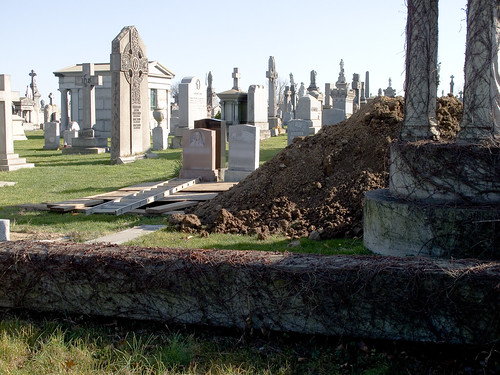
As seen in the above shots, the overgrown monument with its vine covered cupola intrigued and drew my attention. In accordance with usual methods, the object was photographed from many angles, and my path led me widdershins around it. As mentioned in the last paragraph, thanksgiving weekend had evinced a general evacuation of the area surrounding that bulkheaded duct of urban horror called the Newtown Creek, and like their counterparts in the spires of Manhattan it would seem that the workers of Calvary got off early on the previous Wednesday. Just dropped their shovels, as it were.
That’s when I saw it, said “oh. oh… no… just keep walking… don’t take any pictures of…”. Unfortunately, my finger was already depressing the button on my camera. I had lost all control, and still can’t stop myself from posting about it weeks later… I’m all ‘effed up.
– photo by Mitch Waxman
In the interest of full disclosure, the names on the two grave markers are obscured as they were modern burials. If a grave is at least older than me, I feel fine about publishing a photo or talking about who it holds. If it’s an early 1900’s burial- fair game. (note: a cool thing happened recently- a sepulchral portrait, randomly chosen and published in the Mt. Zion series of postings, resulted in a certain Pentacle reader seeing his grandmother’s face for the first time) These interments, however, date from the early 1990’s and later. The context of this post demands some discretion, and censoring the names of the deceased whose graves are seen is definitely the right thing to do.
Now on to something you don’t normally see… and I am cognizant that the presentation of the following is vulgar and in very bad taste. I just can’t stop myself… Its like some alien thing is controlling me…

– photo by Mitch Waxman
There is a limited amount of time that one can tolerate solitary exposure to Calvary Cemetery, as the marble crown of Laurel Hill is a sort of psychic Chernobyl. It preys upon you- this place- in subtle ways, and comes at you in a manner not unlike the gradual stupefaction brought on by liquor. On New Year’s Eve, someone offered me three plots here for free, and withdrew the offer when I explained what a gravesite in Old Calvary is actually worth. Coincidence? hmmm… The place has noticed me, and it is trying to draw me further in…
Like ionizing radiation, whose damage to healthy living flesh is calculated by a multiplex of intensity and duration, whatever it is that lurks in the aether of Calvary is invisible, insidious, and real. Looking into an open grave like this, in this place, carries the comparable psychic risks of unshielded exposure to the thermonuclear eye of god itself.

– photo by Mitch Waxman
What I can’t do, is use my favorite catch phrase. The “who can guess…” one. Horrors too horrible for the graves holding lurk into the abyss, and loathsomeness waits below, but…
That’s what I was thinking as I passed out, again, in a dead faint. Luckily I fell backwards.
Remember, Remember- the 21st of December

Pour me a drink and I’ll tell you some lies – photo by Mitch Waxman
An axial tilt of loathsome memories, shifting identities, and unrealized vengeance torments your humble narrator and makes him thankful that December 21st is, indeed, the shortest day of the year. The long nocturne of the Solstice, however, is no cause for celebration here in the Newtown Pentacle.
Solstice indicates that the Famine Months of January and February are upon us. The ancient Hellenes would enact the barbarous Lenaia bacchanal on solstice, and the Maenads would feast upon human flesh. It was also the central night of a week long Babylonian festival called Zagmuk, a celebration of divine Marduk’s victory over the darkness called the Anunnaki and their champion- the chaos dragon Tiamat. In modernity, in the nation of Mali, the Amma Cult of the atavist Dogon will sing and offer boiled millet at the conical altar of their high god.
from dailyworldbuzz.com
Today is the Celebration of Winter Solstice Traditions – Monday, December 21, 2009 marks the Winter Solstice traditions, and this is the announcement of the official start of the winter in the Northern Hemisphere. Winter Solstice is also known as Yule.
More precisely, winter solstice will take place at 12:47 pm EST (1747 GMT) on Dec. 21. It is a date that will also mark the shortest day and longest night.
Winter solstice falls every year around Dec. 21. It is because of the earth’s axial tilt, which is farthest away from the sun at its maximum of 23° 26′. At this time of the year, the sun is closer to the horizon, thus giving out least amount of daylight therefore shortening the day and lengthening the night.
But there is a bright side to it. Starting Tuesday, the days will start getting longer, leading to summer solstice, which in 2010 will fall on June 21. At that time, the day will be the longest with the daytime lasting for about 15 hours compared to 9 hours on Monday.

Long Island City is ready for an undead invasion, so are parts of Greenpoint – photo by Mitch Waxman
Tonight- Cernunnos- the Horned God of the Wiccans, who the Arabs call Dhu’l Qarnayn, will be reborn after being ritually slain on October 31st.
December 21st is a special day in history, signs and portents abound.
Disraeli and Stalin were born in 1879 and 1804 respectively, Pierre and Marie Curie identified radium in 1898, Elvis had his famous meeting with Nixon in 1970, Ireland finally won its independence from a large and aggressive neighbor in 1948 and Snow White and the Seven Dwarves premiered in 1937. Oh… and then there was Apollo 8.
from wikipedia
Apollo 8 was the first human spaceflight mission to achieve a velocity sufficient to allow escape from the gravitational field of planet Earth; the first to be captured by and escape from the gravitational field of another celestial body; and the first crewed voyage to return to planet Earth from another celestial body – Earth’s Moon.

shot on June 21st 2009 – Summer Solstice – photo by Mitch Waxman
Do not be surprised if you see oddly costumed people beating out unfamiliar melodies on drums today as you make your way around the great metropolitan city. Gatherings of initiates are sure to form, and wild orgiastic dancing will ensue.
Can you be sure, were you to find yourself caught up in some modern celebration in Long Island City or Greenpoint, that you weren’t in the company of flesh eating Maenads? Or that you hadn’t become one yourself? Your humble narrator, lords and ladies of Newtown, will be casting one eager eye at that rivulet of arrested misery called the Newtown Creek- in particular.
from souledout.org
At certain ancient cairns in Ireland the sun only reaches deep inside on the winter solstice, only on that one day is the inner chamber lit … like the celestial body of male Sun impregnating the Mother Earth with rays of light.
At the winter solstice the sun reaches its southernmost position in the northern hemisphere perspective (**), and begins to move northward as it enters into the cardinal, earth sign Capricorn. Through the ages, the period when the sun moves northward again ~ from the winter solstice to the summer solstice ~ has been regarded as a festival season. In many lands and civilizations the winter solstice season has been associated with the coming of a Sun-God to save the world ~ bringing light and fruitfulness to the earth, and bringing hope to humanity.

Gabled roof of netherlandish design, windows glowing with a strange colour, Astoria Church – photo by Mitch Waxman
Of course, this whole rumination on the Solstice takes place against the dominant culture’s winter holiday season. For the better part of a month, ritual feasting and familial gift giving consumes the modern mind. This period of the year, beginning with “Thanksgiving”, culminates in Advent/Yule/Christmas and ends with celebration of a calendar cycling.
1,096 days ago, I was in a hospital bed, and hadn’t yet experienced the pale ecstasies found in the glass strewn alleys and loamy graveyards of the Newtown Pentacle. 26,309 hours ago…
The darkest day, the longest night- my hour of the wolf is an interval of brutal introspections- here at Pentacle HQ in the ice choked heart of Astoria.
Note: Please say a quiet devotion for the ever patient and long suffering “Our lady of the Pentacle” today… she’s going to have to put up with and listen to this kind of maudlin revisionist crap all day…
from wikipedia
In many countries Advent was long marked by diverse popular observances, some of which still survive. In England, especially in the northern counties, there was a custom (now extinct) for poor women to carry around the “Advent images”, two dolls dressed to represent Jesus and the Blessed Virgin Mary. A halfpenny coin was expected from every one to whom these were exhibited and bad luck was thought to menace the household not visited by the doll-bearers before Christmas Eve at the latest.
In Normandy, farmers employed children under twelve to run through the fields and orchards armed with torches, setting fire to bundles of straw, and thus it is believed driving out such vermin as are likely to damage the crops. In Italy, among other Advent celebrations, is the entry into Rome in the last days of Advent of the Calabrian pifferari, or bagpipe players, who play before the shrines of Mary, the mother of Jesus, the Italian tradition being that the shepherds played these pipes when they came to the manger at Bethlehem to pay homage to the infant Jesus. It is the second most important tradition behind Easter for Roman Catholics.
In recent times the commonest observance of Advent outside church circles has been the keeping of an advent calendar or advent candle, with one door being opened in the calendar, or one section of the candle being burned, on each day in December leading up to Christmas Eve.
and just as a note: December 21 is also the anniversary of the Pilgrims landing on Plymouth Rock and getting the whole “America thing” started.


