Posts Tagged ‘queens’
ultimate effect
The nighted Newtown Creek, in today’s post.

– photo by Mitch Waxman
As detailed in several posts this week, one decided to take advantage of the creepy atmospheric effects of the temperature inversion last Thursday – which produced copious mist and fog – and a journey on foot from Astoria to Newtown Creek began at four in the morning. My eventual destination was the historic Maspeth Avenue Plank Road, from whose vantage I planned on capturing a series of “night into day” shots.
The images in today’s post are what I expended the effort for.

– photo by Mitch Waxman
Looking into Brooklyn, that’s the Empire Transit Mix company’s bulkheads. They were just getting to work, as it was just about 5:30 in the morning. Industrial types get started early. Twilight would begin at 6:04 so there was little time for me to fool around, and one started clicking away.

– photo by Mitch Waxman
Looking eastwards towards Grand Street and Newtown Creek’s intersection with another of its tributaries – English Kills. As a note, these shots are quite a bit brighter than what the human eye could see, but that’s actually what I was “going for.”

– photo by Mitch Waxman
Looking across the Turning Basin of Newtown Creek towards the National Grid Liquified Natural Gas facility found at Greenpoint’s historic border with Bushwick.

– photo by Mitch Waxman
A wide shot of the tuning basin, with the Kosciusko Bridge at right.

– photo by Mitch Waxman
Zoomed in on the bridge, that dark hill is Calvary Cemetery and you can just make out the skyline of Long Island City rising behind it in the mists. What might seem like a developing error – the halation present around the bridge and crane – was actually visually present. The fog and mist were being lit up by work lights.

– photo by Mitch Waxman
The remnants of the Plank Road itself, which last spanned the Newtown Creek when Ulysses S. Grant was President in 1875. When the whole superfund thing is over, I’m going to market mud and water from the waterway in the same manner as the folks who do the stuff from the Red Sea – claiming the benefits of its preservative qualities.
“follow” me on Twitter- @newtownpentacle
duplicate and exceed
In the wind, and flying with the Night Gaunts in Industrial Maspeth.

– photo by Mitch Waxman
Continuing my walk through the nighted streets of Maspeth, the path chosen carried me from Astoria to the streets surrounding the Newtown Creek. Caution regarding traffic guided my steps. As illustrated in yesterday’s post, the greatest danger you face around here is heavy vehicle traffic. Despite this assertion, when I mentioned my plans to come down here in the small hours to my neighbor, I was offered a firearm to carry, as he was concerned about me meeting up with malign elements of our society.
Untrained as I am in the brandishing of such weaponry, I retorted that I’d probably end up shooting myself if any attempt was made to discharge the thing and I declined. When I go out shooting, it’s about light hitting a camera lens, not little bits of metal hitting things. The atmosphere continued to thicken as one transversed the sloping street which inevitably led to the fabled Newtown Creek.

– photo by Mitch Waxman
If you want to experience “spooky,” however, one cannot recommend the feeling of isolation and exposure which is offered by industrial Maspeth at night. You truly feel alone here, all of the steel gates are down, with the exception of an occasional warehouse operation’s loading dock being open and spilling light onto the street.
The smell of the place, on a foggy night, is exceptional. Misty atmospherics, fed by high humidity and air temperatures quite a bit higher than those in the gurgling waters of the sewage addled Newtown Creek, caused an omnipresent stink to inhabit the place. One does not like to think what he was breathing, but suffice to say that on a night like this you are fully in touch with Newtown Creek – in fact, you are respirating it.

– photo by Mitch Waxman
You know that you are out early when the DSNY workers haven’t made it to work yet. The Sanitation Department maintains an enormous facility nearby my destination, and the corner of 48th street and 58th road was where I had been heading for all night.

– photo by Mitch Waxman
The Maspeth Avenue Plank Road, a street end which has been recently made salubrious by the efforts of my chums at Newtown Creek Alliance. This is the spot which I had in mind when I announced to Our Lady of the Pentacle that I would be foregoing sleep and heading out to “do some night shooting.”
This is also why I schlepped the tripod with me, as there were a few shots which I was desirous to capture.

– photo by Mitch Waxman
A quick change up of my gear and camera settings began. The tripod came out of its carrying case, and so did a remote shutter release. The dslr was affixed to the tripod, and the shutter release to the camera. One was intent on working in the “night into day” genre, and began a series of long exposure shots of the environs.
The shot above is part of the series, an “amuse bouche” as it were, for the set of images which will greet you in tomorrow’s post.
“follow” me on Twitter- @newtownpentacle
betraying myself
Like the ghouls and ghasts, loosed upon the night wind.

– photo by Mitch Waxman
As described in yesterday’s post, one decided to take advantage of the atmospherics offered by temperature inversion last week and proceed to hike over to Newtown Creek from Astoria at four in the morning. As also mentioned in the prior posting – the manifestations of high humidity like fog and mist, coupled with spring like temperatures, created a physically arduous environment. Perspiration offered an abundance of skin secretions for my clothing to absorb, which, combined with worries about condensation on camera and lens – caused a rather uncomfortable series of existential challenges to endure. No one ever promised me a rose garden, however, so your humble narrator soldiered on into the night.
The apex of this part of Laurel Hill, sitting alongside a shallow valley through which a lost tributary of the lugubrious Newtown Creek which was known as “Wolf Creek” once flowed, is always that moment when a humble narrator comments to himself that the creeklands have been reached.

– photo by Mitch Waxman
Calvary Cemetery’s newer sections are on the left side of the shot above, and the “House of Moses” occupies the center. That’s the Long Island Expressway at center and above, with industrial Maspeth to the right.
This is where 48th street, whose gradual climb in altitude I had been ascending since Northern Blvd., begins to slope roughly towards the elluvial flood plains of the Newtown Creek. Once, this ancient road was paved with crushed Oyster Shells. That colonial era surface would have been replaced with horse and carriage friendly Belgian Blocks (colloquially known as cobble stones) shortly before the Civil War, and later in the 19th century by tar and Macadam. The modern road is formed out of a concrete bed underpinned by steel rebar and is paved in a petroleum industry waste product called “Asphalt.”

– photo by Mitch Waxman
Industrial Maspeth never knows sleep.
There are vast fleets of trucks, locomotives, and shifts of laborers converging at all hours of the day and night on this area, and on every day of the year (except Christmas and Thanksgiving, mostly). Sodium street lamps lend the place a sickly yellow glow, and the harsh illumination of passing heavy trucks provides for occasional blinding white blasts of light.
One has received “safety training” from Union laborers and corporate entities over the years, so a certain amount of confidence in how to handle oneself in locales such as this informed my actions. Donning an orange safety vest with reflective strips was one of the preparations made before leaving Astoria, incidentally. Night time in an M1 zone is one of the few times when the wandering photographer definitely WANTS to be noticed.

– photo by Mitch Waxman
There are lots of giant machines moving around in industrial Maspeth, and 21st century industrial America operates within and promulgates a certain cultural imperative. That culture is called “workplace safety” and it’s important to understand the “lingua Franca,” customs, and mores which these laborers operate within – and their expected cultural normatives – as one moves about.
As a rule, never walk in front of a truck or any sort of machine without its operator acknowledging your presence, and if possible indicate to them which way you will be going and wait for them to further acknowledge that before proceeding – that’s one of them. Another is to not just wander across a driveway without looking. These hard working people aren’t expecting some idiot with a camera to be wandering around at 4:30 in the morning, after all, and the cops don’t exactly enforce the 25 mph speed limit around these parts.

– photo by Mitch Waxman
At the bottom of the hill into which 48th street was carven, the grid of the streets is broken, and you can either head west towards Blissville in Long Island City or deeper into industrial Maspeth to the east or south. The Long Island Railroad tracks are found just beyond the fence line pictured above. That’s Review Avenue/56th Road/Rust Street you’re looking at. This is the very definition of a “not pedestrian friendly” intersection and is a dangerous crossing when on foot or a bike.
How dangerous is it, you ask?

– photo by Mitch Waxman
Another one of the thousands of ghost bikes is found here, a roadside memorial to someone who got squished. Every time you find a ghost bike, you find a human life cut short.

– photo by Mitch Waxman
Crossing the LIRR tracks. It should be mentioned that the “Haberman” section of these tracks are quite active these days, and that the signals are in terrible condition. Over the summer, just east of here, a truck crossing the tracks was swept away by a freight train. The exact spot which this shot was captured saw a similar incident occur a couple of years ago. In both cases the barriers never came down, the bells and flashing lights never sounded, and unlike the summer 2015 event to the east – this is where a fatality occurred.
In the distance, the Kosciusko Bridge project lights the horizon.

– photo by Mitch Waxman
There’s a bit of lens flare present in the shot of the Ferrarra Brothers Concrete trucks above, but there’s little one can do about that in context. The shots in today’s, and yesterday’s, post are almost entirely handheld. High ISO settings, coupled with a “wide open” aperture, and compensating for the counterpoints of bright artificial light and enveloping darkness make for quite the technical challenge. It’s all about technique, shooting postures, and being able to force the camera into “seeing the light.”
Sometimes that means light is bouncing around inside the lens, producing flares. “Work with it” as my pal Bernie Ente used to say.

– photo by Mitch Waxman
Heading towards Maspeth Creek along 49th street. I’ve been told that this, the section of 49th pictured above, is actually one of the lowest places in NYC – in terms of altitude relative to sea level and the sewer shed that feeds into the Newtown Creek. It’s a guarantee that you’ll alway see some flooding here every time it rains, which is something I can say with authority, and based on observation.
An apocryphal story offered by one of my many neighborhood informants stated that during a Hurricane Sandy, geysers of water were erupting from the sewer grates and manhole covers in this spot.
– photo by Mitch Waxman
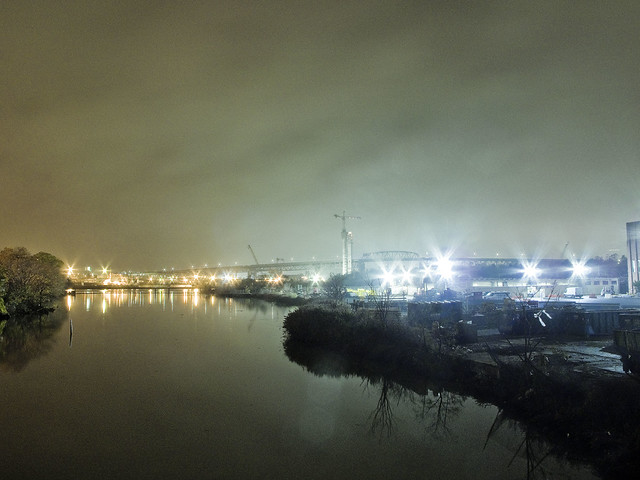
The shot above, depicting Newtown Creek’s tributary “Maspeth Creek” on a foggy night in November of 2015, was actually the first tripod shot which I popped off last Thursday.
I bagged the dslr momentarily, and employed my trusty old Canon G10 with its magnetic tripod and a remote shutter release. The magnet allows me to “clang” the camera onto fences, fire hydrants, anything ferrous. The shot is a 15 second long exposure, which characteristically causes water to assume a mirrored glass like appearance. In the distance – the Kosciusko Bridge, with Manhattan’s skyline lost in the mist rising from that malign example of municipal and corporate excess known only as the lugubrious Newtown Creek.
Tomorrow – more.
“follow” me on Twitter- @newtownpentacle
discoursed of
All access, indeed!

– photo by Mitch Waxman
As described in bit more than six years of prior posts, one has a certain fascination with those things which others ignore. The history of NYC can literally be found right there beneath your feet, especially once you learn how to read the signs and sigils left behind by earlier generations. Access, or Manhole covers, are everywhere. Research has shown that Federal Roadway regulations state a preference for State and Local governments to either replace an access cover with an exact copy from the original foundry, or just leave the old one in place. This means, since most of these things were put in place before the World Wars of the early 20th century, that there are iron or steel discs adorning the “via publica” which can tell the tale of Municpal organization, consolidation, dissolution, and indeed gentrification scattered about.
Pictured above, an access cover put in place by the Bureau of Sewers, Borough of Queens found in Astoria.

– photo by Mitch Waxman
Over in Blissville, also in Queens, an access cover which once belonged to the New York & Queens Electric Light & Power Company, which is one of the consolidated parts of Consolidated Edison. NY&Q EL&Pco. was created in 1900, and quickly bought up most of the smaller players in electrical generation and supply in western Queens. Most of NY&Q EL&Pco.’s common stock was actually held by the Consolidated Gas Company of New York. In 1918, the NY&Q EL&Pco. merged with the Edison Electric Illuminating Company of Brooklyn. The new entity merged with the Edison company of Brooklyn, Inc. Eventually, after decades of this sort of merger and acquisitions nonsense, you get to Con Ed. On it.
The circles, I am told, are standard indicators that electrical equipment will be found below.

– photo by Mitch Waxman
An odd one spotted on West 24th street in Manhattan, which quite obviously belongs to everybody’s favorite corporation – Time Warner Cable. It bears their modern logo, and is quite interesting as there aren’t thousands of wires splayed through the trees and bending utility poles, which is that squamous corporation’s tell tale calling sign is in Queens and Brooklyn. I guess the City people don’t want their blocks all cluttered up so the wires are in the ground where they belong.

– photo by Mitch Waxman
Over in Queens Plaza, sometime between 1912 and 1923, this NYM cover was placed. The New York Municipal Railway Corporation was formed in pursuance of contract 4 of the dual contracts era of the New York City Subway construction era, and was originally connected to the Brooklyn Rapid Transit (BRT) company. In 1923, NYM merged with the New York Consolidated Railroad and formed the New York Rapid Transit Company. It also stopped working on “BRT” or Brooklyn Rapid Transit and instead got busy on the “BMT” or Brooklyn Manhattan Transit situation.
The BMT became the New York City Board of Transportation’s problem in 1940.

– photo by Mitch Waxman
A precursor agency of the modern DEP was the Department of Water Supply.
The DEP was formed in 1983, incidentally, combining several independent bureaucracies into one massive agency which handles the delivery of potable water to the City, the operations and maintenance of the storm water and sanitary sewers, and a bunch of stuff that doesn’t involve getting wet – like noise complaints, air issues, chemical spills, and those sorts of things.
DEP also spends a lot of effort figuring out ways to obscure what they’re doing from the reckoning eyes of regulators and citizens. The DEP accounts for something close to a third of NYC’s budget, has a navy, operates courts and police departments in upstate New York on Resovoir lands, and ultimately reports to a Robert Moses style “Authority” and the Mayor of New York City. The Water Board Authority, whose board is composed of political appointees (The DEP Commisioner plus 4 mayoral and 2 gubernatorial appointments), can borrow a theoretically unlimited amount of money in your name – doesn’t have to tell you who they borrowed it from – and will raise your water rates to pay the interest. They are the permanent government. Kafka would recognize the DEP.

– photo by Mitch Waxman
Another “Authority” who can borrow freely in your name, once upon a time the New York City Transit Authority was known as “Rapid Transit New York City” and that was when this smallish “RTS NYC” hatch cover was embedded in the pavement. The particular specimen pictured above is found on Broadway somewhere near the hazy borders of Jackson Heights and Woodside in the 60’s.
The City’s RTC NYC purchased the BMT and IRT in 1940, and in June of 1953, the New York State Legislature created the New York City Transit Authority to rescue the nearly bankrupted agency. In 1968, NYCTA was folded into the State’s new Metropolitan Transportation Authority, along with LIRR and twelve other counties worth of rail and bus operations. That’s how, long story short, MTA became New York City Transit’s parent agency.

– photo by Mitch Waxman
We were once a plain spoken people, we New Yorkers. Once upon a time it was simply the “N.Y.C. SEWER” department. Today, it’s a division of DEP called “Bureau of Water and Sewer Operations.” Guess it sounds better on your resume when trying to pick up a lucrative Singaporean consulting gig after you’ve done your 25.
NYC has a fairly archaic system, sewer wise. It was state of the art back when Germany had a Kaiser, but the combined sewer system has major drawbacks in our modern time. A quarter inch of rain translates into a billion gallons of water, citywide, moving through the system. Since our sanitary and storm sewers feed into the same pipes, the mixed flow of liquid happiness is far greater than our sewer plants can handle all at once and it gets released directly into area waterways – like my beloved Newtown Creek.

– photo by Mitch Waxman
The access cover pictured above sports six sided bits on its face (hexagons), which indicates there’s some sort of telephone infrastructure under it. Mysterious, to me, is the titanic amount of force and weight required to break one of these cast iron things on Astoria’s Broadway near the 46th street station of the R and M lines. Famously, a 1950’s nuclear test (Operation Plumbob) launched a manhole cover, which resided on a shaft near the blast site, at six times the velocity which would be required to escape Earth’s gravity. The discus was never recovered.
At the end of it all, there will be rats, roaches, and manhole covers.

– photo by Mitch Waxman
You see these all over Long Island City, and they are my favorites. My understanding of the process involved in creating one of these designs is that it’s a pretty straight forward sculptural one. A carving is made which serves as the “positive” for molds. The molds then have molten metal poured into them, creating a casting. The red hot casting is cooled, and undergoes a finishing round of polishing and grinding. The reason that so many of these access covers are as ancient as they are is that foundries generally discard positives and molds after the order has been fulfilled. Most of these foundries aren’t even in existence anymore, either. You don’t meet many blacksmiths or forge stokers in Bushwick or Williamsburg these days, not even artisanal ones.
As stated at the start of this post, the federal highway people prefer for the original cover to stay in place, or be replaced with an exact duplicate. Sans the original mold, that ain’t gonna happen.
“follow” me on Twitter- @newtownpentacle
full joys
On it, in today’s post.

– photo by Mitch Waxman
Not too long ago, some of the neighbors here in Astoria were experiencing electrical problems. The redoubtable employees of the Consolidated Edison Corporation began to appear in great numbers, arrange orange safety cones, and get busy. Luckily, for the 48-72 hours that their repairs took to administer, their idling trucks were directly in front of Newtown Pentacle HQ.

– photo by Mitch Waxman
Famously, what roused me from mere proletarian to activist and “neighborhood crank” was the Great Astoria Blackout of 2006. For an entire week, this neighborhood was without power at the height of summer, and blue fire was erupting from manholes and transformer vaults. People died in the heat, and it seemed as if no one in City Hall cared. Ever since, one pays quite a bit of attention to power supply issues here in the neighborhood.

– photo by Mitch Waxman
The initial swarm of Con Ed employees was soon replaced by one of their emergency units. Like DC Comic’s Flash – the emergency unit is clad in red. Also like the Flash, these workers are meta humans who move faster than the human eye can follow. Often, all you can see is a blur. Guess that’s why they get paid the big bucks.

– photo by Mitch Waxman
It took around 15 seconds for the junior member of this crew to assemble the safety cordon for the work site.

– photo by Mitch Waxman
A more senior member moved even faster, opening the access cover to a hidden transformer vault and deploying a ladder and other equipment into it in the blink of an eye.

– photo by Mitch Waxman
My upstairs neighbor Mario, who is a union guy and can get other adherents of organized labor to “spill the beans” with a few carefully placed “bro’s,” went out to get the story. It seems that some of the electrical supply cables, damaged by the surges and fires of 2006 I would add, had finally given up the ghost and that three homes on the next block were entirely devoid of juice. He deduced this from slowing down an audio recording he made of the Con Ed guys answering him, which sounded like the buzzing of a fly in the original recording.

– photo by Mitch Waxman
The speedsters were assigned the duty of drawing a new set of cables from the transformer vault, in front of HQ, roughly half a block to the affected properties. It seems that in addition to the underground rooms that house the step up transformers which handle the conversion from high voltage “direct” to residential “alternating” current, there are pipes and concrete tunnels through which these wires travel honeycombing the neighborhood. This does beggar the question as to why the high voltage cables that Con Ed hung about Astoria back in 2006 to restore service are still there, but there you go.
Welcome to Queens, now go fuck yourself, after all.

– photo by Mitch Waxman
Couldn’t get a shot of what they were doing down there, but when I woke up the next morning, the Con Ed guys were sleeping in the idling truck and I’m told that the three properties on the next block had been re-energized.
Who can guess, all there is, that might be buried down there?
“follow” me on Twitter- @newtownpentacle


