Posts Tagged ‘Tower Town’
revel and chaff

– photo by Mitch Waxman
As soon as the rain died down, I descended from Newtown Pentacle HQ here in the rolling hillocks of Astoria to the so called “Zone A” to see what Irene might have wrought here in western Queens. The shot above is from Second Street near Borden Avenue, at the largish worksite which Skanska has been employing hundreds for the last few months. Cleverly, the construction giant had dug a diversion ditch to allow storm water drainage.
Smart.

– photo by Mitch Waxman
“There will be plenty of cameras walking around in Tower Town, so it would be silly of me to spend much time there” were the actual words spoken to my walking companion, who we’ll call the Charismatic Croat (CC). CC was also told that we’d be taking a short walk, and would be back in a half hour. He’s used to my lies and wasn’t surprised when we had inexorably headed for another part of “Zone A”.
All through the storm, I was wishing that I had the camera out at Newtown Creek, or at least Dutch Kills.

– photo by Mitch Waxman
Curiosity about the actions of the much feared storm surge upon the fragile bulkheads of Dutch Kills was killing this cat, and I dragged CC back and forth over these streets. There was some flooding, but in the usual places that flood anyway. Back on 2nd street, a few nice shots of the surge were captured by Jesse Winter and others, and an actual wave of East River had risen up and flooded 2nd. The Crab House was bailing water from their basement and more than one giant puddle still remained.
Down at Dutch Kills, 29th street and the large truck yard which houses this cement company were under a foot or more of water- but they are regularly immersed by small amounts of rain anyway.

– photo by Mitch Waxman
What made the day noteworthy, from a Newtown Creek point of view, was this little river of urban chocolate flowing out of one of the many CSO’s (Combined Sewer Outfall) which are found abundantly along the waterfront of the Creek and it’s tributaries. It smelled just the way it looks like it might. One often sees discharges coming from these CSO’s, but this was just a spectacular flow.

– photo by Mitch Waxman
I will point out that this could be soil washed into the pipes during the tremendous amount of rain which Irene brought to Queens. It could be sand or actually be a chocolate spill at some industrial confectionary which got washed into the sewers or something. That’s what I said to CC at the time.
Doesn’t smell like chocolate, the Charismatic Croat opined.
Progress
– photos by Mitch Waxman
The growth of the Tishman Speyer Gotham Center building in the new Queens Plaza, from every corner of the Newtown Pentacle.
enchanting metamorphoses

– photo by Mitch Waxman
Recent announcements have heralded the formal beginnings of the process which will transmogrify the ancient Hunters Point section of Long Island City irrevocably. The support of overt interests of the Manhattan political elite have been made in public, and the financial and real estate folks are in line behind the project.
Behold, the future home of an estimated 11,000 people, imagine Tower Town.
from nyc.gov
More than 5,000 new apartments are anticipated to be constructed in the primary neighborhood character study area by 2017, including completion of the residential development at Queens West and many other mid-size residential buildings throughout the immediate area. Almost 11,000 new residents are expected in the primary study area as a result of this new construction activity.
As the primary study area (and the secondary study area, discussed below) becomes more densely developed, traffic and pedestrian volumes will increase noticeably from the current levels. Intersections throughout the area will be more congested in the morning, midday, and evening peak hours. The intersections that currently experience some congestion on Vernon Boulevard will be noticeably more congested, with some levels of service D and even LOS F, indicating high to unacceptable delays. In addition, other intersections along Vernon Boulevard in the primary study area will also have moderate to high congestion in the peak hours. On the east-west avenues in the area near the project sites (i.e., 48th, 49th, 50th, and 51st Avenues) traffic volumes are expected to increase slightly.
Pedestrian volumes will also increase in the future without the proposed actions, but sidewalks, corners, and crosswalks will generally continue to operate at acceptable levels. The crosswalk across Vernon Boulevard on the north side of 50th Avenue will, however, become noticeably congested during the morning peak hour, as people cross to enter the subway station there. This crosswalk will operate at LOS E, as will the subway stair closest to the corner (Stair S8). Buses serving the primary study area will also be noticeably more crowded.

– photo by Mitch Waxman
Direct sightlines of the heroic Manhattan skyline will be offered by these new high rise buildings, and soar over the starry old coastline that has known only industrial usage since the first Europeans arrived on the archipelago we know as New York. Its value for industry has long been exhausted, and today it is a brutal waste of land.
also from nyc.gov
The proposed actions would almost double the study area’s population. However, the proposed actions’ mix of affordable and market-rate housing could serve to relieve rather than increase residential market pressure in the study area. Additionally, given the very strong trend already in place in the neighborhood, the new population at Sites A and B would not be expected to introduce or accelerate a trend toward increased market rents in the study area that might cause significant indirect residential displacement. The redevelopment of Site B would introduce new residential uses to the Long Island City industrial area south of Borden Avenue. It is possible that the introduction of this residential use could lead to some limited indirect business displacement because of increased rent pressures. However, the potential for indirect displacement resulting from increased rent pressure is limited, and would not result in significant adverse indirect displacement impacts.

– photo by Mitch Waxman
The new development, a planned community with parks and schools, will extend far from the river- nearly all the way to the Pulaski Bridge with a basketball court and green space sited for the location of the old Vernon Avenue Bridge. The shining city of Queens, and a monument to a revolutionary and aggressive group of city planners, the story of Tower Town has begun.
also from nyc.gov
The Hunter’s Point South Rezoning and Related Actions would allow Site A and Site B to be redeveloped with largely residential buildings with building components ranging in height from
40 to 400 feet. Ground floors would include local retail, lobby, and community facility uses. On Site A, a network of new streets, sidewalks, and bikeways would be developed, creating seven new city blocks from the single 30-acre parcel it is today. Center Boulevard would be continued southward onto Site A and would connect to the rest of the street network. On Site B, it is anticipated that a new publicly accessible private road and open space would roughly bisect the site. The new residential buildings would vary in height, with bases ranging in height from 40 to 70 feet and high rise elements ranging in height from 250 to 400 feet. Nine towers would be developed on Site A, and four towers would be developed on Site B. Ground floors would be occupied by local retail and other commercial uses and community facility uses. A new public school would serve the residents of the buildings and the surrounding neighborhood and create a varied and active streetscape.
In addition, a new public waterfront park would be developed along the East River and Newtown Creek frontages of Site A and a shore public walkway would be developed along the Newtown Creek frontage of Site B. An additional linear public park would also be developed on the south side of 55th Avenue between Center Boulevard and 2nd Street, and a similar public open space would be developed on the south side of the publicly accessible private road on Parcel B, creating a wide boulevard on that street. The new waterfront parks and open spaces on Sites A and B along the East River and Newtown Creek waterfronts would provide greatly increased public access to waterfront views. Wide views of the waterfront and Manhattan would be available from locations throughout the park.
Overall, the proposed actions would change the character of Sites A and B from a commercial and industrial neighborhood to a residential neighborhood. This new residential neighborhood would incorporate retail and park uses that would attract visitors. On both Site A and Site B, pedestrian activity and vehicular activity would increase substantially over existing conditions.
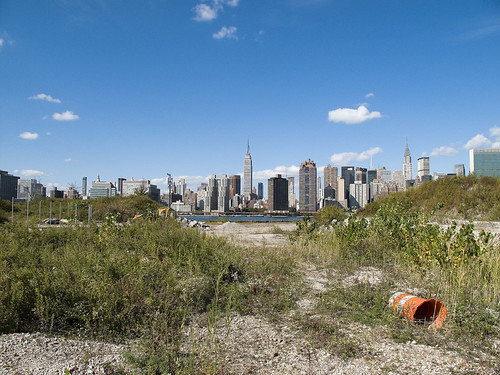
– photo by Mitch Waxman
Tower Town is impossible to argue against, this real estate- former home to rail and ferry docks, and 19th century barge based casinos, and printing plants, and refineries, and power plants- is a blight on the city, and an uncomfortable reminder of that earlier time when brick strewn lots were not remarkable but common.
An economic boom in construction and real estate sales will come, when it is built. A new tax base of luxury and glamour will come to western Queens, and a wildfire of enhanced valuation will spur growth throughout surrounding riverine communities- further enhancing the economy and strengthening their own tax base- Dutch Kills first, then Astoria, and Greenpoint.
Tower Town at Hunters Point South, Atlantic Yards in Brooklyn, Flushing Commons, Willets Point, the Kosciuszko Bridge replacement.
All at once.
from “Air Quality In Queens County” at synapse-energy.com
In the interest of protecting the environment and public health of Northwest Queens, the Natural Resource Defense Council (NRDC) and the Citizens Helping Organize for a Klean Environment (CHOKE) participated in the New York State Article X permitting process for several new power plants proposed in Northwest Queens. One of their objectives was to have a study conducted to analyze the contributors to air pollution in Northwest Queens and to identify possible strategies for improving air quality and reducing risks to public health. As part of the Article X permitting process for its 250 MW Ravenswood Combined Cycle project, KeySpan committed to funding such a study as a community benefit. CHOKE and NRDC contracted with Synapse to conduct this study. The conclusions and recommendations are those of the authors but do not necessarily reflect the position of KeySpan.
One of the reasons that Queens County was chosen for this study is that it is home to many sources of air pollution. In the northwest corner of the county there currently are four large power plants, which together house 46 electric generating units. The county also contains an extensive transportation network that includes the Long Island Expressway, the Brooklyn Queens Expressway, the Grand Central Parkway, two highway bridges, a tunnel to Manhattan, and two airports, along with over 400 miles of arterial and local roads. Queens also has several large industries, and some 2.2 million residents, leading to significant economic activity which contributes to air quality problems.

– photo by Mitch Waxman
A small and insignificant scuttling thing who some might describe as a man, your humble narrator has spent a good deal of time wandering about the lonely industrial frontages of Hunters Point and expended some effort into learning its past. My opinion of this project is meaningless, it is a gathering thunderhead, and Manhattan is coming to Queens. There is just one thing that has been glossed over in mainstream reports about this place…
…this waterfront property…
from a Newtown Pentacle post of 6/7/2009
In 1697, a Dutch sea captain named Peter Praa bought the Bogardus properties and set up farming. He died in 1740, and the land was left to his granddaughter Anne Bennet. Her son, Jacob Diks, inherited next and he passed the land to his daughter- Anna Hunter. In 1817, Hunter, who had three sons, left the land to her children under the proviso that it be sold and the moneys divided evenly between them. This is why the “Mispat” became known as “Hunter’s Point”.

– photo by Mitch Waxman
For the water that promoters of this plan mention is the East River, not the water that has defined it throughout all recorded time.
from a Newtown Pentacle post of 2/28/10:
3.8 miles long, its mouth is directly opposite the Bellevue Psychiatric Hospital in Manhattan, and defines the currently undefended border between North Brooklyn and Western Queens. Estimates state that some 14 million gallons of combined sewage, storm runoff, and industrial waste provide the only flow of water into the Creek. It’s waters are opaque, and in the height of summer turn an unnatural shade of green.
The soft bottom of the waterway is 15-20 feet below the surface of the water, and the hard bottom is occluded by a gelatinous sediment known as “Black Mayonnaise”. Composed of petroleum residues, coal tar, PCB’s, and human excrement- it lies 15 feet thick on the bed. The oxygen content of the water drops precipitously as soon as one leaves the East River. The first of the drawbridges which cross it- known as the Pulaski Bridge, is the borderline beyond which immersion in this water is worthy of full HAZMAT gear and first responders institute biological decontamination procedures for anyone who finds themselves in it.
As I’ve mentioned in the past… the chemicals Putrescine (an organic chemical compound NH2(CH2)4NH2 (1,4-diaminobutane or butanediamine) and Cadaverine (a toxic diamine with the formula NH2(CH2)5NH2)which are produced by the rotting and putrefaction of animal flesh are abundantly found in the Newtown Creek under industrial aliases like Acrylonitrile and are prominent members on the EPA’s list of Volatile Organic Compounds– or VOC’s..
Who can guess, what it is, that may be buried down there?

– photo by Mitch Waxman
Tower Town, you see, will be built along the Creek as well…
…the Newtown Creek…
from epa.gov
“Newtown Creek is one of the most grossly-contaminated waterways in the country,” said Acting Regional Administrator George Pavlou. “By listing the creek, EPA can focus on doing the extensive sampling needed to figure out the best way to address the contamination and see the work through.”
EPA responded to requests by members of Congress to evaluate specific sites along the creek by publishing a September 2007 report that contained a review of past work and recommendations regarding future work at Newtown Creek. The state of New York referred the site to EPA due to the complex nature of the contamination along the creek.
Newtown Creek is part of the core area of the New York-New Jersey Harbor Estuary, which has been designated by EPA as an “estuary of national significance.” Despite the ongoing pollution problems, some residents currently use the creek for recreational purposes such as kayaking, while others catch fish for consumption out of it. Various sediment and surface water samples have been taken along the creek and reveal the presence of pesticides, metals, PCBs, and volatile organic compounds (VOCs), which are potentially harmful contaminants that can easily evaporate into the air.
In the mid -1800s, the area adjacent to the 3.8-mile Newtown Creek was one of the busiest hubs of industrial activity in New York City. More than 50 industrial facilities were located along its banks, including oil refineries, petrochemical plants, fertilizer and glue factories, sawmills, and lumber and coal yards. The creek was crowded with commercial vessels, including large boats bringing in raw materials and fuel and taking out oil, chemicals and metals. In addition to the industrial pollution that resulted from all of this activity, the city began dumping raw sewage directly into the water in 1856. During World War II, the creek was one of the busiest ports in the nation. Some factories and facilities still operate along it, and various adjacent contaminated sites have contributed to its contamination. Today, as a result of its industrial history, including countless spills, Newtown Creek is badly polluted.
dimly lit and illimitable corridors

– photo by Mitch Waxman
Over in the part of Long Island City that isn’t shiny, where it stinks of work and sweat and oil and shit and every surface is painted with an iridescent sheen – the colour- scuttled your unworthy narrator. Perambulation through the apocalyptic wastelands of a post industrial Long Island City is no picnic during the urban season defined by “wind chills”, I assure you. This location will be familiar to longtime readers, this is 51st ave. and what would be 21st street, across the street from the Blanchard Building.
This little pedestrian bridge- officially known as the 51st avenue Bridge, is meant to be replaced fairly soon, according to the City.
from queenscourier.com
“The existing bridge there will be demolished. The new one will be realigned over the tracks and will have brand new ramps,” said Craig Chin of DDC. Chin confirmed that after final design approval has been received by the New York City Design Commission bidding will start for the project in spring 2010, with a possible completion by winter 2010.
At first glance the 51st Avenue bridge appears not to be in such bad shape. However, a DOT spokesperson said that in an internal rating system, that includes many structural elements that might not be visible to a pedestrian or are only visible from the topside, determined that this bridge at 51st Street was a replacement priority.

– photo by Mitch Waxman
This is the only pedestrian connection between the shiny new Long Island City, Tower Town, and the grimy industrial engine which it is being built on top of. Personal observation reveals that the people who use this bridge are laborers moving back and forth from mass transit centers along Jackson Avenue and the Great Machine at Queens Plaza. Underserved as the area is by mass transit, the city nevertheless anticipates an enormous surge in pedestrian and vehicle traffic once a catastrophically bad idea called Hunters Point South is completed.
from nyc.gov
More than 5,000 new apartments are anticipated to be constructed in the primary neighborhood character study area by 2017, including completion of the residential development at Queens West and many other mid-size residential buildings throughout the immediate area. Almost 11,000 new residents are expected in the primary study area as a result of this new construction activity.
As the primary study area (and the secondary study area, discussed below) becomes more densely developed, traffic and pedestrian volumes will increase noticeably from the current levels. Intersections throughout the area will be more congested in the morning, midday, and evening peak hours. The intersections that currently experience some congestion on Vernon Boulevard will be noticeably more congested, with some levels of service D and even LOS F, indicating high to unacceptable delays. In addition, other intersections along Vernon Boulevard in the primary study area will also have moderate to high congestion in the peak hours. On the east-west avenues in the area near the project sites (i.e., 48th, 49th, 50th, and 51st Avenues) traffic volumes are expected to increase slightly.
Pedestrian volumes will also increase in the future without the proposed actions, but sidewalks, corners, and crosswalks will generally continue to operate at acceptable levels. The crosswalk across Vernon Boulevard on the north side of 50th Avenue will, however, become noticeably congested during the morning peak hour, as people cross to enter the subway station there. This crosswalk will operate at LOS E, as will the subway stair closest to the corner (Stair S8). Buses serving the primary study area will also be noticeably more crowded.

– photo by Mitch Waxman
Borden Avenue is the main attraction hereabouts, a loathsome stretch of fortress walled warehouses which passes by the Queens Midtown Tunnel, the LIRR tracks, the Pulaski Bridge– and all the while following the bulkheaded course of a certain body of water. The Newtown Creek is one block away, but you knew that by the smell already. Lately, my headphones have been playing music again, rather than the podcasts and audiobooks normally presented- but even the Dropkick Murphys can’t drown out the sound. There’s an app for that, as the ad slogan goes, and one I like is called “Decibel Meter“.
Here, under the LIE and again- a couple of thousand feet from the Queens Midtown Tunnel and over a rail yard and near the Pulaski- its rough metering reported a sound level 106 db (which is the limit of the iphone microphone). The iphone is hardly a scientific instrument, of course, but all the union guys I see working around here are wearing ear plugs. The non union guys aren’t.
from wikipedia
Louder sounds cause damage in a shorter period of time. Estimation of a “safe” duration of exposure is possible using an exchange rate of 3 dB. As 3 dB represents a doubling of intensity of sound, duration of exposure must be cut in half to maintain the same energy dose. For example, the “safe” daily exposure amount at 85 dB A, known as an exposure action value, is 8 hours, while the “safe” exposure at 91 dB(A) is only 2 hours (National Institute for Occupational Safety and Health, 1998). Note that for some people, sound may be damaging at even lower levels than 85 dB A. Exposures to other ototoxins (such as pesticides, some medications including chemotherapy, solvents, etc.) can lead to greater susceptibility to noise damage, as well as causing their own damage. This is called a synergistic interaction.
Some American health and safety agencies (such as OSHA-Occupational Safety and Health Administration and MSHA-Mine Safety and Health Administration), use an exchange rate of 5 dB. While this exchange rate is simpler to use, it drastically underestimates the damage caused by very loud noise. For example, at 115 dB, a 3 dB exchange rate would limit exposure to about half a minute; the 5 dB exchange rate allows 15 minutes.
While OSHA, MSHA, and FRA provide guidelines to limit noise exposure on the job, there is essentially no regulation or enforcement of sound output for recreational sources and environments, such as sports arenas, musical venues, bars, etc. This lack of regulation resulted from the defunding of ONAC, the EPA’s Office of Noise Abatement and Control, in the early 1980s. ONAC was established in 1972 by the Noise Control Act and charged with working to assess and reduce environmental noise. Although the Office still exists, it has not been assigned new funding.

– photo by Mitch Waxman
The afternoon sun is always a pleasure around this little truss bridge, the 21st street truss as Forgotten-NY once called it. It lights the smoggy miasmas, produced by the fuming exhaust of the thousands of vehicles passing overhead as they mix with those unstudied emissions wafting from the Newtown Creek. The same vapors that tattoo the “colour” and dissolve the marbles and bronze of Calvary, a corrosive ether that smells of petrochemical filth and reminds one of rotting pork, hatch up through the loathsome mud found all along the Creek.
from epa.gov
Newtown Creek is a part of the New York – New Jersey Harbor Estuary that forms the northernmost border between the New York City boroughs of Brooklyn and Queens. In the mid 1800s, the area adjacent to the 3.8 mile Newtown Creek was one of the busiest hubs of industrial activity in New York City. More than 50 refineries were located along its banks, including oil refineries, petrochemical plants, fertilizer and glue factories, sawmills, and lumber and coal yards. The creek was crowded with commercial vessels, including large boats bringing in raw materials and fuel and taking out oil, chemicals and metals. In addition to the industrial pollution that resulted from all of this activity, the city began dumping raw sewage directly into the water in 1856. During World War II, the creek was one of the busiest ports in the nation. Currently, factories and facilities still operate along the creek. Various contaminated sites along the creek have contributed to the contamination at Newtown Creek. Today, as a result of its industrial history, including countless spills, Newtown Creek is one of the nation’s most polluted waterways.
Various sediment and surface water samples have been taken along the creek. Pesticides, metals, PCBs, and volatile organic compounds (VOCs), which are potentially harmful contaminants that can easily evaporate into the air, have been detected at the creek.

– photo by Mitch Waxman
On the other side of the street from this sign is the Queens Midtown Tunnel, with its signage prominently decrying photography or video operation. Loose lips sink ships and all that, and the front line people “in the know” seem to believe this area to be a prominent target for the Terror Warriors, so we’ll just agree that its there and not show it. Despite the fact that its going to be sitting at the very center of a residential neighborhood by 2020 and the fact that you can park a vehicle here.
from mta.info
1020.8 Compliance with posted signs. Every motorist and pedestrian using any facility under the jurisdiction and control of the Triborough Bridge and Tunnel Authority shall obey and comply with the provisions of any posted sign on any of its facilities.

– photo by Mitch Waxman
The scion of this residential neighborhood is L Haus, a newly completed building whose non facing side is similarly on 50th avenue, roughly one and a half city blocks from where we started on 51st avenue.
from curbed.com
Long Island City’s “Mystery Building,” a condo sitting at the foot of the Pulaski Bridge and sort of functioning as the neighborhoods greeter for people driving over from Brooklyn has been outed. The neighborhood blog LIQCity identifies it today as “The L Haus,” named after its shape and, you know, “house” in German. (It’s the big, green boxy thing in the photo.) Other relevant details/rumors: the offering plan is “about to hit the street” and Elliman will be bringing it to market at prices in the $600-$700 per square foot range.


 The Newtown Pentacle