Posts Tagged ‘Tugboat’
Historic Tug at Newtown Creek

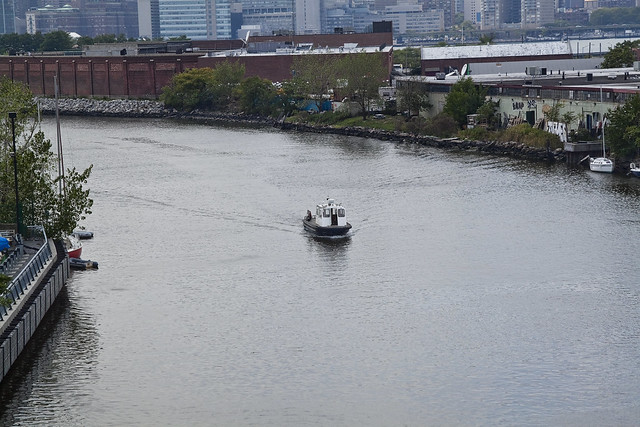
Vintage Tugboat at Newtown Creek – photo by Mitch Waxman
A rare opportunity to ride up the Newtown Creek was recently enjoyed by your humble narrator, and on my journey up that maligned cataract I spotted an artifact of New York Harbor’s glorious past sneaking past Hunters Point.
from epa.gov
Blue-claw crabs, bluefish, weakfish, striped bass, and other species inhabit the creek, and fishing and crabbing for human consumption occurs [Ref. 7, pp. 2, 5; 8, p. 11; 21, p. 13; 22, pp. 1-2; 24, p. 143; 52, p. 93; 68, p. 3; 69, p. 1]. Subsistence fishing has been observed in Newtown Creek at Dutch Kills, and crabbing for consumption has been observed at the end of Manhattan Avenue in Brooklyn [Ref. 7, p. 5; 21, p. 13; 22, pp. 1-2; 68, p. 3; 69, p. 1]. These locations are both within the zone of contamination for the Newtown Creek site [Figure 2 of this HRS documentation record]. Therefore, Actual Contamination is documented, and the target fishery is evaluated for Actual Human Food Chain Contamination.

the W O Decker at Newtown Creek – photo by Mitch Waxman
Wooden hulled, its spitting steam boilers have long been replaced by modern diesel engines, this little (52 feet long) tugboat is the W O Decker.
also from epa.gov
Beginning in the late 1800s and continuing into the 1930s, Newtown Creek was widened, deepened, and lined with bulkheads to accommodate the growing traffic, leading to the destruction of all its freshwater sources [Ref. 8, p. 10; 12,
p. 52]. During World War II, the government commandeered factories along the creek to make military equipment, such as a factory that made aluminum for fighter planes [Ref. 11, p. 14]. At that time, Newtown Creek was the busiest industrial port in the Northeast, with tanker traffic lining its length [Ref. 7, p. 1; 11, p. 13]. The national highway system built after the war took business away from the nation’s waterways, leading to a rapid decline in the level of industry along Newtown Creek [Ref. 7, pp. 1-2].

the W O Decker passing by the “Greenpoint Manufacturing and Design Center” – photo by Mitch Waxman
A “historic place” the Decker was originally called the Russell 1 when it was built in 1930 for the Newtown Creek Towing Company, who were specialists in berthing and towing heavy cargo along the crowded and narrow waterway.
from gmdconline.org
The Greenpoint Manufacturing and Design Center (GMDC) started in the late 1980s as an innovative intersection of two interests: reclaiming derelict factories in North Brooklyn’s Greenpoint neighborhood and sustaining industry and manufacturing in New York City. The organization formally incorporated in 1992.
From its initial purchase and redevelopment of a large facility at 1155 Manhattan Avenue for use by light manufacturers and artisans, GMDC has since expanded and today is the only nonprofit industrial developer in New York City. The organization acquires, develops, and manages industrial real estate that provides small and medium-sized manufacturing enterprises with affordable, flexible production space.

In the shot above, The Decker is passing the Newtown Creek Waste Water Treatment Facility in Greenpoint, Brooklyn – photo by Mitch Waxman
The Decker is currently a high end tour vessel, operated by and out of the South Street Seaport in Manhattan.
from seany.org
The wooden tugboat W.O. Decker was built in Long Island City, Queens in 1930 for the Newtown Creek Towing Company, a firm specializing in berthing ships and barges in the creek that separates Brooklyn and Queens. Originally called the Russell I for the towing company’s owners, she was renamed the W.O. Decker in 1946 after being sold to the Decker family’s Staten Island tugboat firm.

The shield wall of the Shining City, framed by Long Island City on the right and industrial Brooklyn on the left with the Pulaski Bridge just at Horizon – photo by Mitch Waxman
The vessel I was aboard continued on toward the Greenpoint Avenue Bridge, but the Decker turned in the narrow part of the Newtown Creek near the confluence of its tributaries Whale Creek and Dutch Kills.
Check out this 1896 article at the NYTimes, which actually interviews the manager of Newtown Creek Towing Company, John Russell, for whom the Decker was originally named.
Our friends at the Working Harbor Committee are actually doing a few tours this summer on the Decker- click here for more
Ruby M. at Whale Creek

– photo by Mitch Waxman
Someone recently told me that this, your Newtown Pentacle, was a mere paparazzi rag for infrastructure and heavy industry- which made me laugh out loud.
Then, depressed, disturbed, and frightened by even good natured criticism I retreated into a sulking and jealous rage. All ‘effed up, I threw together my little ensemble of camera bag and headphones and set off for the Newtown Creek. When I got to the Pulaski Bridge, it was open and I realized that I had just missed a Tugboat passing through. ARRGHH!!!
What I did see though, was this flatbed truck carrying what appears to be remnants of a Roosevelt Island Tramway tower in the direction of Greenpoint.
“Could this be some sort of super Crow?” thought your humble narrator…
– photo by Mitch Waxman
Brutally hot, vast misty shelves of humid air blanketed the terrain when the Pulaski reconstituted itself into its roadway configuration via those electrical engines that operate its double bascule mechanism. Tepid, the fetid air flow’s tortuous languor augmented that remarkable and certain odor which distinguishes the Newtown Creek watershed. At the apex of the arc which spans this part of that storied rivulet, this small boat was spied.

– photo by Mitch Waxman
As its markings indicate, this is the Emily Miller. A “Job” or Utility boat, Emily Miller is 31 feet long, 185 HP and based at Pier 7 1/2 in Staten Island at Miller’s Launch.
from millerslaunch.com
Miller’s Launch is a marine service company based on the North Shore of Staten Island, New York. With satellite terminals throughout New York, New Jersey and Connecticut, we have provided first-class service to the marine industry since 1977.

– photo by Mitch Waxman
Nothing special, really, but since I missed the Tug… I decided to take some shots of it passing anyway. For a waterway that was once the busiest on Earth, the relative scarcity of traffic on Newtown Creek these days makes any vessel plying its poison expanse notable.

– photo by Mitch Waxman
My endless wanderings found your humble narrator once more at the Newtown Creek Waste Water Treatment Plant Nature Walk, always an easy egress point for observing the malefic realities of Newtown Creek and one of the few water level access points open to the general public along the great canal. To my wonder and joy, I found the tugboat that I had missed when the Pulaski (and this post) opened.

– photo by Mitch Waxman
The tug is the Ruby M. operated by Dann Towing, but once once known as he Texaco Fire Chief when it was built in 1967 at the Jakobson Shipyard in Oyster Bay. Steel hulled, it is 95 feet long and has a gross tonnage of 197. It was sitting astride Whale Creek, and maneuvering a barge into position. Tugboats are seldom observed at work this close, and certainly -in my limited experience- it is a rare thing to see one in such a nearly static position relative to the camera.
Normally, you have to shoot fast to capture one, as it is hurtling past.
The Newtown Creek Waste Water Treatment Plant, incidentally, sits on the site of one those insane fires which Greenpoint seems to have been quite prone to and distinguished by during the heady days of the industrial revolution. Check out this NYtimes article from 1900 which describes the horror.

– photo by Mitch Waxman
Daring contact with that which might exist in the shallow depths, your humble narrator descended those threatening steps found at the Nature Walk, and was rewarded with this found composition. Unlike most of the photos presented here, its presence is not meant to advance a narrative or illustrate a point- I just think its a neat shot.

– photo by Mitch Waxman
Having little else to do, I hung around for a while to see if the Ruby M. was about to do something interesting. It didn’t, just repositioning itself further up the creek and tying off to a different barge than the one they had just delivered. Emily Miller’s role in the transaction seemed to have been completed as well, as it advanced past the rail bridges spanning the Dutch Kills tributary of the Newtown Creek.
From Astoria Park, fireworks show, June 30 2010
– photos by Mitch Waxman
An FDNY fireboat shooting Red White and Blue water in between the Triborough and HellGate Bridges, followed by a cool tugboat, and then a fireworks display framed against the latter bridge. Happy 4th of July!
Laura K. Moran at Kill Van Kull

– photo by Mitch Waxman
Recently spied, the Laura K. Moran in the supernatural lighting of a setting sun, hurtling along the Kill Van Kull.
A 5,100 HP, twin screw Z Drive tug, Laura K. Moran was built in Maine by Hodgdon, Washburn & Doughty Associates, is 92 feet, 184 GT, and was launched in 2008. Our buddy at tugster did a nice portrait of the Laura K., and this ship was the last command before retirement of legendary Tug Captain John Willmot.
from washburndoughty.com
Washburn & Doughty Associates, Inc. of East Boothbay, Maine specializes in the construction of steel and aluminum commercial vessels. Founded by Bruce Doughty, Bruce Washburn and Carl Pianka, the yard began building fishing boats in 1977. Since then, the yard has continued to prosper by diversifying its capabilities, developing innovative designs and building techniques, and reaching out to new markets. Washburn & Doughty has delivered of a diverse mix of tugboats, commercial passenger vessels, fishing boats, barges, ferries and research vessels.
NY Harbor 5/10/2010
Here’s what I saw on the May 10 Working Harbor Committee tour of NY Harbor, Kill Van Kull, and Port Elizabeth…


 The Newtown Pentacle