Posts Tagged ‘ny harbor’
treasure house
Thursday

– photo by Mitch Waxman
Well… this is it. The shots from my last ride on the NYC Ferry, and the literal sunset for my interval shooting NY Harbor. It’s hard not to feel all choked up, as the harbor has been at the literal center of my life for decades. The tugboats, the bridges, Fireboats, the… Creek.
Usually, when I’m feeling a bit overwhelmed or emotional, I’ll put on some appropriate music to lighten my mood.
XX
XX

– photo by Mitch Waxman
Eric Burdon often finds himself in heavy rotation on my various playlists, at least the playlists that don’t involve Cthulhu. Burdon’s talents are many, and I would urge you to particularly seek out his collaborations with LA’s Funk outfit “War.” The tune below could be used as the theme music playing over a montage sequence of me packing boxes and driving back and forth to Pittsburgh.
XX
XX

– photo by Mitch Waxman
Astoria gave birth to one of my favorite hardcore punk bands, Murphy’s Law (actually, the Dutch Kills hood did, but close enough.)
“Pit Bulls, Beer, and herb – aww right!” This does kind of sum up the experience of living in Astoria. Really, Astoria smells like a combination of college and burning brake pads.
XX
XX

– photo by Mitch Waxman
LA punk band Fear are intentionally offensive, and in the modern era their albums would likely be considered a hate crime by either the overly sensitive “Ute’s” or the deeply offended “Normals.”
Great live band, Fear was. Saw them at cb’s a bunch. The only thing that offends me, really, are people who are easily offended.
XX
XX

– photo by Mitch Waxman
One of my little open secrets was that before each and every tour, I would listen to two particular songs on my headphones at top volume, in order to get “amped.” The Dropkick Murphys “Bastards on Parade” – below – is one of them.
In many ways, my entire philosophy is elucidated in this song.
The other song, as in the other one that I listened to right before every boat or walking tour, is this one.
XX
XX

– photo by Mitch Waxman
And so, at last, my season on NY Harbor came to an end. I still had another destination to go to on this particular evening, but this was it for NY Harbor.
As far as what it’s felt like to be in the skin I’m in, quitting and abandoning everything I’ve worked to become or be, while throwing away half of my worldly possessions, all in pursuance of starting over in a new City while in my middle 50’s – how does that feel?
well…
XX
“follow” me on Twitter- @newtownpentacle
Buy a book!
“In the Shadows at Newtown Creek,” an 88 page softcover 8.5×11 magazine format photo book by Mitch Waxman, is now on sale at blurb.com for $30.
doubtful alchemy
Wednesday

– photo by Mitch Waxman
As mentioned in prior missives, one last ride on the NYC Ferry was on my NYC bucket list to accomplish, before the big move to Pittsburgh. My pal Val and I had boarded the service in Queens and ridden the Astoria line boat southwards to Pier 11 in Manhattan, whereupon we then transferred to a Soundview line unit heading northwards.
The East River gave me a good day, for this last outing. The Queensboro Bridge was lit up all pretty like.

– photo by Mitch Waxman
One thing I laugh about continually, since having arrived in Pittsburgh, is when the locals complain about traffic. There’s certainly road congestion here in Western Pennsylvania, but traffic? Look above, at the FDR Drive. That’s what traffic looks like. Pittsburgh traffic, even when it stacks up around the pinch points of tunnels and bridges at rush hour, still moves at 15-20 mph. Normally, it’s flying along at highway speeds. The average speed of a motor vehicle in NYC is 4.1 mph. …traffic…
Val and I had timed our afternoon out perfectly, as it turned out. Despite the complete lack of clouds in the sky, there were already hints of golds, oranges, and scarlets appearing in the early winter sunset.

– photo by Mitch Waxman
After visiting one of the ferry’s stops at 34th street, the boat headed northwards. After 34th street, the Soundview boat moves into the westerly channel of the East River, found between Roosevelt Island and Manhattan, as it navigates north. This is more or the less the pathway that the ill fated General Slocum followed, all those years ago in 1904.
Next stop for the ferry is at East 90th street, nearby Gracie Mansion. The Astoria line stops here as well, and it’s one of the points where you can transfer between the two. Until they get wise to this exploit I’ve been taking advantage of, you’ve got a 90 minute period after activating your ticket during which you can transfer from one line to another. If you play your cards right and time it correctly, you can get from Soundview in the Bronx – nearby the Throgs Neck Bridge – all the way to Rockaway on $2.75.

– photo by Mitch Waxman
That’s the northern edge of Astoria pictured above, where thousands of people will be occupying newly developed luxury apartment houses within just a few years. It ain’t exactly prosaic that the City is putting this sort of population density in place along the waterfront, in an era when the term “managed retreat” is about to become quite familiar to most New Yorkers, but there you go.
Somebody else’s problem, as I now live on the side of a small mountain of coal and shale nearby three rivers, some 400 miles away from NYC.

– photo by Mitch Waxman
So many memories bounce about in my mind about the Hells Gate narrows area of the East River. Truly, this is one of the most amazing places, in a place known for being amazing. Don’t forget, for those of you who are staying in NYC, to stop and smell the roses every now and then. Gaze in wonder at the marvels, and appreciate the billions of hours of labor that they represent. Robert Moses didn’t build that bridge, tens of thousands of our grandparents did.
Mighty Triborough. The Hell Gate Bridge. Randall’s/Ward’s Island.

– photo by Mitch Waxman
The Soundview boat crossed under the two great bridges at Hells Gate, past Astoria Park, and continued north. Our plan, as it were, was to be riding southwards on the return trip at more or less the moment when the burning thermonuclear eye of god itself descended behind New Jersey. In the intervening period since shooting these photos, I’ve made a discovery or two which I’d like to share.
Turns out that the burning thermonuclear eye DOES NOT descend into New Jersey, as I’ve learned clear on the other side of that state. Recent observation has suggested to me that it instead descends somewhere else, perhaps even behind the State of Ohio.
More astronomical discoveries, and other updates tomorrow…
“follow” me on Twitter- @newtownpentacle
Buy a book!
“In the Shadows at Newtown Creek,” an 88 page softcover 8.5×11 magazine format photo book by Mitch Waxman, is now on sale at blurb.com for $30.
alarmed envy
Tuesday

– photo by Mitch Waxman
It’s important to acknowledge, when viewing a place or person for the final time, the gravity of the moment. I don’t plan on coming back to NYC anytime soon, and by soon I possibly mean “ever.” People have asked – is it the politics? Are you leaving because of rising crime, or the unaffordable cost of living, or what? It’s all of those things, and none of those things. It’s about “Act 3” and wanting something better for Our Lady of the Pentacle and myself in our declining years.
I would mention that this is the second version of this post you’re reading. Version 1 strayed into exactly the sort of soliloquy about NYC that I’ve sworn I wouldn’t write or publish. Suffice to say that New York is a City for the young and wealthy to enjoy and that I’m neither of those things.
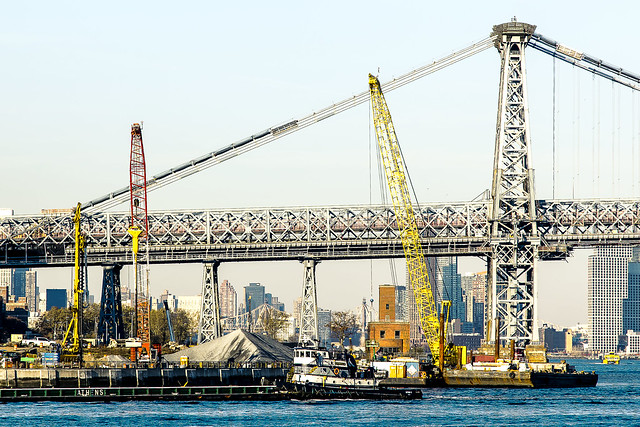
– photo by Mitch Waxman
Speaking of not being young, all of the exertions of the move to Pittsburgh have taken a toll. Shortly after arriving in Pennsylvania after my twice back and forth 1,600 miles of driving, one contracted a wicked cold with a productive cough (not Covid), and one of the many small wounds on my hands (from carrying boxes, packing boxes, unpacking boxes etc.) has developed a sweet infection. An actual Google search I conducted this morning was “What is Pus”? This led to an interesting internet rabbit hole which included medieval medical thought and theory.
Turns out the stuff is composed of white blood cells and other immune system bits. According to the medical consensus from the days before the germ theory of disease became generally accepted – if it’s white pus, you’re probably going to be ok. Yellow, or green, or god forbid black pus, you likely want to get your self bled by a doctor and do it quick. That’s what the Google tells me, anyway. Luckily, I already unpacked the box that had the Duane Reade triple antibiotic topical goo in it.
Overall, I feel like I got into a bar fight at the moment, and have lost badly to several large and sadistic men. That’s officially the end of me whining about how tired and depleted I feel right now. It’ll be ok in a couple of days. I need a whole lot of regular sleep coupled with proper meals.

– photo by Mitch Waxman
On the way to Pittsburgh, one drove the Mobile Oppression Platform (my pet name for the car) through some extremely rural areas wherein fealty to a former President – you know, the orange one who tried to overthrow the Government – runs strong. I saw a hand painted sign on a decaying barn along route 28 south that read “Biden bad, he spend you earn, no socialism.” I’m not sure what these people think “socialism” means, nor where they learned basic grammar. Personally, I roll with what the dictionary says words mean, rather than what some bloke with a busted down barn which he’s doing voluntary advertising for a NYC landlord on, alongside a highway in rural Pennsylvania, thinks.
I actually blame the school system’s cowardice, in terms of discussing modern day political issues, for this era we live in. When I was in public school in the 70’s and 80’s, history officially ended at World War 2 since they didn’t want to tread into all of the “controversial Civil Rights or Cold War stuff.” You get the same thing on the other side of the political fence, with a misunderstanding or misrepresentation of the word “socialism” means in particular, but also with popular usage of “progressive” or “liberal.”
Bah!
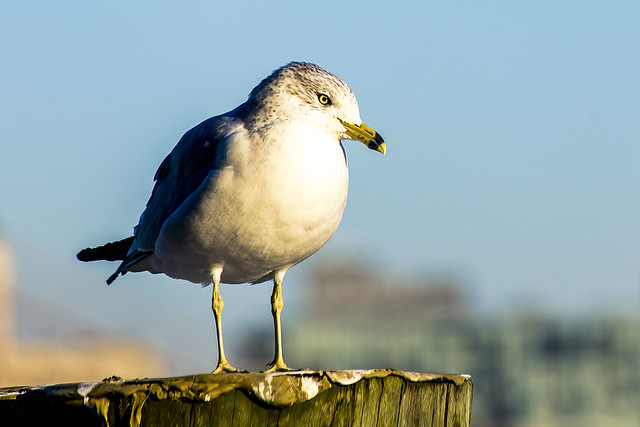
– photo by Mitch Waxman
At any rate, back on the NYC Ferry, which is where I was before I started rambling on about how beat up I am and the weird things I’ve seen here in Pennsylvania – which I’m still working on being able to reliably spell…
My pal Val and I rode the Astoria line of the service to the Pier 11 Wall Street stop over in Lower Manhattan. We had a brief lay over while waiting for the Soundview line boat to arrive. Soundview is a great ride, heading up the west side of the East River towards 34th street, and then past Roosevelt Island where it makes a stop nearby Gracie Mansion at East 90th street. From there it proceeds north through Hells Gate to Bowery Bay and ultimately to Soundview in the Bronx, which is where the footings of the Whitestone and Throgs Neck Bridges sit.
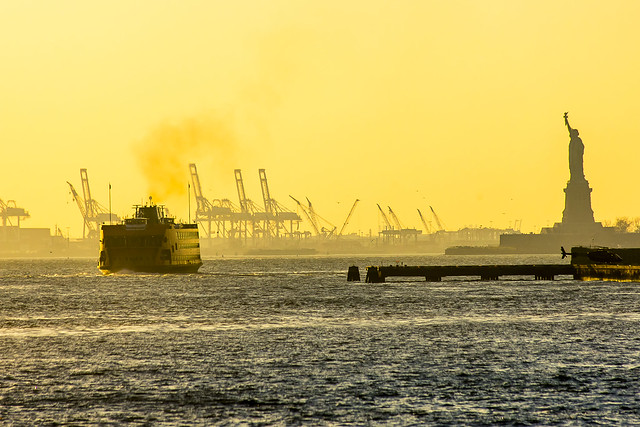
– photo by Mitch Waxman
One had timed the trip for late afternoon, hoping to catch some orange and gold light for this – my last ferry ride.
For the journey north, I deployed a long lens which allowed a 70-300 mm zoom range. It’s not my best piece of glass, this unit, but it does allow for a great deal of reach. On the way south, I had used a wider 24-105 mm zoom lens.
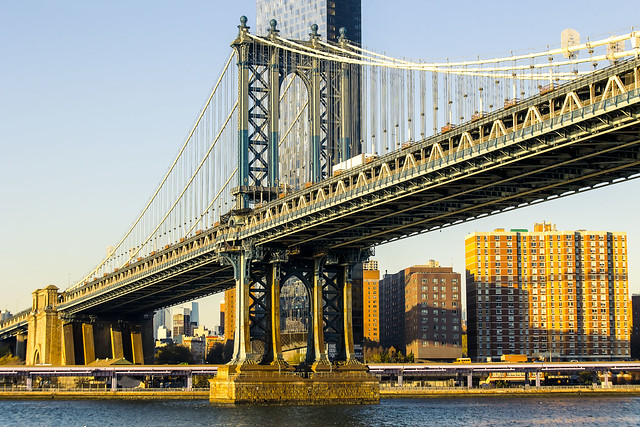
– photo by Mitch Waxman
The hoped for light show started just as the Soundview bound ferry debarked from Pier 11, as predicted. We were heading north, and this ended up being the last time I’d be seeing or taking a photo of the Manhattan Bridge. Bwah!
More tomorrow, at your Newtown Pentacle.
“follow” me on Twitter- @newtownpentacle
Buy a book!
“In the Shadows at Newtown Creek,” an 88 page softcover 8.5×11 magazine format photo book by Mitch Waxman, is now on sale at blurb.com for $30.
standard works
Monday

– photo by Mitch Waxman
November 22nd was a busy day, and one that was full of “last times.”
My pal Val and I met up and headed over to the East River for my last ride on the NYC Ferry. As mentioned in the past, one absolutely refuses to write one of those cliché soliloquies which New Yorkers feel hell bent to offer when they finally leave NYC.
I’ve lived my whole life in this crazy place. School, career, friends and foes, love and loss – all of it happened here. For broad ranging criticisms of how the City functions, its endemic corruptions or temptations or dangers – all of that – just read through the archives linked to just to the right of this text. There’s posts in that list which span back to 2009 that will spell out my various opinions on the milieu.
Saying that, on our way to the boat, I got to grab a shot of the Real Estate people’s minions at work, demolishing yet another small business’s premises in order to make room for luxury waterfront condos.

– photo by Mitch Waxman
Nobody in my world could believe it when I said that I would be moving at the end of 2022. “C’mon Mitch,” where are you going to go? What will you do? You’re “Mr. Newtown Creek!” Why Pittsburgh?
The escape plan for Our Lady of the Pentacle and myself, one we hatched during the COVID isolation months, has played out over the last 14 months or so. We started with the question “what do you want?” This allowed for the creation of a data set built around these wants, one which could be sought and pursued. That’s when the question of “who are you” and “what do you need” took primacy.
I’m a city boy – so urban, and given the stage of life Our Lady and myself are entering, pretty decent health care resources coupled with a quieter form of life that offered fewer existential dangers due to living cheek by jowl with the random madmen who howl on the other side of the wall. Pittsburgh, in the final analysis. offered the “wants, where’s, and who’s” we were looking for in “Act 3.”

– photo by Mitch Waxman
First tasks involved solving a few paperwork issues on my end. An expired drivers license’s replacement was complicated by a similarly expired passport. That was January. By April, I had solved both problems. Next up, we needed to buy a vehicle, since you can’t live in “America” without a car. Research, consciously saving the cash for a down payment all year, and a couple of car rentals later – the Toyota RAV4 had risen to the top of my list, and an order was placed for a new one with the Queensboro Toyota outfit on Northern Boulevard. It wouldn’t end up arriving until the week before Halloween, due to the supply chain problems, but that fit our timeline.
In September, I began to quit jobs, and sever my ties with the various organizations that I was associated with. First one to go was Community Board 1 in Astoria, where I was the Transportation Committee Chair. For those of you interested in serving on a CB, it’s definitely worth the effort, and there is a “Jeffersonian responsibility” to participate in the mechanics of the Democracy but there’s also a whole lot of bullshit you have to put up with – mainly from your fellow board members.
I next rolled up my business with all of the non profits that I either worked with, or was on the board of, over the next two months and made arrangements for a few “goodbye” moments like the Fireboat trip mentioned a couple of weeks back.

– photo by Mitch Waxman
Riding the NYC Ferry one last time was on my list of “have-to’s.” Particularly during the COVID interval, access to the ferry has been nepenthe for me. For just a few bucks, you can get out on the waters of NY Harbor for a bit, and if you time it correctly – be out there for sunrise or sunset during the flood tide when the rivers are thick with maritime traffic. Photographer paradise. Particularly this photographer.
When I told my pal Val (also a photographer) that I wanted to do this trip, she insisted on coming along for one last go.

– photo by Mitch Waxman
All year, I was telling my friends that when things got to late November, things would be moving at a thousand miles an hour. My prediction was correct. I had to work doubly hard for the five days or so leading up to the 22nd in order to buy enough time to get this day off. Boxes to pack, cupboards to be emptied. All that. I got lucky as far as weather goes.
The plan for late November and early December included spending about a week at the new address in Pittsburgh, where I’d be driving Our Lady of the Pentacle and some bare essentials out to Pittsburgh in order to set up housekeeping in the new digs. After a week or so, I’d need to drive back to Queens to handle the final stages of the move and supervise the moving crew, leaving Our Lady of the Pentacle out west in the new PA house while doing so.
After the movers left the Astoria HQ, I’d have to drive back out to Pittsburgh on my own, this time with a carload of hard drives and camera gear, which I don’t trust anyone else to handle. Thereby, in an 8 day period, I ended driving something close to 1,600 miles with all the back and forth. Post facto, this is all kind of a blur for me at this point.
This ferry day in November was, thereby, my last dance with the East River in NYC. It’s so weird saying that.

– photo by Mitch Waxman
I know what’s in those blue boxes on the barge, can describe what the bottom of that tugboat’s hull looks like, and there’s also a story I can offer about each and every thing in the frame. The sort of knowledge I’ve gained in the last twenty or so years can be suffocating.
Want to hear about the time that Mose the Fireboy, the legendary giant of the 19th century “Gangs of New York” era Bowery B’hoys, wrestled a serpent out of the water here at Corlear’s Hook? How the skin of the water monster was draped over the bar mirror at McGurk’s Suicide Palace on the Lower East Side near St. Mark’s? How about the Constellation fire at the Navy Yard? The Sewer Rats gang who would paddle out to anchored ships at night to rob them at knife point? General Slocum, as in the politician whom they named the infamous excursion boat for? Boss Tweed, who lived in George Washington’s Presidential Mansion on Cherry Street in Manhattan, a few blocks back from the water?
More tomorrow…
“follow” me on Twitter- @newtownpentacle
Buy a book!
“In the Shadows at Newtown Creek,” an 88 page softcover 8.5×11 magazine format photo book by Mitch Waxman, is now on sale at blurb.com for $30.
tradewinds sweep
Wednesday
– photo by Mitch Waxman
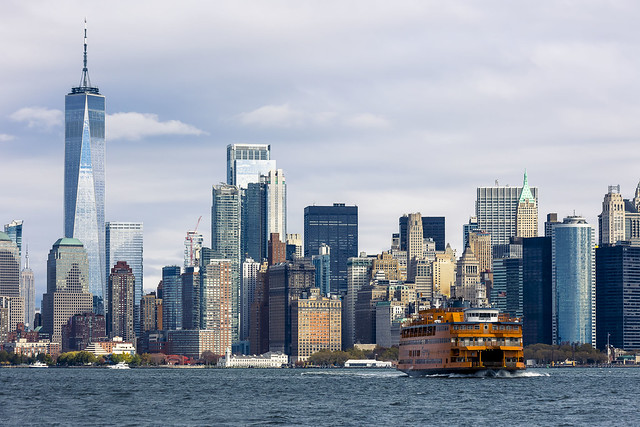
November 13th. My pal Meg Black, from Working Harbor Committee plotzed back at the start of the year. She was cremated, and another Pal – Barbara – had held onto her ashes until an appropriate moment arrived to dispose of them. Meg’s family, on the 13th, was onboard the John J Harvey Fireboat along with us – the Working Harbor Committee. Captain Huntley Gil navigated the 1931 Fireboat down the Hudson River from its home at Pier 66 to the Statue of Liberty.
This is the last time for me, riding on board the Harvey. It was Meg’s last time, too.

– photo by Mitch Waxman
Meg Black is one of the most enigmatic people I’ve ever met. Her last name describes her sense of humor, and she was one of the prime components of the Working Harbor Committee. Tireless is how she’d want me to describe her, but Meg often groaned and creeped under the burdens of her central role in the organization. She always delivered.
Another one of my little mottos is “do what you say, say what you do.” That’s could describe her, my contentious friend Meg. In the picture above, that’s a member of her family – a niece, I believe – letting her loose on New York Harbor.

– photo by Mitch Waxman
This is where the ashes were scattered.
Goodbye, old friend.
“follow” me on Twitter- @newtownpentacle
Buy a book!
“In the Shadows at Newtown Creek,” an 88 page softcover 8.5×11 magazine format photo book by Mitch Waxman, is now on sale at blurb.com for $30.


 The Newtown Pentacle