Archive for January 2011
of antique workmanship

– photo from “King’s views of New York City, A.D.1903” a public domain ebook courtesy Google Books

– photo by Mitch Waxman
Perusing the catalogs of historic photos which I routinely harvest from antiquarian sources such as the “google books” service over the holidays, I came across this image of the Stern Brothers store on 23rd street between 5th and 6th avenues in a 1903 photo survey of New York. For one reason or another, I’ve spent a lot of time marching up and down 23rd street and have always been curious about the structure (which currently houses a largish “Home Depot”).
from wikipedia
Stern Brothers was founded in 1867 by Issac, Louis and Benjamin Stern, sons of German Jewish immigrants. In 1867 they began selling dry goods in Buffalo, New York. From these humble beginnings the Stern Brothers became an important merchandising family in New York City.
In 1868 they moved to New York City and opened a one room store at 367 Sixth Avenue. In 1877 the store was again relocated to larger quarters at 110 West 23rd. Street. Outgrowing the store at 110 West 23rd. Street, Stern Brothers erected a new structure at the same location which became the new flagship store in 1878. It was noted for its cast-iron facade at 32 to 36 West 23rd. Street & 23 to 35 West 22nd. Street.
The building was designed by Henry Fernbach. It was enlarged according to a design by W.M. Schickel in 1892. The enormous, six story building was executed in the Renaissance Revival style. W.M. Schinckel’s typically 19th. century addition tripled the dimensions of the original structure on the eastern portion of the site. The tall central section of this addition animates the long and delicately detailed facade. The company’s monogram is still located above the central arch. (This structure is still in use today. The first floor houses a Home Depot, while the upper floors are showrooms.) The entire Sterns family worked in this store, which carried both luxury goods and merchandise the working classes. It was an elegant store noted for its fashionable clothes. Ladies from all over the city came to Stern Brothers for their Paris fashions. This enterprise was distinguished by its elegant door men in top hats and the generous and friendly service of the Sterns themselves.

A “longer” version of the same subject – photo by Mitch Waxman
On Tuesday, on my way to a client’s office on 23rd street to pick up a job, I made it a point of trying to find a similar vantage point to the one in the historic photo- although the 1903 version is clearly shot from the elevated landing of a staircase, or perhaps, the first story window of some long gone structure.
What remains in Manahattan these days is corporatized, commercialized, bland, and privatized- who would blame these stalwart titans of economic might for shunning and denying the requests of some shabby man with a camera who is unprofitably seeking the past?
the stinking shallows

– photo by Mitch Waxman
As mentioned in yesterday’s posting, aimless wandering around the Dutch Kills tributary of Newtown Creek was how your humble narrator spent Monday afternoon. The stealthy ones… let’s just call them Cats… pointed me in this direction, and low tide was observed.
Strewn, the 29th street roadside coast of the canal is a favored location for illegal dumping of both construction debris and putrescent garbage- which- when combined with the stagnant conditions which are typical of this water and factoring the recent snow melt…
-let’s just say that the smell here is a tangible and seemingly sentient thing.

– photo by Mitch Waxman
It was low tide when I stood there, my attentions drawn to exposed sediments and that curiously decayed steel which composes the hull of a long stranded barge- both of which are remarkable. Casting my lens around, I noticed the sickly trees adorning the filth bearing shore and began thinking about the posting “a creeping run” which was presented here- at your Newtown Pentacle- just days ago.
Hyperbolic, the post pondered the presence of organochemical mutagens in the water, swirling about in that vast cocktail of industrial runoff– whose whispered effects have been studied only as individual constituents rather than “in solution” or “in concert”- not just here, but all along that cautionary tale known as the Newtown Creek.
The trees.

– photo by Mitch Waxman
Let me state three things here…
first- “simulacra” is a term I use to describe the appearance to the human eye of patterns in organic and random shapes. Certain contrasts in entirely random shapes might suggest a “man in the moon” or a “dragon in the clouds” or “Jesus on a pancake” or “Allah’s name inside an apple” or any of the usual visual coincidences experienced by people when confronted with a well done puppet or artistically wrought doll. It’s the way our eyes and brains work, ultimately. I don’t know what other people call it, but that’s what is meant when I say it.
second- I’m a professional photo retoucher in the New York City advertising world, and routine tasks call for me to create composite images which blend multiple exposures into a single illusory image (as well as taking the mustaches off the pretty ladies). This is the creation of a lie in photographic form, featuring distortions of anatomy and removal of a subjective series of perceived flaws in the subject matter. One of the tricks of the trade is understanding how to manipulate that sense of “simulacra”. In other words, I am quite capable of faking something, photographically speaking.
third- As a statement of principle and duty to the record- the photos which occur during these postings are unaltered except for color and exposure correction and sharpening. Whenever it’s a “trick image” like an “HDR” or “stitched panorama” or “tilt shift”- I endeavor to label it as such.
The Trees.
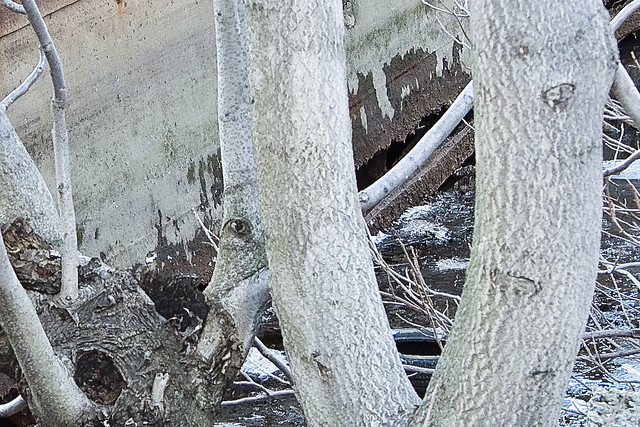
– photo by Mitch Waxman
This shot is un-messed around with, a simulacra caused by a broken branch or a parasitic infection… it must be…
For even around the malignant Dutch Kills…
Even when deeply sunken roots are drinking in some mutagenic stew of petroleum byproducts, sewage borne pharmaceutical runoff, and unmentionable organocoppers…
Even in these unmentionable and shunned waste meadows of the Creekland…
The Trees…
The Trees… are not meant to have eyes.
Guess what

– photo by Mitch Waxman
So, I went out for a walk today. My only intention was to begin carving off some of the lard which has been quickly accumulating about my midsection during the gluttonous holiday season, but found my steps drawn toward the flat marshlands of Hunters Point and Long Island City as I descended from the swollen hills of Astoria. Following my shadow, it wasn’t long before I started seeing… the Cats… again. My odd habit of turning left whenever a feline shape presents itself led me directly to the Borden Avenue Bridge…
WHICH WAS OPEN TO TRAFFIC!!!
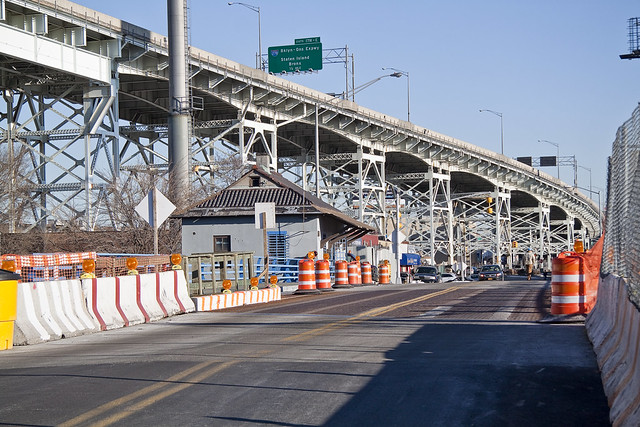
– photo by Mitch Waxman
There was still construction activity going on, but a quick check with one of the guys in high visibility colors revealed that the structure’s roadway was available. The sidewalks were still being worked on, and safety barriers were present- but the long running project seems to be nearing an end. I’m not sure if the bridge is “officially open”, but at least today it was.
Thank you, weird Cats of the Creeklands.

– photo by Mitch Waxman
I should mention that this structure is one of my favorite locations along the Dutch Kills tributary, from a photographic point of view, and an uncharacteristic giddiness seems to be filling me at the near return of a long cherished vantage point. Check out what I mean here.

– photo by Mitch Waxman
The official truth, from the NYC DOT site is:
Borden Avenue is a two-lane local City street in Queens. Borden Avenue runs east-west extending from Second Street at the East River to Greenpoint Avenue. The Borden Avenue Bridge over Dutch Kills is located just south of the Long Island Expressway between 27th Street and Review Avenue in the Sunnyside section of Queens. Borden Avenue Bridge is a retractile type moveable bridge. The general appearance of the bridge remains the same as when it was first opened in 1908. The bridge structure carries a two-lane two-way vehicular roadway with sidewalks on either side. The roadway width is 10.5m and the sidewalks are 2.0 m. The west approach and east approach roadways, which are wider than the bridge roadway, are 15.3m and 13.0m respectively. The bridge provides a horizontal clearance of 14.9m and a vertical clearance in the closed position of 1.2m at MHW and 2.7m at MLW.
As part of the construction of Borden Avenue in 1868, a wooden bridge was built over Dutch Kills. This bridge was later replaced by an iron swing bridge, which was removed in 1906. The current bridge was opened on March 25, 1908 at a cost of $157,606. The deck’s original design consisted of creosote-treated wood blocks, with two trolley tracks in the roadway. Character-defining features of this bridge include the stucco-clad operator’s house, four pairs of rails, and a rock-faced stone retaining wall. The gable-on-hip roof of the operator’s house retains the original clay tile at the upper part. Although alterations have been made, the bridge is a rare survivor of its type and retains sufficient period integrity to convey its historic design significance.
The Department of Transportation has identified a pocket of contaminated soil which has been classified as “contaminated non-hazardous”. As such, it poses no significant health risk to workers or the surrounding community. However, precautionary measures will be taken and every effort is being made to remove and dispose of the contamination quickly, yet safely, within all New York City and State guidelines. A Corrective Action Plan (CAP) for the removal and disposal of the contamination has been submitted to the NYS Department of Environmental Conservation (NYSDEC) for review and approval. Upon receipt of the NYSDEC approval, the contractor will prepare a new construction schedule and commence work under the terms of the permits. At this time, a date for the resumption of work is unknown which precludes an accurate prediction of a new anticipated completion date, although every effort will be made to complete the project in the late Fall of 2010. All posted detours will remain in effect until further notice.
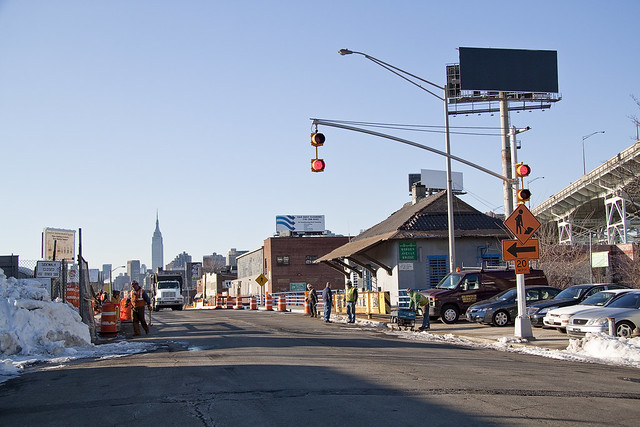
– photo by Mitch Waxman
Further official truth is found in the DOT’s Weekly Traffic Advisory of Saturday January 1, 2011 to Friday January 7, 2011
Borden Avenue Bridge over Dutch Kills (at 27th Street): This Bridge was closed December 31st 2008 for emergency reconstruction and reopened December 24, 2010 to two-way traffic. This closure was to necessitate NYCDOT Bridge major construction activity. Single lane closures will resume after January 2, 2011 to complete sidewalk and punch list work.
a creeping run

– photo by Mitch Waxman
Of late, when staring into the occluded depths of those waters which line the littoral rim of western Queens and north Brooklyn, ones’ fancies dwell on exactly what it might be that could be down there.
While my wild speculations and bizarre imaginings are fixed upon robotic submersibles and benthic monstrosities, the reality of those things which dwell below the sun kissed surface is vast. Great and metropolitan, the community of flora and fauna which underlies the harbor know nothing of political boundaries, and spread into every available crevice.
also from nycedc.com
Two separate but intermingled benthic invertebrate subcommunities have been identified in the East River on the basis of sediment hardness (Hazen and Sawyer 1983).
The hard substrate community is characterized by organisms that are either firmly attached to rocks and other hard objects (e.g., mussels or barnacles) or that build or live in tubes. Other species of polychaetes and amphipods also occur on the hard bottom surfaces, and several species utilize the East River’s hard bottoms and rapid currents by colonizing the abandoned tubes or shells of other species. The soft substrate community occurs in the more protected areas within the East River where detritus, clay, silt, and sand have accumulated in shallow, lower velocity areas near piers and pilings. Common soft substrate organisms include oligochaete worms, the soft-shelled clam Mya arenaria, and a variety of flatworms, nemerteans, polychaetes, and crustaceans (Hazen and Sawyer 1985).

– photo by Mitch Waxman
These creatures, which flip and flop and crawl through the contamination and filth at the bottom- a sort of natural selection is at work which will only allow those that might thrive in such a chemically complex environment to multiply and dominate their individual niches. Said niches, mind you, very well might be a sewer pipe, pier, or a masonry seawall concealing long forgotten chemical tanks and pipelines.
One wonders… Darwinian theory states that these environmentally catastrophic chemicals loosed in our waters are acting in a selective manner- weeding out the so called weak in favor of the so called strong, and if so- what might be evolving that can thrive in Benzene or other Petroleum products?
from nycedc.com
The hard substrate community is characterized by organisms that are either firmly attached to rocks and other hard objects (e.g., mussels or barnacles) or that build or live in tubes. Other species of polychaetes and amphipods also occur on the hard bottom surfaces, and several species utilize the East River’s hard bottoms and rapid currents by colonizing the abandoned tubes or shells of other species. The soft substrate community occurs in the more protected areas within the East River where detritus, clay, silt, and sand have accumulated in shallow, lower velocity areas near piers and pilings. Common soft substrate organisms include oligochaete worms, the soft-shelled clam Mya arenaria, and a variety of flatworms, nemerteans, polychaetes, and crustaceans (Hazen and Sawyer 1985).
In 2003, DSNY conducted field studies for the marine transfer station sites (MTS) as part of the environmental evaluation of the New York City Comprehensive Solid Waste Management Plan (DSNY 2005). Streblospio benedicti (oligochaete) was the most abundant infaunal macroinvertebrate collected in the bottom sediment of Newtown Creek near the Greenpoint MTS, with a density of 80,000 individuals per square meter. The dominant epifaunal macroinvertebrates included Corophium insidiosum (amphipods), Molgula manhattensis (sea grape), and Polydora species (polychaete worms), as well as hydrozoans, and mud and algal film. All of these organisms are tolerant of degraded environments.

– photo by Mitch Waxman
Will the future consider this barrage of environmental stressors- the PCB’s and VOC’s and PAH’s and TPH and all the rest- to have been an attempt at some kind of selective breeding- or will their children just take for granted whatever debased life is witnessed in the water in the same way that we think Cows and Chickens somehow resemble their progenitors?
Rapid environmental change leads to catastrophic extinction events, but the altered environment favors those who are left behind with little or no competition. Look at the odd species of chemosynthesizing bacteria that thrive around deep sea vents, or the bizarre Archaea speciations for examples of such specialization and deviation from the orthodox cycles of more wholesome life.
Who can guess what it is, that might be breeding down there, in the methanogenic waters of the cuprous Newtown Creek?
from epa.gov
EPA conducted an Expanded Site Investigation (ESI) of Newtown Creek in 2009 as part of the Hazard Ranking System scoring process for NPL listing under Superfund. Based on the ESI, which was focused on Newtown Creek itself and not its tributaries, EPA concluded that metals, volatile organic compounds, and semi-volatile organic compounds (including polycyclic aromatic hydrocarbons and polychlorinated biphenyls) were present in Creek sediments at elevated concentrations. The variety and distribution of the detected contaminants suggests that they originated from a variety of sources. Previous environmental investigations of Newtown Creek, or specific portions of the Creek, also disclosed that sediments in Newtown Creek are contaminated by a wide variety of hazardous substances. Environmental investigations of upland parcels adjacent to or nearby the Creek have disclosed contamination of those parcels by hazardous substances similar to hazardous substances found in sediments in Newtown Creek.

– photo by Mitch Waxman
Certain components of the liquid (English Kills is pictured above, but the water quality all along the Newtown Creek displays disturbingly heterogeneous qualities) found in Newtown Creek (the Anilines and Bromines in particular, but all the base analogs which might alter genetic structure are extant in the depths) are known to be mutagens.
A mutagen, incidentally, doesn’t simply give you cancer, nor does it turn you into an X-Man- it garbles genetic reproduction and causes errors to appear in DNA by chemically substituting one molecule for another. It turns “Newtown Creek” into “Newton Cweerk” as replication errors occur, and can ultimately spawn entirely new species over the course of a few generations.
Umm… mutagens also do cause cancer.
from The Eastern District of Brooklyn By Eugene L. Armbruster, via google books
BEYOND THE NEWTOWN CREEK
In the olden times the lands on both sides of Newtown Creek were most intimately connected. County lines were unknown, the creeks were dividing lines between the several plantations, for the reason that lands near a creek were taken up in preference to others, and the creeks were used in place of roads to transport the produce of the farms to the river, and thus it was made possible to reach the fort on Manhattan Island.
The territory along the Newtown Creek, as far as “Old Calvary Cemetery” and along the East River to a point about where the river is now crossed by the Queensboro bridge and following the line of the bridge past the plaza, was known as Dutch Kills. On the other side of Old Calvary was a settlement of men from New England and, therefore, named English Kills. The Dutch Kills and the English Kills, as well as the rest of the out-plantations along the East River, were settlements politically independent of each other and subject only to the Director-General and Council at Manhattan Island, but became some time later parts of the town of Newtown.

– photo by Mitch Waxman
Organochemistry is a subject I failed in high school, as my mathematic abilities are underdeveloped and weak. A layman’s understanding, however, is still able to conceive of certain possibilities and potentialities which can occur in the industrial witches brew of pharmaceuticals, sewage, and chemical pollution which swirls along the slime coating the Newtown Creek’s bed. There is 20 feet of the worst stuff imaginable down there, along with those blind things which wriggle about in the so called “Black Mayonnaise”. What will be found when the Federal authorities begin their work in earnest is enough to make me shudder.
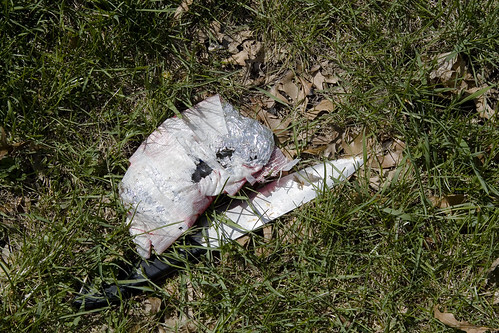
Another disconcerting observation are the little bits of sawed bone and scraps of flesh I’ve been noticing along area pathways of late- all within 100 feet of the waterline- a new and enigmatic horror, here in the Newtown Pentacle.
from nytimes.com
Long Island City is in trouble, and fully 2,000 of her citizens are almost staring death in the face. The explanation is simple. Along the line of Jackson-avenue and Newtown Creek are several bone-boiling, fertilizer, and bad-smell factories which make no pretense of conforming to sanitary laws and regulations.
with palpitant heart

– photo by Mitch Waxman
Startlingly interesting is the only way to describe the experiences of the preceding year. Attempts have been made to cogently describe and colorfully illustrate the encounters your humble narrator has enjoyed in this 10th year of the millennium. For those of you who have just recently started to read this, your Newtown Pentacle, this is your chance to check out some of the highlights of 2010 (according to me), and for the veteran Lords and Ladies of the Pentacle an opportunity to review.
If you’ll indulge me…
January, 2010- The Abbot

The sort of posting which satisfies me deeply, “The Abbot” monument found at Calvary focused my attentions on certain realities of 19th century New York, and proved my theory that Calvary Cemetery is the single greatest historical resource in Queens. Obviation of my satisfaction with the posting is provided by the admission that I had noticed the stone peripherally, found it interesting, and started shooting it with no idea at all about its meaning. Only at home, when reviewing the photos did the whole story come together. Al Smith is buried at Calvary as well (he’s the fellow who built the skyscraper seen in the night shot at the head of this post) but this paragraph is about January 2010 and Governor Smith’s story was told in 2009.
January, 2010- The Great Machine

Also in January, a pet ideation was advanced, one not of theory but of perception. The notion of the megalopolis figures heavily in my thinking- a concept that sees the eastern seaboard of the United States not as a series of cities, but rather one vast urban zone of varying densities with New York City at the titular center of a web of industry, transport, and agricultural systems. The center of the web has a center itself, which is Manhattan- specifically where it connects to “the Great Machine” of the Queensboro bridge and it’s corollaries.

– photo by Mitch Waxman
February 2010– Affordable Housing Development on Borden Avenue

This post, “Affordable Housing Development on Borden Avenue“, is included in the year end wrap up simply because it ended up being one of the more widely read and commented upon endeavors presented in 2010. Most likely, it was the linking shout out from Queenscrap that made it so, rather than any subjective quality or incisive observation. Homeless camps abound in the Newtown Pentacle, hidden away on seldom trodden lanes and along backwater pathways- in this case it’s alongside the oft delayed construction project at the Borden Avenue Bridge which spans Dutch Kills.
February 2010– horrible and unearthly ululations…

A lot of time was spent in 2010 trying to wrap my head fully around the story of the Newtown Creek (which culminated ultimately in the late October release of the first Newtown Pentacle book- Newtown Creek for the vulgarly curious) and “horrible and unearthly ululations…” was the first of several posts which attempted to boil complicated and obscure snippets of historical lore into a cohesive and accessible form. So much is made of the Greenpoint Oil Spill and the Meeker Avenue Plumes by the legal community, whose hungry jowls slaver and shake at the financial possibilities offered by the EPA’s superfund designation and various court decisions, that the true and terrible wonder of the Newtown Creek is often overlooked. This post and several others of its ilk attempt to present a fuller version of things, and act as reminders that what was may once again be.

– photo by Mitch Waxman
March 2010– The Shadow over Sunnyside

The St. Pat’s Day for All parade in Sunnyside is a yearly event which draws in a citywide coterie of political entities, all desperate for attention and attribution as being friendly to the GLTG members of the electorate. The parades origins are a reaction against the banning of outwardly gay marchers in the RC church’s own St. Patricks day parade in Manhattan. Despite its politically contentious birthing, the Sunnyside parade is actually a fun and light hearted event, and signals the coming of springtime in the Newtown Pentacle. While there principally to get shots of the political master race which rules over us, amongst the crowd I noticed small clots of dire intent armed with ugly signage. Research into this group, which was clearly coordinated and queerly ominous, revealed them to be adherents to a bastardized form of Catholic fundamentalism which has been outlawed and defined as a dangerous cult by several Nation-states. A shadow over Sunnyside indeed.
March 2010– Exhausted
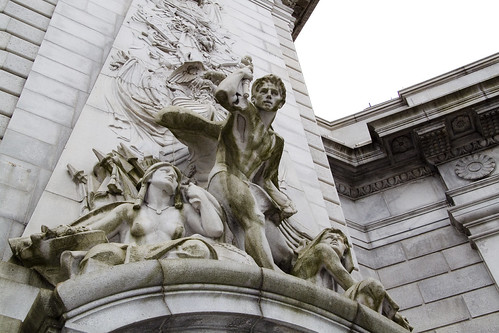
A brighter experience for your humble narrator was the Manhattan Bridge Centennial Time Capsule event, on March 5. Interactions and conversations were enjoyed by the least of men with certain powers and potentates of the City of Greater New York and entry to the interior space of the Manhattan Bridge was obtained. One of the high points of my year, “Exhausted” detailed the embedding of a time capsule in the East River Bridge #2- aka the Manhattan Bridge. Remarkable self control was exercised when I met the DOT Commissioner, Jeanette Sadik-Khan. My sincerest desire was to bend her ear with my alleged wisdom about bike lanes and bridge safety- but self control was ascendent that day and only congratulations were offered to both her and the other staffers at DOT.

– photo by Mitch Waxman
April 2010– City of Marble and Beryl
Odd shenanigans were observed at St. Michael’s Cemetery here in Astoria, which were of a decidedly magickal nature. A ritual site that your humble narrator stumbled across was examined and evidentiary examination suggested that certain third world cults were extant here in the old village of Astoria, conducting midnight bacchanals concurrent with the lunar cycle. “City of Marble and Beryl” was but the first of many moons which witnessed a working of will amongst the desolations of our kind.
April 2010– Searching for Gilman

A good part of 2010 was spent “Searching for Gilman” at First Calvary Cemetery, which I am doing as you are reading this, assuming it’s the start of 2011 whenever you do. Gilman is the source of no small amount of pain and financial hardship around these parts, as your humble narrator has become dangerously obsessive and paranoid around the subject. A psychotic need to find Gilman’s grave torments me, coloring my days and painting my dreams a dull yellow.

– photo by Mitch Waxman
May 2010– the king in yellow, brick
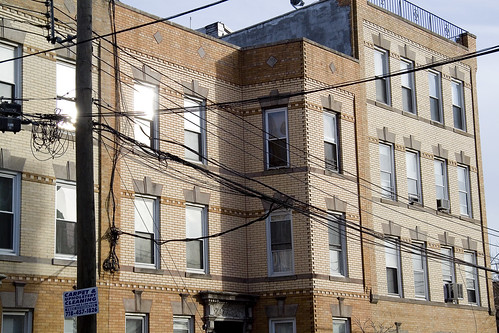
Remiss would be apparent were I to not mention the “Madison Avenue Bridge Centennial” but “the king in yellow, brick” advanced another of my pet theories and served up a fascinating (to me at least) sequence of events and relationships which attempts to explain why those yellow Kreischer bricks are all over the older sections of Queens.
May 2010– after cycles incalculable

“After cycles incalculable” is another one of those perfect posts, from a personal perspective. Wandering around with a friend, which is a disturbing trend which developed over the course of 2010, at Skillman Avenue’s start we observed the Lemuria hatching in concordance with the anniversary of the Roman festival of Lemuralia in Long Island City.

– photo by Mitch Waxman
June 2010– from Hells Gate, loosed upon the world

When I set out on my little walks, there is seldom a destination in mind. Literally wandering, obscure symbols and pseudo occultism guide my steps- I’ll follow a black cat, or merely adopt a roughly heliotropic path using my own shadow as compass. At the very end of May, my feet carried me toward Astoria Park and the notorious section of the East River known as Hells Gate. The odd craft, an “unidentified floating object” if you would, which sped past my lens required more than a small bit of detective work to identify- which was detailed in “from Hells Gate, loosed upon the world“.
June 2010– Gods Gift to Pain

English Kills, which is the logical and modern end of Newtown Creek, is a heavily industrialized and largely anaerobic tributary of the larger waterway and is seldom visited (by me, at least) at its extant. One fine day, while hanging out with another Creek enthusiast (you should not go to this place alone), we decided to enter the largely hidden urban foyer which leads here- despite the fact that we were most likely trespassing- which violates Newtown Pentacle policy. The title of the post- “Gods Gift to Pain” was lifted from an enigmatic and appropriate bit of graffiti observed in this forgotten pace of dissolution and poison.

– photo by Mitch Waxman
The reason for Brooklyn, and Queens- why it was a viable alternative to living in Manhattan in the 19th century was defined by the horrors of tenement life. The grand old buildings with their high ceilings, thick plastered walls, convenient dumbwaiters, and incredibly ornate lobbies- the structures which distinguished and made life desirable in the incalculably distant boroughs, were built as an alternative to the crowded and dangerous tenements of “The City”- especially the warren which was known as the “Five Points“. Additionally, Calvary Cemetery (of particular interest to me, and perhaps, to you) was founded by the parishioners of Old St. Patrick’s Cathedral which is smack dab in the middle of this ancient labyrinth of poverty, crime, and squalor. It was decided that to fully understand what one observes in the remains of the supposed “answer to the problem”, exploration of “the problem” itself is required.
July 2010– Bandits Roost, 2010

Ideal source material for the textural and societal milieu of the Five Points is the admittedly biased “How the Other Half Lives” by 19th century do-gooder Jacob Riis. Speaking the truth that power wants to hear is always a sound move if one considers fiscal realities and historical reputation. Attempts were made to find the modern locale in which Riis shot some of his more famous shots, such as this visit to “Bandits Roost 2010“.
July 2010– The house of Dagger John

Another critical visitation for me, as part of my larger education and study of the early development of the City of Greater New York was occasioned on the day when I went to “The house of Dagger John“. Old St. Patrick’s Cathedral satisfies both my continuing fascination with the counterpoint of sacred and profane in the story of the Megalopolis, and figures largely in the predictions of certain obscure lore which governs the schedule of my researches.

– photo by Mitch Waxman
August 2010– not to harsh anyone’s buzz… but…

August of 2010 brought a posting which garnered a lot of attention, due to curbed.com noticing and linking to it. Simply noticing that a growing proliferation of small boats were berthing illegally at the Vernon Avenue street end, it would be irresponsible of me- given everything that I know about the location not to point out the mortal and existential danger that the operators of these boats were placing themselves in. It’s not even the water, really, its the high pressure natural gas line- the enormous CSO which drains LIC- the omnipresent heavy industrial maritime traffic- which makes the spot so hazardous. Mortal threats were received via email (which I’ve kept private), and the comments thread displayed an angry and accusatory tone. As is the case with all such critique, these comments were presented verbatim- here’s a taste: “i have red your article in which you show a great deal of unger towards me and my friends . i believe that you base your article on many misconceptions that are rooted in a lack of communication”, “Blogger or not, the prudent journalist would make an effort to uncover basic facts before publishing a story full of assumptions”, “are you just the type of little man that tells teacher when the cool kids make you feel inferior. The water is public domain! And according to maritime law it is not illegal to moor a boat as long as it safe and looked after.”, “They are not bothering anyone. And get sick from the canal, come on. They are not living down there as far as I know. Parking your boat in the canal is not going to get them sick! Stop over doing it.” Check out “not to harsh anyone’s buzz… but…“.
August 2010– lively antics

One of the greatest joys of living in Queens are the chance encounters you’ll have with people who hail from the furthest points of the compass, such as this Bouzouki player during another visit to Hells Gate. His “lively antics” added splendor to a brightly lit walk around Astoria.

– photo by Mitch Waxman
September 2010– Lucky Shot

Although veteran photographers caution me against use of this term, I call the photo above my “shot of the year”. The steel structure attached to the bottom of the Brooklyn Bridge was installed as part of a bridge painting and maintenance project, and I was luckily along on a Working Harbor trip just as the sun was setting. Right place, right time, it was a “Lucky Shot“.
September 2010– stronger than fear

The dynamic new Safeboats utilized by NYPD and other entities around the harbor were a frequent subject over several of the Working Harbor expeditions I was lucky enough to attend. The many shapes, colorways, and missions of these quick little patrol boats are a delight to observe- and to those who would work maritime malice upon the metropolis- they are the head of the spear. Check out “stronger than fear“.

– photo by Mitch Waxman
A high of the year was the Newtown Creek Cruise which I had the honor of co-narrating with Bernard Ente on October 24th, of course, but the main topic of conversation amongst the antiquarian and environmental communities of the Newtown Pentacle in October revolved around the EPA’s superfund announcement about Newtown Creek at the very end of September. October is spooky time around these parts, and I spent a little time digging around the area for thrills and chills as well.
October 2010– blurred outlines

As part of series of postings detailing what might be seen in the Brooklyn neighborhood of Greenpoint, “blurred outlines” discusses the alleged appearance of a pyrokinetic at 84 Guernsey Street in January of 1895.
October 2010– scenes familiar, and loved

One of my frequent walks through Calvary Cemetery took me to the curiously empty chapel which enjoys the paramount of Laurel Hill. I will admit that I came here this day seeking two things- one was a likely entrance to a vast subterranean structure which underlies the area- the other was a vain hope that the grave of Gilman might present itself in a section which was, at the time, not terribly familiar to me as I normally stay close to the fringes of the place where the whipporwills wail. I very well might have captured what mass media paranormal media sources describe as a ghost orb in “scenes familiar, and loved“.

– photo by Mitch Waxman
November 2010– peace rests nevermore

One of the goals of this, your Newtown Pentacle, is to provide some sort of documentation about this terrible and wonderful place called the Newtown Creek- and I’m happy to say that I was there when the then Attorney General and Governor Elect Andrew Cuomo announced the settlement of a lawsuit brought by his office on behalf of New York State against Exxon-Mobil which involved the Greenpoint Oil Spill. “Peace rests nevermore” indeed.
November 2010– shocking coruscations

Entertaining maritime folklore from past centuries was offered in “shocking coruscations“, which is told against a series of twilight photos from good old Hells Gate between the two great bridges.

– photo by Mitch Waxman
During the cold, when inclement clime restricts my movements and the black dog nips at my heels, I tend toward shorter postings- and in December of 2010 there were two “Then and Now” postings that really took my fancy. These posts are difficult because of the scarce source material available in the public domain, but fun nevertheless. In my usual fashion “dumb idiot” fashion, I had shot the modern views completely unaware of the original photo. Our friends at the Greater Astoria Historic Society have recently released a book of similar historical views, which is worthy of consideration.
December 2010– Bowery Savings Bank 2010 and 1903

As the title states, this is the iconic shell of a once essential and awesomely powerful institution called the Bowery Savings Bank in Manhattan, with a 1903 photo from a similar perspective.
December 2010– Hunters Point Avenue Bridge Centennial

If you told me a year ago that I’d end up doing a press conference with a United States Congresswoman, I’d have hit you. That’s how I ended up at the Degnon Terminal’s own Sunshine Biscuits (LaGuardia Community College) building though, and by an odd coincidence- found myself standing in nearly the same spot as some unknown photographer did in 1921. This posting was built around the announcement of the “Hunters Point Avenue Bridge Centennial” event.

– photo by Mitch Waxman
Overall, a positive and exciting year, despite the deaths of several members of my family.
For a while, I enjoyed a spot on the board of the nascent Newtown Historical Society as a trustee, which is a position that I’ve had to resign for a variety of personal reasons- but I’d like to thank fellow board members Kevin Walsh, Christina Wilkinson, Steve Garza, and Bob Singleton for an interesting and educational experience. Kevin Walsh of forgotten-ny gets a personal call out, as his support, knowledge, and encouragement has been invaluable. Special thanks also are extended toward Capt. John Doswell and Meg Black of the Working Harbor Committee, all the guys and gals aboard the John J. Harvey fireboat, and everybody else who allowed a piss poor specimen such as myself to come along on adventures. Bernard Ente of the Newtown Creek Alliance, Working Harbor, and others also receives a heartfelt gratitude and shout out from this humble mendicant. Standing on the shoulders of giants is difficult if you suffer from altitude related nosebleeds.
What’s next?
Tell you what, feel like taking a walk?
Meet me at the border of Brooklyn and Queens – bring a camera… and ID… I’ll show you something cool…


 The Newtown Pentacle