Archive for April 2012
present position

– photo by Mitch Waxman
Maritime Sunday is with us once again, happening to coincide with Greek or Eastern Orthodox Easter (known as greester here in Astoria) as well as the 100th anniversary of the well known Titanic disaster. That subject will be explored by everyone else, I suspect, so instead let’s check out the scene on the Kill Van Kull.
from wikipedia
The Bayonne Bridge is the fourth-longest steel arch bridge in the world, and was the longest in the world at the time of its completion. It connects Bayonne, New Jersey with Staten Island, New York, spanning the Kill Van Kull. Despite popular belief, it is not a national landmark.
The bridge was designed by master bridge-builder Othmar Ammann and the architect Cass Gilbert. It was built by the Port of New York Authority and opened on November 15, 1931, after dedication ceremonies were held the previous day.

– photo by Mitch Waxman
These shots were captured while onboard one of the many Working Harbor Committee excursions I attended last summer, and portrays one of those summer days which New York is infamous for. Heavy clouds of humidity dangle, and inescapable temperatures render the entire archipelago in a tropical aspect.
from wikipedia
The Kill Van Kull is a tidal strait between Staten Island, New York and Bayonne, New Jersey in the United States. Approximately 3 miles (4.8 km) long and 1,000 feet (305 m) wide, it connects Newark Bay with Upper New York Bay. The Robbins Reef Light marks the eastern end of the Kill, Bergen Point its western end. Spanned by the Bayonne Bridge, it is one of the most heavily travelled waterways in the Port of New York and New Jersey.

– photo by Mitch Waxman
From this cauldron of wet heat emerged the vermillion hull of a Bouchard tug, the Frederick E Bouchard. It was returning from the gargantuan Port Newark complex, where it’s unknown mission seemed to have been accomplished.
From his first voyage at eleven years of age as a cabin boy on a sailing ship bound for China, Captain Bouchard knew that shipping would be his life. By 1915, he was the youngest tugboat captain in the Port of New York.
On July 30, 1916, while on watch of the tug C. GALLAGHER of the Goodwin, Gallagher Sand Co., Captain Bouchard witnessed the infamous Black Tom Explosion, which detonated $22 Million dollars worth of WW I munitions. Always one to set out to accomplish what few others could, he took his tug from the Long Dock at Erie Basin in Brooklyn and headed for New Jersey. Amongst continuing explosions, which blew the glass panes and lights out of his tug, he worked to rescue the 4,000-ton Brazilian steamer TIJOCA RIO, and the schooner GEORGE W. ELEZY, of Bath, ME. Later the US District Court awarded the Captain a salvage award and an additional award for personal bravery, which totaled $9,000. He quickly invested the salvage award to create his own company, Bouchard Transportation Company, which was incorporated in 1918.

– photo by Mitch Waxman
A fairly large boat, for NY Harbor at least, the tug made good time against the tide. Models like this one are used by the petroleum industry to ferry fuel barges from point to point along the waterfront, ensuring that bulk delivery of “product” to local distribution depots happens in a timely fashion.
Built in 1975, by Halter Marine of New Orleans, Louisiana (hull #437) as the Frederick E. Bouchard for Bouchard Transportation of Melville, New York.
She is a twin screw tug rated rated at 3,900 horsepower.

– photo by Mitch Waxman
Omnivorous, of course, the Frederick E Bouchard has also been personally observed handling non volatile cargos as well. You have to stay busy in the maritime industry, and cargo is cargo. The actual nature of the cargo may change, requiring special handling dictated by custom and regulations, but at the end it’s physics and profit margin that define the mission carried out by maritime professionals.
Law of Gross Tonnage
The law, which is more common sense then explicitly written in the code, goes like this: “The heavier vessel always has the right-of-way.”
This is based on simple Newtonian physics. Newton’s first law talks about objects in motion stay in motion unless another force is acted upon it. In other words, if a boat is moving a 5 mph east and you were in the vacuum of space, it would never stop traveling east at 5 mph. However, we all know when we stop our engine on our boat, we slow down.
How long it takes to go from 5 mph to zero, depends on wind, and current. Even if there was no wind or current, we’d still slow down, because the water itself provides friction upon the hull of the boat, and that in itself acts as a brake.
We all have, by observation found that the bigger the object, the longer it takes to slow down. Newton’s second law of physics talks about how the amount of force required to move an object is inversely proportional to the mass of the object.
So, if a tug and barge were traveling down a narrow channel, and you stopped your boat 1,000 feet away, right in front of the tug and barge; and, if the master of the tug saw you immediately; and if the master of the tug immediately began to stop the tug and barge; you’d have less than one minute to move your vessel.
Because if you didn’t move your vessel in less than 60 small seconds, the tug and barge would just run right over you. It would be impossible for the master of the tug to stop, based of the collective mass of both the vessel and the barge, in 1,000 feet.
The law of gross tonnage is un-relenting. It is a fact of life. What also is a fact of life, is that you should not depend on the master of the tug or any other large vessel is able to see you, either visually or on radar.

– photo by Mitch Waxman
As mentioned at the start of this post, today is Easter Sunday to adherents of the Eastern Orthodox church, but oddly enough, it coincides with a decidedly goddess based celebration which the Roman Empire celebrated called Fordicidia.
from wikipedia
In ancient Roman religion, the Fordicidia was a festival of fertility, held April 15, that pertained to animal husbandry. It involved the sacrifice of a pregnant cow to Tellus, or Mother Earth, in proximity to the festival of Ceres (Cerealia) on April 19.
On the Roman religious calendar, the month of April was in general preoccupied with deities who were female or ambiguous in gender, opening with the Feast of Venus on the Kalends. Several other festivals pertaining to farm life were held in April: the Parilia, or feast of shepherds, on April 21; the Robigalia on April 25, to protect crops from blight; and the Vinalia, or one of the two wine festivals on the calendar, at the end of the month. Of these, the Fordicidia and Robigalia are likely to have been of greatest antiquity. William Warde Fowler, whose early 20th-century work on Roman festivals remains a standard reference, asserted that the Fordicidia was “beyond doubt one of the oldest sacrificial rites in Roman religion.”
Project Firebox 40

– photo by Mitch Waxman
At the edge of nowhere in Maspeth, this noble soldier of the realm sits on the truncated remains of the Jamaica and Newtown Turnpike, which was once carried the Maspeth Plank Road over Newtown Creek. A no mans land of trucks, industrial concerns, and desolation, the corner it polices is one seldom travelled except by those of us drawn to the mysteries of the Creeklands. In the distance, one can discern the Freedom Tower rising in the Shining City.
mighty dome

– photo by Mitch Waxman
Queensboro beckons as always, when business in the Shining City calls. It is best not to muse about Friday the 13th of April, which is one of those special dates which have been remarked upon in the past at this- your Newtown Pentacle, rather than engage in simple triskaidekaphobia. Simply put, there are certain dates on the calendar during which momentous events just seem to cluster. Births, deaths, the fall of empires. For instance, in 1204 AD, Crusaders conquered Constantinople, eradicating the joy which the date had brought to the citizenry of the Eastern Roman Empire (the Romoloi, as they would have called themselves) as the anniversary of the death of a legendary King of the Bulgars and implacable enemy of the second Rome- Krum the Horrible- who died in 814 AD.
from wikipedia
While Nikephoros I and his army pillaged and plundered the Bulgarian capital, Krum mobilized as many soldiers as possible, giving weapons even to peasants and women. This army was assembled in the mountain passes to intercept the Byzantines as they return to Constantinople. At dawn on July 26 the Bulgarians managed to trap the retreating Nikephorus in the Vărbica pass. The Byzantine army was wiped out in the ensuing battle and Nikephorus was killed, while his son Staurakios was carried to safety by the imperial bodyguard after receiving a paralyzing wound to the neck. It is said that Krum had the Emperor’s skull lined with silver and used it as a drinking cup.

– photo by Mitch Waxman
This is the birthday of Thomas Jefferson and Butch Cassidy, and the traditional New Years day in Laos, Cambodia, and Thailand- referred to as Chaul Chnam Thmey in Khmer, Songkan in Laotian, and Songran in Thai. Additionally, this is the anniversary of an oxygen tank exploding on the Apollo 13 spacecraft in 1970, while enroute to the moon.
from wikipedia
Apollo 13 was the seventh manned mission in the American Apollo space program and the third intended to land on the Moon. The craft was launched on April 11, 1970, at 13:13 CST from the Kennedy Space Center, Florida, but the lunar landing was aborted after an oxygen tank exploded two days later, crippling the service module upon which the Command Module depended. Despite great hardship caused by limited power, loss of cabin heat, shortage of potable water, and the critical need to jury-rig the carbon dioxide removal system, the crew returned safely to Earth on April 17.

– photo by Mitch Waxman
Handel’s Messiah was performed for the first time in 1742, Fort Sumter surrendered to Confederate forces in 1861, starting the American Civil War. All of this, and lots more, happened on April 13th, which in 2012 falls on a Friday. None of these events though, explain the crude cruciform graffiti recently observed on the Queensboro Bridge pedestrian walkway.
from wikipedia
The Queensboro Bridge is a double cantilever bridge, as it has two cantilever spans, one over the channel on each side of Roosevelt Island. The bridge does not have suspended spans, so the cantilever arm from each side reaches to the mid-point of the span. The lengths of its five spans and approaches are as follows:
- Manhattan to Roosevelt Island span length (cantilever): 1,182 ft (360 m)
- Roosevelt Island span length: 630 ft (190 m)
- Roosevelt Island to Queens span length (cantilever): 984 ft (300 m)
- Side span lengths: 469 and 459 ft (143 and 140 m)
- Total length between anchorages: 3,724 ft (1,135 m)
- Total length including approaches: 7,449 ft (2,270 m)

– photo by Mitch Waxman
Perhaps the folks in the Shining City know something about what might be lurking in Western Queens, scuttling about in the night, and have opted to install wards and sigils on the crossing to keep it out of Manhattan.
from wikipedia
The term sigil derives from the Latin sigillum, meaning “seal”, though it may also be related to the Hebrew סגולה (segula meaning “word, action, or item of spiritual effect, talisman”). The current use of the term is derived from Renaissance magic, which was in turn inspired by the magical traditions of antiquity.
In medieval ceremonial magic, the term sigil was commonly used to refer to occult signs which represented various angels and demons which the magician might summon. The magical training books called grimoires often listed pages of such sigils. A particularly well-known list is in The Lesser Key of Solomon, in which the sigils of the 72 princes of the hierarchy of hell are given for the magician’s use. Such sigils were considered to be the equivalent of the true name of the spirit and thus granted the magician a measure of control over the beings.
dull wonder

– photo by Mitch Waxman
Ongoing observations of the FedEx construction project at Dutch Kills are impossible for your humble narrator to avoid, as my daily travels often necessitate that my incessant marching carry me past the place. Luckily, recent phases of the project have created lapses in the fencing around the site which have allowed visual access that doesn’t require climbing upon or dangling from either traffic signals or the Long Island Expressway.
from dutchkillscivic.com
In 1642, licenses were granted to some Dutch citizens to settle in Queens. “Kill” is a Dutch word meaning “little stream.” Since Dutch men settled around the “Kill,” (in Long Island City) the name Dutch Kills was adopted. The “Kill” (or stream) is a tributary of Newtown Creek, which divides Queens from Brooklyn.
During the Revolutionary War, British troops were billeted in a series of farmhouses on 39th Avenue (Beebe Avenue). These houses stood until 1903 when they were torn down to make way for the railroad. In the early 1900’s the Queensborough Bridge was opened. Proximity to Manhattan, presence of railroads, and Long Island all contributed to the importance of Dutch Kills.

– photo by Mitch Waxman
I’ve conducted a few private walking tours of the area around Dutch Kills in recent weeks, mainly for groups of European and American students, many of whom were aghast at the scale of this endeavor and stunned by the lack of dust abatement going on. Wisely, several of them held handkerchiefs to their mouth and nose while walking by.
from wikipedia
Dust abatement refers to the process of inhibiting the creation of excess soil dust, a pollutant that contributes to excess levels of particulate matter.
Frequently employed by local governments of arid climates such as those in the Southwest United States, dust abatement procedures may also be required in private construction as a condition of obtaining a building permit.
Dust abatement methods include the regular spraying of water on loose dirt in construction sites, the paving of or applying magnesium chloride to dirt roads, and restricting access to dusty areas.
Abatement oil (an organic, lubricating and penetrating oil) most commonly used to remove debris such as dust and asbestos. Application of this product is normally done by lathering onto the surface and then removing with a clean dry cloth.

– photo by Mitch Waxman
One of the things which I’m growing increasingly apprehensive about is the “occupational exposure” to the endemic pollutants surrounding and suffusing the Newtown Creek waterway. As mentioned in earlier postings, when visiting a sewer plant I no longer react to the smell and consider a visit to a Waste Transfer station on the banks of English Kills to be a pleasurable diversion.
The sudden illness and death of my friend and mentor Bernie Ente a year ago weighs heavily on my mind even now, and little doubt exists in my mind that the Creek had at least a tangential role in his decline.
from wikipedia
An occupational exposure limit is an upper limit on the acceptable concentration of a hazardous substance in workplace air for a particular material or class of materials. It is typically set by competent national authorities and enforced by legislation to protect occupational safety and health. It can be a tool in risk assessment and in the management of activities involving handling of dangerous substances. There are many dangerous substances for which there are no formal occupational exposure limits. In these cases, control banding strategies can be used to ensure safe handling.

– photo by Mitch Waxman
In the world of the Newtown Creek- where the very air you breathe is a poisonous fume, where sickly trees fed by a morbid nutrition struggle to burst forth from the shattered cement, where the water is a sickly shade of antifreeze green, and where every surface is coated with a queer and iridescent “colour”- what strange and undesirable substance might be carried by the lightest of breezes?
Who can guess all there is, that might be buried down there, which has been granted freedom?
from dec.ny.gov
To protect humans and the environment from damage by air pollution, DEC continually measures levels of pollutants in the air. DEC regularly reports the results of these measurements — in the case of ozone, which at high levels can be a threat to human health, the results and predicted pollution levels are reported in real time, on DEC’s website and through broadcast media.
DEC measures air pollutants at more than 80 sites across the state, using continuous and/or manual instrumentation. These sites are part of the federally-mandated National Air Monitoring Stations Network and the State and Local Air Monitoring Stations Network. Real time direct reading measurements include gaseous criteria pollutants (ozone, sulfur dioxide, oxides of nitrogen, carbon monoxide), PM2.5 (fine particulate with diameter less than 2.5 microns), and meteorological data. Filter based PM2.5, lead, and acid deposition samples are collected manually and shipped to the laboratory for analysis.
Monitoring air for pollutants is a complex technical task, requiring not only direct measurement, but also measurement standards and quality assurance to ensure that the information provides a correct understanding of air quality in New York State. Ambient air quality reports provide the data and interpretations to the technical community and the public.

– photo by Mitch Waxman
These concerns about exposure to the poisons of the watershed have been expressed to the team of medical professionals who keep my health at delicate balance. Queries are advanced from this group of doctors as to why I just can’t leave this place to its own devices and disposition. What compulsion is it that drives one time and again to venture into this veritable lions den of carcinogens, corrosives, and environmental corruption?
from wikipedia
In human context, self-destructive behaviour is a widely used phrase that conceptualises certain kinds of destructive acts as belonging to the self. It also has the property that it characterises certain kinds of self-inflicted acts as destructive. The term comes from objective psychology, wherein all apparent self-inflicted harm or abuse toward oneself is treated as a collection of actions, and therefore as a pattern of behaviour.
Acts of “self-destruction” may be merely metaphorical (“social suicide”) or literal (suicide). Generally speaking, self-destructive actions may be deliberate, born of impulse, or developed as a habit. The term however tends to be applied toward self-destructions that are potentially habit-forming or addictive, and are thus potentially fatal.

– photo by Mitch Waxman
Simply put, it has become my belief that if Newtown Creek and it’s tributaries can “be solved”, a thorough understanding of the problem- both historical and modern- will be required. Such a magnificent puzzle as the one this place represents, located at the very navel of New York City, might offer a solution to larger national puzzles. It’s my hope that in some small way, this blog can help to “connect the dots” when somebody far more intelligent than myself applies themselves to the issue in the future.
The answer won’t be offered by me, of course, as I must always remain an outsider cursed to watch and record but never to participate in such things.
from wikipedia
The optimisism bias (also known as unrealistic or comparative optimism) is a self-serving bias where an individual perceives that they are less at risk of experiencing a negative event compared to others. The optimistic bias is seen in a number of different scenarios, including causing individuals to believe that they are less at risk of being a victim of a crime, smokers to believe they are less likely to contact lung cancer or disease than other smokers, and even first-time bungee jumpers believe that they are less at risk of an injury than other jumpers. Although this bias occurs in both positive and negative events, there is more research and evidence that the bias is stronger for negative events. However, there are different consequences that come from these events: positive events often result in feelings of well being and self-esteem, while negative events lead to consequences with more risk, such as engaging in risky behaviors and not taking precautionary measures. The optimistic bias can also be viewed in terms of expectancies about specific events
tones and accents

– photo by Mitch Waxman
Sauntering suspiciously through the hinterlands of Maspeth, along the malign fence lines of Rust Street, your humble narrator suddenly sensed a cacophony of ringing bells which occluded all reason. Assuming that one of my states was coming on, those hours of panic and terror brought on by a weakened constitution and the numerous afflictions which plague me, my first instinct was to monitor both pulse and temper.
Suddenly I realized that this ringing in my ears, now accompanied by a clattering and approaching ruckus, heralded the nearness of a train!
Note: Train folks, if you’ve got anything to say or link to regarding the actual model of locomotive, please use the comments link for this post. Every time a train photo is displayed here, I get at least a couple of emails telling me something cool about the locomotive. Please share, and leave a comment.
A
from wikipedia
Tinnitus can be perceived in one or both ears or in the head. It is usually described as a ringing noise, but in some patients, it takes the form of a high-pitched whining, electric buzzing, hissing, humming, tinging or whistling sound, or as ticking, clicking, roaring, “crickets” or “tree frogs” or “locusts (cicadas)”, tunes, songs, beeping, sizzling, sounds that slightly resemble human voices or even a pure steady tone like that heard during a hearing test. It has also been described as a “wooshing” sound, as of wind or waves. Tinnitus can be intermittent, or it can be continuous, in which case it can be the cause of great distress. In some individuals, the intensity can be changed by shoulder, head, tongue, jaw, or eye movements.

– photo by Mitch Waxman
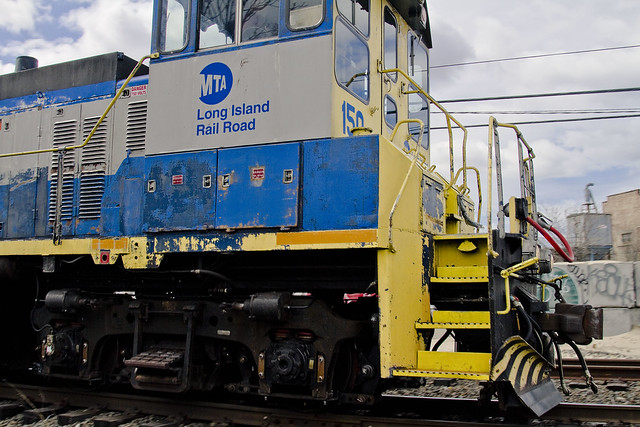
This was once one of the busiest stretches of rail in New York, let alone the United States. The Long Island Railroad (in its various guises, incarnations, and corporate forebears) have maintained their “road” here since the 1860’s. A shame, these tracks are a shadow of their former self and it’s not all that frequently that one sees traffic along the route. Hurling myself across the busy truck route, your humble narrator quickly sprang onto that fence which vouchsafe the track from trespass and interference, and whipped out the camera and began clicking away.
from wikipedia
The LIRR chartered the New York and Jamaica Railroad on September 3, 1859, and a supplement to the LIRR’s charter passed March 12, 1860 authorized it to buy the NY&J and extend to Hunters Point. The LIRR carried through with the NY&J purchase on April 25, along with the purchase of a short piece of the Brooklyn and Jamaica at Jamaica, and the next day it cancelled its lease of the Brooklyn and Jamaica, but continued to operate over it. The Brooklyn Central and Jamaica Railroad, a consolidation of the B&J with the new Brooklyn Central Railroad, began operating from South Ferry over the top of the tunnel, along the B&J tracks to Flatbush Avenue, and south on the new Fifth Avenue Line in August 1860. The new line to Hunters Point was officially opened on May 9, 1861, with regular service starting May 10. A ferry connection (Hunter’s Point Ferry) was initially advertised to James Slip; connecting boats began running to East 34th Street Pier in October. he BC&J soon began operating horse cars over the old line from South Ferry, connecting with LIRR trains at Jamaica. The tunnel was closed off in December.
– photo by Mitch Waxman
This double engine was hurtling along, which was somewhat remarkable. When I do see trains along this route, 9 times out of 10 they are NY & Atlantic freight trains which lumber along at a fairly tepid pace compared to this blue and gold comet which roared past me. Sadly, a diminished capacity for joy and low threshold for excitation allow one to consider the witnessing of this passing locomotive to be the high point of the day. Juvenile in character despite advanced years, it does not take much to impress one such as myself.
from wikipedia
Federal regulators limit the speed of trains with respect to the signaling method used. Passenger trains are limited to 59 mph and freight trains to 49 mph on track without block signal systems. (See dark territory.) Trains without “an automatic cab signal, automatic train stop or automatic train control system” may not exceed 79 mph. The order was issued in 1947 (effective 31 Dec 1951) by the Interstate Commerce Commission following a severe 1946 crash in Naperville, Illinois involving two Chicago, Burlington & Quincy Railroad trains. Following the 1987 Chase, Maryland train collision, freight trains operating in enhanced-speed corridors have been required to have locomotive speed limiters to forcibly slow trains rather than simply alerting the operator with in-cab signals. The signal panel in the Maryland crash had been partially disabled, with a muted whistle and a missing light bulb.

– photo by Mitch Waxman
Undoubtedly, as these tracks lead toward the Long Island City yard- which offers connections to both Manhattan and the gargantuan Sunnyside Yard- it is impossible to speculate on their final destination, but these engines were headed to somewhere in Long Island City.
for more on the twisting trackways of the Montauk Cutoff, check out this trainsarefun.com page

– photo by Mitch Waxman
On the Queens side of the Newtown Creek, a loathsome flood plain typified by concreted devastation and the relicts of the industrial revolution, the Long Island Railroad has long been the proverbial “800 pound gorilla” and as such- goes wherever it wants to go.
For visual orientation to more familiar locales, notice that dagger in the heart of Queens- the Sapphire Megalith- embedded in the innocent soil of Court Square in LIC, or the distant Freedom Tower under construction in lower Manhattan.
from wikipedia
“800 pound gorilla” is an American English expression for a person or organization so powerful that it can act without regard to the rights of others or the law. The phrase is rooted in a riddle:
“Where does an 800 lb. gorilla sleep?”
The answer:
“Anywhere it wants to.”
Also,

Obscura Day 2012, Thirteen Steps around Dutch Kills
April 28th, 10 a.m.
Your humble narrator will be narrating humbly at this year’s Obscura Day event on April 28th, leading a walking tour of Dutch Kills. The tour is already half booked up, and as I’m just announcing it, grab your tickets while you can.
“Found less than one mile from the East River, Dutch Kills is home to four movable (and one fixed span) bridges, including one of only two retractible bridges remaining in New York City. Dutch Kills is considered to be the central artery of industrial Long Island City and is ringed with enormous factory buildings, titan rail yards — it’s where the industrial revolution actually happened. Bring your camera, as the tour will be revealing an incredible landscape along this section of the troubled Newtown Creek Watershed.”
For tickets and full details, click here :
obscuraday.com/events/thirteen-steps-dutch-kills-newtown-creek-exploration


 The Newtown Pentacle