Archive for 2012
sepulchral resonances
“follow” me on Twitter at @newtownpentacle

– photo by Mitch Waxman
As mentioned earlier this week, a recent rip to St. Michael’s cemetery was accomplished on a lovely autumnal afternoon. Affinity for morbid settings notwithstanding, area cemeteries provide one with a peaceful and introspective interlude, free of the nonstop noise which typifies an existence in western Queens. Back home in Astoria, a never ending series of auditory distractions roll past beneath my windows and often elucidated is a desire for a few minutes of quiet. The well tailored grounds and open sight lines of the graveyard serve this purpose, and I was quite alone on this particular day, except for a rough looking trio who were celebrating a cannabis charged tribute to some departed compatriot.
The original property for St. Michael’s Cemetery was purchased in 1852 by the Rev. Thomas McClure Peters and occupied seven acres. Over the years St. Michael’s gradually acquired additional land to its present size of approximately eighty-eight acres. Because it was Dr. Peters’ intention to provide a final dignified resting place for the poor who could not otherwise afford it, areas within the cemetery were assigned to other free churches and institutions of New York City. These areas are still held for the institutions they were assigned.

– photo by Mitch Waxman
While wandering about, I noticed this magnificent sepulchral portrait attached to a small monument. A once common practice, attaching a photographic portrait of the departed to their monument was accomplished by transferring the image to a ceramic matrix. Modern day mourners seem to be reviving the practice, although modern digital printing techniques involving the four color printing process and laser etching of the monument itself seem to be the preferred fashions. It offends some, referring to such practice as fashion- but if you spend as much time in cemeteries as I do- you discern certain typographic, linguistic, and symbolic patterns which seem to go in and out of vogue. For example- Obelisks, mausolea, usage of footstones or curbs, foliated columns, portraits etc.
The particular sepulchral portrait depicted in these shots is of Maria Concetta Niosi in life. 27 years old, she died on the 1st of April in 1919.
from thehistorychannelclub.com
In 1854 two French inventors patented a method for fixing a photographic image on enamel or porcelain by firing it in a kiln. These “enamels” were used for home viewing well into the 20th century, when the more convenient paper photos replaced them. The custom of attaching ceramic photos to tombstones spread throughout Southern and Eastern Europe and Latin America. In the late 19th and early 20th centuries, Italian and Jewish immigrants brought this practice to the United States. “Ceramic photo portraits . . . represent the first period in the history of gravestone manufacture in the United States when intense personalization became available—and affordable—on a large-scale basis,” says Richard E. Meyer, a professor at Western Oregon State College who has studied American cemeteries for more than 25 years. During the first decade of the 1900s, Sears-Roebuck advertised: “Imperishable Limoges porcelain portraits preserve the features of the deceased . . .” At “$11.20 for a photograph set in marble, $15.75 for one set in granite,” these portraits “competed with the cost of many burial plots.”

– photo by Mitch Waxman
Evidence of her life in the United States is scant, and although I have managed to find two people with similar names who appeared at the Ellis Island immigration facility- neither seems to fit the bill as being this individual. Perhaps Niosi was a married or assumed name she gained after immigration, or perhaps she came to the United States via Baltimore or Boston (with NY, all three were common ports of entry for the Italians).What struck me, other than the haunting image of a clearly formidable woman, was the pure physical size of this portrait. Normally, a sepulchral portrait is of a small oval or round shape and seldom larger than a modern 4×6 inch photographic print. The Niosi plaque was large, the size of a sheet of common day letter sized paper. This would have cost a small fortune in 1919, several times the price of the actual grave, and yet it was attached to this meager and barely noticeable stone marker.
Who was this woman?
rough handling
“follow” me on Twitter at @newtownpentacle
– photo by Mitch Waxman
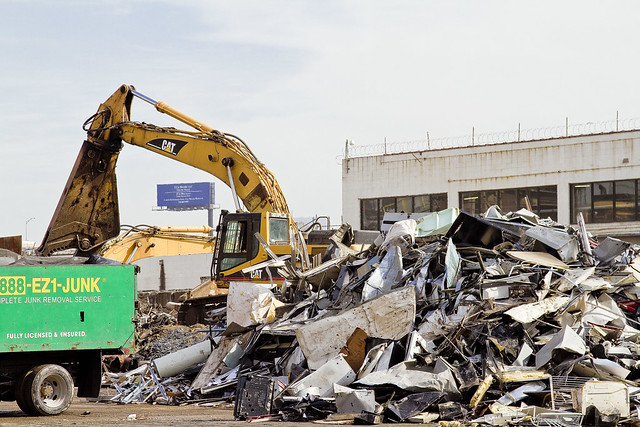
Rejoice, for this is the day when men and women return to their ancestral villages and seaside hamlets, gathering beneath cobbled roofs and behind garret windows to celebrate “America Recycles Day”. Children shall be offered solemn pledges and vast ritual amalgamations of litter will be assembled for display and dissemination. Many and varied will be the manifestations of this occasion, which is ultimately rooted in the solemn traditions set down by a group known as “Keep America Beautiful”.
from wikipedia
America Recycles Day (ARD) is the only nationally recognized day dedicated to encouraging Americans to recycle and buy recycled products. ARD is celebrated annually on November 15. The World Recycling Day celebrated in most countries, though falls on July 8. Thousands of events are held across the U.S. to raise awareness about the importance of recycling and to encourage Americans to sign personal pledges to recycle and buy products made from recycled materials.

– photo by Mitch Waxman
Gaze in astonished wonder at the industry of man, and the tyranny of wealth. Imagine, if you would, the raw tonnages of refined metals displayed in these shots. Surely, just in today’s posting, we are seeing a greater amount of waste metals than an entire nation might be capable of producing just a scant 200 years ago. We waste so much, and our culture- if nothing else- will prove itself a boon to future archaeologists.
The multitudinous middens of the megalopolis, well moistened with motor oil, will stand as our monument.
from wikipedia
Keep America Beautiful was founded in 1953 by consortium of American businesses (including founding member Philip Morris, Anheuser-Busch, PepsiCo, and Coca-Cola) nonprofit organizations, government agencies, and concerned individuals in reaction to the growing problem of highway litter that followed the construction of the Interstate Highway System, and an increasingly mobile and convenience-oriented American consumer. The original goal of the organization was to reduce litter through public service advertising (PSA) campaigns.
Keep America Beautiful conducted many local PSA campaigns early in its history. One of these early campaigns in Pennsylvania (PENNDOT), some attribute to having coined the term “litterbug”, as opposed to the New York Transit Authority. There is some confusion over the origin of the actual word “litterbug” due to several early uses of it in widespread public service advertisements. It was, in fact, coined by Paul B. Gioni, a copywriter in New York City who originated it for The American Ad Council in 1947. Keep America Beautiful joined with the Ad Council in 1961 to dramatize the idea that every individual must help protect against the terrible effects litter has on the environment.
A popular television campaign theme in 1963, with copy written by Paul B. Gioni who also coined the word “litterbug” in 1947, was “Every Litter Bit Hurts”. Another appeared in 1964 featuring character Susan Spotless. In 1970 KAB began distributing a free brochure; more than 100,000 copies were requested within 4 months.
On Earth Day 1971, a new campaign was launched with the theme “People Start Pollution. People can stop it” featuring the now iconic “Crying Indian” played by Iron Eyes Cody.

– photo by Mitch Waxman
Amongst those who tolerate my presence, some work in the recycling industry. A missive they ask a humble narrator to transmit reads as: “Recycle. Please. Don’t do it for us and our business, do it for your kids”. They continue that it’s probably already too late, and that the future is trashed. Perhaps, just perhaps, they are wrong. Until the ultimate answer is found to this disposables issue, they are likely being far more pragmatic than the rest of us. It is they, after all, who see the trucks tipping and collecting, and spend more time than they would like handling putrescent garbage as a loss leader.
Figuring out when, where and how to recycle in your community couldn’t be easier. Log on to www.americarecyclesday.org and select the “Find Recycling” tab and click on the Earth911.com logo. This will direct you their recycling resource page, where you can enter the item type and your zip code to find the nearest recycling facility.

– photo by Mitch Waxman
By no means should this humble narrator be considered a creature of primal intelligence, good hygiene, or high moral turpitude. Neither should it be inferred that the role of exemplar is claimed, as far as the contributions of my own household to the problem. A lone and singular advantage is that I am instead smart enough to realize how smart I’m not, and realize the shallow depths of my grasp on the situation. Around here, we just try not to be too loose with using things that can’t be washed, or reused, or cross purposed. How about you?
from wikipedia
Recycling statistics:
- 251 million – tons of trash in the United States
- 53.4 – percentage of all paper products recycled in the United States
- 32.5 – percentage of total waste that is recycled in the United States
- 100 – approximate percentage of increase in total recycling in the United States during the past decade
- 8,660 – number of curbside recycling programs in the United States in 2006
- 8,875 – number of curbside recycling programs in the United States in 2003
- 95 – percentage of energy saved by recycling an aluminum can, compared with manufacturing a new one
- 4.6 – pounds of trash per person per day in the United States (most in the world)
- 1.5 – pounds of recycled materials per person per day in the United States
common superstition

– photo by Mitch Waxman
Things have been relatively quiet over in St. Michael’s cemetery of late. The declaration refers to the lack of occultist activity, documented in earlier posts, at a certain spot which is high on a hill that has served some unknown individual in the past as an altar- likely in accordance with one of the syncretic Afro Cuban religions adhered to by many of the new neighbors in Queens who hail from the Caribbean and South American locales.

– photo by Mitch Waxman
The week before Halloween, and Sandy, your humble narrator walked over to the polyandrion and surveyed the scene. By all appearances, there was little to report, with the exception of extraordinarily deep ruts in the ground thereabouts. By all appearances, it seemed that something quite heavy stood here.

– photo by Mitch Waxman
The ruts were in a roughly tripodal configuration, with a fourth that was not quite as deep. Other than this puzzling series of indentations, no bottles of fluid nor the presence of melted candles was detected. How I would love to set up a camera nest in a nearby tree on the night of a full moon, and witness what this unknowable cultist gets up to, but one does not hang around in cemeteries after the burning thermonuclear eye of god itself has set into the western sky. Not here, in the Newtown Pentacle.
“follow” me on Twitter at @newtownpentacle
ache horribly

– photo by Mitch Waxman
Down Under the Greenpoint Avenue Bridge Onramp, or DUGABO as I call it, on the Queens side of the loquacious Newtown Creek, is found south of the tracks of the Long Island Railroad. A largish industrial footprint, whose boot heels were dug into the swampy soil as early at the 1830’s, both describes and damns the area. The ghosts of fat renderer and yeast brewery alike haunt the spot, as does your humble narrator.

– photo by Mitch Waxman
Wandering around down here recently, this intriguing bit of graffiti was observed. I’ve seen such markings before, over on Dutch Kills Street nearby Queens Plaza. It’s unusual mainly because of the figurative nature of the illustration, most area graffiti tends to be gang oriented, typographical in nature, or features the usage of a stylized and highly practiced logo or “tag”.

– photo by Mitch Waxman
Deeper meanings and interpretation are best left to curators and wonks, but I for one like the drawing. The text betrays the twee irony of the hipsters, in my opinion. Always remember, lords and ladies, I go to these places so you don’t have to.
“follow” me on Twitter at @newtownpentacle
engulfing mist

– photo by Mitch Waxman
Another victim of Sandy seems to have been the Old Orchard Shoal Lighthouse, which according to Coast Guard reports, has been scoured away from its century long occupation in Great Kills.
Wo.
Lighthouses are amongst the most resilient structures mankind can produce, and this thing reliably weathered the entire 20th century.
I will say it again- Wo.
from workingharbor.wordpress.com
The US Coast Guard has confirmed the total loss of the Old Orchard Shoal Light off Great Kills Beach, Staten Island. The historic structure was swept away by Hurricane Sandy on October 29, 2012.

– photo by Mitch Waxman
My pal Mai Armstrong, known to you Lords and Ladies of the Pentacle as “far eastern correspondent Armstrong”, beat me to the punch on this news.
She has been writing the fantastic Working Harbor Committee blog for a while now, linked to above. She also has shots of the aftermath at the post linked to above.
from wikipedia
Old Orchard Shoal Light was completed and lit on April 25, 1893.
The Fresnel lens was removed in 1950.
Before moving on to Governor’s Island and then finally Coney Island Light, Frank Schubert, said to be the last civilian lighthouse keeper in the United States, was stationed at Old Orchard Shoal Light.
Old Orchard Shoal Light is listed on the National Park Service’s Maritime Heritage Program as Lighthouse to visit [6] and as one of New York’s Historic Light Stations.
On May 29, 2007, the Secretary of the Interior identified Old Orchard Shoal Light Station as surplus under the National Historic Lighthouse Preservation Act of 2000. The property was described as Gedney Channel/Lower New York Bay, 3.5 miles south of New Dorp Beach. Remote 35 ft. conical, 3-story “spark plug” style light (1893) with keeper’s quarters (approx. 1000 SF). Interior lined in brick up to 3rd floor. On 0.72 acre submerged land. Constructed of cast iron on concrete/cast iron caisson. Markings: white upper/black. Protective riprap and breakwater sheltering light’s boat basin. Accessible by boat only.”
“follow” me on Twitter at @newtownpentacle


 The Newtown Pentacle