Archive for 2012
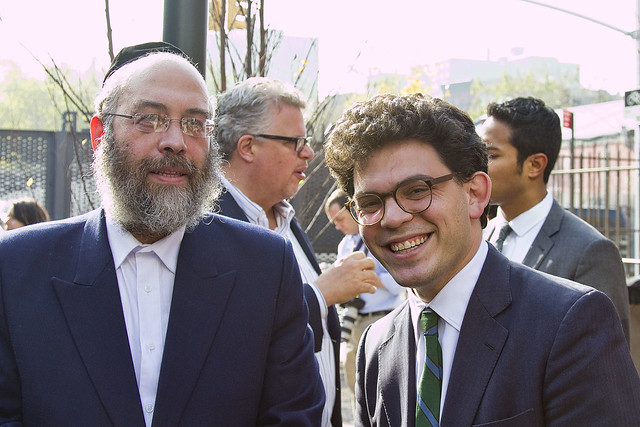
Lincoln Restler

– photo by Mitch Waxman
A statement which I make constantly is that “abstention from political intrigue and partisanship is both necessary and prudent”. Nevertheless, one must call attention to one of the candidates vying for the office of “State Committeeman” in the 50th district.
Lincoln Restler is seeking reelection, and against difficult odds at that. I know this man, and hope that any of you within his district consider him as your choice for the office. The election will be held on Thursday the 13th of September.
– photo by Mitch Waxman
As mentioned in the past, staying abreast of the story of the Newtown Creek and the communities surrounding it have carried me to literally hundreds of public events and meetings over the last few years. A familiar face at these multitudinous gatherings, Mr. Restler is not your typical politician, and he has earned more than just my respect. I consider him to be worthy, upright, and exactly the sort of man whom you’d hope would enter public life. Whether it be his efforts at “saving the g train”, his advocacy for the residents of public housing, or just trying to bring a supermarket into Fort Greene- Lincoln is always on the side of the community and his style is never “politics as usual”.

– photo by Mitch Waxman
To be clear, this is the opinion of Mitch the private citizen, who cannot vote for the fellow I’m endorsing as I live in a different district, but my interest in the contest is sparked by… well let’s just say that one of the borders of this election district has a certain Creek running through it which is near to my heart.
I wish that we had “a Lincoln Restler” in Queens, and I’m sure his political opponents wish he was here too. Lincoln is a heck of a guy, hard working with a good heart, and if you live anywhere in North Brooklyn- Lincoln is always on your side.
A “real mensch” as my grandmother would have said.
ruined palaces

– photo by Mitch Waxman
Attempts to “take it easy” for a week or two at the end of the summer, coupled with the puzzling virus which hampered all egress to joy, have left your humble narrator in a state of quivering misery. Downtrodden by vast physical inadequacies, failing organs, and a certain sense of ennui- nowhere is nepenthe to be found. Truly- I’m all ‘effed up. Crises, both existential and supranormal, abound.
from wikipedia
Within the framework of the post-Classic cycle of thirteen katuns (the so-called ‘Short Count’), some of the Yucatec Books of Chilam Balam present a deluge myth describing the collapse of the sky, the subsequent flood, and the re-establishment of the world and its five world trees upon the cycle’s conclusion and resumption. In this cosmic drama, the Lightning deity (Bolon Dzacab), the Earth Crocodile (Itzam Cab Ain), and the divine carriers of sky and earth (the Bacabs) have an important role to play. The Quichean Popol Vuh does not mention the collapse of the sky and the establishment of the five trees, but focuses instead on a succession of previous mankinds, the last of which was destroyed by a flood.

– photo by Mitch Waxman
A very bad thought, the sort of tormenting suspicion which instructs and informs madness, infects my mind. There are certain questions which should never even be asked, lest they be answered. Forbidden knowledge is prohibited for a reason, there are some things you cannot unlearn- like what the term “sediment mounds” connotes. The actions of others, with their unknowable motivations, rain random and unpredictable consequences into my days.
from wikipedia
There is a long philosophical and scientific history to the underlying thesis that reality is an illusion. This skeptical hypothesis (which can be dated in Western thought back to Parmenides, Zeno of Elea and Plato and in Eastern thought to the Advaita Vedanta concept of Maya) arguably underpins the mind-body dualism of Descartes, and is closely related to phenomenalism, a stance briefly adopted by Bertrand Russell. In a narrower sense it has become an important theme in science fiction, and recently has become a serious topic of study for futurology, in particular for transhumanism through the work of Nick Bostrom. The Simulation Hypothesis is a subject of serious academic debate within the field of transhumanism.
In its current form, the Simulation Argument began in 2003 with the publication of a paper by Nick Bostrom. Bostrom considers that the argument goes beyond skepticism, claiming that “…we have interesting empirical reasons to believe that a certain disjunctive claim about the world is true”, one of the disjunctive propositions being that we are almost certainly living in a simulation. Bostrom and other writers postulate there are empirical reasons why the ‘Simulation Hypothesis’ might be valid. Bostrom’s trilemma is formulated in temporal logic as follows:
“A technologically mature “posthuman” civilization would have enormous computing power. Based on this empirical fact, the simulation argument shows that at least one of the following propositions is true:
The fraction of human-level civilizations that reach a posthuman stage is very close to zero;
The fraction of posthuman civilizations that are interested in running ancestor-simulations is very close to zero;
The fraction of all people with our kind of experiences that are living in a simulation is very close to one.
If (1) is true, then we will almost certainly go extinct before reaching posthumanity.
If (2) is true, then there must be a strong convergence among the courses of advanced civilizations so that virtually none contains any relatively wealthy individuals who desire to run ancestor-simulations and are free to do so.
If (3) is true, then we almost certainly live in a simulation.
In the dark forest of our current ignorance, it seems sensible to apportion one’s credence roughly evenly between (1), (2), and (3).
Unless we are now living in a simulation, our descendants will almost certainly never run an ancestor-simulation.”

– photo by Mitch Waxman
Instead of allowing the intangible to complicate an already tenuous circumstance, and in the name of the annual “it’s September, so time to double down on the work” season, your humble narrator is retreating to the Creeklands. This is, after all, where one such as myself belongs- amongst the discarded and the decayed.
A long black raincoat hangs in my closet, awaiting the coming of another equinox, here in the Newtown Pentacle.
from wikipedia
In the near future, anthropogenic extinction scenarios exist: global nuclear annihilation, overpopulation or global accidental pandemic; besides natural ones: bolide impact and large scale volcanism or other catastrophic climate change. These natural causes have occurred multiple times in the geologic past although the probability of reoccurence within the human timescale of the near future is infinitesimally small. As technology develops, there is a theoretical possibility that humans may be deliberately destroyed by the actions of a nation state, corporation or individual in a form of global suicide attack. There is also a theoretical possibility that technological advancement may resolve or prevent potential extinction scenarios. The emergence of a pandemic of such virulence and infectiousness that very few humans survive the disease is a credible scenario. While not actually a human extinction event, this may leave only very small, very scattered human populations that would then evolve in isolation. It is important to differentiate between human extinction and the extinction of all life on Earth. Of possible extinction events, only a pandemic is selective enough to eliminate humanity while leaving the rest of complex life on earth relatively unscathed.
20th annual Great North River Tugboat Race
Last Sunday, the race was run on the Hudson River. Your humble narrator was onboard the “officials” boat and the following slideshow is what was captured on the day of. How’s that for a “Maritime Sunday”?
doorless corridor

– photo by Mitch Waxman
I’ve probably been walking past this sign for better than a year. Never actually took the time to notice it, let alone grab a shot or two. Just the other day, a casual glance caused me to register its message and delightful usage of the English language, and frozen in his tracks was a humble narrator. I can almost work out the accent of the guy who made this sign.

– photo by Mitch Waxman
To start with, I really like the idea of an inconvenience station, even if it is spelled in a rather creative fashion. Not only is the idea of a centralized location wherein one may be inconvenienced an extremely New York City sort of thing, and especially a “Queens thing”, but this might be a great- albeit “temperory”- addition to the new Queens Plaza.


 The Newtown Pentacle