Archive for 2012
a poison cauldron

– photo by Mitch Waxman
Long have I been reluctant to bring people to this place.
For several months now, your humble narrator has been narrating in a not so humble fashion while leading boat and walking tours of the Newtown Creek watershed.
Literally hundreds of people have attended either the “Thirteen Steps around Dutch Kills“, “Insalubrious Valley“, or “Newtown Creek Boat Tour” events this year- and one question has been asked by all- “What about the Greenpoint Oil Spill?”.
Next week- a group of enthusiasts will be assembling, under the auspices of Atlas Obscura, to explore the lamentable “Poison Cauldron” of the Newtown Creek.
There are still tickets available, should you care to witness the place prior to its forthcoming demolition.

– photo by Mitch Waxman
Down Under the Kosciuszko Bridge Onramp, or DUKBO, is the name I’ve assigned to this lunar landscape of industrial mills and waste transfer stations which lines the Brooklyn side of the Creek. This year is functionally the last time you will be able to witness this place, as the Kosciuszko Bridge replacement project will be kicking into high gear in the spring of 2013.
For the urban explorer and photographer crowd, this is a wonderland of shattered streets and rusted infrastructure which will soon be eradicated from all but living memory.

– photo by Mitch Waxman
The tour will tell the story of Standard Oil at its start and cross over the Greenpoint Oil Spill’s heart, revealing that lost world of industrial aspiration and 20th century dissolution which lies less than a mile from the geographic and population centers of New York City.
In the past, I’ve described the area as “Mordor” at this, your Newtown Pentacle, and the Tolkien analogy is apt. The very air you breathe is a poisonous fume, the water is hopelessly tainted with bizarre combinations and millions of gallons of petroleum and industrial chemicals, the soil is impregnated with heavy metals, asbestos, and truly- who can guess all there is that might be buried down there?
An odd concentration of food distribution, waste transfer and garbage handling facilities, and energy industry plants make the area remarkable, and everywhere you look will be a “colour“- a bizarrely iridescent sheen which resembles no wholesome nor familiar earthly color but is instead like something from out of space- coating every bit of broken masonry and the sweat slicked skin of laborer and passerby alike.

– photo by Mitch Waxman
Standard offer copy follows:
Meetup at the corner of Kingsland and Norman Avenues in Greenpoint at 11 on Saturday, August 25th.
We will be exploring the petroleum and waste transfer districts of the Newtown Creek watershed in North Brooklyn. Heavily industrialized, the area we will be walking through is the heart of the Greenpoint Oil Spill and home to scores of waste transfer stations and other heavy industries. We will be heading for the thrice damned Kosciuszko Bridge, which is scheduled for a demolition and replacement project which will be starting in 2013. Photographers, in particular, will find this an interesting walk through a little known and quite obscure section of New York City.
Be prepared: We’ll be encountering broken pavement, sometimes heavy truck traffic, and experiencing a virtual urban desert as we move through the concrete devastations of North Brooklyn. Dress and pack appropriately for hiking, closed toe shoes are highly recommended- as are a hat or parasol to shield you from the sun.
Bathroom opportunities will be found only at the start of the walk, which will be around three hours long and cover approximately three miles of ground. Drivers, it would be wise to leave your cars in the vicinity of McGolrick Park in Greenpoint.
Click here for tickets, and as always- a limited number of walk ups will be welcomed- but for safety reasons we need to limit the group to a manageable size. Contact me at this email if you desire further details.
caged glories

– photo by Mitch Waxman
Just a quick one today, which is coming to you quite a bit later than normal. Big announcements are coming in the next day or two. Stay tuned.
drift pleasantly

– photo by Mitch Waxman
As mentioned in the past, my habit is to turn up early for appointments and engagements. Accordingly, before one of the many Working Harbor Committee excursions leaving from South Street Seaport this summer, your humble narrator found himself wandering around lower Manhattan with an hour or so to kill.
– photo by Mitch Waxman
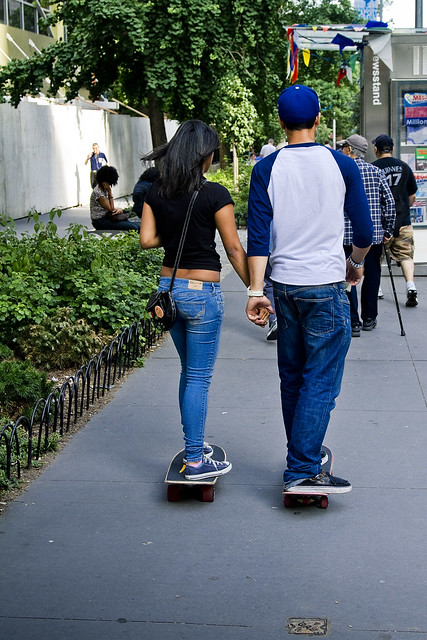
This young couple came rolling past me, texting and skate boarding while holding hands. They were young, at most sixteen. Seemed to be locals, likely from one of the many apartment complexes which neighbor Fulton Street.

– photo by Mitch Waxman
There was just something really sweet about these kids, who seemed to be lost in their own little world. The sight of them made even one as calcified as myself smile.

– photo by Mitch Waxman
Then, as is the case with such cycles of life, the young lovers were forced to separate as their path became blocked by others. The fellow hopped over the curb and headed south while the young lady continued toward some eastern destination.
long narrative

– photo by Mitch Waxman
Today’s shots are from “da Bronx”, captured last year while following the estimable Kevin Walsh of Forgotten-NY fame around. Mr. Walsh was busy planning a walking tour of the area, and his companion at arms- Richard Melnick of the Greater Astoria Historical Society, was along as well. While they were debating the finer points of Bronx history and an overall narrative structure for the excursion, I made myself busy photographing the various sights.
To wit- the Van Cortlandt House museum.
The Van Cortlandt family were prominent members of New York’s mercantile class and its social and business milieus. The business of trade connected the Van Cortlandt’s with mercantile families in the West Indies, European ports, and other American port cities. Additionally, their Dutch heritage linked them with many wealthy and powerful New York families. Marriages forged strong ties between the Van Cortlandt’s and the Schuyler, Phillipse, Jay, DePeyster, and White families of New York.

– photo by Mitch Waxman
The Knickerbocracy, a 19th century term used to describe the land and slave owning class of Dutch who stuck around after the English arrived and took over, is what the Van Cortlandts were a part of. No small amount of ennui was felt by the English and later the Anglo Americans towards the Dutch, who largely took off for northern and western New York State as the city began to grow.
Like Tolkien’s elves, they headed for the forests and quiet wooded sections of the country- gradually diminishing in prominence and social importance during their diaspora.
The English looked down upon them, describing them as superstitious and degenerate.
also from vancortlandthouse.org
After 140 years of occupancy by the Van Cortlandt family and their slaves, in 1889 the property was sold to the City of New York and made a public parkland. It was added to the National Register of Historic Places in 1967 and became a National Historic Landmark in 1976. The house has been operated as a public museum since 1897.

– photo by Mitch Waxman
Nearby the historic structure is a statue of a Civil War General, and one of the the founders of the National Guard- General Josiah Porter. Reports by those who knew him in life described the statue as bearing an uncannily accurate likeness to the actual fellow, and accolades were awarded to the sculptor for his skillful rendering.
from nycgovparks.org
This sculpture of General Josiah Porter (1830–1894) was created by William Clark Noble (1858–1938) and dedicated in 1902. It was commissioned at a cost of $20,000, and was a gift to the City of New York by the National Guard Association of New York State.
Porter is reputed to have been the first Harvard College graduate to enlist in the Union Army during the Civil War. He was made a first lieutenant in the Massachusetts Volunteers in 1861, and promoted to captain that same year. In 1865, he commanded the 22nd Regiment of the National Guard of New York (who would sponsor the statue), and in 1867, received the rank of major. Porter’s distinguished service led him to be promoted to colonel in 1869, and then to major general and adjutant general in 1886.

– photo by Mitch Waxman
General Porter met an undignified and messy end, dying in Manhattan on an elevated train line while on his way home from a party. The headline at the New York Times described the General as dying of “apoplexy”.
An archaic term, apoplexy is described by the redoubtable Wikipedia as “From the late 14th to the late 19th century, the word “apoplexy” was also used to describe any sudden death that began with a sudden loss of consciousness, especially one in which the victim died within a matter of seconds after losing consciousness. The word “apoplexy” may have been used to describe the symptom of sudden loss of consciousness immediately preceding death and not a verified disease process. Sudden cardiac deaths, ruptured cerebral aneurysms, certain ruptured aortic aneurysms, and even heart attacks may have been described as apoplexy in the past.”
from nytimes.com
“The train moved on, and I was left alone with the General, who was left lying on the platform near the edge. I asked the ticket chopper to help me carry the General to the waiting room. The man refused. He said something about the helpless officer ‘having a load.” which I indignantly denied. I explained that he had suddenly been taken sick. I tried to carry the General into the waiting room myself, but found that I could not do so. I then went inside the waiting room, where the ticket chopper had gone, and where the ticket agent was. I again asked help, but neither of the men would do anything. The result was that I was compelled to leave the sufferer stretched upon the platform in the cold night air while I went in search of a cab.
diurnal prison

– photo by Mitch Waxman
During the colonial era, there were small operators who exploited the route in two masted ships called Periaugers, but it wasn’t until 1817- when a farm boy from Staten Island started a motorized service- that the most popular tourist destination in New York City truly got started. The farm boy bought a steamboat called Nautilus with a loan from his mother, which was captained by his brother in law. Not many people would recognize the name of that Captain- John DeForest- but it’s easy to be overlooked in the historical record when your brother in law was named Cornelius Vanderbilt.

– photo by Mitch Waxman
The consolidated City of New York took possession of the route from the Vanderbilts in 1905, as the family had moved into decidedly less maritime interests like railroads and real estate speculation. It’s run by the NYC DOT today, and is the most reliable of all the mass transit systems in the entire city with a 96% on time rate. The particular ferry boat in these shots is the Guy V Molinari, named for the long sitting and dynastic Borough President of Staten Island.

– photo by Mitch Waxman
An astounding set of statistics accompanies the huge orange boats which trawl back and forth between Staten and Manhattan Islands. The service crosses the archipelago some 35,000 times annually, carrying 60,000 people per day- which resolves to some 20 million riders per year. All free. The Ferry was the origin of the Vanderbilt empire, and when Cornelius Vanderbilt died in 1877- he was worth some 100 million dollars, which would be worth something like two billion today. He was born a pauper in 1794.

– photo by Mitch Waxman
The ferry terminals at both ends of the approximately 30 minute trip have recently been modernized and upgraded. Whitehall terminal in Manhattan allows connection to subway and bus lines, and on the Staten Island “St. George” side- you can catch the bus or Staten Island rail. Hundreds are employed directly by the operation, with a “long tail” of suppliers and contractors supplying various services and employing thousands more. The City recently issued an “RFP” or “Request For Proposal” for new and modernized ferry boats to augment the aging fleet.


 The Newtown Pentacle