Archive for December 2015
urge primal
Trigger warnings abound in today’s post.
– photo by Mitch Waxman
So, last week there’s a day I have off. My mac is back from the shop and working again – and that’s a good thing. It’s also unseasonably warm out, so a humble narrator starts cooking his noodle about finding some cheap diversion to spend the afternoon in pursuit of, which – as any New Yorker will tell you – ain’t that easy.
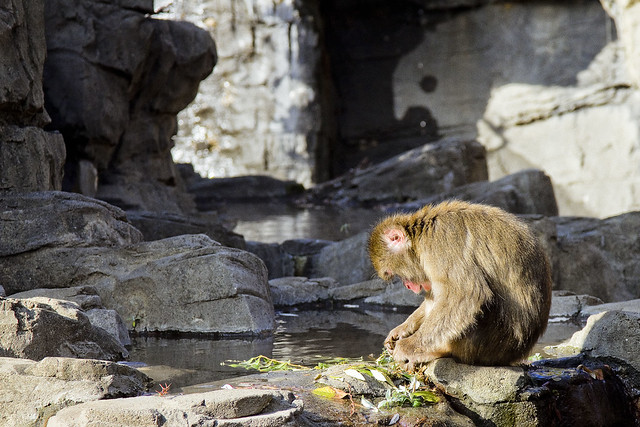
It occurs to me that I haven’t been to the Central Park Zoo in a few years, and since the price of admission is just twelve samolians, a visit is within my means. Alternatively, I’d go take a walk around the Newtown Creek, but I just wasn’t in the mood for pollution and devastation this particular day, so off to the City I went in pursuance of getting some charming shots of the critters which the Manhattan people hold captive for their amusement.
The trip also fit into the whole “House of Moses” thing I’ve been doing all year, wherein I’m trying to visit as many of the Robert Moses built projects scattered around the City as I can. Central Park Zoo, the original I mean, not the modern version which was rebuilt in the 1980’s, was one of Moses’s flagships.

– photo by Mitch Waxman
I enjoy shooting critters, even if they are the captives of the Manhattan types.
The Japanese Snow Monkeys… is it still ok to refer to the national origins of a monkey… I don’t know. Does it make one a specist, referring to the particular clade of primate which a creature is? How about the snow part? The world has changed, and so has language, in the last few years. Is this creature a “cisprimate?” I don’t know. Is it ok to use “critter” anymore? Is there an approved thesaurus which vouchsafes the linguistic sensitivities of every possible iterate? I’m old now, and hail from a violent and ignorant era where half of the nicknames from my old neighborhood in Brooklyn would now be prosecutable as hate crimes.
I’d like to reach out to the college campus types to advise.

– photo by Mitch Waxman
While pondering the incomprehensible mine field offered by the overly sensitive and “waiting to be offended” types, the… beings(?)… were engaged in that most primatological of behaviors – grooming each other.
Ahh… that’s nice, said I, and focused the lens in on this pair.

– photo by Mitch Waxman
Suddenly, this happened.
My triggers all began to pull without warning, and a humble narrator was reduced to a shivering wreck. Didn’t these “beings” realize that there were children about at the zoo? There were no consent forms exchanged between them, nor “safe words” negotiated in the presence of a third and impartial party. The Zoo displayed no signage warning me about what might be encountered on their grounds, and at no point was I offered a safe space in which to recover from the bestial display which the organization just allowed to happen. I had to make due with the Penguin house.

– photo by Mitch Waxman
Unbridled, and with zero concern for the casual observer, these creatures continued their lewd act. One wishes that he could have stopped photographing it, but every muscle in my body had involuntarily spasmed into the position it was in when this display started, and my camera shutter just kept on flipping. Oh, unhappy act.
I intend on instituting a law suit against the Central Park Zoo shortly after this post is published, as I have been materially damaged and will never be able to photograph a primate again without revisiting this scene. In effect, I have been raped by my willful observance of this act of sexual violence, and my delicate eyes will never be able to look upon a Curious George book again without micro aggressions rocking the mirrored surface of my mind.

– photo by Mitch Waxman
After this occurrence, which was as serious an offense as the Nazi extermination of the Jews to one as correct, and politically sensitive as myself, a humble narrator returned to his darkened rooms to sit and shake while whimpering. How dare these primates parade themselves thusly, knowing that others might be offended by their public actions?
This never happened while Bloomberg was Mayor, and therefore it must be de Blasio’s fault. These apes need to be sent to a sensitivity training camp, and educated in proper societal etiquette. Accordingly, an announcement is offered that I’ve founded a new non profit which offers this service to zoo animals, for which I’m applying to both City Hall and the Federal Government for funding.
“follow” me on Twitter- @newtownpentacle
antique forms
Visiting with the Alsops, in today’s post.

– photo by Mitch Waxman
Famously, the Roman Catholic Church purchased the land which would become LIC’s Calvary Cemetery back in 1848 from the Alsop family, who had inhabited it since the time of the Dutch decadence. The first Alsop on the land was a fellow named Thomas Wandell, who had ran afoul of Lord Protector Cromwell back in England and decided his best move was to hide out in the American colonies, specifically the ones which ran the flag of the Staten Generaal up the pole. The property was occupied during the American insurrection by none other than Lord Cornwallis and General Howe, and the experience of the Alsops regarding the forced quartering of troops and the damages inflicted on home and hearth by Hessian and Dragoon alike actually helped inform the Constitution of the United States’s ban on the practice. By 1848, the family line had dispersed and there was only one full blooded Alsop left in Queens. His estate sold the property to the Church, with the provision that the Catholics would maintain – in perpetuity – the Alsop family graveyard within the larger cemetery.
The Alsop plot is a theoretically unique place upon the earth, a Protestant graveyard entirely enclosed within a Catholic one. This doesn’t sound like too big a deal to modern ears, but back in the 1700’s, the Protestant Reformation and the Eighty Years War were still pretty present in people’s minds.

– photo by Mitch Waxman
The Protestant Reformation, incidentally, is the filter by which one such as myself processes the news of the day. When you’re reading about insurgents and terrorists in the Middle East, it’s hard not to think that “those people” are savages and barbarians. That’s because… well, this post is written in English… Europe’s experience with this sort of thing has sort of faded into the historical firmament.
Martin Luther was excommunicated from the Catholic Church back in 1521, which is coincidentally the same period in which Catholic Spain conquered the Mexica Aztec culture and appropriated an enormous quantity of precious metals and wealth from them. Churches in Spain, to this day, have a lot of Mexican silver worked into their ornamentation. What the Spanish Crown did with most of that silver, though, was fund the war against the Protestant crowns who followed Luther into the cold. It’s how they paid for the Spanish Inquistion, and the Counter Reformation, and it’s how Holland and the Netherlands ended up becoming independent countries after fighting their way out of the Hapsburg empires.
Europe, for a bit more than a century, was ripped apart by the religious wars. Famine, plague, all that good stuff was the result. Ultimately, the Thirty Years war between 1618 and 1648 ended up killing something like 25-40% of what modernity refers to as Germany.
At the end of it, the Crowns of Europe set up authoritarian states which brooked no dissidence and strictly controlled religion, printing, and what we would call “free speech.” The Dutch, and later the English, both began sending their religious zealots to the colonies in the Americas in an effort to try and keep the peace back home.
These zealots – Anabaptists, Puritans, Quakers – even Cromwell himself – were considered to be dangerous and it was best to make them go away. The reformation and its wars were bad for business and everyone agreed that a predictable future was better than the inverse, so the Kings grew ever more powerful in the name of stability.

– photo by Mitch Waxman
Remember too, that 500 years ago, what we know as “Europe” was considered a violent backwater. The royalty were essentially the descendants of inbred motorcycle gangs who had ridden into a city and taken over by force of arms. Death came swiftly for the common people, as any infraction of the rules set down by these undereducated masters incurred reprisals that the ISIS people would be very comfortable with. After the Protestant Reformation’s wars had run their course, Europe entered into a period which is referred to as “the enlightenment” during which the winners of the reformation game consolidated feudal holdings they’d won control over into nation states whose names are familiar to modern ears – France, for instance. The countries which were never burned by the fires of these wars remained feudal duchys of the Catholic Church until quite late in the game – Italy comes to mind.
The absolute monarchs who ruled these new “national” territories were tyrants, so much so that the merchant classes of Europe – the so called Bourgeoise – began to pick up stakes and follow the zealots over to the Americas.
These Bourgeoise, who were heavily influenced by the Freemasons philosophically, are the people who led the revolutions against the European Monarchs, and the influence of the very conservative Catholic Bishops, and who set about trying to create Nation States which would operate in “rational” and “scientific” ways.

– photo by Mitch Waxman
What’s happening today in the Middle East is not entirely unlike the Protestant Reformation. The Protestants were religious fundamentalists driven to violent action by tyrannical and unfair governments who were supported by a clergy that supported and reinforced the power of the tyrants – those motorcycle gangs mentioned above. The Spanish empire was ruled by the Hapsburg family, who also controlled what would one day be called the Austro Hungarian Empire but at the time was called the “Holy Roman Empire.” Both Catholic and Protestant militarized and controlled vast resource bases, and when the Spanish hit the jackpot in Mexico – things flew into high gear. Genocide was an official policy back then, and the reason that the Crusades were abandoned wasn’t entirely because of the rising power of the Ottomans. It was because the Crusades were being aimed at the Albigensians and Cathars in France and what we would call Germany.
As Americans, we are the inheritors of a particularly Anglophile point of view. The fact that this POV exists at all is because the Spanish Armada never made it to the Thames.

– photo by Mitch Waxman
For a straight up history of the Alsops, check out this post presented at this – your Newtown Pentacle – back in 2011. Institutional memory is something that I constantly rattle on about. Something has gone wrong with our culture – it just might be Facebook – in recent years. A scandal or tragedy occurs, and everybody acts as if it’s something that’s happening for the first time. Ignorance of history seems willful, which breeds a sense of fatalism on the part of many. The world is not going to hell in a hand basket, rather, it’s been there before.
How did the Europeans solve the religious wars which decimated them for nearly 150 years? Totalitarian governments and absolute monarchy, that’s how, which sparked the age of colonialism. How did they solve that? Republics and representational democracy. Where that led – the second thirty years war – WW1 and 2. Which led to the Cold War…
I’ve got to stop hanging out in cemeteries, because places like the Alsop plot are how every story ends.
“follow” me on Twitter- @newtownpentacle
odd alterations
Curious things, in Astoria.

– photo by Mitch Waxman
It is happening again, here in Astoria Queens. As a humble narrator stumbles along while walking a highly reluctant dog named Zuzu, many things which the human infestation hereabouts get up to are noticed. The curious customs of the summer notwithstanding, every time the air begins to grow chill, a menacing event begins and spreads throughout the community.
Zuzu the dog is rather timid, and somewhat paranoid about several things. I’ve learned to trust the dog, and her vast canid sensory range – one that extends well beyond the dross observations which primate organs can discern. Well, except for the whole “see things in color” part, as dog vision ain’t so hot.

– photo by Mitch Waxman
You’re not paranoid if people are actually trying to mess with you.
Wires begin to intertwine with vegetation annually, carrying current to blinking bulbs of uncertain origin. One has attempted to discern if these blinks are carrying some sort of coded message, but mathematics has always been a language alien to me.
Like the “Aglet,” which is the metal or plastic tips of shoelaces, I believe their purpose might be sinister.

– photo by Mitch Waxman
Curious combinations of colored light have been known to carry coded missives. Given that the vast majority of these wired strings are manufactured in the factories of China, one wonders if the Commisars of the People’s Republic of China’s Communist Party have found a way to directly infiltrate the subconscious mind.
I’m not paranoid, though.
“follow” me on Twitter- @newtownpentacle
impolite exclusions
It’s horrible to be me.

– photo by Mitch Waxman
Recent endeavor found me wandering amidst the Degnon Terminal in Long Island City during a light drizzle, which for one such as myself indicates that’s it’s time to start recording the things I see. Above, the off ramp of the Queensboro Bridge that doth feed traffic unto the Thomson Avenue Viaduct.
As I’ve stated in the past, NYC never looks as good as it does when it’s raining.

– photo by Mitch Waxman
I was on my way to attend a meeting for the group that’s sprung up around the abandonment of the Montauk Cutoff tracks by the MTA, a project which was described at this – your Newtown Pentacle – recently. The meeting of the so called “Cut off coalition” was taking place over in the former Waldes Koh I Noor complex in the Degnon Terminal, and since it was raining I used the subway to get there rather than my usual methodology of walking in pursuance of not getting drenched.

– photo by Mitch Waxman
The Degnon Terminal, just in case you’ve missed the thousands of times I’ve referenced it, is an industrial park which was built in the early 20th century by a fellow named Michael Degnon. Degnon and his team land filled a famously honerous swamp fed by Newtown Creek’s Dutch Kills tributary at around the same time that the Pennsylvania Railroad was busy building the Sunnyside Yards railroad complex. Degnon’s project took advantage of the yards, and provided for a “ship to rail” link at the head of Dutch Kills.
“Progress” was a pretty big concept back in the early 20th century, and the Degnon Terminal saw some of the first poured concrete mega structures in the United States rise from the reclaimed wetlands of LIC.

– photo by Mitch Waxman
Loose Wiles bakery, Eveready Battery, American Chicle and other large manufacturers based themselves here and provided tens of thousands of jobs, which drew the immigrant masses out of Manhattan and out to LIC and its environs. By the 1930’s, this section of LIC had become a vast industrial sector.
After the Second World War, when manufacturing in the northeastern United States began to decline, the buildings were left behind and nobody was quite sure what to do with them.

– photo by Mitch Waxman
In the early 1990’s, it was decided to demolish a hospital to make way for the new, and the Citi building megalith was erected. The first of the glass and steel skyscrapers in LIC, this malefic eidolon used to be a singular tower. That has changed in the last ten years, as multiple high rise residential buildings have risen around “court square.”

– photo by Mitch Waxman
Over on Pearson street off of Skillman, in the Degnon Terminal, the four building Koh I Noor complex found profitable life after splitting the property up amongst smaller tenants. The Waldes company manufactured milliners and tailoring supplies – it’s said that they invented the metal zipper, for instance. Warehouse businesses, printers, and small manufacturers have taken up residence here in the 21st century.
None of them utilize the rail, nor the maritime connections, and are instead truck based businesses.
“follow” me on Twitter- @newtownpentacle
cyclopean endeavor
Down Under the Kosciuszko Bridges Onramps – DUKBO – in today’s post.

– photo by Mitch Waxman
Around two weeks ago, Newtown Pentacle presented a pair of postings (this, and that) showing the progress of the Brooklyn side of the Kosciuszko Bridge construction project. I was invited to walk through the site by the NYS DOT, along with other members of the “Stakeholders Advisory Committee,” and the photos captured during the walk populated the posts. Today, the Queens side of DUKBO.
It should be mentioned that I didn’t enter the site for these, and just creeped around the fences on Thanksgiving weekend. It would have been a simple thing to enter the deserted site, of course, but the Newtown Pentacle way is to never trespass. I’m like a vampire, and have to be invited in before I do my work. Luckily, you don’t need an invitation to walk down the sidewalks of Queens in the direction of Newtown Creek.

– photo by Mitch Waxman
These are the 1939 era bridge’s concrete approaches, as seen from Laurel Hill Blvd., which is the eastern border of Calvary Cemetery. The street that’s all ground up into gravel is “used to be 54th avenue.” “Used to be” is an apt adjectival phrase, as when the new bridge is finished several of the existing streets will have been relocated and the geometry of the street grid will be altered to accommodate the new structure.

– photo by Mitch Waxman
As you can see, security is tight as a drum here in Blissville. Nobody over 350 pounds would be able to get through this gap. It’s at times like these that my “no trespassing” rule really grates.

– photo by Mitch Waxman
Looking down Laurel Hill Blvd. to the south. That’s Calvary Cemetery on the right of the shot, and the redoubtable 1939 Robert Moses version of the Kosciuszko Bridge on the left. Moses convinced LaGuardia that the old Penny Bridge, which crossed Newtown Creek from the end of Meeker Avenue in Brooklyn and connected to Review Avenue in Queens, would be insufficient to handle the traffic load which the 1939 Worlds Fair in Corona would create. He proposed the “New Meeker Avenue Bridge,” which LaGuardia agreed to. Moses then argued that without the 2.1 miles of high speed approach roads, the money spent on the bridge would be wasted. LaGuardia agreed again. Moses then expanded the approaches, on one side to connect to his “Grand Central” Parkway and Mighty Triborough, and on the other to connect via Meeker Avenue to Grand Street, he also created something LaGuardia did not agree to in the bargain. What would become the “Brooklyn Queens Connecting Highway,” something we refer to in modernity as the “Brooklyn Queens Expressway.”
Clever one, that Moses.

– photo by Mitch Waxman
Crossing under the Kosciuszko Bridge at 54th road – a corrugated fence which used to be part of an NYPD towing impound lot allowed for a quick view of the “House of Moses.”

– photo by Mitch Waxman
By the end of 2017 (if I remember the schedule accurately), this will be an enormous demolition site. All the steel will be coming down in sections, and the cyclopean concrete piers will be chipped away. The stripping away of the central span of the Kosciuszko Bridge promises to be quite an exciting sight.
Essentially, they are going to bring in maritime cranes which will affix supports to the truss section in the center, cut it away from its supports with torches, and then lower it onto a platform composed of several barges. Multiple tugboats will guide it away, heading in a westerly direction down Newtown Creek.

– photo by Mitch Waxman
Crossing under the Kosciuszko Bridge via 54th road onto “used to be” 43rd street, the now familiar masonry of the BQE overpass appears. The roadway will be considerably lower here, in comparison to the old setup. Not really sure how much I like that, actually. It’s going to be bringing the close to 200,000 vehicles a day that cross the thing down to nearly street level. Noise, exhaust, etc. It’s higher on the Brooklyn side.
Oh well… welcome to Queens, now go fuck yourself… right?

– photo by Mitch Waxman
This is “used to be” 54th drive, and you can see the new concrete supports for the Kosciuszko Bridge approaches are coming along nicely. If you refer back to the two posts from the Brooklyn side linked to in the first paragraph, you can check out what this area will look like probably 6-8 months into 2016. The deck roadway will ride along on the top of this piers, rising to the cable stay supported section spanning Newtown Creek.
On the other side of the concrete structures are a bunch of office trailers which house the administrative and engineering staff for the project.

– photo by Mitch Waxman
The Kosciuszko Bridge project is striking its path through the former location of the Phelps Dodge company, on a patch of land which was once adjudicated as being “too toxic to park empty United States Postal Trucks on.” Phelps Dodge is a NYS Superfund site, and the company is one of the “potentially responsible parties” named in the Federal Superfund listing of Newtown Creek itself. Incidentally, Phelps Dodge and their copper refining operations were pretty much a 20th century thing, they inherited the property after a merger with a chemical conglomerate that had been here since the 1830’s.
The State Bridge people have made it a point of mentioning that they’re able to deal with the environmental stuff, but that it’s an immensely complicated situation. There’s a sign on the fence that says “Hazwoper.” I mentioned this signage to my Union laborer neighbor Mario during conversation about the project, which caused the big fellow to utter a “woof” sound, followed by “Hazwoper Zone, bro, woof.”
The entire project is an immensely complicated situation, actually.

– photo by Mitch Waxman
Imagine building a bridge, next to an existing one which carries the Brooklyn Queens Expressway over a heavily polluted maritime industrial waterway found in the dead bang center of NYC. Imagine that this waterway was where the oil refining industry, and the manufactured gas industry, and the waste disposal industry, and the chemical industry, and the Long Island Railroad, all figured themselves out. Refineries, distilleries, waste transfer stations, open sewers… Ok? Got it?
Ok, so you finish the bridge, and reroute the highway onto it. Ok. Now you have to demolish the old bridge and cart it away. Now, you get to start on building the second half of the new bridge, and then reroute the highway again to take advantage of the completed bridge.
Ahh… my beloved Creek!

– photo by Mitch Waxman
This shot looks north, from the “will continue to be” Restaurant Depot Parking lot. Most NY’ers are surprised at how much of the food they eat has spent some of its journey to their colons at Newtown Creek, but a humble narrator has reached the age where his innermost psychology can best be described as “a severe and apathetic form of nihilism,” so nothing really surprises me anymore. I don’t buy sausages in supermarkets, as an example of how this numbed acceptance of the world we live in informs my days and tortures my nights.
As you’ll notice, the shots depict concrete still being formed into the columns, and rebar sticking out of a few of them. The Brooklyn side is a bit further along, I’m told it was a bit more complicated on the Greenpoint side due to the rerouting of the BQE over Meeker Avenue, and the presence of dense populations surrounding the road.
In Maspeth, here on the Queens side, there were just two or three private homes and a few warehouse sized businesses. The various entities, hereabouts, were recompensed for their properties by the State and assisted with relocation to parts unknown. Or they might now be sausages in a freezer at a Costco. You’ll never know… which brings me back to the whole nihilism thing. There you go.

– photo by Mitch Waxman
Our Lady of the Pentacle often reminds me that whereas everything in the shot above is familiar to me, I shouldn’t make the assumption that everyone reading this enjoys the same visual catalog as my creek chums and I do.
This shot looks towards the west, where you can see the Empire State Building over in Manhattan. Out of sight, not mind, the tracks of the LIRR Montauk line are aimed directly at midtown Manhattan and are travelling under the bridge and along the tree line. The wooded section, on the right, is Calvary Cemetery. Just beyond those concrete blocks is part of the Phelps Dodge site, and the truss section of the 1939 Kosciuszko Bridge is overflying Newtown Creek and traveling out of frame at top left – or south.
Just keeping y’all in the loop, here in DUKBO, Down Under the Kosciuszko Bridges Onramps.
“follow” me on Twitter- @newtownpentacle


 The Newtown Pentacle