Archive for February 2016
cubits wide
More macro comestibles, in today’s post.

– photo by Mitch Waxman
As described in a couple of posts from last week (this, and that), a humble narrator is making productive use of the hermitage forced upon him by the cold weather by experimentation with macro lens photography. The subject matter for this pursuit has almost exclusively been food based, and in the case of what you see in today’s post – it’s a true fruit and a drupe, not berries which are commonly referred to as fruit like banana or citrus.
The circumstance of the shots utilizes a jury rigged lighting set up which includes the usage of a powerful flash placed behind the subject, which allows for some of the internal structure of the food stuffs to be revealed. It’s all somewhat complicated.

– photo by Mitch Waxman
First up on the stage are apples, specifically two of them, and I’ll be damned if I can tell you exactly which one of the 7,500 breeds of the thing they are – they’re red apples which I bought at the bodega across the street from my house is all I can tell you. The nice thing about this sort of project is that in addition to providing for an interesting technical challenge which produces somewhat intriguing results, it also results in a series of tasty and healthy snacks for a narrator to enjoy when the work is done.

– photo by Mitch Waxman
Apples and humans have been together a long time. Literal interpreters of certain holy texts will tell you that the fruit of the tree of knowledge of good and evil consumed by Adam and Eve was an apple, but that’s largely because of a translation era. There’s also the Nordic tradition of the Golden Apples of Idunn, which supplied Odin, Loki, and the rest of that crew with immortality. Heracles had twelve labors, and acquiring the golden apples found at the Garden of the Hesperides was one.

– photo by Mitch Waxman
Malus domestica is the botanical classification for all 7,500 kinds of domesticated apple, which have been bred out from a wild ancestor native to Kazakhstan, Kyrgyzstan, Tajikistan, and Xinjiang that is called Malus sieversii. It’s believed that the original cultivation of apples as a crop began in China’s Tian Shan mountains in prehistoric times. Apples are produced by a deciduous tree which is part of the same botanical family that produces Roses and Plums, amongst other useful things.

– photo by Mitch Waxman
It seems that China is the world’s apple superpower, producing roughly half of the worldwide annual 80 million ton harvest of the fruit. Apples are nearly twice as genetically complex as human beings, and unlike humans, if you store them under the right conditions you can count on them staying fresh for months. The Granny Smith and Fuji variants can be kept viable in storage for nearly a year under tightly controlled circumstance.

– photo by Mitch Waxman
Apples were brought to the Americas by European colonists in the 17th century, and the first orchard on the continent was in Boston. The schoolboy mythology version of American history claims that Johnny Appleseed distributed cultivars of Apples to far flung homesteads. The reality was that John Chapman was a Swedenborgian missionary, who maintained a far flung apple tree nurseries business, who would just show up on your property and try to convert you to the “New Church.” He would distribute individual sections of the bible to people he visited, operating a one chapter at a time library service for pioneers. Chapman would also try to talk the farmers he met into partnering with him on an apple nursery planted on their property.
The esoteric side of Swedenborgian thought opined that if if you could create a society that operated in the manner of an orchard, it would be producing better citizen and parishioner fruit than you could by letting them grow wild. Later adherents of the philosophy would popularize and institutionalize into education a tenet of their faith, and if you attended Kindergarten then you’ve experienced it.
Swedenborgian Kindergarden – American Child Orchard.

– photo by Mitch Waxman
The shot above looks right down where the stem of the fruit connected to the branch. My “under” flash was set to maximum power and “throw” to illuminate the otherwise lightfast skin and flesh of the fruit. I’ve received a couple of comments about the prior posts that there’s a “Georgia O’Keefe” sort of sexual vibe going on with some of these shots, btw.

– photo by Mitch Waxman
Technically speaking, these are the sex organs of a life form, so… probably not far off. I’ve always been interested in the visual similarity of various animal body parts to analogous organs found in the plant world. My opinion on the subject has always been that evolution is a somewhat lazy beast, and that certain anatomical configurations were figured out very early in the game and have been widely transmitted as the various clades diverged from each other. Someday, science will describe certain shapes and structures as being distinctly terrestrial – presuming we have something else to compare earthly life to in a clinical setting.
Either that, or it’s the same mechanism of the human brain which renders a passing cloud as either a winged dragon or a unicorn and sees recognizable shapes in otherwise random patterns, which is called pareidolia.

– photo by Mitch Waxman
As mentioned above, Plums also belong to the Rosales or Rose family, just like apples. A taxonomist will argue about the number of plum species there are, but the presumption is that there are something like 20-40 individual variants. Commercially available plums are a different story, with most of the Plums we eat originate from either the European plum (Prunus domestica) or the Japanese plum (Prunus salicina).

– photo by Mitch Waxman
Plums aren’t fruits, unlike apples, instead they’re drupes. They’ve been domesticated by humans since Neolithic times. If you spot a stand of Prunus domestica in the woods of the Caucasian Montains of Eastern Europe, you’ve got a good candidate spot for archaeologists and paleontologists to poke at.

– photo by Mitch Waxman
One of the things I’m trying to do with these macro experiments is to find a way to do an “x-ray view.” This requires a bit of “studio-fu.” The shot above is the same basic setup as the one below, with the difference between them being that in the one above, I left a lamp on that flooded the lens facing section of the plum with light. This reveals surface details and true color.

– photo by Mitch Waxman
In the “x-ray view” above, the lamp was turned off after about a second. When the big flash underneath the Plum went off, all that light went traveling straight up through the thing, revealing all the internal structure. Haven’t quite perfected this procedure yet, but intriguing – ain’t it?

– photo by Mitch Waxman
The shots above and below are long exposures, coupled with that flash traveling up through the Plum to reveal the internal structure of the skin.

– photo by Mitch Waxman
The one above is my favorite of the plum series, mainly because you see both exterior and interior of the thing simultaneously. I had to jump through a few digital hoops developing these things, incidentally, as my improvised lighting and flash set up hopelessly confused the camera.
I’ll be doing more of this kind of thing periodically, as I’m having a lot of fun, and eating a lot of fruit.
“follow” me on Twitter- @newtownpentacle
only the
Big doings on my beloved Newtown Creek, in today’s post.

– photo by Mitch Waxman
Word reached me that a barge had sunk on Newtown Creek last week, at the Allocco Recycling plant in Greenpoint, and despite suffering from a debilitating shoulder injury (Don’t worry, I seem to be on the mend) a humble narrator painfully packed up his kit and headed over to the tripartite intersection of North Henry Street and Kingsland Avenue at Newtown Creek.

– photo by Mitch Waxman
Allocco Recycling are in the metals and aggregates (or Fill Materials) industries. Metals are the usual thing – copper, aluminum, iron recycling and collection. Aggregates involves the seining and separation of rock, stone, sand, and gravel from construction and excavation materials. Allocco are good guys, in my book, as they ship their processed materials out of Greenpoint using barges rather than trucks. A single barge is the equivalent of 38 heavy trucks.

– photo by Mitch Waxman
Allocco has a large property that borders on one of Newtown Creek’s minor tributaries – the so called “Unnamed Canal.” Across the street is the Newtown Creek Wastewater Treatment Plant’s employee entrance, and down the block is a biofuel company called Metro Fuel. I’m prejudiced towards both entities, it should be pointed out. The DEP lies to me on a regular basis, so I don’t like them. Metro – whom I do like – on the other hand, was founded by my pal Paul Pullo. Paul is a friend and supporter of Newtown Creek Alliance whom I work with on a number of the NC committees like NCMC and the Newtown Creek CAG. NCA is also working with Allocco on our Living Dock project which is playing out on Unnamed Canal, as well as the “North Henry Street Project” which will be discussed in some detail at an NCA meeting next week.
All of my conflicts of interest are laid out in the paragraph above, except for one, which I’ll mention later.

– photo by Mitch Waxman
Showrunner Mike Allocco, it’s a family owned business after all, told me what happened (and allowed me on the property). It seemed that they were filling a barge with stone on a Friday night and closed shop. The half filled barge was about one third of the way submerged when they returned to work the next morning. His crew did everything they could to hoist and pump out the barge, but it continued to sink and by Saturday afternoon the barge was in the state you see in the shot above.
Allocco then contacted DonJon towing to salvage the thing, and DonJon brought in its heavy equipment. The large maritime crane – which is actually the second largest unit of its type in NY Harbor – is the Chesapeake 1000, and the smaller unit with the crawler crane attached is the Delaware Bay. There were a couple of tugs keeping them in position, but I was unable to identify which boats they were.

– photo by Mitch Waxman
The plan, which has already played out and been accomplished, closed Newtown Creek to maritime traffic for an interval. The DonJon crews fed a pair of cables under the sunken barge, lifted it out of the water, pumped out the water, and then moved it into a shallower section of the Allocco bulkhead for repairs. When these shots were gathered, the presumption was that the barge had a damaged hull.
That other conflict of interest mentioned above? As I was shooting these photos, I got a call from a reporter friend who was working for DNAinfo that wanted to buy a shot from me. That shot, and my buddy’s reportage, can be observed in this post at DNAinfo. As the article discusses, the barge had settled down over the Buckeye Pipeline, and luckily for all of us – the fuel delivery infrastructure wasn’t damaged. This was due to the barge settling down onto the so called “Black Mayonnaise” sediments which sit 15-20 thick on Newtown Creek. The quote from DEC’s Randy Austin presented in the DNA piece is ““That’s probably the first time in the history of the Newtown Creek when that sludge bank served as an environmental benefit.”

– photo by Mitch Waxman
For a maritime industrial geek like your humble narrator, seeing the Chesapeake 1000 was a real treat. DonJon Towing hosts a page listing all of the technical specifications that this 1972 vintage 2,484 Gross Tonnage crane entails. The “1000” part of its name comes from its lifting capacity, but it used to be known as the Sun 800 before DonJon got it. The Sun 800 was damaged in a storm, and during the repair process it was upgraded and outfitted with the 1,000 ton boom it currently sports. The hard hat guys I chatted with on the shoreline at Allocco related the cranes history to me as we watched the operation.
Now, this is where the interesting bit comes in.

– photo by Mitch Waxman
It seems that the Sun 800/Chesapeake 1000 was originally built by the Howard Hughes corporation to facilitate the Glomar Explorer project. Glomar Explorer was a giant ship built in the early 70’s which the Hughes people told the world was going to be used for the harvesting of ocean floor minerals and specifically manganese nodules.
That was a cover story, however, for the true mission of the thing, which was to recover a Soviet submarine which had sunk some three miles down on the floor of the Pacific Ocean for the CIA. The project was called “Project Azorian.” The Chesapeake 1000 is officially an artifact of the height of the Cold War, like the Saturn V rocket.
It continually amazes me, the sort of things that Newtown Creek leads to.

– photo by Mitch Waxman
The other DonJon rig on the job was Delaware Bay, which is a clam shell dredge vessel. It’s got 1,250 square feet of deck space and was built in 2006. It’s 225 feet long and 54 feet wide, and 1,205 gross tonnage.

– photo by Mitch Waxman
The barge itself is unremarkable, other than the fact that it’s submerged. It’s a dry bulk type, and is essentially a giant floating bucket.

– photo by Mitch Waxman
As mentioned above, the crews from DonJon were executing a plan in which a couple of heavy cables would be run under the sunken barge, at which point the Chesapeake 1000 would lift the thing up and out of the Creek and then pump out the water. To this end, there was a dive team operating.

– photo by Mitch Waxman
One cannot imagine the horrors of diving into the turbid waters of Newtown Creek, nor the safety precautions that a professional diver would need to undertake in pursuance of the act. I’ve had the pleasure of chatting with members of this profession who operate in NY Harbor, and they tell me that it’s actually a blind business.

– photo by Mitch Waxman
Visibility in the waters of NYC is a couple of feet under best case circumstance, but in the East River and its tributaries, you often can’t see your hand six inches from your face mask. They do a lot of their job by feeling around, and relying on their training.
One fellow kept on bobbing up around the cables which were being fed under the sunken barge.

– photo by Mitch Waxman
So, that’s the story about the time in February of 2016 that a barge sunk at a recycling company called Allocco in Greenpoint, along the lugubrious Newtown Creek.
“follow” me on Twitter- @newtownpentacle
conducive circumstance
Macro shots, berries, and my life’s savings – in today’s post.

– photo by Mitch Waxman
On Monday of this week, a series of table shots were offered, depicting various food stuffs and comestibles which were photographed under a “macro” table shot setup. This sort of setup is kind of technical, involves all sorts of measurements and secondary equipment like lights and flashes. I won’t bore you with all the details, but suffice to say it allows a somewhat magnified version of reality to be captured. It should be mentioned that my macro setup is by no means a professional one, rather it’s cobbled together from various bits of kit I already own. A proper macro lens is a wonderful bit of optical engineering, and expensive.
On my kitchen counter, there’s a bag of garlic which has been there since the first week of January, and some of the cloves have sprouted – as you’ll notice in the shot above. Garlic is native to Central Asia, is officially known as Allium sativum, and is a species of the onion genus – Allium. It’s one of mankind’s oldest cultivars, and is evidenced as far back as 7,000 years in the historic record. Most of the world’s garlic is produced in China, which is probably why you don’t hear many vampire stories with a Han twist.

– photo by Mitch Waxman
A taproot, the Carrot is another ancient vegetable, especially so for the one pictured above which withered away in the back of my refrigerator. The word “Carrot” suddenly manifested in the English language around 1530, orignating from the Middle French “carotte,” which comes from the Late Latin carōta, which borrowed the word from the Greek καρωτόν or “karōton.” Daucas Carota is the scientific name for the wild Carrot, and there are many, many variants of it found throughout Iran. Wild Carrot variants were grown in Europe as early as 2,000 BCE, but most modern folks wouldn’t recognize those purple colored vegetables as carrots. The modern yellow and orange cultivar “Daucas Carota Sativum” comes from Afghanistan, and found its way into Europe via the Moors back in the 8th century CE.
Suffice to say, the specimen above found its way into the compost bucket shortly after the shot above was captured.

– photo by Mitch Waxman
All citrus trees belong to a single genus – Citrus – and are almost entirely interfertile, with farmers reproducing them via grafting. A single superspecies – grapefruits, lemons, limes, oranges, and various other types and hybrids are all one “thing.” The fruit of a citrus tree is a hesperidium, which is modified berry and is covered by a rind which is actually a rugged and thickened ovary wall. According to various sources – the word “orange” comes from the Sanskrit word for “orange tree” (नारङ्ग nāraṅga). The Sanskrit word reached European languages through Persian نارنگ (nārang) and its Arabic derivative نارنج (nāranj). The first recorded use of the word Orange in English was in 1512.
The Navel Orange, as pictured above, is a mutant variant which emerged in Brazil sometime between 1810 and 1820. The navel part is actually a conjoined twin.

– photo by Mitch Waxman
Lemons are thought to have originated in either Northern India, Burma, or Southern China. The plant made its way to Europe and the Romans in the 1st century CE, but it was the Arabs who embraced them in cuisine and widely planted them. Columbus brought lemon seeds along with him to the Americas back in 1493, but it wasn’t until 1747 that Lemons began to be widely planted and cultivated by Europeans – due to a Scot Doctor named James Lind – who discovered that lemon juice could help sailors in the British Royal Navy avoid coming down with Scurvy.
The word “lemon” is thought to be of Arabic origin – “laymūn or līmūn” – which came to the European tongues via the Old French “limon,” and then the Italian “limone.” An older Persian term for it is “līmūn,” which is a generic term for citrus fruit, and there’s also the Sanskrit root word “nimbū.”

– photo by Mitch Waxman
Limes are actually prehistoric cultivars, and were widely grown by the Persians and Baylonians. There are multiple fruits (actually berries) called “limes,” but not all of them are actually Citrus. The Royal Navy switched over from Lemons to Limes around the time of the American Civil War, which was a HUGE military secret in the middle of the 19th century, given that the latter contained more Scurvy fighting vitamin C than the former. Also, they go better with Gin.
This is where the term “Limey,” as used to refer to a British person, began.

– photo by Mitch Waxman
Botanists will tell you that the Banana is also a berry, just like the various iterations of the Citrus family.
Wild Bananas are chock full of seeds. Seedless bananas are all cultivated from two wild variants known as Musa acuminata and Musa balbisiana. Native to Austrailia and the Indo-Malayan archipelagos of the southern Pacific, Banana is believed to have first been actively cultivated in New Guinea, of all places, in impossibly ancient times – 5,000 – 8,000 BCE. The word “Banana” is believed to West African in derivation, and transmitted to European tongues via Spanish and Portuguese trade ships.
There’s ultimately two families of banana you’re likely to encounter in the Americas – the sort you eat raw which are called Cavendish, and the kind you cook – which are commonly referred to as Plantains – and are called Saba. In Asia and Africa, you’ve got a pretty big group of variants for this sort of big yellow berry. The Portuguese brought the banana to the Americas in the 16th century.
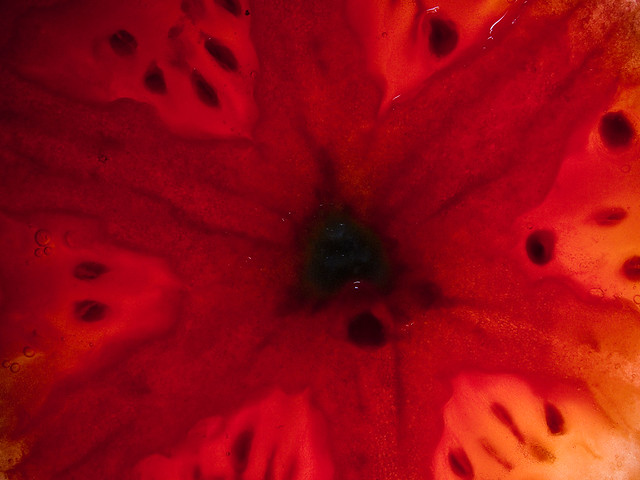
The banana trade, incidentally, is one of the most evil endeavors which British and American Capitalism has ever engaged in. Subjugation and enslavement of native peoples, importation of African and Asian slaves to work the plantations; interference with, corruption of, and the overthrow of foreign governments – were and are a part of doing business right up to today. NAFTA only made things worse, and there’s a reason for the negative connotations of the term “Banana Republic.” The same people who won’t buy a “conflict diamond” or eat a veal chop will happily cut up a banana for their bowl of Cheerios. I know I will, and politics be damned.
– photo by Mitch Waxman
There are few things which are fun to say out loud as the phrase “Deadly Nightshade,” and the Tomato or Solanum lycopersicum is a member of the family. It’s regarded as a fruit, but in reality it’s another berry. The Conquistadors counted the Tomato as one of their many captured treasures after the conquest of the Mexica or Aztec Capital City of Tenochtitlan in 1521. The English word tomato hails from the Spanish word “tomate” which was lifted from the Nahuatl (the mesoamerican language) word tomatl. The Spaniards carried the plant around their empire, distributing it globally. It ended up all over the Mediterranean, and again it was the Arabs who first embraced the crop. Europeans were always uneasy about the deadly nightshade thing.
The Medici’s were growing tomatoes in 1548, over in Florence, Italy. For the fancy types, tomatoes were ornamental props and not for consumption as they grew too low to the ground. For the peasants – then as now, you eat what you can afford to eat. Mangiare.

– photo by Mitch Waxman
Just about everything you’ve seen in Monday’s, and today’s, posts were basically harvested from the food stuffs which Our Lady of the Pentacle and I normally keep on hand here at HQ. There were a few other options, incidentally – potatoes come to mind, but I was particularly keen on the sliced fruit (or berries) stuff, given their complex internal structures.
As mentioned earlier these shots were produced using a complicated setup on my countertop – a stage if you will, which was also harvested from stuff I had laying around. The transluscent stand was a plastic container with a slot cut into it for the strobe, and there’s also a flashlight or two gaff taped to table top tripods and a basic photographic “umbrella” light involved as well. The camera is wearing a flashgun as well, set to its lowest setting for some fill light, but its main job was to actuate the slave strobe that’s stuck under the subject to provide back light. So, there you are.

– photo by Mitch Waxman
Finally, a shot of my life savings.
“follow” me on Twitter- @newtownpentacle
overtones of
Another random series of shots, in today’s post.

– photo by Mitch Waxman
Over in Greenpoint, a line of empty taxis parked on Provost Street, across the street from the sewer plant.
It’s actually meant to be pronounced as “Provoost” despite being spelled as “Provost.” The Provosts were one of the original five families of Greenpoint, along with the Bennets, Calyers, Praas, and Messeroles. These five Dutch families dominated Greenpoint politically for nearly two centuries, owned most of the land, and only began to recede into history when Neziah Bliss married into the Messerole clan. Bliss laid out the modern street grid, erected the first bridges over Bushwick and Newtown Creeks, and is the father of the modern community.

– photo by Mitch Waxman
The IND R train entering into Queens Plaza. Queens Plaza’s IND service opened for business on August 19th in 1933, but back then there was only express service between Manhattan and Queens. It wasn’t until 1955 when the 60th street tunnel opened that the Queens local trains began to travel back and forth into the Shining City. I work on getting this shot every time I’m there, and you have to time it just right to catch an arc flash that the train sets off as it comes to the station tracks grade.

– photo by Mitch Waxman
It’s amazing how many manhole cover types there are, a subject which has been discussed endlessly at this – your Newtown Pentacle. The story of municipal consolidation can be read in the screeds embossed onto these iron discs, and the one pictured above was once the property of the “Bureau of Water and Sewers” which is now part of the NYC DEP and can be observed at the border of Sunnyside and Blissville in Queens.

– photo by Mitch Waxman
This is a “Brooklyn Department of City Works” access cover, which was found back in Greenpoint. DCW is also now a part of the consolidated DEP.
– photo by Mitch Waxman
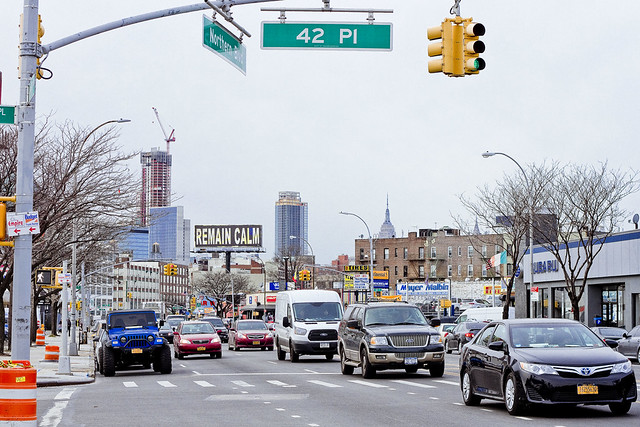
Back in Queens, on the “carridor” of Northern Blvd., a puzzling bit of signage has emerged on one of the enormous advertising bill boards found on the corner of 38th street. The easterly facing side says “Stay Calm” with a screed reading “-Peter.”

– photo by Mitch Waxman
The westerly facing side says “Don’t Panic,” and also has the “-Peter” signature. Dictionary definitions are superimposed on the block print messaging, this one bears the definition of courage. I’ve looked around for what these signs are meant to be selling or saying, but haven’t been able to find out much. If anybody knows what’s up with these messages, please share in the comments.
Either way, they are reminiscent of the sort of things Rowdy Roddy Piper observed in the John Carpenter film “They Live.”

– photo by Mitch Waxman
A gorgeous bit of hand painted signage adorns the back of a NYCHA emergency truck back in Greenpoint, and is pictured above.
“follow” me on Twitter- @newtownpentacle
lured and
Adventure and pedantic excitement, in today’s post.

– photo by Mitch Waxman
Recent endeavors found me at what I’m fairly sure is the western boundary of the former garden of Eden, the modern day Times Square. Often have I advanced the theory that Eden was not only in North America, but in Manhattan, and that the Tree of Knowledge was found in the dead bang center of 42nd street between 7th Avenue and Broadway opposite the Subway entrance on the south, and the news ticker on the north. Furthermore, it is my belief that Times Square is actually the geographic center – or Omphalos – of the universe itself, but esotericism and magick seldom apply to cartography.
I am sure that Adam and Eve would have headed in the direction of modern day Port Authority after eating the forbidden fruit, as original sin and mortal damnation are inextricably linked to that hellish terminal building and all the lost souls who dwell therein.
Somewhere deep below Port Authority is a forgotten and unmapped subway platform servicing the H, E, and LL lines, with transfers available only from the S, I, and N lines. One needs to ride the latter in the correct order, in order to arrive at the entrance leading to the former.

– photo by Mitch Waxman
Speaking of the E, and hellish subterranean complexes filled with ironic punishments, here’s one entering Queens Plaza. MTA played one of its little jokes on me last week, when I found out that they had instituted a “you can’t get there, from here” rule for the local R train on a Saturday afternoon.
Putting the signage up on the platform, rather than at the turnstile? Well played, MTA, well played.

– photo by Mitch Waxman
The melting snow last week saw Steinway Street here in Astoria offering water curtains slipping off of construction sheds, which was actually kind of magical when the sun was out. I say it all the time – “NYC never looks so good as it does when it’s wet.”

– photo by Mitch Waxman
Unfortunately, and this happens every year, some escaped toy had frozen to death and its corpse emerged as the snow pack dissolved. Why people who own toys don’t install screens on their windows, I cannot fathom. Personally, I won’t let any of my toys out of the house without a leash, and they’re all “chipped.”

– photo by Mitch Waxman
Whilst waiting for the bagel shepherds to accomplish the fashioning of breakfast one day, I was fascinated by the forensics offered by a tree pit on Astoria’s Broadway. Notice the normal sized human boot print and the gargantuan one superimposed at the top of the shot.
I can confirm that there very well might be a Sasquatch family living here in Astoria, which would make sense as every other tribe of the hominids maintains a residence hereabouts, but that their big feet are clad in galoshes. Vibrant Diversity includes cryptids, you know.

– photo by Mitch Waxman
Over on Skillman Avenue in Sunnyside, I met a Mariachi one night.
He seemed nice. He was certainly vibrant, I believe he said his name was Luis, but I can’t say a thing about whether he was diverse or not. We have a LOT of guys who work as Mariachi musicians hereabouts, and I know more than just one Luis who lives in Western Queens.
We discussed Robert Rodriguez’s “El Mariachi movies” and the gentleman affirmed that his guitar case held a musical instrument rather than a series of automatic weapons by producing the thing and strumming out a tune.
Luis (?) The Mariachi told me that he was a classically trained guitarist who loved Bach, but paid his rent working as an entertainer at restauarants and parties. I commented that I’m a fan of the Moorish influenced 12 string Spanish Guitar genre, whereupon he informed me that there is no such thing as Spanish guitar – it’s “Mexican Guitar” – that’s all there is. After parting company, I immediately regretted not mentioning Bix Beiderbecke, given where our encounter took place on Skillman Avenue in Sunnyside.
“follow” me on Twitter- @newtownpentacle


 The Newtown Pentacle