Archive for September 2017
increasingly rigid
It’s National Date-Nut Bread Day, in these United States.
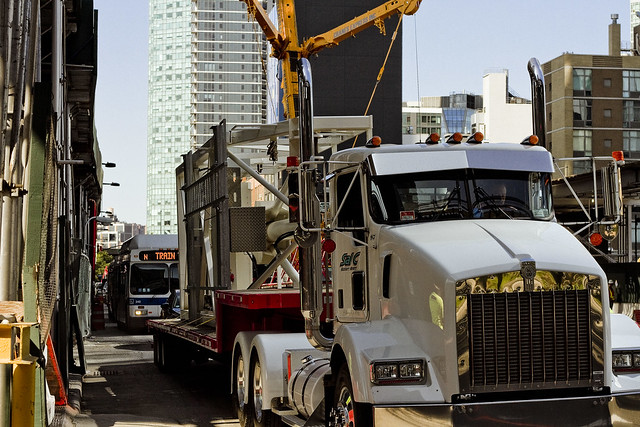
– photo by Mitch Waxman
Hunters Point is a section of Long Island City. Most modern people refer to it “as” Long Island City, but LIC – as in the “independent municipality of” – includes the neighborhoods of Astoria, Sunnyside, Blissville, Ravenswood, Dutch Kills, and Hunters Point as well. Hunters Point is pretty much defined as the zone sitting between Skillman Avenue to the east, the East River to the west, Queens Plaza to the north, and Newtown Creek to the south. The independent municipality of LIC’s old borders ran eastwards to what’s now the Kosciuszcko Bridge and Woodside Avenue to the east, Bowery Bay on the north, Newtown Creek on the south, and by the East River to the west.
The Dutch arrived in this peninsular area, sparsely populated by bands of the Lenape, back in the 1640’s. The first European land holder was a Dutch Priest named Dominie Everardus Bogardus, and back then LIC was referred to as “Dominie’s Hoek.” Bogardus, whom the historical record is not kind to, died in a shipwreck in 1647. Hunters Point, as defined above, came into the possession of a Dutch Sea Captain named Peter Praa, and the land stayed in his family until just before the American Revolution. At that time, the deed was in the hands of a Praa descendent named Anna Hunter. That’s why it’s called Hunters Point.

– photo by Mitch Waxman
Anna Hunter had three sons, and in the name of family unity and amity, her will stipulated that the land be sold off to avoid them fighting over the inheritance. By the time of the Civil War, the land had been divided into lots and sold off to a number of different concerns. The village, or town, of Hunters Point was a part of a county municipal organization called “Newtown” whose borders stretched all the way into modern day Nassau County. Newtown was a relict of the Dutch civilization’s “Nieuwtown,” whose function and borders were continued by the British and later the American governments long after the Dutch. The British first called it “Nieuwe Stad,” and at the time of the Revolution it was “Newtown.”
In the early 19th century, NYC was a ship building colossus. Manhattan shoreline properties along the East River were dearly held, and massively expensive to acquire. Ship yards, carpentry shops, iron foundries, coal yards, and rope factories were moving their operations over to Williamsburg and Greenpoint in Brooklyn and moving steadily north.
Industrial piers began to appear along the busy East River in Hunters Point, and along Newtown Creek. In 1848, the Roman Catholic Church bought the Alsop farm in Blissville in pursuance of creating Calvary Cemetery. Vernon Avenue was created and paved, and a plank road was built connecting to agricultural Blissville. The plank road was named for its destination, at the Borden Dairy Farms in Maspeth, and it was erected out of the swampy lowlands adjoining the Newtown Creek in 1868.
In the 1860’s, railroad tracks were connected to the east river by a company that would soon call itself the Long Island Railroad. Industrialization got its footing in LIC, due to easy access to the railroad AND to the water. Speculators began buying up dismal tidal swamps, filling them in with garbage, dead animals, human waste, and other fill materials. The Borden Plank road was paved and became Borden Avenue.
In 1870, a group of ambitious and notorious politicians, railroad operatives, and robber barons were successful in their bid to secede from agricultural Newtown and the independent municipality of Long Island City was formed.
The first land grab in what we call Queens got underway.
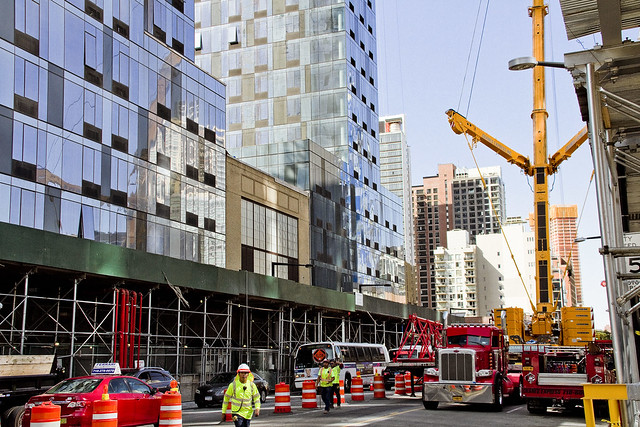
– photo by Mitch Waxman
Over twenty nine years of glorious misrule and an infamously corrupt political environment, LIC grew into the workshop of America. Enormous factories opened, and the waterfront in Hunters Point became a maritime industrial center, with nearly all of the freight traffic carried by the Long Island Railroad moving through it. Sugar factories, steel mills, oil refineries, chemical plants, fat renderers, pickle factories, fertilizer mills, manure yards, dead animal wharves – you name it – it was here. The City of Greater New York consolidated itself in 1898, incorporating LIC into its now familiar five boroughs, all under the guidance of the notorious Tammany Hall leader Richard Croker. Manhattan began to convert its industrial shorelines over to residential districts, and started to export all of its dirty industries to its new holdings in Brooklyn, and to the newly named Queens.
Manhattan began a process which modernity would describe as gentrification, displacing the working class poor and encouraging them to move to newly constructed row housing in the “outer boroughs.” The row housing was constructed by political insiders like Cord Meyer. Mr. Meyer and his fellow real estate speculators like Michael Degnon had inside information from the politicians of Tammany Hall about where the roads and subways would be created and they began to buy up agricultural properties all over the former Newtown. Entire neighborhoods were created, seemingly overnight. Call it Elmhurst? That’s Cord Meyer Sr. you’re echoing.
In 1909, the Queensboro Bridge was opened for business. Hell Gate Bridge opened in 1917. The Sunnyside Yards opened in 1919, made possible by the Pennsylvania Railroad company, which also created the East River tunnels that LIRR and Amtrak use to this day. The subways made gradual appearances in the first, second, and third decades of the twentieth century. Notably, what we call the 7 line – which already had three stops connecting Hunters Point to Manhattan as of 1915 – opened the Corona extension in April of 1917.
The second land grab in Queens got underway.
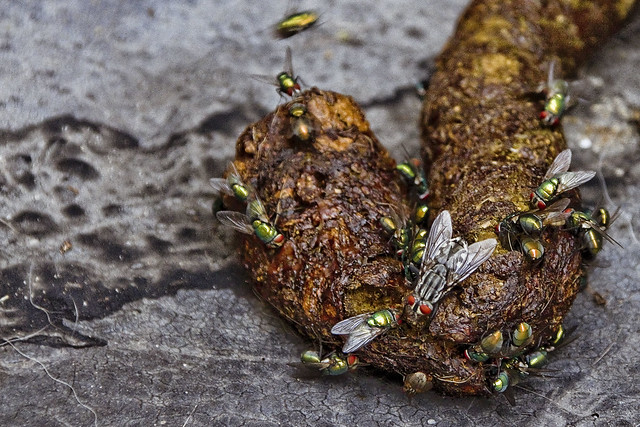
– photo by Mitch Waxman
Manhattan’s infamous tenement slums began to empty, and the working class hordes of immigrants began to populate into the new residential neighborhoods in Brooklyn, Queens, and the Bronx. Hunters Point had a relatively small residential population, which was centered not in the industrial zone but rather in the neighborhoods surrounding it. Sunnyside Gardens was created as an early example of “affordable housing” and as a planned community in the late 1920’s, in response to the multi story apartment houses which began to rise in Dutch Kills and Astoria along the new subway lines. At the same time, Robert Moses had appeared on the scene, along with his Triborough Bridge project.
Mighty Triborough opened in 1936, and the highways that feed into it like the Grand Central Parkway soon followed. The age of the automobile arrived in Queens, which allowed for heavy residential construction in previously rural areas. Forest Hills and Rego Park, Bayside and Douglaston, even Jamaica were now connected to Manhattan. For those who supported Mr. Moses, the routes and off ramps of the new high speed roads were revealed. In 1940, the Long Island Expressway and Queens Midtown Tunnel appeared in Hunters Point, which effectively blighted and cut the ancient community in half.
The third land grab in Queens got underway.
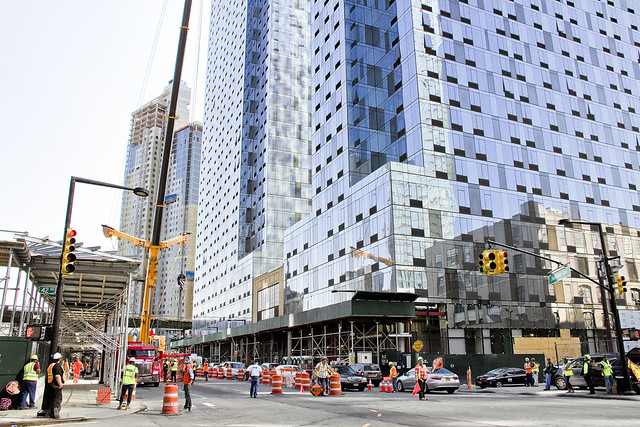
– photo by Mitch Waxman
After the Second World War, things began to change in Hunters Point. New York City began a process of de industrialization that wouldn’t become truly apparent until the middle 1960’s. Heavy industry began migrating to the American south and west, where industrial campuses of collossal size could be constructed. The political establishment of NYC, still married to the industrial labor unions, realized that they had to do something to try and protect their base. In 1961, The Department of City planning (which was controlled by Robert Moses) issued a decree that Hunters Point was now an “M1” zone – the land was reserved exclusively for heavy manufacturing use only.
For the homeowners and residential community in Hunters Point (and in Dutch Kills as well), what that meant was that no bank would advance them credit for a mortgage, or loan them money for renovation projects on existing residential properties. The fly in the ointment this time around, however, was that because of a general decline of manufacturing activity in the entire Northeastern United States the industrial base was seeking to vacate New York City. By the 1970’s, you couldn’t give the land away in Hunters Point. The residential community dwindled, but narrow strips of habitation persisted. The political establishment was heavily involved in “urban renewal” projects, and floods of federal money enabled developers like the Tishmans, Trumps, and Lefraks to build massive commercial and housing projects in Manhattan, Brooklyn, and Queens. This is when the big landlords and the politicians first really got to know each other, and the current alliance between big real estate and the political establishment of Manhattan was cemented.
It’s also when, in an attempt to revive a moribund local economy, the City began giving away land to developers. This process really kicked into gear in the 1980’s, under Mayor Koch.
– photo by Mitch Waxman
In 1981, NYC City Planning rechristened Hunters Point as a “mixed use district.” The first large scale development that occurred after this was the Citigroup tower, which opened in 1993, a 53 story structure which was built on land formerly occupied by a hospital. In 1995, 2001, and again in 2004, City Planning opened up zoning restrictions on height in LIC – particularly along the Hunters Point waterfront. As restrictions were loosened, and residential corridors were created, there was some construction activity but it was a lot of smoke with very little flame. The New York Times and other cheerleaders for the real estate interests began to refer to Hunters Point as “LIC” and started calling it “the next big thing.” (City planning is currently working on further loosenings of zoning in Hunters Point, and preparing the “LIC Core” rezoning which will make it possible to build high density residential towers as far east as Steinway Street, along Northern Blvd.) The currently underway Hunters Point South development is billed as the largest “affordable” housing project in the United States, but it’s not affordable by many of the current residents of LIC.
The so called “Brooklyn miracle” happened instead. From the post industrial waterfront of Williamsburg all the way south to what is now referred to as “DUMBO,” high density towers rose and created the new “Gold Coast” of Long Island. In the last decade, financial speculators and globalist investors have driven the price of Brooklyn real estate so high that financiers have begun to focus in on Hunters Point and Astoria instead, looking for a “good buy.”
The fourth land grab in Queens is underway, as you read this.
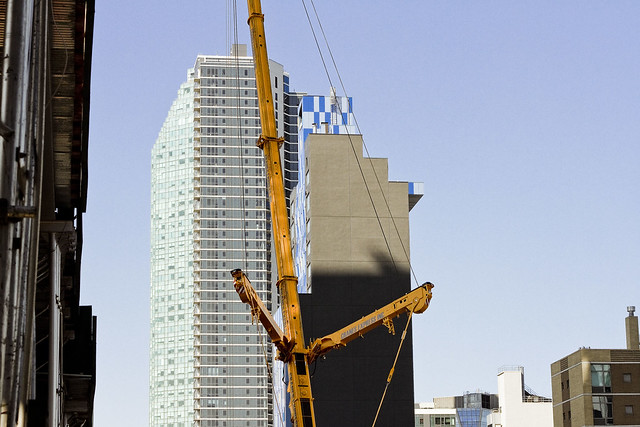
– photo by Mitch Waxman
All of this development has avoided upgrading the municipal infrastructure which the new population would require – cops, fire department, sewerage, hospitals, schools. If you’re walking through one of the glorious new waterfront parks in Hunters Point, and you suddenly grab at your chest, where the FDNY ambulance will take you is either Bellevue Hospital in Manhattan, the Mount Sinai hospital on Crescent street in Astoria, or out to Elmhurst hospital. FDNY’s fire fighting apparatus in western Queens was designed for industrial fires, and the 108th precinct is housed in a tiny 19th century building which still has horse stables. The sewer plant servicing this gargantuan residential population was opened by Fiorella LaGuardia in 1936. Our transit needs far outweigh current capability. There are not enough school desks. Don’t get me started on the environmental legacy of all that industry which used to be here. The buildings being erected in the photos in today’s posts are on the site of a former chemical factory in Queens Plaza, for instance.
Simply put, “gentrification” is nothing new in Western Queens and it’s been going on since at least the Civil War. The “G bomb” has already been dropped, and it has gone off. A looming infrastructure crisis is just beginning.
Upcoming Tours and events
Calvary Cemetery Walking Tour, with Atlas Obscura – Saturday, September 9th, 11 a.m. – 1 p.m.
Explore NYC history, hidden inside sculptural monuments and mafioso grave sites, as you take in iconic city views on this walking tour, with Newtown Creek Alliance Historian Mitch Waxman – details here.
“follow” me on Twitter- @newtownpentacle
true conditions
It’s National Salami Day, in these United States.

– photo by Mitch Waxman
On this day, in 70 AD, the Romans sacked Jerusalem. In 1776, the very first submarine attack on a warship occurred in New York Harbor when the Turtle attached a time bomb to the hull of HMS Eagle. In 1860, Garibaldi entered Naples and began the process of creating the modern day Nation of Italy. In 1921, the first Miss America pageant was held in Atlantic City, New Jersey. Over in San Francisco back in 1927, inventor Philo Farnsworth demonstrated the first television signal. Benjamin, the last of the thylacines, died alone in a Tasmanian zoo in 1936. In 1940, the Nazis began the London Blitz, and in 1978 Rock and Roll drummer Keith Moon kicked the bucket.
The cool car pictured above was spotted in Greenpoint, incidentally. I was out one night conducting a walking tour of Newtown Creek and happened across it. The graffiti is what drew me in.

– photo by Mitch Waxman
After conducting the walking tour, one set upon his path back towards the rolling hills of almond eyed Astoria, but had to pass through the concrete devastations of Hunters Point and Queens Plaza in order to do so. It was a nice night, and I decided upon walking home. On my way, I passed by the Queens Midtown Tunnel and captured this shot.
The funny bit – to me at least – about the current efforts by the State of New York to elimate toll booths in favor of electronic tolling is that no one thought about what happens on the Manhattan side of the tunnel. I’ve been noticing massive traffic backups on the Long Island Expressway since they instituted the new system, which was meant to ease traffic and smooth the commute for the 80,000 or so daily vehicle trips through the tunnel. The toll booths had the effect of causing traffic to pulse through the toll plaza four or five at a time, but now the traffic just snakes into it. The head of the snake emerges into the City and is met by traffic lights on second avenue. Those traffic lights are now the de facto governors of how fast traffic can flow through the tunnel, and on the 71 miles of the Long Island Expressway found to the east of it.
The military guys and gals have a word for this sort of thing – it’s “FUBAR.”

– photo by Mitch Waxman
Back in Astoria, it was preternaturally dark when I arrived home, but this sort of thing doesn’t bother my little dog Zuzu. She operates by smell and sound, my dog, and as we engaged in her evening saunter and as she performed her investigative sniffing, I was growing increasingly apprehensive for some reason.
My pineal gland was twitching with latent horror.

– photo by Mitch Waxman
As we swung back around onto Broadway and made our way back towards HQ, a large group of teenaged men were riding their bicycles down the block in a pack. According to a report I saw on the local CBS TV news, events such as this are to be viewed in a menacing light and feared. I found it menacing simply because they’re all teenagers. Darned kids, with their bicycles and the hip hop, engaging in group activities without first obtaining police permits or parental approval. Chaos!
There should be a curfew for anyone under the age of thirty, I tell ya. Damn kids.

– photo by Mitch Waxman
Bicycles such as the ones pictured above are a fairly modern invention, but some scholars attribute the first bike design to a sketch by one of DaVinci’s students in 1534. The first verified appearance of bicycles was in the 19th century, specifically in 1817 Germany with the “dandy horse.” These were “running machines” which were operated sans pedals or chains. The velocipede era saw the addition of pedals to the front wheel, but it wasn’t until 1863 that a french engineer came up with what we’d recognize instantly as a bike – with pedals and a chain driven rotary crank. What you’re looking at in the shot above are 21st century variants of what was introduced as the “safety bicycle” back in 1885. John Dunlop introduced the pneumatic tire in 1888. In 1889, the diamond shaped frame of the modern bike was introduced, in a model that also folded. The modern multi geared bike, which included a “Derailleur” mechanism on the chain, came on the scene at the start of the 20th century. Everything since has simply been refinement of the design.
Teenagers, however, have always been dangerous and unpredictable. Curfew!
Upcoming Tours and events
Calvary Cemetery Walking Tour, with Atlas Obscura – Saturday, September 9th, 11 a.m. – 1 p.m.
Explore NYC history, hidden inside sculptural monuments and mafioso grave sites, as you take in iconic city views on this walking tour, with Newtown Creek Alliance Historian Mitch Waxman – details here.
“follow” me on Twitter- @newtownpentacle
beaten man
It’s National Coffee Ice Cream Day, in these United States.

– photo by Mitch Waxman
Wandering around Long Island City with the camera is kind of “my thing.” Ordinarily, I’ve got one of my H.P. Lovecraft audiobooks blaring away in my headphones. More often than not, there’s some destination at Newtown Creek I’m heading for, as I was when these shots were gathered. On this particular day, I front loaded some “wander” time into the equation which allowed me to take a rather circuitous route to my eventual destination over in Brooklyn’s Greenpoint section.
I also wanted to “check in” on an area which I’ve not visited in the last few months to see if anything novel was happening. This area would be best described as the “angle” between Sunnyside and Blissville along Van Dam Street.

– photo by Mitch Waxman
There’s three moments in the history of LIC’s Van Dam Street to take note of. One occurred in 1909 when the Queensboro Bridge began to feed vehicular traffic into “Queens Plaza,” another was in 1914 when the newly consolidated City of Greater New York funded a project to raise the grade of Van Dam street several feet in elevation, and the other was in 1940 when the Long Island Expressway opened. The 1917 appearance of the IRT Flushing Line subway service on what was Thomson Venue but was soon renamed “Queens Blvd.,” is also kind of important (this was about 1921, I’m told).
Van Dam is angled against the street grid of the Blissville section of LIC, but its generally north/south path leads to Greenpoint and North Brooklyn from its start at Queens Blvd. Apparently, there used to be trolley service on Van Dam, which was a part of the Steinway Line. The street is named for the Van Dam family, which was quite prominent in both City and the future State back in the 17th and 18th centuries. One of them, Rip Van Dam, was the governor of the British owned New York colony from 1731-2.

– photo by Mitch Waxman
Robert Moses didn’t start the Queens Midtown Tunnel or Long Island Expressway projects, but by the time they both opened for business in August of 1940 they were firmly a part of his empire. It took four years to build the tunnel itself, and the high speed road that snakes into it runs eastwards for some seventy one miles. As you can see from the shots above and below, not much thought was paid into what would happen to the runoff from the highway.
It just splatters down onto LIC and into the sewer grate.

– photo by Mitch Waxman
This is nothing unusual, and I’ve been informed by the powers that be that not one of NYC’s many bridges, tunnels, or highways is directly connected to a sewer plant – even the brand new Koscisuzcko. Rather, they all just feed into storm sewers, which then release into area waterways. The world is a joyful place, for one such as myself.

– photo by Mitch Waxman
This section of the Long Island Expressway, officially known as the Queens Midtown Expressway, carries an average of 80,000 vehicle trips a day to and from the Queens Midtown Tunnel. That’s 29.2 million vehicle trips annually.
Upcoming Tours and events
Calvary Cemetery Walking Tour, with Atlas Obscura – Saturday, September 9th, 11 a.m. – 1 p.m.
Explore NYC history, hidden inside sculptural monuments and mafioso grave sites, as you take in iconic city views on this walking tour, with Newtown Creek Alliance Historian Mitch Waxman – details here.
“follow” me on Twitter- @newtownpentacle
unmentionable allies
It’s National Cheese Pizza Day, in these United States.

– photo by Mitch Waxman
As the adage goes, when one gazes into the proverbial abyss, there’s always something staring out of it at you. In the case of the Sunnyside Yards here in Queens, that’s usually a bored Amtrak cop whose eyes have glazed over in front of a bank of monitors connected to security cameras.
Me? I know where every hole in the fencelines can be found, and which one of my lenses will fit through it. In the case of the shot above, the hole is around twenty five millimeters, and I haven’t got anything in my kit that can be inserted through the hole. Luckily, there’s a lot of holes in the fence.

– photo by Mitch Waxman
One attempted to use the downtime last week in a productive fashion, wandering about whenever the weather permitted. Saying that, I didn’t get too much done – on purpose – in order to vouchsafe a bit of time to just sit and think. I did have a couple of things to do that interrupted my reveries, however.
I was asked by Councilmember Van Bramer’s office if I would write a response to an “Op Ed” by the Queens Anti Gentrification Project” aimed at Jimmy and offered at the citylimits site. QAGP seems to have taken some umbrage at my response and published this post at their own site addressed towards me. I’ve known Jimmy Van Bramer for a while now, his Mom lives a couple of blocks away from me here in Astoria, and I emphatically support his reelection campaign. Jimmy has been, and I’m sure will continue to be – an effective advocate for his district.

– photo by Mitch Waxman
One shall be responding in my usual manner – next week – to the QAGP folks, but allow me this:
As I’ve said in the past, “gentrification” is not an apropo term for what’s happening in LIC (or North Brooklyn). The proposal to deck over the Sunnyside Yards, the rezoning of the LIC industrial districts and consequent residential tower construction by monied interests based and interested only in short term benefits to Manhattan offered by this build out, the complete blindness towards the municipal infrastructure costs associated with this process… we haven’t got a word for it yet.
This POV will be crystallized in a post offered next week.

– photo by Mitch Waxman
One does stand ready to be accused of being a shill, again.
When I first “stepped out” in public and began discussing Newtown Creek and the environmental issues affecting our community the accusations were waiting for me. New York City Planning asked me “who do you think you are”? One well known activist openly described my efforts at building awareness of these issues as a shell game initiated by the real estate developers, whom I was obviously a clandestine agent of. My willingness to converse with and try to find common ground between the community and the historical corporate polluters of Newtown Creek – ExxonMobil and the like – saw me accused of being an agent of the petrochemical industry sent amongst the environmental community to sow chaos. When I became involved with transit issues, more recently, accusations of being a Democratic Party operative emerged. The kayakers, the bicycle people… don’t get me started.
I wish my life was that interesting, and that the monies people presume I’m receiving for my activities were actually in my possession. Our Lady of the Pentacle and myself barely scratch by, just like everyone else these days.

– photo by Mitch Waxman
Speaking as the first person in Queens to throw down the gauntlet to City Hall regarding the Sunnyside Yards mega development, and one of the principal flies in the ointment of the people planning it, one finds all of these accusations amusing. Ask the NYC DEP if I’m in their employ, or ExxonMobil, or any of the other entities who’ve I set my focus on over the years. I’m quite popular with the MTA establishment at Jay Street as well, and as far as the BQX goes… let’s just say that when I walk into a meeting room the staffers from EDC collect up in a quiet corner and discuss how to handle the fact that I’ve shown up.
My resume and activist credentials which have defined my life over the last ten years have not been gained by throwing around a bunch of meaningless slogans. Instead it’s been “showing up” to nighttime meetings with bland officials at a sewer plant during snow storms in January, and sweating in the July heat to build consensus and constituency amongst my fellow citizens. I’ve put my name on everything I’ve done, as well. When I’ve been wrong, the first person to bring it up has been “yours, truly.”
This is real life, not some intellectual game, and a looming infrastructure crisis is about to hurt us all.
Upcoming Tours and events
Calvary Cemetery Walking Tour, with Atlas Obscura – Saturday, September 9th, 7 p.m. – 9 p.m.
Explore NYC history, hidden inside sculptural monuments and mafioso grave sites, as you take in iconic city views on this walking tour, with Newtown Creek Alliance Historian Mitch Waxman – details here.
“follow” me on Twitter- @newtownpentacle
sweating brow
It’s National Welsh Rarebit Day, in these United States.

– photo by Mitch Waxman
A humble narrator is indulging in a bit of down time this week, and single images will be greeting you from now until Labor Day on September 4th.
“follow” me on Twitter- @newtownpentacle


 The Newtown Pentacle