Archive for the ‘Brooklyn’ Category
existing make

– photo by Mitch Waxman
Normally, with this being Saturday and all, you’d find a photo of a Firebox in some godforsaken locale displayed prominently and spoken about in glowing terms.
Since it’s August, and that means vacation lazy time, let’s take this week off from “Project Firebox” and instead visit with the FDNY Marine 1 at Wallabout Bay.
The unit housed therein have several historic fireboats in their inventory. That’s the Governor Alfred E. Smith fireboat pictured above, for instance.
from marine1fdny.com
Marine 1 was the first Marine Company formed in the City of New York. We have moved several times over the years (find out more on our history page). We are on call and respond to 560 miles of waterfront surrounding the City of New York. These waterways are among the busiest in the world, used for both shipping and enjoyment. Along with the other two fireboats and a total of four small rapid response boats, we protect the people of New York as well as those visitors who are just passing through.
Marine 1 is manned by a crew of seven; an officer, a pilot, two engineers, and two firefighters.

– photo by Mitch Waxman
Those are the Firefighter and John D. McKean fireboats, both longtime veterans of the harbor which have passed out of useful duty. Firefighter 2 is the sister ship of the futuristic Three Forty Three, and Firefighter 1 is already retired.
Just a short visit to the Wallabout today, go outside and play some ball or something, don’t waste the entire summer sitting inside surfing the net.
from wikipedia
Fire Fighter, also known as Firefighter, is a fireboat serving the New York City Fire Department. She was an active fireboat serving as Marine Company 9 until being retired in 2010. She was the most powerful diesel-electric fireboat when built in 1938. She has fought more than 50 fires, including upon the SS Normandie in 1942.
_______________________________________________________________
August 5th, 2012- Newtown Creek Alliance Walking Tour- The Insalubrious Valley- Tomorrow

– photo by Mitch Waxman
Newtown Creek Alliance historian Mitch Waxman will be leading a walk through the industrial heartlands of New York City, exploring the insalubrious valley of the Newtown Creek.
The currently undefended border of Brooklyn and Queens, and the place where the Industrial Revolution actually happened, provides a dramatic and picturesque setting for this exploration. We’ll be visiting two movable bridges, the still standing remains of an early 19th century highway, and a forgotten tributary of the larger waterway. As we walk along the Newtown Creek and explore the “wrong side of the tracks” – you’ll hear tales of the early chemical industry, “Dead Animal and Night Soil Wharfs”, colonial era heretics and witches and the coming of the railroad. The tour concludes at the famed Clinton Diner in Maspeth- where scenes from the Martin Scorcese movie “Goodfellas” were shot.
Lunch at Clinton Diner is included with the ticket.
Details/special instructions.
Meetup at the corner of Grand Street and Morgan Avenue in Brooklyn at 11 a.m. on August 5, 2012. The L train serves a station at Bushwick Avenue and Grand Street, and the Q54 and Q59 bus lines stop nearby as well. Check MTA.info as ongoing weekend construction often causes delays and interruptions. Drivers, it would be wise to leave your vehicle in the vicinity of the Clinton Diner in Maspeth, Queens or near the start of the walk at Grand St. and Morgan Avenue (you can pick up the bus to Brooklyn nearby the Clinton Diner).
Be prepared: We’ll be encountering broken pavement, sometimes heavy truck traffic as we move through a virtual urban desert. Dress and pack appropriately for hiking, closed-toe shoes are highly recommended.
Clinton Diner Menu:
- Cheese burger deluxe
- Grilled chicken over garden salad
- Turkey BLT triple decker sandwich with fries
- Spaghetti with tomato sauce or butter
- Greek salad medium
- Greek Salad wrap with French fries
- Can of soda or 16oz bottle of Poland Spring
for August 5th tickets, click here for the Newtown Creek Alliance ticketing page
wonderful likewise

– photo by Mitch Waxman
Often spotted but seldom photographed, this is (apparently) a Great Blue Heron which has been evading my lens on the fabled Newtown Creek all year. Often too far away to claim a clear shot, or darting about the sky madly, I’ve been chasing this bird for a very long time.
from wikipedia
It is the largest North American heron and, among all extant herons, it is surpassed only by the Goliath Heron and the White-bellied Heron. It has head-to-tail length of 91–137 cm (36–54 in), a wingspan of 167–201 cm (66–79 in), a height of 115–138 cm (45–54 in), and a weight of 2.1–3.6 kg (4.6–7.9 lb). Notable features include slaty flight feathers, red-brown thighs, and a paired red-brown and black stripe up the flanks; the neck is rusty-gray, with black and white streaking down the front; the head is paler, with a nearly white face, and a pair of black plumes running from just above the eye to the back of the head. The feathers on the lower neck are long and plume-like; it also has plumes on the lower back at the start of the breeding season. The bill is dull yellowish, becoming orange briefly at the start of the breeding season, and the lower legs gray, also becoming orangey at the start of the breeding season. Immature birds are duller in color, with a dull blackish-gray crown, and the flank pattern only weakly defined; they have no plumes, and the bill is dull gray-yellow. Among standard measurements, the wing chord is 43–48 cm (17–19 in), the tail is 15.2–19 cm (6.0–7.5 in), the culmen is 13.1–15.2 cm (5.2–6.0 in) and the tarsus is 15.7–21 cm (6.2–8.3 in).

– photo by Mitch Waxman
Just in case you’re wondering, the weird background blur you see was produced entirely “in camera” rather than via the wonders of photoshop. Your humble photographer was onboard a boat headed in the opposite direction than that which the heron was traveling in, and I was horizontally tracking its flight while narrowly “zone focused”- producing the motion blur.
from harborestuary.org
Collectively known as the Harbor Herons, this suite of species includes: Great Egret (Ardea alba), Snowy Egret (Egretta thula), Glossy Ibis (Plegadis falcinellus, Little Blue Heron (Egretta caerulea), Cattle Egret (Bubulcus ibis), Tricolored Heron (Egretta tricolor), Green Heron (Butorides striatus), Black-crowned Night-Heron (Nycticorax nycticorax), and Yellow-crowned Night-Heron. Herons and their allies are not new to the NY metropolitan region (Bernick and Elbin, in preparation). Since enforcement of the Clean Water Act of 1972, the Harbor Herons have significantly colonized the NY/NJ Harbor Region. Water quality has improved (NJ Harbor Dischargers Group 2006), but quality wetland habitat has become scarce, degraded, and fragmented.. Birds of traditionally isolated habitats, secure from human disturbance, have adapted to human- altered landscapes (Parsons and Burger 1982). Some species thrive as ̳human subsidized‘ and learn to forage among landfills, loaf on the rip rap, and raise their young on islands nestled between barges and smoke stacks (Burger 1981a, Parsons 1987, 1990, Maccarone and Parsons 1994, Maccarone and Brzorad 1998).

– photo by Mitch Waxman
It’s always surprising to see an animal of this size and niche status here at the Newtown Creek, especially considering the comments of State officials offered to me a few months back describing the place as a “dead sea”. If you click through to the full set of images surrounding these four at my Flickr page, you’ll see the bird hunting amongst the waterline stones of a “rip rap” shoreline which is quite typical for the Brooklyn side of the Creek between Maspeth Creek and Meeker Avenue.
That’s right, this bird is flying around under the Kosciuszko Bridge through the heart of the Greenpoint and Blissville Oil Spills.
The great blue heron nests colonially and usually in tall living or dead trees. The nest is a large flat platform of twigs. Nests may be used for more than a year. The nest will become larger each year as the birds add more nesting material.
Breeding begins from early March through April and usually ends in July. Each pair lays 3 to 7 eggs and incubation lasts 25 to 29 days. Both parents incubate the eggs and care for the young. The young are usually ready to fly at 60 days after hatching and will leave the nest at between 64 to 90 days. They may then breed at two years of age.

– photo by Mitch Waxman
Consultation is appreciated by those who are familiar with the world of birding, for- as mentioned in the past- every time I try to identify a bird I end up with egg on my face. From references found online, I seem to be correct in my identification, but have often been wrong in the past.
What do you think, gentle readers? Use the comments link below if you can bless or damn my assessment of the specie.
from dec.ny.gov
An estuary is a place where salty water from the ocean mixes with fresh water from the land and creates a unique and special place for marine species to live, feed, and reproduce. Estuaries are transitional areas where the ocean tides bring in nutrients and animals, while freshwater runoff reduces the stress caused by saltwater and carries even more nutrients. Often, estuaries have a restriction across the mouth, like a barrier beach or sand bar which offers protection from the full force of ocean waves and storms. Estuaries are a critical part of the life cycle of many different species. They are the spawning and nursery area for thousands of animals who seek out the quieter waters of estuaries to provide a protected nursery for their offspring. Estuaries also provide a food rich resting area for migrating waterfowl like black ducks, harlequin ducks, scoters, and scaup. Wading birds like the great blue heron, great egret, and glossy ibis, and snowy egret nest in colonies on islands found in New York Harbor, Long Island Sound and Gardiners Bay. Raptors like osprey and northern harriers also nest and feed throughout the marine district of New York.
_______________________________________________________________
August 5th, 2012- Newtown Creek Alliance Walking Tour- The Insalubrious Valley- This Sunday
– photo by Mitch Waxman
Newtown Creek Alliance historian Mitch Waxman will be leading a walk through the industrial heartlands of New York City, exploring the insalubrious valley of the Newtown Creek.
The currently undefended border of Brooklyn and Queens, and the place where the Industrial Revolution actually happened, provides a dramatic and picturesque setting for this exploration. We’ll be visiting two movable bridges, the still standing remains of an early 19th century highway, and a forgotten tributary of the larger waterway. As we walk along the Newtown Creek and explore the “wrong side of the tracks” – you’ll hear tales of the early chemical industry, “Dead Animal and Night Soil Wharfs”, colonial era heretics and witches and the coming of the railroad. The tour concludes at the famed Clinton Diner in Maspeth- where scenes from the Martin Scorcese movie “Goodfellas” were shot.
Lunch at Clinton Diner is included with the ticket.
Details/special instructions.
Meetup at the corner of Grand Street and Morgan Avenue in Brooklyn at 11 a.m. on August 5, 2012. The L train serves a station at Bushwick Avenue and Grand Street, and the Q54 and Q59 bus lines stop nearby as well. Check MTA.info as ongoing weekend construction often causes delays and interruptions. Drivers, it would be wise to leave your vehicle in the vicinity of the Clinton Diner in Maspeth, Queens or near the start of the walk at Grand St. and Morgan Avenue (you can pick up the bus to Brooklyn nearby the Clinton Diner).
Be prepared: We’ll be encountering broken pavement, sometimes heavy truck traffic as we move through a virtual urban desert. Dress and pack appropriately for hiking, closed-toe shoes are highly recommended.
Clinton Diner Menu:
- Cheese burger deluxe
- Grilled chicken over garden salad
- Turkey BLT triple decker sandwich with fries
- Spaghetti with tomato sauce or butter
- Greek salad medium
- Greek Salad wrap with French fries
- Can of soda or 16oz bottle of Poland Spring
for August 5th tickets, click here for the Newtown Creek Alliance ticketing page
slow decadence

– photo by Mitch Waxman
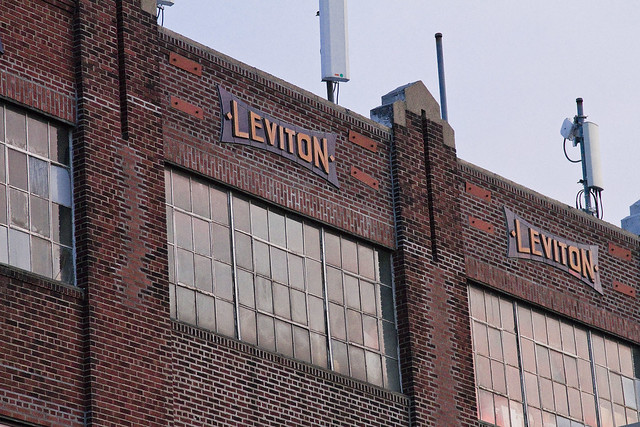
I seem to walk past this structure at least once a week, have done so for several years now, and until recently was completely ignorant about one of the largest employers of 20th century Greenpoint. The Leviton family built this commercial empire by the sweat of their brows- stories of part time employees encountering old Isidor working on the factory floor are rampant in Greenpoint, verging on Pop culture amongst garden spotters of a certain age.
from wikipedia
Leviton Manufacturing Company, Inc. is a manufacturer of electrical wiring devices, data center connectivity apparatus and lighting energy management systems. The company was founded in 1906 by Evser and his son Isidor Leviton. They began by manufacturing brass mantle tips for the natural gas lighting infrastructure in Manhattan. They sold their mantle tips on a pushcart on the Bowery on the Lower East side of Manhattan. Isidor Leviton designed a screw in lampholder for Thomas Edison’s Electric Lamp in 1910 and within ten years the lampholders were being used in every apartment in New York. In 1936 Leviton built a two square block 4 story factory and warehouse in Greenpoint, Brooklyn which still stands today. Leviton products include over 25,000 devices and systems, used in homes and businesses.

– photo by Mitch Waxman
Another bit of reputation that the family gathered unto itself was a certain liberalism regarding class, religion, and creed in their hiring practices- eschewing the segregation and selective hiring practiced by other corporations- particularly those in the electronics sector. The father of a close friend once told me that, in the years following the second world war, he was denied an opportunity to use his ivy league engineering degree because of a last name that sounded “too Italian”. Not an issue at Leviton, I am told.
from heresgreenpoint.com
By 1910 Leviton was designing and manufacturing pull-chain lamp holders for Thomas Edison’s newly developed light bulb, and in 1922 the company was moved to Greenpoint to better facilitate its rapid ascention. The massive factory took up two city blocks between Newel and Jewel Streets and produced over 600 electrical items, from fuses to socket covers to outlets and switches. Leviton would remain in Greenpoint until 1975, when the company again relocated, this time to Little Neck, NY.
– photo by Mitch Waxman
Newspaper reports describe the company as resistant to unionization, and even Eleanor Roosevelt found herself standing in solidarity with a picket line on Greenpoint Avenue in the 1940’s. In August of 1940, a large group of laborers “went out”, despite Leviton paying “benefits”- a rare and coveted perk of employment in that era. “Benefits” are what health insurance and a retirement plan were once known as, and were not an automatic or legislated requirement before the 1970’s- for those of you reading this under the age of 30, understand that these “insurance benefits” were something won by the labor movement of the early 20th century.
This was the scene of a long and contentious labor strike in 1940,
as detailed in this preview of the George Ruffini book– “Harry Van Arsdale, Jr: Labor’s Champion”, courtesy google books.

– photo by Mitch Waxman
Today, the structure is called the “Greenpoint Industrial Center” and seems to host a series of industrial, artisanal, and warehousing operations who make use of its cavernous interior spaces. The Leviton company left Greenpoint in the 1970’s, migrating to literal greener pastures in eastern Queens and ultimately Melville, Long Island.
from nationmaster.com
The Leviton Manufacturing Company was founded in New York by Isidor Leviton, at the dawn of the electrical era in 1906. Originally engaged in the fabrication of mantle tips for gas lighting, the Company soon afterwards in 1910, converted to production of a single electrical product — a pull-chain lampholder (designed for Edison’s new light bulbs).
- 1922: Leviton relocated to Greenpoint, Brooklyn after acquiring the TECCO plant, and now offered 568 products.
- 1929: Acquires Meteor Electric Company, a leading manufacturer of wiring devices.
- 1932: Leviton devices are used in the Empire State Building.
- 1937: Acquires American Insulated Wire and becomes the industry leader in wire, cable and cord products.
- 1939: Leviton devices featured at World’s Fair.
- 1950: Purchases the Deal Electric Company.
- 1953: Acquires Hale Brothers Companies, now known as Leviton Canada.
- 1960: Leviton is among the first manufactures to institute an employee pension plan.
- 1961: Leviton devices are installed in the White House.
- 1965: Harold Leviton becomes President and CEO.
- 1972: Introduces the first GFCI, the first touch dimmer, and a selection of home automation powerline carrier components.
- 1973: Introduces Decora® designer-style devices.
- 1975: Moves corporate headquarters to current location in Little Neck, NY.
_______________________________________________________________
August 5th, 2012- Newtown Creek Alliance Walking Tour- The Insalubrious Valley- This Sunday
– photo by Mitch Waxman
Newtown Creek Alliance historian Mitch Waxman will be leading a walk through the industrial heartlands of New York City, exploring the insalubrious valley of the Newtown Creek.
The currently undefended border of Brooklyn and Queens, and the place where the Industrial Revolution actually happened, provides a dramatic and picturesque setting for this exploration. We’ll be visiting two movable bridges, the still standing remains of an early 19th century highway, and a forgotten tributary of the larger waterway. As we walk along the Newtown Creek and explore the “wrong side of the tracks” – you’ll hear tales of the early chemical industry, “Dead Animal and Night Soil Wharfs”, colonial era heretics and witches and the coming of the railroad. The tour concludes at the famed Clinton Diner in Maspeth- where scenes from the Martin Scorcese movie “Goodfellas” were shot.
Lunch at Clinton Diner is included with the ticket.
Details/special instructions.
Meetup at the corner of Grand Street and Morgan Avenue in Brooklyn at 11 a.m. on August 5, 2012. The L train serves a station at Bushwick Avenue and Grand Street, and the Q54 and Q59 bus lines stop nearby as well. Check MTA.info as ongoing weekend construction often causes delays and interruptions. Drivers, it would be wise to leave your vehicle in the vicinity of the Clinton Diner in Maspeth, Queens or near the start of the walk at Grand St. and Morgan Avenue (you can pick up the bus to Brooklyn nearby the Clinton Diner).
Be prepared: We’ll be encountering broken pavement, sometimes heavy truck traffic as we move through a virtual urban desert. Dress and pack appropriately for hiking, closed-toe shoes are highly recommended.
Clinton Diner Menu:
- Cheese burger deluxe
- Grilled chicken over garden salad
- Turkey BLT triple decker sandwich with fries
- Spaghetti with tomato sauce or butter
- Greek salad medium
- Greek Salad wrap with French fries
- Can of soda or 16oz bottle of Poland Spring
for August 5th tickets, click here for the Newtown Creek Alliance ticketing page
vast reaches

– photo by Mitch Waxman
Pictured today are the operations of A.R.C. scrap metal division of a corporation called Alloco found at 540 Kingsland avenue in the Greenpoint section of Brooklyn, pictured from a vantage point on the loquacious Newtown Creek.
Another former Standard Oil property converted over to modern usage, A.R.C. scrap metal is involved in the recycling trade.

– photo by Mitch Waxman
I’ve had the privilege of meeting some of the folks who work here, and you couldn’t ask to encounter a nicer bunch of guys. Their yard always displays a frenzy of activity, with heavy equipment sorting through the flow of waste materials and what seems like dozens of safety vested and hard hatted workers laboring away.

– photo by Mitch Waxman
You may have seen one of these shots before, and apologies are offered for repetition. One is still sorting out problems and playing catch up after the interruption to work flow offered by the lightning strike which disabled much of my equipment.
It has been a very, very busy period of time with many unexpected and unscheduled obstacles.
_______________________________________________________________
August 5th, 2012- Newtown Creek Alliance Walking Tour- The Insalubrious Valley
– photo by Mitch Waxman
Newtown Creek Alliance historian Mitch Waxman will be leading a walk through the industrial heartlands of New York City, exploring the insalubrious valley of the Newtown Creek.
The currently undefended border of Brooklyn and Queens, and the place where the Industrial Revolution actually happened, provides a dramatic and picturesque setting for this exploration. We’ll be visiting two movable bridges, the still standing remains of an early 19th century highway, and a forgotten tributary of the larger waterway. As we walk along the Newtown Creek and explore the “wrong side of the tracks” – you’ll hear tales of the early chemical industry, “Dead Animal and Night Soil Wharfs”, colonial era heretics and witches and the coming of the railroad. The tour concludes at the famed Clinton Diner in Maspeth- where scenes from the Martin Scorcese movie “Goodfellas” were shot.
Lunch at Clinton Diner is included with the ticket.
Details/special instructions.
Meetup at the corner of Grand Street and Morgan Avenue in Brooklyn at 11 a.m. on August 5, 2012. The L train serves a station at Bushwick Avenue and Grand Street, and the Q54 and Q59 bus lines stop nearby as well. Check MTA.info as ongoing weekend construction often causes delays and interruptions. Drivers, it would be wise to leave your vehicle in the vicinity of the Clinton Diner in Maspeth, Queens or near the start of the walk at Grand St. and Morgan Avenue (you can pick up the bus to Brooklyn nearby the Clinton Diner).
Be prepared: We’ll be encountering broken pavement, sometimes heavy truck traffic as we move through a virtual urban desert. Dress and pack appropriately for hiking, closed-toe shoes are highly recommended.
Clinton Diner Menu:
- Cheese burger deluxe
- Grilled chicken over garden salad
- Turkey BLT triple decker sandwich with fries
- Spaghetti with tomato sauce or butter
- Greek salad medium
- Greek Salad wrap with French fries
- Can of soda or 16oz bottle of Poland Spring
for August 5th tickets, click here for the Newtown Creek Alliance ticketing page
final destinations
This is tomorrow, as in Sunday the 22nd. Seriously- you can count the number of seats left with one hand. If you haven’t got your tickets yet, today is probably your last chance.
 |
 |
Many people know about the environmental issues facing Newtown Creek, but did you know that the Creek was once the busiest waterway in North America, carrying more industrial tonnage than the entire Mississippi River?
You’ll learn much more when Working Harbor Committee’s maritime historians and harbor experts
put it all in context during a Hidden Harbor Tours: Newtown Creek Exploration.
The heart of industrial New York, Newtown Creek was home port to hundreds of tugboats (one of which is the historic WO Decker). It was also an international destination for oceangoing ships and a vast intermodal shipping and manufacturing hub that employed hundreds of thousands of people. Forming the border of Brooklyn and Queens for nearly three miles, five great cities grew rich along the Newtown Creek’s bulkheads — Greenpoint, Willamsburg, Bushwick, Long Island City and Manhattan itself. The waterway is still a vital part of the harbor and the Working Harbor Committee (WHC) is proud to present this tour as part of the celebration of their tenth anniversary year.
Mitch Waxman, a member of WHC’s steering committee and the group’s official photographer, also serves with the Newtown Creek Alliance as its group Historian. In addition to working on WHC’s boat tours of the Creek, Mitch offers a regular lineup of popular walking tours, and presents a series of well-attended slideshows for political, governmental, antiquarian, historical and school groups. His website – newtownpentacle.com – chronicles his adventures along the Newtown Creek and in the greater Working Harbor.
He was recently profiled in the NY Times Metro section, check out the article here.
Upcoming tour: Hidden Harbor Tours: Newtown Creek Exploration.
On July 22nd, Mitch shares his unique point of view and deep understanding of the past, present and future conditions of the Newtown Creek as the narrator and expedition leader for this years Hidden Harbor Tours: Newtown Creek exploration.
Our NY Water Taxi leaves from South Street Seaport at 11 a.m. (sharp) on a three hour tour of the Newtown Creek. From the East River we’ll move into the Newtown Creek where we’ll explore explore vast amounts of maritime infrastructure, see many movable bridges and discover the very heart of the Hidden Harbor.
Limited seating available, get your tickets today.
 |
|||||||||||||||
|
|||||||||||||||


 The Newtown Pentacle