Archive for the ‘Greenpoint’ Category
thicker fungi
Deep within the bowels of New York City.

– photo by Mitch Waxman
As mentioned yesterday, I was asked to speak at a Waterfront Alliance meeting which was scheduled to occur last week in Greenpoint at the Newtown Creek Wastewater Treatment Plant, and the DEP folks who manage the plant offered to bring the WA group through the facility for a tour. Of course, I’ve been through here several times, and due to my various committees and general obsession with Newtown Creek, the sewer plant is kind of a familiar place to me – but you never say no when City employees open a locked door and invite you in somewhere to take a look around.

– photo by Mitch Waxman
We actually got to go to a section of the plant which I’ve seldom seen, which is the generator and electrical room. Normally the plant consumes power from off the CON ED electrical grid, but during power outages and high usage periods the DEP can flip the switches that power up the plants own power turbines and fend for themselves.

– photo by Mitch Waxman
The DEP engineer conducting the tour explained that these turbines are functionally jet engines whose thrust drives the generators. There was some routine maintenance going on and we got to see what the equipment actually looks like, which was a first for me.

– photo by Mitch Waxman
Of particular interest are the pumps and enormous pipes through which the waste water enters into the plant, pictured above. On a dry weather day, these pipes carry around 310 million gallons of the stuff. The day we were visiting with the DEP followed a terrific thunderstorm that had just rolled through the night before, and the DEP folks said that they had processed an astounding 800 million gallons of water at the plant.

– photo by Mitch Waxman
The shot above looks down around two to three stories from a catwalk, and the gizmo framed by the yellow steel is one of the actual sewage pumps. DEP has had some issues with these pumps, supposedly a factory defect, and they are being repaired/replaced by the manufacturer. A misplaced sensor inside the pipe was forming a turbulence in the flow to form which caused the pumps to cavitate.
The cavitation, which is the sort of motion that a washing machine on spin cycle creates, was causing fastenings to work themselves loose and creating general mechanical havoc for the engineers.

– photo by Mitch Waxman
This is the screen room, where mechanical claws pull solid materials out of the wastewater flow. The smell in this area of the plant is unique – distinct from the smell of sewage, I would mention. Sewer solids smell like… the best analogy I can offer for the smell is to suggest what it tastes like when you lick the terminals of a 9 volt battery – metallic, bitter, and shocking.
More tomorrow.
Upcoming Events and Tours
Wednesday, August 3rd, 6:30 p.m. – 8:30 p.m. –
Glittering Realms Walking Tour,
with NYC H2O. Click here for more details.
Saturday, August 6th, 2:00 p.m. – 4:00 p.m. –
Insalubrious Valley Walking Tour,
with NY Adventure Club. Click here for more details.
Sunday, August 14th, 11:00 p.m. – 1:00 p.m. –
Calvary Cemetery Walking Tour,
with Atlas Obscura. Click here for more details.
Sunday, August 21, 11:00 a.m. – 1:00 p.m. –
Poison Cauldron Walking Tour,
with Atlas Obscura. Click here for more details.
“follow” me on Twitter- @newtownpentacle
bright stone
Tugboat action on part of America’s Maritime Superhighway, Newtown Creek, in today’s post.

– photo by Mitch Waxman
Chickity check yo ass, if you think that new school Newtown Creek is a punk in New York Harbor. Obama and his crew down in D.C. call the Creek a “SMIA” or “Significant Maritime Infrastructure Area.” Dope tugboats can be seen rolling through here all the time.
That’s the Dann Towing company’s Ruby M slipping by and flying its colors.

– photo by Mitch Waxman
Awesome, Ruby M is a 48 year old crusher, bro. She’s a hundred feet long with a beam of 28 feet, and Dann’s Ruby M only needs 12 feet of draft to fire up those 1,750 HP twin steel screws. She was crunching a fuel barge down the Creek, but needed the bitchin’ Pulaski Bridge to pop open before she could thrash through to the east.

– photo by Mitch Waxman
Woe to you, oh earth and sea, if you don’t acknowledge the inherent wonders of Newtown Creek. Above, the latest entrant in the Creek’s pageant of wonders enters the frame as the tug Helen Laraway plies its gelatinous waters. A twin screw, steel hulled push boat, Helen Laraway was built in 1957 and can muster up 2,000 HP to power its twin screws.

– photo by Mitch Waxman
Newtown Creek once hosted the most valuable maritime industrial bulkheads on the entire Earth. The unfortunate truth of the modern age is that only a small percentage of the owners of the waterfront properties hereabouts use their bulkheads. A single barge carries the equivalent cargo of 38 heavy trucks.
Upcoming Events and Tours
Sunday, August 21, 11:00 a.m. – 1:00 p.m. –
Poison Cauldron Walking Tour,
with Atlas Obscura. Click here for more details.
“follow” me on Twitter- @newtownpentacle
nail biting
A bit of Newtown Creek “now and then,” in today’s post.

– photo by Mitch Waxman
One has been at work on several subjects regarding that fabulously decadent cataract of Municpal neglect known to all as the Newtown Creek. It’s kind of big picture stuff, which requires a “long tail” of research on and about certain industries. You can’t understand something modern unless you understand its past, I always say.
For example – If I want to describe the Brooklyn Union Gas Manufactured Gas plant on Newtown Creek in Greenpoint (which is now the National Grid LNG plant on Varick), I need to possess an at least topical amount of knowledge regarding the history and technology of the 19th century Manufactured Gas Industry in New York City.
Actually, that’s not an example, it’s precisely the thing I’ve been working on – to develop an understanding of. Manufactured Gas Plants – or MGP’s as they’re known in the environmental community.
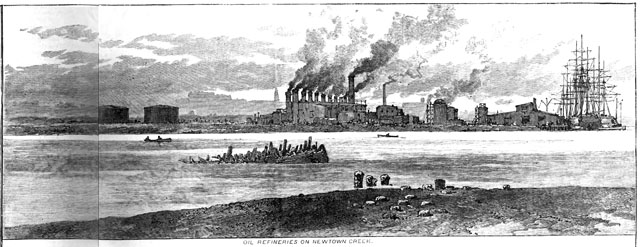
– from Harper’s Weekly, August 6th, 1881 (courtesy google books)
This sort of research always turns up a few surprises, and for an area like Newtown Creek – which is of truly national importance in the story of the second industrial revolution, but for which scant historical visual documentation exists – it’s sometimes pretty interesting. Harper’s Weekly was on quite a tear about my beloved Creek back in the summer of 1881, and presented a few illustrations of “the horror” interspersed with texts describing the oil drenched mud and stinking waters of Newtown Creek.
Here’s my speculation as to what I think we are seeing in these drawings. Educated guesses, btw., that’s all.
Nowadays, the outline of Newtown Creek barely resembles what it looked like back in 1881 – there used to be a couple of islands in the Maspeth Creek/Turning Basin area for instance – but there are few historical constancies with which you can reckon location around the creek when old photos or even illustrations are presented. The LIRR tracks are one of them, and another is the Maspeth Avenue Plank Road.
In the shot above, that pile of piles on the shoreline in the center of the shot? The smokestacks on the far shore? The gas holder tanks on the horizon?

– photo by Mitch Waxman
I think that the illustrator was sitting right about where I was last winter, at the shoreline intersection of industrial Maspeth’s 58th road with Newtown Creek, looking south west towards Greenpoint’s National Grid LNG site with the ruins of the Maspeth Avenue Plank Road directly in front of me.

– from Harper’s Weekly, August 6th, 1881 (courtesy google books)
The view above has railroad tracks in it, ones which follow a certain curve, one that has remained fundamentally the same since the LIRR laid them down in the late 1860’s. The tall smokestacks at the left of the shot are likely those of Phelps Dodge. The ones off in the distance are probably the Haberman rendering plant. Calvary cemetery would be to your left, and I have a sneaking suspicion that the illustrator set up his tripod at Penny Bridge – which is the modern day spot that Review Avenue transmogrifies into Laurel Hill Blvd.
That would put the illustrators point of view somewhere on the eastern side of Blissville, looking eastward towards Maspeth.

photo by Mitch Waxman
I’m of the belief that this is the same shoreline seen in the left side of the shot above, although my photo was captured from out in the middle of the channel while onboard a boat. The masonry on the lower right – or Brooklyn side – of the shot is what’s left of old Penny Bridge, and the 1939 model Penny Bridge (Kosciuszcko) is right where that divot on the shoreline is in the 1881 illustration from Harper’s Weekly. Phelps Dodge would have been found on the east side of the Kosciuszcko Bridge, and their property included the gray building with the blue stripe (the modern day Restaurant Depot).
Upcoming Events and Tours
Saturday, July 16, 11:15 a.m. – 12:45 p.m. –
FREE Newtown Creek Boat Tour,
with Waterfront Alliance (note- WA usually releases tix in batches).
Click here for more details.
Saturday, July 23, 11:00 a.m. – 1:00 p.m. –
Calvary Cemetery Walking tour,
with Brooklyn Brainery. Click here for more details.
Tuesday, July 26, 6:30 p.m. – 8:30 p.m. –
Glittering Realms Walking tour,
with NYC H2O. Click here for more details.
Wednesday, July 27, 1st trip – 4:50 p.m. 2nd trip – 6:50 p.m. –
2 Newtown Creek Boat Tours,
with Open House NY. Click here for more details.
“follow” me on Twitter- @newtownpentacle
Leviton
A “reblog” from August of 2012.

– photo by Mitch Waxman
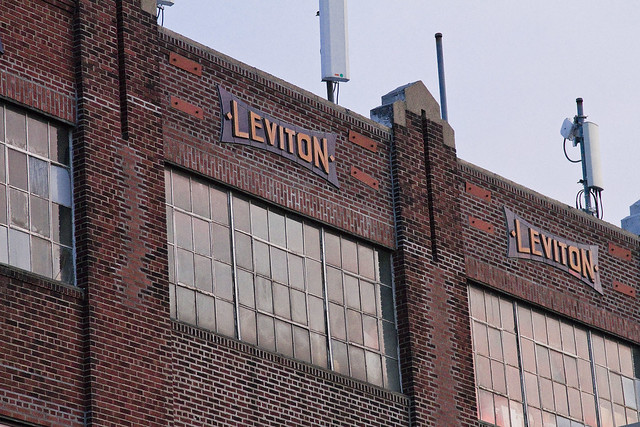
I seem to walk past this structure at least once a week, have done so for several years now, and until recently was completely ignorant about one of the largest employers of 20th century Greenpoint. The Leviton family built this commercial empire by the sweat of their brows- stories of part time employees encountering old Isidor working on the factory floor are rampant in Greenpoint, verging on Pop culture amongst “garden spotters” of a certain age.
from wikipedia
Leviton Manufacturing Company, Inc. is a manufacturer of electrical wiring devices, data center connectivity apparatus and lighting energy management systems. The company was founded in 1906 by Evser and his son Isidor Leviton. They began by manufacturing brass mantle tips for the natural gas lighting infrastructure in Manhattan. They sold their mantle tips on a pushcart on the Bowery on the Lower East side of Manhattan. Isidor Leviton designed a screw in lampholder for Thomas Edison’s Electric Lamp in 1910 and within ten years the lampholders were being used in every apartment in New York. In 1936 Leviton built a two square block 4 story factory and warehouse in Greenpoint, Brooklyn which still stands today. Leviton products include over 25,000 devices and systems, used in homes and businesses.

– photo by Mitch Waxman
Another bit of reputation that the family gathered unto itself was a certain liberalism regarding class, religion, and creed in their hiring practices- eschewing the segregation and selective hiring practiced by other corporations- particularly those in the electronics sector. The father of a close friend once told me that, in the years following the second world war, he was denied an opportunity to use his ivy league engineering degree because of a last name that sounded “too Italian”. Not an issue at Leviton, I am told.
from heresgreenpoint.com
By 1910 Leviton was designing and manufacturing pull-chain lamp holders for Thomas Edison’s newly developed light bulb, and in 1922 the company was moved to Greenpoint to better facilitate its rapid ascention. The massive factory took up two city blocks between Newel and Jewel Streets and produced over 600 electrical items, from fuses to socket covers to outlets and switches. Leviton would remain in Greenpoint until 1975, when the company again relocated, this time to Little Neck, NY.
– photo by Mitch Waxman
Newspaper reports describe the company as resistant to unionization, and even Eleanor Roosevelt found herself standing in solidarity with a picket line on Greenpoint Avenue in the 1940’s. In August of 1940, a large group of laborers “went out”, despite Leviton paying “benefits”- a rare and coveted perk of employment in that era. “Benefits” are what health insurance and a retirement plan were once known as, and were not an automatic or legislated requirement before the 1970’s- for those of you reading this under the age of 30, understand that these “insurance benefits” were something won by the labor movement of the early 20th century.
This was the scene of a long and contentious labor strike in 1940,
as detailed in this preview of the George Ruffini book– “Harry Van Arsdale, Jr: Labor’s Champion”, courtesy google books.

– photo by Mitch Waxman
Today, the structure is called the “Greenpoint Industrial Center” and seems to host a series of industrial, artisanal, and warehousing operations who make use of its cavernous interior spaces. The Leviton company left Greenpoint in the 1970’s, migrating to literal greener pastures in eastern Queens and ultimately Melville, Long Island.
from nationmaster.com
The Leviton Manufacturing Company was founded in New York by Isidor Leviton, at the dawn of the electrical era in 1906. Originally engaged in the fabrication of mantle tips for gas lighting, the Company soon afterwards in 1910, converted to production of a single electrical product — a pull-chain lampholder (designed for Edison’s new light bulbs).
- 1922: Leviton relocated to Greenpoint, Brooklyn after acquiring the TECCO plant, and now offered 568 products.
- 1929: Acquires Meteor Electric Company, a leading manufacturer of wiring devices.
- 1932: Leviton devices are used in the Empire State Building.
- 1937: Acquires American Insulated Wire and becomes the industry leader in wire, cable and cord products.
- 1939: Leviton devices featured at World’s Fair.
- 1950: Purchases the Deal Electric Company.
- 1953: Acquires Hale Brothers Companies, now known as Leviton Canada.
- 1960: Leviton is among the first manufactures to institute an employee pension plan.
- 1961: Leviton devices are installed in the White House.
- 1965: Harold Leviton becomes President and CEO.
- 1972: Introduces the first GFCI, the first touch dimmer, and a selection of home automation powerline carrier components.
- 1973: Introduces Decora® designer-style devices.
- 1975: Moves corporate headquarters to current location in Little Neck, NY.
Upcoming Events and Tours
Saturday, June 25, 10:30 a.m. – 1:00 p.m. –
The Insalubrious Valley of the Newtown Creek,
with Brooklyn Brainery. Click here for more details.
Sunday, June 26, 11:00 a.m. – 1:00 p.m. –
Calvary Cemetery Walking Tour,
with Atlas Obscura. Click here for more details.
“follow” me on Twitter- @newtownpentacle
tangible efforts
From Bushwick Inlet, in Greenpoint.

– photo by Mitch Waxman
Happy Memorial Day, y’all. Never forget, never forgive.
Upcoming Events and Tours
Saturday, June 4, 11:00 a.m. -1:30 p.m. –
DUPBO: Down Under the Pulaski Bridge Onramp,
with Brooklyn Brainery. Click here for more details.
“follow” me on Twitter- @newtownpentacle


 The Newtown Pentacle