Archive for the ‘kosciuszko bridge’ Category
coloured hills

– photo by Mitch Waxman
There are lots of things to do this weekend, lords and ladies. To begin, or end with- depending on ones perspective- this is the closing weekend of the Newtown Creek Armada. A fun and public art project by Laura Chipley, Nate Kensinger, and Sarah Nelson Wright- the show is found at the Newtown Creek Wastewater Treatment Plant’s Nature Walk.
check out details and hours at the armada site.

– photo by Mitch Waxman
On Sunday, and this comes verbatim from newtowncreekalliance.org-
“Sept 30 – Water Quality event with North Brooklyn Coat Club and Friends
The Capitol to Capitol by Canoe expedition lands at NBBC, and a water quality discussion ensues! The event will feature presentations from a number of local organizations including the Newtown Creek Alliance, Riverkeeper, Metropolitan Waterfront Alliance and New York City Water Trails Association. We will also be celebrating the arrival of the Capital to Capitol by Canoe expedition in NYC. A project of the Canadian Wildlife Federation, this 1800 kilometer paddle will travel on rivers, lakes, canals, harbours and bays from Ottawa to Washington D.C. in a 34 foot voyageur canoe.

– photo by Mitch Waxman
Also going on this weekend- Saturday is “Field Trip Day” in Greenpoint, a free event.
Calling all urban explorers, history buffs, and lovers of Greenpoint. Drift with us through the culture and history of Greenpoint, Brooklyn, a tucked away neighborhood sculpted by its maritime and industrial past.
Field Trip day is dedicated to the art of the wander, and discovery through exploration. Come and see Greenpoint for the first time or with new eyes: for on this one day she will reveal herself through the Field Trip app, on-site installations, challenges, and quests.
Discover where colored pencils came from, get up close and personal with one of the most polluted waterways in the US, and take down your opponents in a dramatic restaging of a Civil War ironclad battle! Together we’ll find hidden places, discover secret histories, and learn skills long forgotten.
There are no right choices, no wrong turns – but there are treasures to be uncovered just out of sight.
Click here for more info and registration
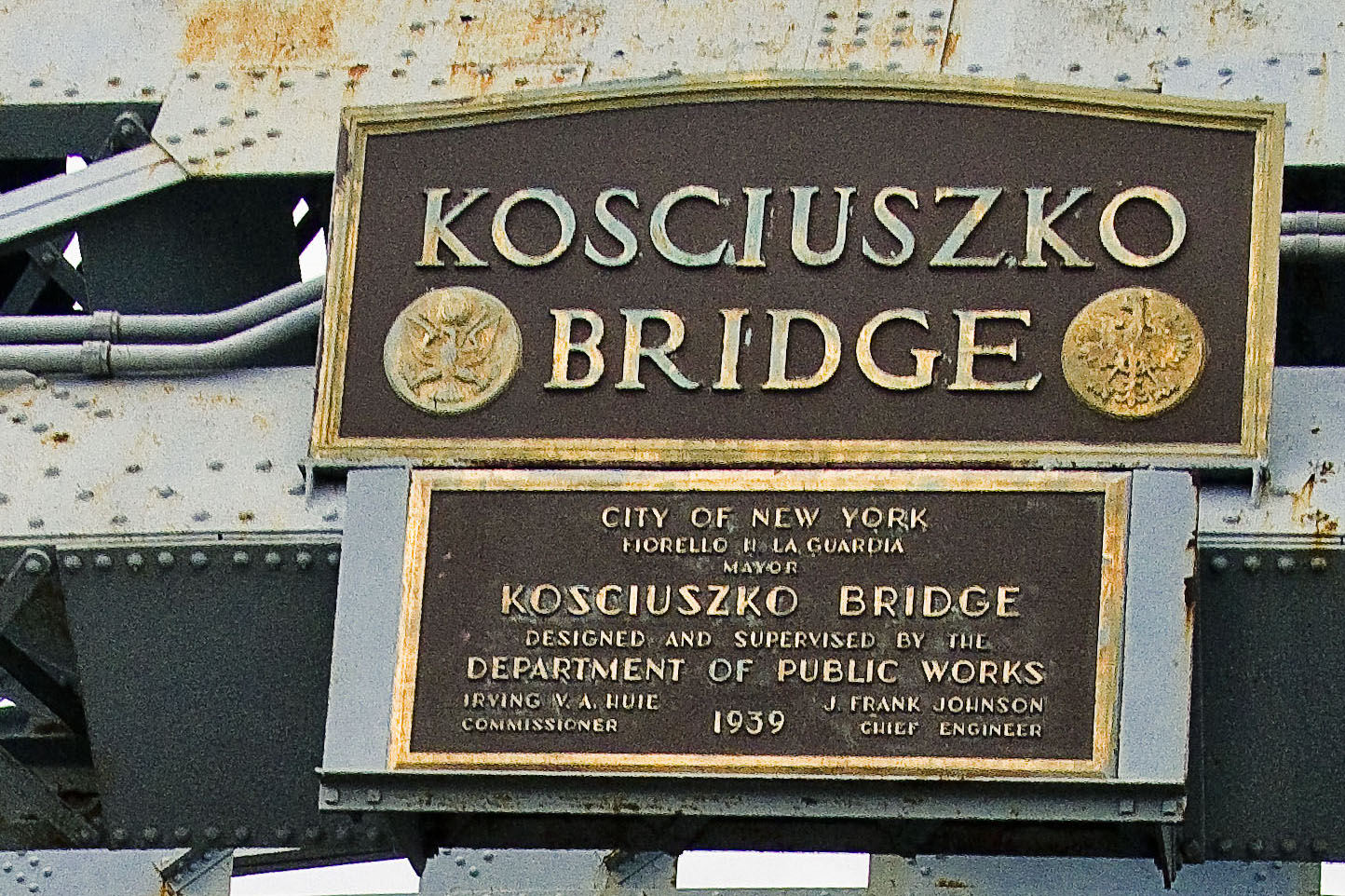
the last birthday of the Kosciuszko Bridge
– photo by Mitch Waxman
Oh, the old gray mare, she ain’t what she used to be,
Ain’t what she used to be, ain’t what she used to be.
The old gray mare, she ain’t what she used to be, Many long years ago.
Seventy Three years ago today, the Little Flower cut the ribbon and officially opened the “New Meeker Avenue Bridge” to traffic. The following April in 1940, it was renamed as the Kosciuszko Bridge.
It’s the Night of the Living Dead, by the way. Also, it’s Vulcanalia…
August 23, 1939, image New York City Municipal Archives at nycma.lunaimaging.com

– photo by Arthur J. Foley
According to the Long Island City Star-Journal of August 24th, 1939– the lineup of folks in the shot and action above are described as:
Mayor LaGuardia snips the ribbon which admitted the first autos lo use the lofty new Meeker Avenue Bridge over Newtown Creek in Laurel Hill, at the dedication held yesterday at Laurel Hill Plaza. To the right of the mayor is Acting Borough President John J. Halloran of Queens. To his left is Borough President Raymond V. Ingersoll of Brooklyn. Left of Ingersoll is Frederick J. H. Kracke, who was commissioner of Plant and Structures when that department originated plans for the bridge.

– photo by Mitch Waxman
American Bridge Company and Bethlehem Steel worked on her, along with dozens of other contractors. The Big K was part of what was known as “the Regional Plan”, which also provied the pretext for the erection of the Triborough, Whitestone, Marine Parkway and a slew of other bridges across the archipelago.
July 14, 1939, image New York City Municipal Archives at nycma.lunaimaging.com,

– photo by Arthur J. Foley

– photo by Mitch Waxman
Odds are very good that this is her last birthday, as the “Fast Track” program announced by the Governor will be kick starting the construction of a “Newer Meeker Avenue Bridge”- or perhaps the “Kosciuszko Two”- by the late spring of 2013. She will be gone by 2017, if one were to believe the schedule currently touted by State officials.
June 29, 1939, image New York City Municipal Archives at nycma.lunaimaging.com,

– photo by Joseph Shelderfer

– photo by Mitch Waxman
The historic shots included in this post all link out to the New York City Municipal Archives site, which has famously begun releasing thousands of historic images of the City online. One of the tricks to using the system, I’ve discovered, is knowing what things used to be called. It’s a “streetcar” versus “trolley” kind of thing. We call the former light rail system by the latter name, while those who dwelled in the past used the former.
June 29, 1939, image New York City Municipal Archives at nycma.lunaimaging.com,

– photo by Joseph Shelderfer

– photo by Mitch Waxman
Very little information is available about the construction and planning of the Kosciuszko, but there’s plenty about the New Meeker Avenue Bridge. The Big K was built for two official reasons- first, to provide a link between the multitudes of infinite Brooklyn and the World Fair Grounds in Flushing (Flushing Meadow Corona Park), and secondly to replace the aging swing bridge that spanned Newtown Creek between Meeker Avenue in Brooklyn and Laurel Hill Blvd. in Queens. Unofficially, Robert Moses really wanted to get the Brooklyn Queens Expressway built and this was as good a place as any to start.
August 14, 1939, image New York City Municipal Archives at nycma.lunaimaging.com,

– photo by Arthur J. Foley

– photo by Mitch Waxman
One does look forward to that day in the latter half of this decade, which I seriously doubt will be anything even close to 2017, when the pedestrian lane of the new bridge will be open for inspection. One of the most frustrating parts of the current bridge is that it once sported such a lane for perambulation, but it has long been closed off- thwarting photographic exploitation of the surreal vantage point that it offers.
How I would love to set up a tripod on the Kosciuszko Bridge…
from nydailynews.com
style=”padding-left:30px;”>Construction on a new bridge is now expected to begin in spring 2013 — a year ahead of schedule, thanks to $460 million made available for the job by Gov. Cuomo’s New York Work initiative.
The 73-year-old bridge, which carries the Brooklyn-Queens Expressway over the Newtown Creek, qualified for the money in part because it is on the state’s “deficient bridge” list.
The initial phase of construction will build an eastbound lane next to the existing bridge, according to the state Department of Transportation, the agency overseeing the project. The 1.1-mile bridge is expected to be done in 2017 and will cost about $800 million.
When completed, two new spans with a total of nine vehicle lanes and paths for pedestrians and bikes will replace the original structure.
Here’s a rare historic shot- in color- of the mighty span, from the year it was opened, also courtesy New York Municipal Archives

– photo by New York City Municipal Archives

– photo by Mitch Waxman
And just as a remider, in the name of public good and an abundance of caution- don’t forget about the whole Night of the Living Dead thing- this could be trouble.
from youtube– I’d suggest skipping forward to the 1 hour 13 minute marker, btw, unless you’ve got time to watch the whole flick via the Crackle Youtube page.
a poison cauldron

– photo by Mitch Waxman
Long have I been reluctant to bring people to this place.
For several months now, your humble narrator has been narrating in a not so humble fashion while leading boat and walking tours of the Newtown Creek watershed.
Literally hundreds of people have attended either the “Thirteen Steps around Dutch Kills“, “Insalubrious Valley“, or “Newtown Creek Boat Tour” events this year- and one question has been asked by all- “What about the Greenpoint Oil Spill?”.
Next week- a group of enthusiasts will be assembling, under the auspices of Atlas Obscura, to explore the lamentable “Poison Cauldron” of the Newtown Creek.
There are still tickets available, should you care to witness the place prior to its forthcoming demolition.

– photo by Mitch Waxman
Down Under the Kosciuszko Bridge Onramp, or DUKBO, is the name I’ve assigned to this lunar landscape of industrial mills and waste transfer stations which lines the Brooklyn side of the Creek. This year is functionally the last time you will be able to witness this place, as the Kosciuszko Bridge replacement project will be kicking into high gear in the spring of 2013.
For the urban explorer and photographer crowd, this is a wonderland of shattered streets and rusted infrastructure which will soon be eradicated from all but living memory.

– photo by Mitch Waxman
The tour will tell the story of Standard Oil at its start and cross over the Greenpoint Oil Spill’s heart, revealing that lost world of industrial aspiration and 20th century dissolution which lies less than a mile from the geographic and population centers of New York City.
In the past, I’ve described the area as “Mordor” at this, your Newtown Pentacle, and the Tolkien analogy is apt. The very air you breathe is a poisonous fume, the water is hopelessly tainted with bizarre combinations and millions of gallons of petroleum and industrial chemicals, the soil is impregnated with heavy metals, asbestos, and truly- who can guess all there is that might be buried down there?
An odd concentration of food distribution, waste transfer and garbage handling facilities, and energy industry plants make the area remarkable, and everywhere you look will be a “colour“- a bizarrely iridescent sheen which resembles no wholesome nor familiar earthly color but is instead like something from out of space- coating every bit of broken masonry and the sweat slicked skin of laborer and passerby alike.

– photo by Mitch Waxman
Standard offer copy follows:
Meetup at the corner of Kingsland and Norman Avenues in Greenpoint at 11 on Saturday, August 25th.
We will be exploring the petroleum and waste transfer districts of the Newtown Creek watershed in North Brooklyn. Heavily industrialized, the area we will be walking through is the heart of the Greenpoint Oil Spill and home to scores of waste transfer stations and other heavy industries. We will be heading for the thrice damned Kosciuszko Bridge, which is scheduled for a demolition and replacement project which will be starting in 2013. Photographers, in particular, will find this an interesting walk through a little known and quite obscure section of New York City.
Be prepared: We’ll be encountering broken pavement, sometimes heavy truck traffic, and experiencing a virtual urban desert as we move through the concrete devastations of North Brooklyn. Dress and pack appropriately for hiking, closed toe shoes are highly recommended- as are a hat or parasol to shield you from the sun.
Bathroom opportunities will be found only at the start of the walk, which will be around three hours long and cover approximately three miles of ground. Drivers, it would be wise to leave your cars in the vicinity of McGolrick Park in Greenpoint.
Click here for tickets, and as always- a limited number of walk ups will be welcomed- but for safety reasons we need to limit the group to a manageable size. Contact me at this email if you desire further details.
evil counsel

– photo by Mitch Waxman
As mentioned in prior postings, there are certain dates on the calendar which are remarkable for the long list of significant events which have made their mark in the historical record. August 9th is one of those days.
In 586 BCE, for instance- the Temple of Solomon was toppled during the Babylonian siege of Jerusalem, and in 1483- the Sistine Chapel was opened for Mass in Rome. In 1936, Jesse Owens won his fourth gold medal in Berlin.

– photo by Mitch Waxman
Charlie Manson sent his Helter Skelter squad to Sharon Tate’s place on the ninth of August in 1969, and the Victorian era ended when the Edwardian began in Great Britain. In 48 BCE, Julius Caesar and his Legions won the Battle of Pharsalus against Pompey. In 117 AD, a Caesar named Trajan died, and two hundred sixty one years later in 378- another named Valens was obliterated by the Visigoths.

– photo by Mitch Waxman
Today is the “national day” of Singapore, the Eastern Orthodox feast day of Saint Herman of Alaska, and the day that Jerry Garcia died. It’s also the day that history changed forever, for the second time, when the city of Nagasaki ceased to be.

– photo by Mitch Waxman
This is the 222nd day of the 12th year of the 2nd millennia, and the anniversary of Richard M. Nixon resigning the Presidency of the United States. It’s also the United Nations “International Day of the World’s Indigenous People“.

– photo by Mitch Waxman
We’ve just passed through the halfway point of summertime in the Northern Hemisphere, on this oddly propitious date. History is a series of coincidences, strung together after the fact, but any calendrical marker which ties together the fall of the Temple of Solomon with the rise of Caesar, the fall of Dick Nixon, the great working of Charlie Manson, and the use of an Atomic Bomb betrays something else. Dire portent abounds.
wonderful likewise

– photo by Mitch Waxman
Often spotted but seldom photographed, this is (apparently) a Great Blue Heron which has been evading my lens on the fabled Newtown Creek all year. Often too far away to claim a clear shot, or darting about the sky madly, I’ve been chasing this bird for a very long time.
from wikipedia
It is the largest North American heron and, among all extant herons, it is surpassed only by the Goliath Heron and the White-bellied Heron. It has head-to-tail length of 91–137 cm (36–54 in), a wingspan of 167–201 cm (66–79 in), a height of 115–138 cm (45–54 in), and a weight of 2.1–3.6 kg (4.6–7.9 lb). Notable features include slaty flight feathers, red-brown thighs, and a paired red-brown and black stripe up the flanks; the neck is rusty-gray, with black and white streaking down the front; the head is paler, with a nearly white face, and a pair of black plumes running from just above the eye to the back of the head. The feathers on the lower neck are long and plume-like; it also has plumes on the lower back at the start of the breeding season. The bill is dull yellowish, becoming orange briefly at the start of the breeding season, and the lower legs gray, also becoming orangey at the start of the breeding season. Immature birds are duller in color, with a dull blackish-gray crown, and the flank pattern only weakly defined; they have no plumes, and the bill is dull gray-yellow. Among standard measurements, the wing chord is 43–48 cm (17–19 in), the tail is 15.2–19 cm (6.0–7.5 in), the culmen is 13.1–15.2 cm (5.2–6.0 in) and the tarsus is 15.7–21 cm (6.2–8.3 in).

– photo by Mitch Waxman
Just in case you’re wondering, the weird background blur you see was produced entirely “in camera” rather than via the wonders of photoshop. Your humble photographer was onboard a boat headed in the opposite direction than that which the heron was traveling in, and I was horizontally tracking its flight while narrowly “zone focused”- producing the motion blur.
from harborestuary.org
Collectively known as the Harbor Herons, this suite of species includes: Great Egret (Ardea alba), Snowy Egret (Egretta thula), Glossy Ibis (Plegadis falcinellus, Little Blue Heron (Egretta caerulea), Cattle Egret (Bubulcus ibis), Tricolored Heron (Egretta tricolor), Green Heron (Butorides striatus), Black-crowned Night-Heron (Nycticorax nycticorax), and Yellow-crowned Night-Heron. Herons and their allies are not new to the NY metropolitan region (Bernick and Elbin, in preparation). Since enforcement of the Clean Water Act of 1972, the Harbor Herons have significantly colonized the NY/NJ Harbor Region. Water quality has improved (NJ Harbor Dischargers Group 2006), but quality wetland habitat has become scarce, degraded, and fragmented.. Birds of traditionally isolated habitats, secure from human disturbance, have adapted to human- altered landscapes (Parsons and Burger 1982). Some species thrive as ̳human subsidized‘ and learn to forage among landfills, loaf on the rip rap, and raise their young on islands nestled between barges and smoke stacks (Burger 1981a, Parsons 1987, 1990, Maccarone and Parsons 1994, Maccarone and Brzorad 1998).

– photo by Mitch Waxman
It’s always surprising to see an animal of this size and niche status here at the Newtown Creek, especially considering the comments of State officials offered to me a few months back describing the place as a “dead sea”. If you click through to the full set of images surrounding these four at my Flickr page, you’ll see the bird hunting amongst the waterline stones of a “rip rap” shoreline which is quite typical for the Brooklyn side of the Creek between Maspeth Creek and Meeker Avenue.
That’s right, this bird is flying around under the Kosciuszko Bridge through the heart of the Greenpoint and Blissville Oil Spills.
The great blue heron nests colonially and usually in tall living or dead trees. The nest is a large flat platform of twigs. Nests may be used for more than a year. The nest will become larger each year as the birds add more nesting material.
Breeding begins from early March through April and usually ends in July. Each pair lays 3 to 7 eggs and incubation lasts 25 to 29 days. Both parents incubate the eggs and care for the young. The young are usually ready to fly at 60 days after hatching and will leave the nest at between 64 to 90 days. They may then breed at two years of age.

– photo by Mitch Waxman
Consultation is appreciated by those who are familiar with the world of birding, for- as mentioned in the past- every time I try to identify a bird I end up with egg on my face. From references found online, I seem to be correct in my identification, but have often been wrong in the past.
What do you think, gentle readers? Use the comments link below if you can bless or damn my assessment of the specie.
from dec.ny.gov
An estuary is a place where salty water from the ocean mixes with fresh water from the land and creates a unique and special place for marine species to live, feed, and reproduce. Estuaries are transitional areas where the ocean tides bring in nutrients and animals, while freshwater runoff reduces the stress caused by saltwater and carries even more nutrients. Often, estuaries have a restriction across the mouth, like a barrier beach or sand bar which offers protection from the full force of ocean waves and storms. Estuaries are a critical part of the life cycle of many different species. They are the spawning and nursery area for thousands of animals who seek out the quieter waters of estuaries to provide a protected nursery for their offspring. Estuaries also provide a food rich resting area for migrating waterfowl like black ducks, harlequin ducks, scoters, and scaup. Wading birds like the great blue heron, great egret, and glossy ibis, and snowy egret nest in colonies on islands found in New York Harbor, Long Island Sound and Gardiners Bay. Raptors like osprey and northern harriers also nest and feed throughout the marine district of New York.
_______________________________________________________________
August 5th, 2012- Newtown Creek Alliance Walking Tour- The Insalubrious Valley- This Sunday

– photo by Mitch Waxman
Newtown Creek Alliance historian Mitch Waxman will be leading a walk through the industrial heartlands of New York City, exploring the insalubrious valley of the Newtown Creek.
The currently undefended border of Brooklyn and Queens, and the place where the Industrial Revolution actually happened, provides a dramatic and picturesque setting for this exploration. We’ll be visiting two movable bridges, the still standing remains of an early 19th century highway, and a forgotten tributary of the larger waterway. As we walk along the Newtown Creek and explore the “wrong side of the tracks” – you’ll hear tales of the early chemical industry, “Dead Animal and Night Soil Wharfs”, colonial era heretics and witches and the coming of the railroad. The tour concludes at the famed Clinton Diner in Maspeth- where scenes from the Martin Scorcese movie “Goodfellas” were shot.
Lunch at Clinton Diner is included with the ticket.
Details/special instructions.
Meetup at the corner of Grand Street and Morgan Avenue in Brooklyn at 11 a.m. on August 5, 2012. The L train serves a station at Bushwick Avenue and Grand Street, and the Q54 and Q59 bus lines stop nearby as well. Check MTA.info as ongoing weekend construction often causes delays and interruptions. Drivers, it would be wise to leave your vehicle in the vicinity of the Clinton Diner in Maspeth, Queens or near the start of the walk at Grand St. and Morgan Avenue (you can pick up the bus to Brooklyn nearby the Clinton Diner).
Be prepared: We’ll be encountering broken pavement, sometimes heavy truck traffic as we move through a virtual urban desert. Dress and pack appropriately for hiking, closed-toe shoes are highly recommended.
Clinton Diner Menu:
- Cheese burger deluxe
- Grilled chicken over garden salad
- Turkey BLT triple decker sandwich with fries
- Spaghetti with tomato sauce or butter
- Greek salad medium
- Greek Salad wrap with French fries
- Can of soda or 16oz bottle of Poland Spring
for August 5th tickets, click here for the Newtown Creek Alliance ticketing page


 The Newtown Pentacle