Archive for the ‘Long Island Expressway’ Category
defeated aspirations
It’s National Roast Suckling Pig Day, in these United States.

– photo by Mitch Waxman
The other night, I mentioned to a friend that I had no reason to get up in the morning, and he inquired as to whether or not I was depressed. My statement had nothing to do with mood or mental state, instead it was factual – my daytime calendar is fairly empty between the first week of December and middle January. Part of this is my peculiar vulnerability to cold weather which necessitates a certain amount of hermitage, another part of it is that this is the time of the year when I’m hitting the books and doing research into this or that, and working on presentation materials (working on the 2018 photo portfolio, me). This has really hampered photo gathering – as a note – which is a negative, but I’ve got to get my house of cards together for the new year. You’re only as good as the last provable shutter flop.
Since I don’t have to necessarily be “somewhere” at 8 in the morning most days, what’s the point of maintaining a farcical kabuki and simulating adherence to the “ole nine to five”? I’m often up at the hour of the wolf this time of the year. If you’re sacking out at four or five in the morning, you ain’t getting up at seven, if you know what I’m saying.

– photo by Mitch Waxman
One thing that’s emerged in my searching through multiple archives of photos, which number in the tens of thousands at this point, is that I seem to have fallen into a bit of a rut over the last year and a half. The other is that a bunch of my friends have died along the way. There’s a few long term projects which will be reaching fruition in the next twenty four months, and the stuff generated by this “rut” has become noticeably more refined, but it seems I need to get out more. That’s my New Years resolution, by the way.
“I been everywhere, man” is a bit of generalization and I certainly haven’t been “everywhere.”

– photo by Mitch Waxman
As is my annual habit, I plan to wallow in laziness and turpitude for another couple of weeks and get it out of my system. By the new year, boredom and self hatred will have expanded sufficiently to force me into action. Some pedantic and utterly banal explosion of activity inspired by Marcus Aurelius will form up and despite my ennui – me and the camera are going to be “out there” every single day.
For now, though, I still don’t have much of a reason to wake up in the mornings.
“follow” me on Twitter- @newtownpentacle
furnace tending
It’s National Gazpacho Day, in these United States.

– photo by Mitch Waxman
Sometimes one will catch a glimpse of himself in a store window or other reflective surface, and even a humble narrator is known to flinch at the sight. Loping along in a filthy black raincoat, a wandering mendicant burdened down with a heavy sack of lenses and other photographic accoutrements, the ravages and scars of a half century in a City affectionately referred to as “home sweet hell” are scribed deeply into his flesh. Corpulent and corrupted, disliked and denounced, egomaniacal and estranged, feckless and forgettable, ghoulish and ghastly… all of these words fail to fully and generally generate the hateful, hopeless, idiotic image obvious to all but revealed to a humble narrator only as he passes by a pane of silvered glass on area streets.
No wonder children burst into tears, dogs growl, cats haunch up, women clutch at their purses, security cameras swivel and follow when one appears. Police and security personell always watch me closely, with their hands resting upon the weapons they’ve been issued.
from komatsuamerica.com
Move more material with less fuel and a more comfortable operator’s environment! The WA500-8 has a newly designed bucket with increased capacity and improved digging performance to maximize production. The EPA Tier 4 Final certified engine incorporates enhanced controller logic for lower fuel consumption. A new high capacity, heated, air suspension seat provides premium comfort.

– photo by Mitch Waxman
One does not visit “the country” for fear of spreading an infection of blight. Like a pellet of some radioactive metal displayed in the midst of an otherwise verdant forest, one’s presence causes other living things to wither away. It has always been this way, for one such as myself.
The memories of childhood should be of summery afternoons spent in joyful pursuits, rather than locked rooms with tightly shuttered, and barred, windows decorated with atavist hangings. Sitting in the shadows of spare apartments, watching idle shafts of atmospheric dust lit by those few rays of light offered by the burning thermonuclear eye of God itself which somehow managed to permeate the barrack – these should not be the only recollections one is able to summon regarding those days. There was no joy, just tedium punctuated by wild and unpredictable furies erupting amongst those who cared for my needs.
Visitors to my caretakers were always of an advanced age. Often they brought plastic offerings obtained on a pilgrimage to some eastern land, formerly held by the Ottoman Turks. These plastic things often carried religious idioms written in English but rendered in a hebraized script. The visitors would carry on conversations in a language familiar only to the parts of Europe that have historically bordered Russia, and indeed within the Tsar’s former holdings. Sometimes these conversations would erupt into anger, others laughter. It was all very puzzling, but ultimately pedantic and boring.
from wikipedia
The expressway begins at the western portal of the Queens–Midtown Tunnel in the Murray Hill section of Manhattan. The route heads eastward, passing under FDR Drive and the East River as it proceeds through the Triborough Bridge and Tunnel Authority-maintained tunnel to Queens. Once on Long Island, the highway passes through the tunnel’s former toll plaza and becomes known as the Queens–Midtown Expressway as it travels through the western portion of the borough. A mile after entering Queens, I-495 meets I-278 (the Brooklyn–Queens Expressway) at exit 17. At this point, I-495 becomes the unsigned highway NY 495, although it is still signed as an Interstate Highway.

– photo by Mitch Waxman
The psychic plague which one was infected with at an early age is that nothing which is good or joyous or in any way positive stays with me for long. Others remonstrate the negative experiences of their lives, blocking out trauma, and do not realize that their lives are subconsciously shaped by avoiding similar pain. A humble narrator, on the other hand, gleefully rips away at his scabs every chance he gets, and likes to scratch away at scars. One has quite a bit of time for reflection, on my long scuttles around the concrete devastations of the Newtown Creek. Just the other day, one grew furious over an event which occurred in the Second Grade when I was accused of kicking someone in the leg as our class was on the way to Assembly in the school auditorium.
“My list” goes all the way back to before Kindergarden. All the good stuff thats ever happened to me? That one started when I woke up this morning, and it’s been a shitty day so far. What can I tell you, I’m all ‘effed up.
also from wikipedia
A portion of the path of the Long Island Expressway was along the former road path and right of way of a streetcar line that went from the southern part of Long Island City to southern Flushing.
The Long Island Expressway was constructed in stages over the course of three decades. The first piece, the Queens–Midtown Tunnel linking Manhattan and Queens, was opened to traffic on November 15, 1940. The highway connecting the tunnel to Laurel Hill Boulevard was built around the same time and named the “Midtown Highway”. The tunnel, the Midtown Highway, and the segment of Laurel Hill Boulevard between the highway and Queens Boulevard all became part of a realigned NY 24 in the mid-1940s. In the early 1950s, work began on an eastward extension of the Midtown Highway. The road was completed to 61st Street by 1954, at which point it became known as the “Queens–Midtown Expressway”. By 1956, the road was renamed the “Long Island Expressway” and extended east to the junction of Queens (NY 24 and NY 25) and Horace Harding (NY 25D) Boulevards. NY 24 initially remained routed on Laurel Hill Boulevard (by this point upgraded into the Brooklyn–Queens Expressway) and Queens Boulevard, however.

– photo by Mitch Waxman
Unfortunately for my self loathing, while these shots were being gathered, my attention was taken up by a conference call with environmental officialdom and hotly discussing Newtown Creek, so I didn’t have a chance to really work myself over about that thing in Second Grade, nor the debacle that was my ninth birthday, or any of the humiliations suffered but left unanswered in Junior High School. On the plus side, my left foot was giving me a bit of trouble, so at least there was some tangible physical pain I could enjoy, rather than the psychic kind I relish.
Such reveries, wherein a humble narrator spends his mental capacity on beating himself up, are a little luxury I like to enjoy. The internal soliloquy also has other tasks to work on – wondering about what’s making a certain smell, plotting vengeance, planning future walking tours, working the camera, avoiding getting squished by a truck. I hate getting squished more than anything. Regrets… I’ve had a few.
from wikipedia
The first known construction cranes were invented by the Ancient Greeks and were powered by men or beasts of burden, such as donkeys. These cranes were used for the construction of tall buildings. Larger cranes were later developed, employing the use of human treadwheels, permitting the lifting of heavier weights. In the High Middle Ages, harbour cranes were introduced to load and unload ships and assist with their construction – some were built into stone towers for extra strength and stability. The earliest cranes were constructed from wood, but cast iron, iron and steel took over with the coming of the Industrial Revolution.

– photo by Mitch Waxman
Long Island City’s Hunters Point and Degnon Terminal (LaGuardia Community College zone) areas have become positively infested with humans since this whole real estate frenzy has set in. Manifest, motley mobs of mankind now occupy these precincts of Queens’ rookeries. Lonely Island City is no more, if it ever was. The only place one can be truly alone, and avoid the shocking countenance of his own reflection, is industrial Maspeth. There are zero reflective surfaces hereabouts, except on the steel bumpers of newly washed heavy trucks. All is caked in grit, and clods of unknown substances. The waters in this section of the Newtown Creek offer a certain perfume, hinting at the respiratory or digestive processes of unknown biological or bacterial entities. Vast puddles of rancid water line the broken streets. The very air you breathe is a poisonous fume.
A humble narrator is probably the only person on this entire Long Island, or one of the lesser islands of the archipelago, who actually longs for chances to visit Industrial Maspeth. Other than somebody who has something they need to illegally dump into the water or leave some junk on the street, of course. Most of the folks who come here do so simply to earn their keep, notably those who have to deal with the rest of us being slobs.
Me? I love the place.
from wikipedia
The Bureau of Cleaning and Collection is responsible for collecting recycling and garbage, cleaning streets and vacant lots, and clearing streets of snow and ice. BCC assigns personnel and equipment to standard routes while managing the weekly allocation of personnel to address litter and illegal dumping.
The Cleaning Office oversees the removal of litter and debris from city streets, collects material for recycling and garbage from public litter bins and coordinates with Derelict Vehicle Operations to remove abandoned vehicles. The Lot Cleaning Unit cleans vacant lots and the areas around them, and around city-owned buildings in order to meet the city’s Health Code standards.
The Collection Office oversees regularly scheduled recycling and garbage collection services to the city’s residential households, public schools, public buildings, and many large institutions.

– photo by Mitch Waxman
What I really like to do around here, however, is creep down to the shoreline and hide in the bushes. One will really let loose hereabouts, and start laughing maniacally, instead of my usual hissing and basso growling. The stoutest cord long broken, my crazy laugh will shortly turn into a sobbing cry and then wailing lament, before transitioning back to the hilarity. I’ll cycle through this a few times. Once a flock of geese came to investigate the racket, another a laborer came sniffing around thinking that somebody was drowning a pig in Newtown Creek. There’s a reason I hide in the bushes, along with all the other monsters I’ve seen.
I don’t get too close to the water though, due to an irrational phobia revolving around my whole “seeing ones own reflection unpreparedly, with all its sudden and dire implications” disorder.
As a note: You should never look too deeply, or too long, into a mirror lest a piece of yourself become trapped within it. At least that’s the opinion amongst certain occultists. In the case of the lugubrious Newtown Creek…
from wikipedia
Laughter is not always a pleasant experience and is associated with several negative phenomena. Excessive laughter can lead to cataplexy, and unpleasant laughter spells, excessive elation, and fits of laughter can all be considered negative aspects of laughter. Unpleasant laughter spells, or “sham mirth,” usually occur in people who have a neurological condition, including patients with pseudobulbar palsy, multiple sclerosis and Parkinson’s disease. These patients appear to be laughing out of amusement but report that they are feeling undesirable sensations “at the time of the punch line.”
Excessive elation is a common symptom associated with manic-depressive psychoses and mania/hypomania. Those who suffer from schizophrenic psychoses seem to suffer the opposite—they do not understand humor or get any joy out of it. A fit describes an abnormal time when one cannot control the laughter or one’s body, sometimes leading to seizures or a brief period of unconsciousness. Some believe that fits of laughter represent a form of epilepsy.
Upcoming Tours and events
Calvary Cemetery Walking Tour, with Atlas Obscura – Sunday, December 10th, 11 a.m. – 1 p.m.
Explore NYC history, hidden inside sculptural monuments and mafioso grave sites, as you take in iconic city views on this walking tour, with Newtown Creek Alliance Historian Mitch Waxman – details here.
“follow” me on Twitter- @newtownpentacle
after action
It’s National Have a Bagel Day, in these United States.
– photo by Mitch Waxman
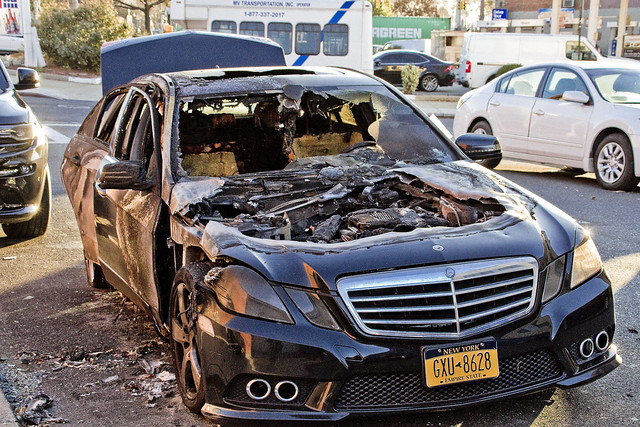
Encountered at the corner of Hunters Point Avenue and 36th street, which is at the “angle” between the Blissville and Sunnyside sections of LIC here in Queens, this formerly cool car appears to have suffered through some sort of catastrophic event. You’ll notice that there’s more than few odd things about this scene. My reckoning, at least, is that I can’t imagine that this immolation of an expensive auto was desired by its owner – but who knows?
Kids these days.

– photo by Mitch Waxman
This was a fairly thorough fire, by all appearances, but one that was quite selective in terms of what it consumed. Little green cards with NYPD logos on them were visible on the heap, instructing “Do Not Tow” and proclaiming the wreck as being “evidence.” The vehicle is of the Mercedes sedan type, or at least it was. This puppy is likely going to be seen somewhere along Newtown Creek in the coming weeks, squished into a pile of castoff vehicles at one scrap yard or another.
Anybody out there missing a black Mercedes sedan?

– photo by Mitch Waxman
That had to be some sort of super hot fire, in my eyes, to have melted away the engine bonnet.
Apparently, though, that’s what happened. In some ways, it visually reminds one of that mysterious phenomena called “spontaneous human combustion.” That’s the one where a body is found that’s been partially burned all the way to ash but the flames were super selective, leaving behind a hand or foot that is otherwise unharmed, and with little damage to furniture or wall hangings in proximity to high temperature combustion. To get human flesh to ash, crematoriums create fiery environments that are 1,400 to 1,800 degrees fahrenheit. How can something anywhere even close to an environment of that temperature not get scorched?
I mean… this blaze was hot enough to melt the engine hood, parts of the engine, and the entire interior cabin – but the tires are perfectly intact? Weird.
Steel melts at 2,750 degrees fahrenheit, I’m told.
“follow” me on Twitter- @newtownpentacle
true conditions
It’s National Salami Day, in these United States.

– photo by Mitch Waxman
On this day, in 70 AD, the Romans sacked Jerusalem. In 1776, the very first submarine attack on a warship occurred in New York Harbor when the Turtle attached a time bomb to the hull of HMS Eagle. In 1860, Garibaldi entered Naples and began the process of creating the modern day Nation of Italy. In 1921, the first Miss America pageant was held in Atlantic City, New Jersey. Over in San Francisco back in 1927, inventor Philo Farnsworth demonstrated the first television signal. Benjamin, the last of the thylacines, died alone in a Tasmanian zoo in 1936. In 1940, the Nazis began the London Blitz, and in 1978 Rock and Roll drummer Keith Moon kicked the bucket.
The cool car pictured above was spotted in Greenpoint, incidentally. I was out one night conducting a walking tour of Newtown Creek and happened across it. The graffiti is what drew me in.

– photo by Mitch Waxman
After conducting the walking tour, one set upon his path back towards the rolling hills of almond eyed Astoria, but had to pass through the concrete devastations of Hunters Point and Queens Plaza in order to do so. It was a nice night, and I decided upon walking home. On my way, I passed by the Queens Midtown Tunnel and captured this shot.
The funny bit – to me at least – about the current efforts by the State of New York to elimate toll booths in favor of electronic tolling is that no one thought about what happens on the Manhattan side of the tunnel. I’ve been noticing massive traffic backups on the Long Island Expressway since they instituted the new system, which was meant to ease traffic and smooth the commute for the 80,000 or so daily vehicle trips through the tunnel. The toll booths had the effect of causing traffic to pulse through the toll plaza four or five at a time, but now the traffic just snakes into it. The head of the snake emerges into the City and is met by traffic lights on second avenue. Those traffic lights are now the de facto governors of how fast traffic can flow through the tunnel, and on the 71 miles of the Long Island Expressway found to the east of it.
The military guys and gals have a word for this sort of thing – it’s “FUBAR.”

– photo by Mitch Waxman
Back in Astoria, it was preternaturally dark when I arrived home, but this sort of thing doesn’t bother my little dog Zuzu. She operates by smell and sound, my dog, and as we engaged in her evening saunter and as she performed her investigative sniffing, I was growing increasingly apprehensive for some reason.
My pineal gland was twitching with latent horror.

– photo by Mitch Waxman
As we swung back around onto Broadway and made our way back towards HQ, a large group of teenaged men were riding their bicycles down the block in a pack. According to a report I saw on the local CBS TV news, events such as this are to be viewed in a menacing light and feared. I found it menacing simply because they’re all teenagers. Darned kids, with their bicycles and the hip hop, engaging in group activities without first obtaining police permits or parental approval. Chaos!
There should be a curfew for anyone under the age of thirty, I tell ya. Damn kids.

– photo by Mitch Waxman
Bicycles such as the ones pictured above are a fairly modern invention, but some scholars attribute the first bike design to a sketch by one of DaVinci’s students in 1534. The first verified appearance of bicycles was in the 19th century, specifically in 1817 Germany with the “dandy horse.” These were “running machines” which were operated sans pedals or chains. The velocipede era saw the addition of pedals to the front wheel, but it wasn’t until 1863 that a french engineer came up with what we’d recognize instantly as a bike – with pedals and a chain driven rotary crank. What you’re looking at in the shot above are 21st century variants of what was introduced as the “safety bicycle” back in 1885. John Dunlop introduced the pneumatic tire in 1888. In 1889, the diamond shaped frame of the modern bike was introduced, in a model that also folded. The modern multi geared bike, which included a “Derailleur” mechanism on the chain, came on the scene at the start of the 20th century. Everything since has simply been refinement of the design.
Teenagers, however, have always been dangerous and unpredictable. Curfew!
Upcoming Tours and events
Calvary Cemetery Walking Tour, with Atlas Obscura – Saturday, September 9th, 11 a.m. – 1 p.m.
Explore NYC history, hidden inside sculptural monuments and mafioso grave sites, as you take in iconic city views on this walking tour, with Newtown Creek Alliance Historian Mitch Waxman – details here.
“follow” me on Twitter- @newtownpentacle
beaten man
It’s National Coffee Ice Cream Day, in these United States.

– photo by Mitch Waxman
Wandering around Long Island City with the camera is kind of “my thing.” Ordinarily, I’ve got one of my H.P. Lovecraft audiobooks blaring away in my headphones. More often than not, there’s some destination at Newtown Creek I’m heading for, as I was when these shots were gathered. On this particular day, I front loaded some “wander” time into the equation which allowed me to take a rather circuitous route to my eventual destination over in Brooklyn’s Greenpoint section.
I also wanted to “check in” on an area which I’ve not visited in the last few months to see if anything novel was happening. This area would be best described as the “angle” between Sunnyside and Blissville along Van Dam Street.

– photo by Mitch Waxman
There’s three moments in the history of LIC’s Van Dam Street to take note of. One occurred in 1909 when the Queensboro Bridge began to feed vehicular traffic into “Queens Plaza,” another was in 1914 when the newly consolidated City of Greater New York funded a project to raise the grade of Van Dam street several feet in elevation, and the other was in 1940 when the Long Island Expressway opened. The 1917 appearance of the IRT Flushing Line subway service on what was Thomson Venue but was soon renamed “Queens Blvd.,” is also kind of important (this was about 1921, I’m told).
Van Dam is angled against the street grid of the Blissville section of LIC, but its generally north/south path leads to Greenpoint and North Brooklyn from its start at Queens Blvd. Apparently, there used to be trolley service on Van Dam, which was a part of the Steinway Line. The street is named for the Van Dam family, which was quite prominent in both City and the future State back in the 17th and 18th centuries. One of them, Rip Van Dam, was the governor of the British owned New York colony from 1731-2.

– photo by Mitch Waxman
Robert Moses didn’t start the Queens Midtown Tunnel or Long Island Expressway projects, but by the time they both opened for business in August of 1940 they were firmly a part of his empire. It took four years to build the tunnel itself, and the high speed road that snakes into it runs eastwards for some seventy one miles. As you can see from the shots above and below, not much thought was paid into what would happen to the runoff from the highway.
It just splatters down onto LIC and into the sewer grate.

– photo by Mitch Waxman
This is nothing unusual, and I’ve been informed by the powers that be that not one of NYC’s many bridges, tunnels, or highways is directly connected to a sewer plant – even the brand new Koscisuzcko. Rather, they all just feed into storm sewers, which then release into area waterways. The world is a joyful place, for one such as myself.

– photo by Mitch Waxman
This section of the Long Island Expressway, officially known as the Queens Midtown Expressway, carries an average of 80,000 vehicle trips a day to and from the Queens Midtown Tunnel. That’s 29.2 million vehicle trips annually.
Upcoming Tours and events
Calvary Cemetery Walking Tour, with Atlas Obscura – Saturday, September 9th, 11 a.m. – 1 p.m.
Explore NYC history, hidden inside sculptural monuments and mafioso grave sites, as you take in iconic city views on this walking tour, with Newtown Creek Alliance Historian Mitch Waxman – details here.
“follow” me on Twitter- @newtownpentacle


 The Newtown Pentacle