Archive for the ‘Long Island City’ Category
contracted chill
Nothing like an adventure, MTA style.

– photo by Mitch Waxman
Recent endeavor found me leaving HQ just after the burning thermonuclear eye of God itself had begun its journey across the sky. A humble narrator’s intention was to have been out and about for a couple of hours in the pre dawn part of the day, but one overslept and left the house just as dawn arrived. My eventual destination was in lower Manhattan, and my plan was to be mid span on the Queensboro Bridge when dawn occurred, but as mentioned – I rolled over and kept on sleeping rather than springing out of bed when the alarm sounded at four in the morning. It wasn’t until about 5:30 that I stumbled out into the staggering realities of Astoria.
A brief scuttle across Northern Blvd. and the Sunnyside Yards ensued, and bored with the idea of walking across Queensboro at this point, it was elected that I would catch the most photogenic of all NYC’s Subway lines – the 7 – at 33rd street and cruise into the shadowed corridors of midtown Manhattan.

– photo by Mitch Waxman
The “international express” as it’s known, arrived in the station accompanied by announcements that due to construction there was no Manhattan bound service at 33rd street. Having set aside literally five hours for the walk, I figured I’d just play along and see where the MTA wanted to take me.
As a note, with the exception of the F line, on the weekend of the 5th and 6th of March – there was “no way to get there from here” without playing the game laid out by the MTA.

– photo by Mitch Waxman
The 7 carried me to the 61st Woodside stop, where Manhattan bound service could be accessed. Off in the distance, at what must have been the 69th street station, there were crews of laborers and what seemed like a crane busily at work. The normal “Manhattan bound” side was entirely subsumed by their activity.

– photo by Mitch Waxman
The 7 train, with its multitudinous delays and seemingly constant construction, has spawned a bit of activism. My pal Melissa Orlando, and others, formed first a Facebook group called “The 7 Train Blues,” and have since begun the formation of an organization called “Access Queens” with the intention of acting as advocates for the ridership community along this “international express” traveling between Flushing and Manhattan’s west side.

– photo by Mitch Waxman
On the subject of the 7 train, my immediate response is to discuss its immense photogeneity.

– photo by Mitch Waxman
It is virtually impossible to point a camera at the 7 and not get something interesting. Maybe it’s the low lying nature of Western Queens, with the elevated tracks running at rooftop level… can’t say. After running through the MTA’s perverse hoops, a humble narrator found himself in the Shining City, and what was encountered at my destination will be discussed in a post presented next week at this – your Newtown Pentacle.
“follow” me on Twitter- @newtownpentacle
mendicant parlors
Happy Saint Patrick’s, y’all.

– photo by Mitch Waxman
The pup pictured above was spotted at the annual St. Pat’s Day for All parade in Sunnyside on Saturday the 6th. Truth be told, 50% of the reason I attend and shoot this parade is for the dogs dressed up in holiday regalia.
What follows is a series of random shots which have been recently collected, which don’t seem to fit into other posts, but which I like for one reason or another.

– photo by Mitch Waxman
One of the pithy jokes I like to repeat to disinterested people is: “When I say I’m a street photographer, I mean that I literally photograph the street,” as evinced by the shot of Northern Blvd. presented above.

– photo by Mitch Waxman
Speaking of Northern Blvd., that ongoing constriction project at 47th street, which is installing a new ventilation room for the F line subway, had some supplies arranged in an accidentally artful pattern when I was passing by a couple of weeks back. The construction guys here in Queens compose masterpieces of geometric composition when they’re plunking their junk down, the sort of thing which any art student might labor over for days.

– photo by Mitch Waxman
Early one recent morning, a humble narrator noticed that the Queens Cobbler seems to have reactivated and resumed their activities. The single shoe phenomena continues.

– photo by Mitch Waxman
Also from an early morning, I found myself crossing the Boulevard of Death as the burning thermonuclear eye of God itself rose in the eastern sky.
This was shot at about six or seven in the morning, and this year my plans include a lot of pre dawn and early morning shooting.
“follow” me on Twitter- @newtownpentacle
illegitimate assertion
Once, you’d tell the operator you wanted to speak to Hunters Point 3342.

– photo by Mitch Waxman
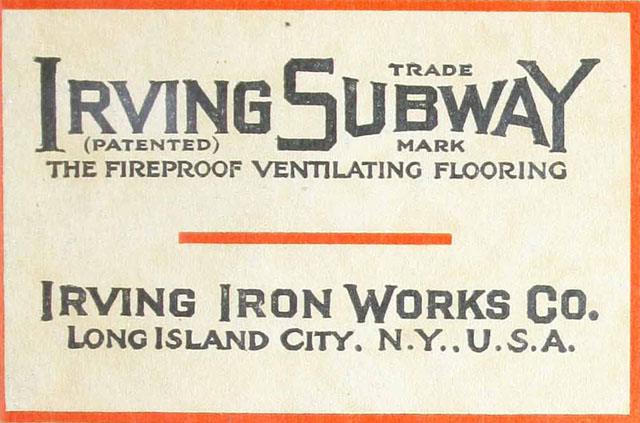
Walter E. Irving opened for business along Newtown Creek’s Dutch Kills tributary in LIC back in 1907, but at first his operation was just another iron and steel works. It wasn’t until 1914 that the company became commonly known as either “Irving Subway Grating” or “Irving Iron Works.”
Their honeycomb steel walkways were offered to both the Subway (as the name would imply) people and to maritime customers. It was the maritime world which made the company rich. Irving, a structural engineer, actually started his business in Astoria in 1902, but it was here on Dutch Kills in “America’s Workshop” that he had both rail and maritime access, and that’s why the company centered its operations in LIC.
Here’s a shot of the place from back in 1915.

– photo by Mitch Waxman
Back then, and by then I mean 1914, 51st avenue was called Third Street, and 27th street was called Creek Street.
There was no Long Island Expressway or Midtown Tunnel, and railroad freight tracks snaked around on every street. If you’re in the neighborhood today, you can still find a lot of those old tracks blistering up through the modern day asphalt. There’s “Belgian Blocks” paved streets here in what I’ve long referred to as “the empty corridor” as well. Belgian Blocks are colloquially referred to as “cobblestones.”

– photo by Mitch Waxman
At its height, when their patented honeycomb steel lattice plates were being installed on merchant and naval ships, and into factorys and industrial boiler rooms, Irving’s facility commanded some 22,000 square feet of the most valuable industrial bulkheads in America here in LIC.
It remains one of the largest properties along Dutch Kills to this day, but as you’ve noticed by now, Irving Subway Grating has left the proverbial building.

– photo by Mitch Waxman
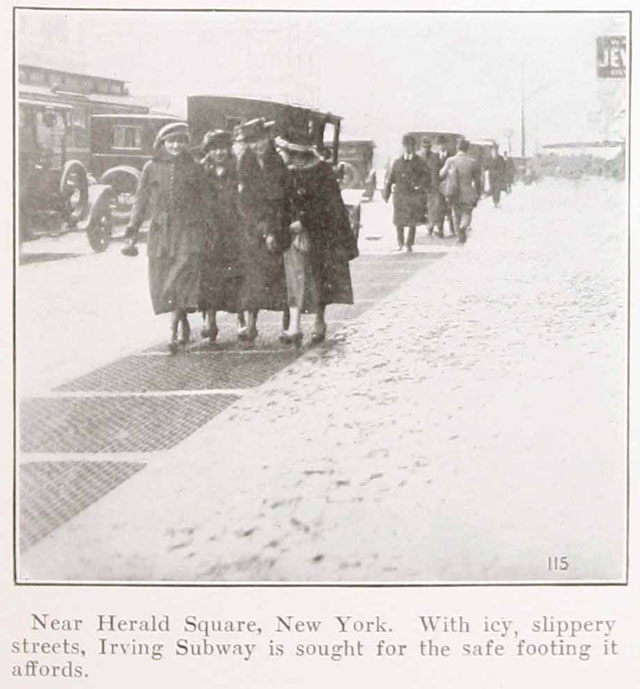
In the early 20th century, Irving employed a staff of about 300, and the facility produced something like 50,000 feet of the honeycomb flooring material a month. The value of the grating was that water, light, and air could move through it – making it perfect for the exterior decking and ladder steps on ships – and that while it had the same strength as a plate of steel, it weighed a significant amount less. It was also appropriate for use in boiler rooms and other industrial applications due to its permittance of ventilation.
Irving also found a place for his products in the steel decking on vehicle and rail bridges, and the United States military would lay his grating down into sand and soil to create stable runways for aircraft in battle zones. Irving received accolades from the War Dept. for his industrial contributions to the Aliied forces’s victory during the Second World War. The NY Subway system, as the name of the product would imply, ate Irving’s products as fast as he could make them. If you work in Manhattan’s Flatiron district, the Tenderloin, or Herald Square, you’re probably already familiar with Irving.
Build a better mouse trap, I guess.

– photo by Mitch Waxman
A Mexican conglomerate called HARSCO bought Irving, and its portfolio of patents, back in 1966. Irving continues as their IKG Industries division today, and they still manufacture those steel grids. I cannot seem to determine exactly when the Irving Plant at Dutch Kills was shut down, nor accurately ascertain the current owners of the property beyond some LLC holding company. There was an enormous fire here in 2009, which burnt away a lot of what was left of the site.
Here’s what I saw of the pre fire Irving Works back when I first starting getting into this whole Creek thing, in a post that clearly illustrated my neophyte status back in 2009.

– photo by Mitch Waxman
Over the last seven years, I’ve watched the Irving site being slowly harvested by metal collectors – The Crows – who have grabbed every inch of copper and aluminum that they can reach. There’s a security fence with a giant hole cut in it along 27th street, but the chained up shopping carts and well fed cat colony nearby the hole indicate that somebody is living here in the ruins.
As I was by myself when these shots were gathered… well… let’s just say it’s not a great idea to barge into a homeless camp in LIC when you’re all alone, so I stuck to the front of the site nearby the hole in case I had to exit quickly. Next time I have a chum along with me, however, I plan on doing a bit more exploring – mainly because there is a lot of cool graffiti in there I want to check out.

– photo by Mitch Waxman
Scenes familiar, and loved, in Long Island City.
“follow” me on Twitter- @newtownpentacle
potential responsibility
Creek Week continues, in today’s post.

– photo by Mitch Waxman
After visiting the Kosciuszko Bridge project, 57th avenue, and then Railroad Avenue, a humble narrator’s dogs were barking and a generally homeward course was adopted. As usual, that meant swinging down Borden Avenue and cutting over to Skillman Avenue on the way back to raven tressed Astoria.
My favorite sections of Newtown Creek to photograph are found in LIC, along this particular tributary of the troubled waterway – called Dutch Kills.
It’s something about the light, I guess.

– photo by Mitch Waxman
I haven’t been around here in a few weeks, and I discovered that a formerly fenced in section of the shoreline adjoining the Borden Avenue Bridge had been cleared away, which offered a few points of view which would have formerly required illegal trespass to capture.
Given such an opportunity, a humble narrator will always take it.

– photo by Mitch Waxman
Looking west, towards what I call the “empty corridor” found under the Long Island Expressway truss.
The LIE is some 106 feet high in this spot over Dutch Kills, and was built so to accommodate the stacks of ocean going vessels which were headed for the Degnon Terminal Turning Basin which is about a half mile away. The Federal War Dept. also required this particular height for the possibility of installing warships in the canal in order to protect the industrial sector in case of foreign invasion forces entering New York Harbor (a real worry, prior to the Atomic Bomb).

– photo by Mitch Waxman
Looking eastwards, you see the sort of scene most life long Queensicans would associate with the words “Newtown Creek.” Still, check out that tuney old truck – cool, huh?
“follow” me on Twitter- @newtownpentacle
mortal assurances
Did you feel that? Did a truck just go by?

– photo by Mitch Waxman
The geology of Western Queens is fairly fascinating. A humble narrator is interested in all things, and one of them is the very ground beneath his feet. Historically speaking, the zone which modernity calls Queens Plaza and Court Square in Long Island City were wetlands. There is rock down there somewhere, but the “craton” which underlies this section of a very Long Island was deposited by the glacial retreat at an odd angle which slopes downward as you head south. A craton is essentially a giant boulder, and that underground slab of rock which is found in LIC’s neck of the woods is buried beneath layers of naturally occurring clay and sand, and a loosely packed 20-30 foot thick layer of anthropogenic landfill material sits atop it. True geologic bedrock doesn’t appear until you get to Maspeth, where the terminal moraine of Long Island begins.
Municipal landfill began to reduce the wetlands and swamps of LIC beginning in the early 19th century, which buried many of the now lost tributaries of both Newtown and Sunswick Creeks which flowed through these parts. Once, you could sail from Newtown Creek all the way to Northern Blvd. at 31st street, and by once I mean 1881. The desire to stamp out typhus and cholera in LIC, Dutch Kills, and Astoria during the “sanitary era” is part of what provided impetus for the landfill process.
The construction of the Queensboro Bridge and the Sunnyside Yards in the first decade of the 20th century finished the job of reclaiming what was – by all accounts – a pestilential swamp. Modernity has forgotten all about that, just ask the East Side Access guys who accidentally found one of those buried waterways – a catastrophic discovery which delayed their progress and added billions of dollars onto the cost of the project.

– photo by Mitch Waxman
Now, I’m not much of anything, let alone an engineer or a geologist. What I am, however, is a guy with a collection of old maps and a series of books which describe what things were like in the area surrounding Jane Street Queens Plaza from the colonial period to the start of the 20th century. The engineers who worked on Sunnyside Yards described some pretty esoteric conditions at the corner of Skillman and Thompson – for instance – including mud that would form 18 feet high waves spontaneously as the tidal action from surrounding waters transmitted through it. The Ravenswood houses are built on a tidal pond/marsh/swamp formed by Sunswick Creek, and the area around the present day LaGuardia Community college was known as the “waste meadows” until Michael Degnon got ahold of them in the 1910’s and filled the wetland swamps in with rock tailings harvested from the subway tunnels which his company was working on.
I’m also a guy who understands that even the stoutest limb will crack if it’s made to bear weight beyond its tolerance. Now, it’s pretty unlikely that a craton, which is a boloid of rock the size of an asteroid that is miles across and thousands of feet thick, would crack. It could sink, however, into the glacial till which it rests upon. This fills me with real concern, given the whole climate change/sea level thing that the Republicans claim isn’t happening. How much crap can you pile in one place before something “gives”?
The firmament is literally shaking in LIC these days, what with all the high rise construction going on, and the truck loads of structural steel and concrete rolling through.

– photo by Mitch Waxman
My buddies in construction tell me that once you find solid footing – driving steel and concrete down until it meets that rock craton – you can pretty much build as big as you want. The piles sit on the rock, then you create a concrete slab which provides for a stable surface that spreads weight load out over a large area, and you build. Engineers calculated wind sheer, vibration, soil solidity and a thousand other factors years before the first shovelful of earth was turned. An elaborate bureaucracy of planners and building specialists have scoured the plans, looked for any possible error or issue, and made corrections when warranted. Believe when I tell you, these people won’t allow any single structure to crack the earth open anywhere in NYC.
Saying that, they are all largely looking at projects on an individual basis, and not a holistic whole. What will happen when everything scrapes the sky? Will the ground continue to shake, or will LIC just sink?
“follow” me on Twitter- @newtownpentacle


