Archive for the ‘Long Island City’ Category
refuge open
Street photography, literally, in today’s post.

– photo by Mitch Waxman
A humble narrator has been on a bit of a “notice everything” kick of late, which I imagine would translate into “normal person” as “by Jove, one is surrounded by things which have always been accepted but unquestioned.” Well, I guess that’s how normal people think, I wouldn’t know. One of the things I’ve gotten curious about lately are streets, and more specifically – the roadway itself. This has led me down a bit of a merry path, which has led to the realization that just about every road in NYC, the United States, and in fact the world is paved with industrial waste.
Elucidation follows, but first we need to discuss the development of the thoroughfare.

– photo by Mitch Waxman
Roads were originally created from the compaction of soil along trade routes in prehistoric times, and there were fairly common paths developed in Eurasia and Africa by around 10,000 BCE. The oldest stone paved road known to archaeology was built by the Egyptians, in roughly 2,300 BCE, although there are older “courdoroy” or log roads known (There’s a few in the UK which date back to around 4,000 BCE). Over on the Indian Subcontinent, streets were paved with brick as early as 3,000 BCE.
Famously, the Romans were bloody brilliant at building roads, many of which have lasted into modern times. Their system involved the excavation of a fairly deep trench, followed by the laying and tamping down of several feet of differing grades of stone into it, with the top layer formed from a series of carefully cut paving stones which were quite heavy. The bottom layers allowed for drainage, the top layer armored the structure while using the force of gravity to keep it in place. For about a thousand years, the Roman system (similar technologies were used in China, and amongst the Inca in South America) was the best you could really hope for.
The Europeans who colonized North America used crushed oyster shells and stones to form a road surface, and they mitigated the dust generated by horse and cart by using various forms of oil to hold the stuff in place. It wasn’t until the middle 18th century that roads became “modern” when a Frenchman named Pierre-Marie-Jérôme Trésaguet began working on carefully graded roads around Paris. Trésaguet was followed at the beginning of the 19th century by a Scot named Telford who created what modernity would refer to as “a cobblestone road” wherein the pavers were mortared in place using stone dust and gravel. Unfortunately, these methodologies used a tremendous amount of material, and required an enormous investment to lay the several feet of stone that was required for proper drainage and surface stability.
It was another Scot – John McAdam – who invented the precursor of the modern roadway, and his pavement came to be known as “Macadam.”

– photo by Mitch Waxman
Macadam roads wore tougher under carriage wheels, and were cheaper to build than “Telford’s”. Trial and error taught McAdam that a course of stones, broken up small enough and compacted by a heavy iron roller, would act as a solid mass if given proper drainage. It was perfect for horse and carriage, albeit a bit dusty. The roads of the industrial revolution era were generally paved in Macadam.
In 1902, a Swiss doctor named Ernest Guglielminetti hit upon the novel idea of using tar to coat the roads in Monaco. About twenty years later, an Englishman named Edgar Purnell Hooley patented a formula (in the UK and USA) which combined coal tar and blast furnace slag mixed into gravel and called his new product Tarmac, or Tarred Macadam. Tarmac became quite wide spread by the early days of the automobile, but by the late 1920’s the literal king of the road appeared and Tarmac went out of style.
Also, even by the beginning of the 20th century, physician and politicians alike began to realize that Coal Tar was a particularly unhealthy thing to loose upon the environment. Luckily, nothing bad had ever come out of the nascent petroleum industry.

– photo by Mitch Waxman
There are 42 gallons of crude oil in one of those shipping barrels which you always hear business people referring to. When the distillation process is complete, multitudes of chemicals are wrung out of it. 1.7% of every barrel ends up as a fairly inert form of tar which is referred to as “Asphalt or Road Oil.” Asphalt actually occurs naturally, and when it bubbled up out of the ground in historical settings, it was referred to as “pitch.”
Pitch was used for waterproofing the wooden joins on ships, inside buildings – anywhere you’d need a waterproof seal. It was also used as an incendiary for flaming arrows, and for boiling people you’d want to teach a lesson to. The British, and geologists, refer to naturally occurring Asphalt as “bitumen.” There’s natural lakes of the stuff to be found, notably in Trindidad/Tobago and it’s the tar you’ll find in the LaBrea Tar pits over on the left coast in Los Angeles.
The English were paving with Asphalt as early as the 1830’s, and in 1837 a fellow named Richard Tappin Claridge was granted a patent on a formulation for asphalt paving. Claridge’s company survived until the First World War, when it had just entered into a new venture to manufacture “Asphalted Macadam.”

– photo by Mitch Waxman
In New York City, modern day roads (with the exceptions of historic “Belgian Block” pavement, or the rare brick surface like Stockholm Street in Ridgewood) are paved with asphalted concrete. It’s a layer cake, according to the NYC DOT. There’s a base layer of gravel, which is covered by cement or concrete (which is sometimes reinforced with structural steel, depends of where it is and what the substrate is) which is armored by a top layer of asphalted concrete. Luckily, the roads in Queens are crappy, and on a recently replaced section of Northern Blvd. in Long Island City – you can see two of the layers surrounding a collapsing sewer drain.
It’s actually quite a thin crust, when you get down to it. This PDF at NYC.gov offers the “Materials” chapter of the DOT’s street design manual, and it covers the various approved road surfaces (sidewalks too) which you are encouraged to use in the City of Greater New York. It will tell you that, amongst other things, asphalted concrete is the most highly recycled substance in our municipality.
There is a “Green Asphalt” plant found in Blissville, at my beloved Newtown Creek, which is one of many facilities around the City which perform this sort of service. It seems that there is an economic, and practical, reason for placing these facilities within the City itself. Your “mix” needs to be within a certain distance of where you’re going to be laying it down, otherwise it begins to solidify and degrade in transit.

– photo by Mitch Waxman
Closer to home – my home at least – on Broadway in Astoria, a “trencher” was observed cutting its way through the street. You can see the layer cake of concrete and asphalt, and in the post which originally described the device – this one – your humble narrator reported that several largish chunks of timber were being brought to the surface along with the concrete and asphalt.
Broadway, in this section, is quite a complicated structure. The IND tracks of the R train are found at what’s probably 20-30 feet under the surface, which were constructing using the “cut and cover” method. There’s all kind of other stuff snaking around – sewers, utility tunnels, rat middens, etc. That means that the street is actually the uppermost section of a larger structure, meaning that if you fell down in the crosswalk – you’ve actually just landed on the roof of a building. As I mentioned above, how normal people think is a bit of a mystery to me.

– photo by Mitch Waxman
According to officialdom, 99% of Asphalt is recycled, and that 95% of the roads in the United States are paved with it. Asphalt pavement is rated according to the weather extremes it can withstand, and there are certain formulations designed for different climates. A different mix of tar and concrete is used for roads in Buffalo than those in NYC, for instance, due to climatological factors.
Engineers I’ve checked in with like the stuff – describing it as “easy to work with, and easy to repair.” It seems that a fresh laid bed of asphalted concrete is structurally a single unit – until something goes wrong under the surface or utility access requirements and repairs forces laborers to start cutting holes in it. That’s when the surface starts to flow, and pull, and crack. NYC is basically always working on one street or another – grinding, paving, laying new foundations. Given that a lot of the City sits on former wetlands, it’s a task best described as Sisyphean.

– photo by Mitch Waxman
So – back to the industrial waste part of things – according to a buddy who works as an Enviro-Cop, asphalt is actually a fairly benign substance as far as petroleum goes. Unlike other derivates, it’s environmentally stable once it has set. The recycling industry uses high levels of heat to release the bitumen from the concrete matrix, which allows it to be mixed in with a fresh batch of concrete and applied to a street. There’s all sorts of things which have, and still, get mixed into asphalted concrete. Although NYC claims its has never used the stuff on its roads, some have experimented with mixing in asbestos fibers, and or coal tar. Plastics collected by the recycling industry are often shredded and mixed in with the tar and concrete, as is glass. For a while, automotive tires were considered a good candidate for inclusion in the mix, but the cost of shredding steel belted rubber was too high. Routinely, fly ash from industrial furnaces is mixed in, along with all sorts of other stuff which would otherwise just fill up an ever shrinking square footage of municipal landfills and dumps. By the ton, the singularly largest part of the flow of NYC’s garbage involves the disposition of road construction waste. The fumes emitting from hot and freshly laid asphalt carry some risk, cancer wise, but the injuries most often associated with the material in its malleable form are laborers getting burned while working with it.
Regardless, it’s another one of the many byproducts produced by the petroleum industry. Remember, asphalt – which is found on nearly all of NYC’s 6,074 miles of roads and on 95% of the roads in the United States represents 1.7% of every barrel of crude oil sent to the refinery.
About half of that barrel will become gasoline.
According to the U.S. Energy Information: “In 2014, the United States consumed a total of 6.97 billion barrels of petroleum products, an average of about 19.11 million barrels per day. This total includes about 0.34 billion barrels of biofuels”.
Of course this beggars the question, a paradox actually, which asks: if 99% of asphalt is recycled, where’s all the freshly manufactured stuff going? 1.7% of 6.97 billion barrels of oil would suggest that the U.S.A. produces 118,490,000 barrels of fresh Asphalt (or road oil) per year.
“follow” me on Twitter- @newtownpentacle
sophist shuffling
Taking my chances, vampire wise, in Long Island City.

– photo by Mitch Waxman
As all residents of Western Queens know, the Vampires which infest our section of the borough begin to wake up as the sun is setting. Accordingly, a humble narrator normally performs his daily rounds in the morning and afternoon, but one recent perambulation found me out and about during the danger time around sunset. Bereft of the normal sachet of garlic worn during evening walks, my steps quickened as I made for the relative safety of Astoria where bloodsuckers fear to tread due to the prevalence of Croatian and Serbian residents.
Both nationalities have long traditions regarding the nosferatu, as do the Greeks and Italians. South Eastern Europeans don’t play around with the Strigoi. My neighbor Dario spends his free time sharpening wooden spikes in the basement of Newtown Pentacle HQ, for instance, and the superintendent of the building next door keeps a ready supply of granulated garlic at the ready in case of emergency.

– photo by Mitch Waxman
I decided the safest course for me to follow would be to leave Skillman Avenue and head home via Jackson Avenue. One of the many viaducts which cross the Sunnyside Yards is often referred to as “Queens Blvd.” but that street name only applies once this viaduct intersects with Thomson Avenue a block away. This is officially Queens Plaza South, and it provides a crossing for pedestrian, bicycle, motor vehicular, and IRT subway traffic over the titan rail yard. It’s not the friendliest environment for pedestrians, with the caterwaul of the subway above and the mephitic emanations of motor vehicles, but when one is concerned about vampiric attack – the most direct route is the best one.

– photo by Mitch Waxman
Looking north easterly across the yards, the surviving factory buildings which surround the yards may be observed. The fires of gentrification have burned many of these older buildings away in recent years, replacing them with bland residential and hotel buildings. The yards were constructed back the first decades of the 20th century, after the Queensboro Bridge opened in 1909. Back then this pathway was called Jane Street, and it crossed an ancient swamp fed by Newtown Creek’s Dutch Kills tributary. LIC used to drain its sewerage into the swamp, which fed a series of endemic water based pathogens – typhus, cholera – that sort of thing.
Legend has it that the Vampires began to arrive in LIC about when the English displaced the Dutch, but that they avoided feeding hereabouts due to the various blood conditions in the populace caused by the stagnant water.

– photo by Mitch Waxman
Heading towards Queens Plaza, one quickened his steps as movement was observed in the shadowed rafters of the IRT rail bridge carrying the 7 train over the yards. Plump and well fed after several holiday meals, my vital fluids would be a prized delicacy to the undead. The sun was dipping down in the west, after all, and I had no silver on me. My delicate physical condition, carefully maintained by a team of doctors with an arcane set of medications, began to manifest psychologically. Nervous and skittish by nature, one felt himself descending into “one of my spells” which usually ends with a humble narrator running through the streets screeching.

– photo by Mitch Waxman
Elevated mood, coupled with a stertorous action of the heart, caused one to constantly look back over his shoulder for ghastly pursuers. Blood began to evacuate the extremities, rendering fingers into little more than chalk white claws clutching desperately at a camera. Beneath a filthy black raincoat, my shoulders began to hunch, and due to the aforementioned exsanguniation of extremity, my gait began to alter and I noticed that one of my feet was dragging along the pavement forcing the other leg to do all the work.
My eyes began to bulge, and mouth grow dry, which caused my lips to draw back over the teeth.

– photo by Mitch Waxman
Signs and portents of lurking horror accompanied every pained step as a desperate narrator made for the safety of Astoria in a bizarre and somewhat ataxic gait. Surely the monsters nested above had noticed me at this point, and were licking their chops at the though of consuming the corpulent pedestrian below them. The night haunts would soon be dropping from the IRT rafters in the manner of rotten fruit, loosed from the prison which the burning thermonuclear eye of God itself imposed upon them. That’s when a plexiglass window, impressed into a construction fence at a former chemical factory being converted into residential housing revealed that it was already too late, one of the monsters appeared.

– photo by Mitch Waxman
But… a reflection? Vampires enjoy no reflection.
Staring into the pale visage of an ancient monster – with its bulging eyes, and lips drawn back over yellowed teeth, it’s pale and numbed claws reached out towards me – and I was compelled to do the same. That’s when the supreme horror presented itself, as my finger touched that of the monster’s in the reflection, and it is why I shall never again know peace.
“follow” me on Twitter- @newtownpentacle
squamous aspiration
Constantly disappointing, and complaining, that’s me.

– photo by Mitch Waxman
Winter boredom is anathema to one such as myself. The cold and dark, the thirty five pounds of insulation, the constant flux between the dry and cold air of the out of doors contrasted with the high temperature and humidity found within. The constancy of a drippy nose. Bah.
It’s always been a bit of a mystery to me why some feel the need to jack the heat up to the mid 80’s inside of structures, knowing full well that inhabitants and visitors will be wearing clothing appropriate for the out of doors. The worst culprit on this front seems to be the subway system, where you’ll step off of a station platform whose atmospheric temperature is commensurate with the freezing of water and suddenly find yourself in a hurtling metal box whose ambient air mass is heated to something approaching that of an afternoon in July. Add in the sniffling, coughing, and dripping orifices of the mob…
Well, I’ve often opined that what this City needs is a good plague – and I’m fairly certain that one will eventually start on a Subway in Queens during middle January. Don’t touch that subway pole, if you can help it.

– photo by Mitch Waxman
Ultimately, one is awaiting a particularly personal moment which occurs every year, when a humble narrator’s boredom grows so intense that he has little choice but to brave the cold and head back outside. At this juncture, however, the moment hasn’t arrived, and one has been spending his time reading about the Second Empire period of French history, Otto Von Bismarck, and researching the chemicals which the seething cauldrons of industry produce that are classified as petroleum or coal distillates. One does a lot of reading during this time of the year.
I’ve also read up a bit on Kazakhstan, the Crimean Tartars, and the Deccan Plain on the Indian subcontinent. Briefly, I also looked into the Chicago stock yards and the post civil war meat packing industry as well as the suffragettes of 19th century Brooklyn Heights. I continue to study the rise and fall of the Roman Catholic empire in New York City, which is fascinating. Also reiterated will be the fact that if you enjoy gelatin based desserts – never, ever, inquire too deeply as to what gelatin actually is nor how it is produced for you will never, ever, eat it afterwards. Jello brand gelatin was invented by Peter Cooper in a glue factory on Newtown Creek in the 19th century, which is all you really need to know about it. Isenglass is also soul chilling.
Sexy stuff, I know, but the so called “fin de siècle” of the late 19th and early 20th centuries are when the foundations of our modern civilization were laid down and it remains a certain benchmark from a cultural point of view. Labor unions, representative government (both socialist and capitalist), industrial warfare – all of it was imagined up back then. It’s also when the environment surrounding us began to die off due to anthropogenic reasons. The dominoes were lined up, quite unconsciously, back then for the end of our world.

– photo by Mitch Waxman
“Fin de siècle” is a French expression which gained popularity in the first decade of the 20th century, a part of the run up to the Great War, which indicated that the “end of the cycle” or “end of an age” was apparent. It’s part of a phenomena known as millennial fatalism, wherein a culture believes that the “end of the world” nears. It’s difficult to not think that our culture may have reached its breaking point, given what we see on the nightly news. The fatalism and general horror which the various news organizations pump into our heads is, of course, not accidental. Don’t forget that most of the news gathering and dissemination companies are owned and operated by defense contractors.
I’ve always been an optimist, however. What other choice have you got, ultimately? Winter will come and go, and then… flowers and puppies. That’s the way that the wheel of the year spins, after all.
“follow” me on Twitter- @newtownpentacle
measures appropriate
The Astoria Tumbleweeds doth roll, and the wheel of the year turns.

– photo by Mitch Waxman
The gloomy skies of late December and early January are less than inviting in the City of Greater New York. Cold – and rain – coupled with a general sense of annual ennui and thwarted personal ambition, contribute to a dire outlook and general sense of malaise. Bones creak, tendons stretch painfully, and the extremities are rendered numb as vital fluids retreat towards the core. Regardless, a humble narrator marches forth, in pursuance of presenting the truth of our times in graphic narrative – at this – your Newtown Pentacle.
Raised in the Hebraic culture, it has always struck one such as myself strange that the Goyem cut down trees and drag them into their homes in December, only to cast the dearly held verge aside in January.

– photo by Mitch Waxman
The tumbleweeds of Astoria have been often mentioned here. The corpses of trees abandoned, and carried by the sciroccos of Queens which cause them to drift along the concrete hereabouts unheralded. Thirty, sixty, even ninety days hence – their dehydrated corpses will be observed still rolling around the “via publica” – stripped of their verdance. Wild agglutinations of kindling will be observed sticking out of snow banks, or adorning the abandoned fence lines of construction lots.

– photo by Mitch Waxman
As opined, the native art form of the borough of Queens seems to be illegal dumping, and never has this statement been truer than when the subject of Christmas trees and decorations is brought up. Observance of the habits and mores of the Sanitation department has revealed an unexplainable, and certain, reluctance to collect this particular specie of refuse. Officialdom encourages the gentry to bring the cast away trees to certain locations, usually accessible only by motor vehicle, for mulching in pursuance of creating compost.
As this would require effort on the part of the citizenry, it’s simpler for the average Queensican to just leave the thing on the sidewalk, or dump it along Skillman Avenue, and allow the wind to carry it away.

– photo by Mitch Waxman
Illegal dumping is something that a humble narrator sees everywhere he goes in the borough of Queens. Some of it is simply explained as emanating from low tier building contractors attempting to avoid the cost of disposing of construction waste – manifested as a pile of contractor bags filled with dry wall or plaster that you’ll see under a rail trestle or along an industrial facilities’ fence. There’s the domestic furniture as well, and odd agglutinations of paint cans and sometimes spoiled food stuffs. A recent change in the rules enacted by State and City Governments concerning curb side pickup will undoubtedly be feeding a new phyla of curbside dumping – electronics.
The State of New York recently changed the law regarding electronics disposal, which as of April 1st of this year, make it a fineable offense to place commonly held items on the curb for DSNY pickup. A full list of the offending items can be accessed here, and the City has created intake centers – one in each borough – for electronics to be disposed of legally. In Queens, it’s in College Point, which is fairly distant for most of us and impossible to access without a motor vehicle.
Get ready to witness a new flowering of the native art form of Queens this spring.

– photo by Mitch Waxman
The reason I call it an art form rather than a misdemeanor in our fair Borough is due to the careful placement and juxtapositioning of abandoned trash. Brooklyn? Haphazard and rushed dumping with nary a consideration for negative space. Manhattan and the Bronx? Disorganized piles and middens of trash placed with no aesthetic care. Staten Island? You don’t see a lot of illegal dumping on Staten Island, or at least I don’t. That’s because you’ve got a predominance of DSNY workers living there, and the garbage men like their nests neat.
“follow” me on Twitter- @newtownpentacle
sun choked
Consarned and new fangled gizmos – in today’s post.

– photo by Mitch Waxman
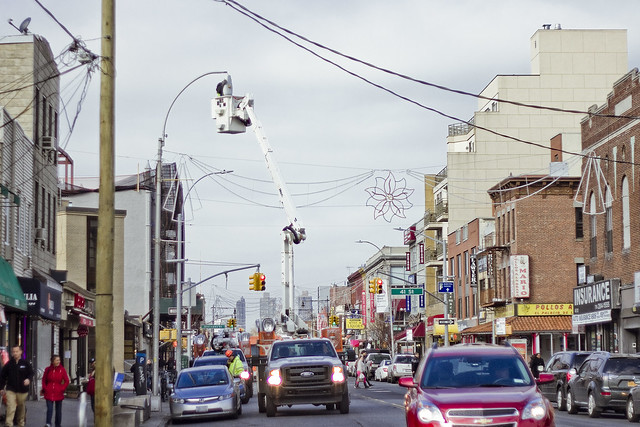
My pal Kevin Walsh of Forgotten-NY is the lamp post guy. You will tremble in your boots when he begins discussing “luminaires” and other mechanistic implementations designed to light the streets of the City of Greater New York. Saying that, here on Broadway in Astoria (and along 34th avenue) between Steinway and 48th street, the inestimable NYC DOT has recently installed the latest generation of street lighting – which are LED fixtures that replace the familiar sodium lighting which has long punctured the sepulchral darkness of Gotham.
– photo by Mitch Waxman
At the start of December, work crews from Weisbach – DOT’s contractor for all things electrical – were observed on the throroughfare in a “cherry picker” truck swapping out the old school sodium lights for the new LED ones. According to official sources “NYC DOT operates the largest municipal street-lighting system in the country, with 262,000 lights on City streets, bridges and underpasses, 12,000 in parks and 26,000 on highways,” and the City plans on replacing every single one of them with the new LED lights.
The effort is expected to reduce the amount (and cost) of electricity consumed in pursuit of lighting the streets by a significant amount, as well as reforming the “carbon footprint” of the municipality. It’s costing us tax payers about $75 million smackers to change out every light, but is expected to save about $6 million a year in energy costs.

– photo by Mitch Waxman
As you’d imagine, the gentry here in Astoria have been busy debating the relative merits of the new lighting. On the plus side, the LED’s produce a brighter light which is quite a bit “whiter” than the old sodium lamps. The actual color of the light is 4300 Kelvin, which is quite a bit “bluer” than the sodium lamps which produced the familiar (and warmer) orange yellow light that all New Yorkers are used to suffering in. The LED light is quite a bit better focused on the street itself, and from a photographic point of view – has brightened things up by around two stops.
Observation and conversation, however, have revealed that the new lights create quite a bit of glare. I wear glasses, so… bother.

– photo by Mitch Waxman
Non empirically speaking, the sodium lamps scattered their light in a globe of illumination whereas the newer lights are a bit more like a reading lamp in design. Drivers have reported to me that on rainy nights the new lights create a problem for them, windshield glare wise, but nothing insurmountable. There’s also people who just don’t like the new color.
Most of Astoria’s Broadway community seems fairly ambivalent/positive about the change, as a note, offering “why would I care, what can you do about it?” as a response to queries such as “what do you think about the new street lights?”.

– photo by Mitch Waxman
There are all sorts of theories on the effects which LED lighting on human perception. Like the shutter of a motion picture projector, the LED’s flicker at a rate which is just outside of normal human perception. Some say that the flicker induces a state of anxiety to the sensitive, but truth be told, I’ve tried to capture it using video capture and have been unable to perceive anything other than steady illumination – no strobing, in other words.

– photo by Mitch Waxman
On the plus side, the directed light is no longer illuminating the residential windows along Broadway, and since I live along the street – I can report that at night my windows are considerably darker than they used to be under the old sodium lights. Additionally, the streets and particularly the sidewalks seem considerably and perceptually brighter.
Everything you could possibly want to know about the new LED lights is answered by this PDF at NYC.gov.

– photo by Mitch Waxman
You can discern the different temperatures of the two lighting systems in the shot above. The avenue (Broadway) is lit by the new and bluish LED’s and the street (44th) by the older and orange sodium light system.
“follow” me on Twitter- @newtownpentacle


