Archive for the ‘Long Island City’ Category
limned orb
Seasons Greetings, indeed.

– photo by Mitch Waxman
The first electric Christmas tree lights were displayed back in 1882, by Edward Hibberd Johnson. It just so happened that Johnson was a partner in the Edison Illuminating Company, incidentally. In 1903, commercially available Christmas lights went on the market, and America has been gaga for the decorations ever since. Pictured above is Nassau Avenue in Greenpoint, which like many commercial strips in NYC, has a merchants association that strings lights over the thoroughfare to bring the cheer. Closer to home, the merchants association on Steinway Street here in Astoria, Queens, actually pipes Christmas music onto the commercial strip through speakers. I cannot imagine anything more horrible than living on Steinway Street and having Christmas music playing in a continuous loop outside my window.
Factor in the fact that the vast majority of people who live on Steinway are observationally religious Muslims, and it gets that much more macabre. The neighbors from the Levant seem to tolerate it pretty well, but still…

– photo by Mitch Waxman
One such as myself would do away with all of these winter holidays and instead create a custom of serious self reflection and ascetic study. I think Voltaire had it right when he suggested that we should all spend more time pursuing our studies, but to each his own. Giant inflatable puppets it is.
Idiots and demagogues claim that there is a “war on Christmas” underway in our society, which causes me to retort that Christmas is a actually illegal in the nation of Brunei, and that the Sultan who rules that country was a dear and personal friend of Ronald Reagan.
This usually rubs those idiots and demagogues the wrong way, which is my intention.

– photo by Mitch Waxman
For myself, when I want to see red and green lights, I head over to the Sunnyside Yards. You don’t have to wait for December, which is a plus.
“follow” me on Twitter- @newtownpentacle
antique forms
Visiting with the Alsops, in today’s post.

– photo by Mitch Waxman
Famously, the Roman Catholic Church purchased the land which would become LIC’s Calvary Cemetery back in 1848 from the Alsop family, who had inhabited it since the time of the Dutch decadence. The first Alsop on the land was a fellow named Thomas Wandell, who had ran afoul of Lord Protector Cromwell back in England and decided his best move was to hide out in the American colonies, specifically the ones which ran the flag of the Staten Generaal up the pole. The property was occupied during the American insurrection by none other than Lord Cornwallis and General Howe, and the experience of the Alsops regarding the forced quartering of troops and the damages inflicted on home and hearth by Hessian and Dragoon alike actually helped inform the Constitution of the United States’s ban on the practice. By 1848, the family line had dispersed and there was only one full blooded Alsop left in Queens. His estate sold the property to the Church, with the provision that the Catholics would maintain – in perpetuity – the Alsop family graveyard within the larger cemetery.
The Alsop plot is a theoretically unique place upon the earth, a Protestant graveyard entirely enclosed within a Catholic one. This doesn’t sound like too big a deal to modern ears, but back in the 1700’s, the Protestant Reformation and the Eighty Years War were still pretty present in people’s minds.

– photo by Mitch Waxman
The Protestant Reformation, incidentally, is the filter by which one such as myself processes the news of the day. When you’re reading about insurgents and terrorists in the Middle East, it’s hard not to think that “those people” are savages and barbarians. That’s because… well, this post is written in English… Europe’s experience with this sort of thing has sort of faded into the historical firmament.
Martin Luther was excommunicated from the Catholic Church back in 1521, which is coincidentally the same period in which Catholic Spain conquered the Mexica Aztec culture and appropriated an enormous quantity of precious metals and wealth from them. Churches in Spain, to this day, have a lot of Mexican silver worked into their ornamentation. What the Spanish Crown did with most of that silver, though, was fund the war against the Protestant crowns who followed Luther into the cold. It’s how they paid for the Spanish Inquistion, and the Counter Reformation, and it’s how Holland and the Netherlands ended up becoming independent countries after fighting their way out of the Hapsburg empires.
Europe, for a bit more than a century, was ripped apart by the religious wars. Famine, plague, all that good stuff was the result. Ultimately, the Thirty Years war between 1618 and 1648 ended up killing something like 25-40% of what modernity refers to as Germany.
At the end of it, the Crowns of Europe set up authoritarian states which brooked no dissidence and strictly controlled religion, printing, and what we would call “free speech.” The Dutch, and later the English, both began sending their religious zealots to the colonies in the Americas in an effort to try and keep the peace back home.
These zealots – Anabaptists, Puritans, Quakers – even Cromwell himself – were considered to be dangerous and it was best to make them go away. The reformation and its wars were bad for business and everyone agreed that a predictable future was better than the inverse, so the Kings grew ever more powerful in the name of stability.

– photo by Mitch Waxman
Remember too, that 500 years ago, what we know as “Europe” was considered a violent backwater. The royalty were essentially the descendants of inbred motorcycle gangs who had ridden into a city and taken over by force of arms. Death came swiftly for the common people, as any infraction of the rules set down by these undereducated masters incurred reprisals that the ISIS people would be very comfortable with. After the Protestant Reformation’s wars had run their course, Europe entered into a period which is referred to as “the enlightenment” during which the winners of the reformation game consolidated feudal holdings they’d won control over into nation states whose names are familiar to modern ears – France, for instance. The countries which were never burned by the fires of these wars remained feudal duchys of the Catholic Church until quite late in the game – Italy comes to mind.
The absolute monarchs who ruled these new “national” territories were tyrants, so much so that the merchant classes of Europe – the so called Bourgeoise – began to pick up stakes and follow the zealots over to the Americas.
These Bourgeoise, who were heavily influenced by the Freemasons philosophically, are the people who led the revolutions against the European Monarchs, and the influence of the very conservative Catholic Bishops, and who set about trying to create Nation States which would operate in “rational” and “scientific” ways.

– photo by Mitch Waxman
What’s happening today in the Middle East is not entirely unlike the Protestant Reformation. The Protestants were religious fundamentalists driven to violent action by tyrannical and unfair governments who were supported by a clergy that supported and reinforced the power of the tyrants – those motorcycle gangs mentioned above. The Spanish empire was ruled by the Hapsburg family, who also controlled what would one day be called the Austro Hungarian Empire but at the time was called the “Holy Roman Empire.” Both Catholic and Protestant militarized and controlled vast resource bases, and when the Spanish hit the jackpot in Mexico – things flew into high gear. Genocide was an official policy back then, and the reason that the Crusades were abandoned wasn’t entirely because of the rising power of the Ottomans. It was because the Crusades were being aimed at the Albigensians and Cathars in France and what we would call Germany.
As Americans, we are the inheritors of a particularly Anglophile point of view. The fact that this POV exists at all is because the Spanish Armada never made it to the Thames.

– photo by Mitch Waxman
For a straight up history of the Alsops, check out this post presented at this – your Newtown Pentacle – back in 2011. Institutional memory is something that I constantly rattle on about. Something has gone wrong with our culture – it just might be Facebook – in recent years. A scandal or tragedy occurs, and everybody acts as if it’s something that’s happening for the first time. Ignorance of history seems willful, which breeds a sense of fatalism on the part of many. The world is not going to hell in a hand basket, rather, it’s been there before.
How did the Europeans solve the religious wars which decimated them for nearly 150 years? Totalitarian governments and absolute monarchy, that’s how, which sparked the age of colonialism. How did they solve that? Republics and representational democracy. Where that led – the second thirty years war – WW1 and 2. Which led to the Cold War…
I’ve got to stop hanging out in cemeteries, because places like the Alsop plot are how every story ends.
“follow” me on Twitter- @newtownpentacle
impolite exclusions
It’s horrible to be me.

– photo by Mitch Waxman
Recent endeavor found me wandering amidst the Degnon Terminal in Long Island City during a light drizzle, which for one such as myself indicates that’s it’s time to start recording the things I see. Above, the off ramp of the Queensboro Bridge that doth feed traffic unto the Thomson Avenue Viaduct.
As I’ve stated in the past, NYC never looks as good as it does when it’s raining.

– photo by Mitch Waxman
I was on my way to attend a meeting for the group that’s sprung up around the abandonment of the Montauk Cutoff tracks by the MTA, a project which was described at this – your Newtown Pentacle – recently. The meeting of the so called “Cut off coalition” was taking place over in the former Waldes Koh I Noor complex in the Degnon Terminal, and since it was raining I used the subway to get there rather than my usual methodology of walking in pursuance of not getting drenched.

– photo by Mitch Waxman
The Degnon Terminal, just in case you’ve missed the thousands of times I’ve referenced it, is an industrial park which was built in the early 20th century by a fellow named Michael Degnon. Degnon and his team land filled a famously honerous swamp fed by Newtown Creek’s Dutch Kills tributary at around the same time that the Pennsylvania Railroad was busy building the Sunnyside Yards railroad complex. Degnon’s project took advantage of the yards, and provided for a “ship to rail” link at the head of Dutch Kills.
“Progress” was a pretty big concept back in the early 20th century, and the Degnon Terminal saw some of the first poured concrete mega structures in the United States rise from the reclaimed wetlands of LIC.

– photo by Mitch Waxman
Loose Wiles bakery, Eveready Battery, American Chicle and other large manufacturers based themselves here and provided tens of thousands of jobs, which drew the immigrant masses out of Manhattan and out to LIC and its environs. By the 1930’s, this section of LIC had become a vast industrial sector.
After the Second World War, when manufacturing in the northeastern United States began to decline, the buildings were left behind and nobody was quite sure what to do with them.

– photo by Mitch Waxman
In the early 1990’s, it was decided to demolish a hospital to make way for the new, and the Citi building megalith was erected. The first of the glass and steel skyscrapers in LIC, this malefic eidolon used to be a singular tower. That has changed in the last ten years, as multiple high rise residential buildings have risen around “court square.”

– photo by Mitch Waxman
Over on Pearson street off of Skillman, in the Degnon Terminal, the four building Koh I Noor complex found profitable life after splitting the property up amongst smaller tenants. The Waldes company manufactured milliners and tailoring supplies – it’s said that they invented the metal zipper, for instance. Warehouse businesses, printers, and small manufacturers have taken up residence here in the 21st century.
None of them utilize the rail, nor the maritime connections, and are instead truck based businesses.
“follow” me on Twitter- @newtownpentacle
strange and roving
Someday, a real rain will come.

– photo by Mitch Waxman
An assertion often offered to Our Lady of the Pentacle is that “NYC never looks so good as it does when it’s wet.”
Long suffering, Our Lady is infinitely patient when confronted with pedantic statements and oft repeated phrases like the one above. One recent storm found a humble narrator hanging out at my local pub, Doyle’s Corner at the Times Square of Astoria, and clicking away while enjoying the shelter offered by an awning.

– photo by Mitch Waxman
The big problem encountered in the pursuit of photographing weather events is obvious. Keeping your lens clean and avoiding the infiltration of water into the internal cavities of the camera. My rig enjoys a certain amount of weather sealing, but a soaking or immersion would be ruinous. It’s always a challenge, and positioning yourself so that the wind is at your back is critical to the operation.

– photo by Mitch Waxman
One of the little tricks I’ve learned over the years is to find “rain shadows.” Manhattan, particularly lower Manhattan, is a good place for this sort of thing. The canyon walls, construction sheds, and narrow streets offer the pedestrian several opportunities for temporary shelter from storms. When I’m walking, my naturally quick pace allows me to walk around the rain drops, but some still inevitably find the camera.

– photo by Mitch Waxman
Umbrellas are an obvious choice, but operating the camera with one hand whilst struggling against wind and rain with the other makes for a dicey proposition. Ponchos are more trouble than they’re worth, and do little to protect the equipment.
A few people over the years have asked me how I achieve the “sharpness” apparent in my photos, and they’re all hoping that I can pass on some sort of technical trick or camera setting they can use when they ask. The simple fact is that I’ve read about and adopted a series of techniques which military snipers employ governing posture and body position. Snipers don’t use umbrellas, or at least they don’t mention them in the army and marine training manuals.

– photo by Mitch Waxman
Snipers and photographers are essentially preparing for their respective tasks in the same manner. You assume a stable position, ready your equipment, look through a view finder, and then push a button.
In the case of photo gathering, you’re collecting light reflecting back from a farway target, whereas snipers are trying to embed a piece of metal in theirs. Regardless, you breathe out before triggering your device to reduce metabolic interference in the process and posture yourself in a manner designed to steady your device.
You’d be surprised at how much you’re actually moving around, even when you believe yourself to be still. On long exposures (anything over 1/60th of a second in my case, although I’ve know individuals who can do hand held 1/30ths) you can actually discern the seismic shocks rippling through the arterial system as caused by the stertorous motion of the heart, necessitating the usage of camera supports such as a tripod.

– photo by Mitch Waxman
Despite the hazards and problems introduced by rain and the lack of light it brings – airborne water droplets, wind, etc. – a humble narrator irregardless stands behind his assertion that “NYC never looks as good as it does when it’s wet.”
Stormy weather adds a dramatic sense of latency to an otherwise pedestrian capture, and should you see some mendicant wandering alongside the road in a filthy and quite saturated black raincoat during a storm somewhere in Western Queens or North Brooklyn – you very well might have spotted me trying to conquer the weather. Maybe the world too, depends on how much coffee I drank that day.
“follow” me on Twitter- @newtownpentacle
these views
Welcome to the Montauk Cutoff, Long Island City.

– photo by Mitch Waxman
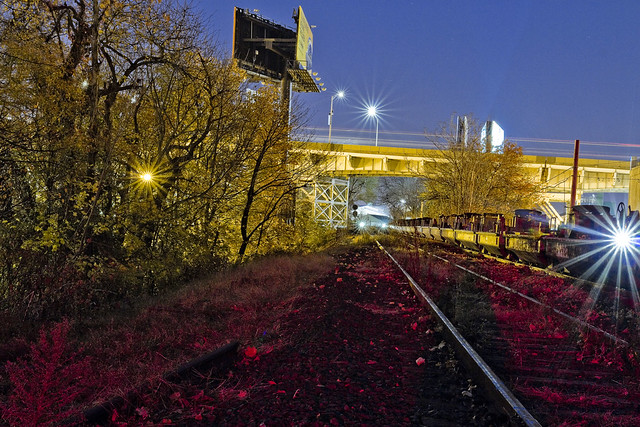
Recently, one found himself hitting the tracks just before sunrise. I was there with sanction, accompanied by an MTA employee and entirely “legal.” It should be mentioned, again, that illegal trespass is against a humble narrator’s code, and like a vampire – I need to be invited in to do my thing. You also really, really, don’t want to get caught trespassing up here by the railroad cops, by the way. You also really, really, don’t want to meet the sort of person who camps out along railroad tracks in LIC when you’re all alone in the wee hours.
The Montauk Cutoff in Long Island City was designed to connect the North Shore line with the Montauk Line. The Montauk Line uses the tracks which follow the shoreline of Newtown Creek through Queens, eventually intersecting with the Bushwick Branch and both head for the rail yard at Fresh Pond. The elevated trackway of the Montauk Cutoff crosses Skillman, 49th, 50th, 51st, and Borden Avenues, whereupon it meets a rail bridge called Cabin M which spans Newtown Creek’s tributary Dutch Kills.
The North Shore line used what are approximately the modern LIRR passenger tracks, give or take a few yards, which transverse the Sunnyside Yards and head through Woodside on their way east. The Montauk Cutoff was built for freight, as were the North Shore and Montauk Lines. Passenger service was always a loser for the LIRR. Modern day freight on the LIRR is handled by the New York & Atlantic company.
– photo by Mitch Waxman
The first discussion, which I’ve been able to find at least, about building LIC’s Montauk Cutoff was in 1906 – as part of a series of railroad projects either proposed or already under construction at the start of the 20th century by the Pennsylvania Railroad Company – projects which included Penn Station and Sunnyside Yard. Other documents I’ve examined state that the LIRR was paying taxes to New York State as early as 1912 on the Montauk Cutoff, which suggests that it came into service around the same time that the Sunnyside Yards came online. The surrounding Degnon Terminal wasn’t far behind the rail complex, either, with the Loose Wiles factory and other mega factories opening in the 1920’s.
As is always mentioned, old Mitch ain’t no authority on the whole railroad thing. If there’s something wrong in my little summary, please let me know in the comments and corrections or an errata will be incorporated. I can speak pretty intelligently about the maritime/locomotive complex around Newtown Creek, but I’ll admit to having vast gaps on the particular subject of the iron road. That was my pal Bernie Ente’s area of expertise.
For a historic series of shots, maps, and technical descriptions of anything involving the LIRR, you are going to have to visit the fairly excellent trainsarefun.com. Here’s their Montauk Cutoff Page.
Another set of maps and historic shots can be accessed at an equally fantastic site called arrts-arrchives.com. Here’s their Montauk Cutoff page.
I’ve written about the Smiling Hogshead Ranch before, which sits on the interchange between the Degnon Terminal Railway and the Montauk Cutoff, over at my old Brownstoner Queens column.

– photo by Mitch Waxman
The view from up on the Montauk Cutoff is unique. That big parking lot at the bottom of the shot above is a UPS shipping center, the one on 49th avenue. Rearing above and behind it is the Queens Midtown Expressway section of the Long Island Expressway, which arches up and over Dutch Kills some 106 feet from its beginning at the Queens Midtown Tunnel – which is around a half mile away.
My MTA companion and I met up at the Smiling Hogshead Ranch at 5:30 in the morning to get these shots, which gave me a solid hour to work in absolute pitch darkness up on the tracks. The shots in today’s post are obviously tripod shots, and long exposures. Leaving the shutter open for 20-30 seconds at a pop, you can gather a tremendous amount of light and color, but the hot spots of electric street lighting always cause certain problems. Compensation for this is to move the aperture into “hyperfocal” range, f11 and narrower, which is counterintuitive for night shots but nevertheless effective. It also produces those neat little star bursts around the lights.

– photo by Mitch Waxman
So, why was I out on a chilly November morning with an MTA property manger, walking on a century old rail spur in Long Island City?
The MTA has decided to “abandon” this line. Abandon doesn’t mean the same thing in “railroad” as in does in english. It means that the agency has no current plans for the line and wishes to free itself of the duties necessitated in maintaining it as functional track. It means that the MTA will retain ownership of the Montauk Cutoff, and can at any time reactivate the pathway should “future use” require it. Given the speed with which rail projects generally move, however, that means a window of at least a couple of decades of inactivity awaits the property no matter what happens.
Accordingly, MTA has issued a “Request for Expressions of Interest,” or RFEI, regarding the Montauk Cutoff and is seeking potential lessees for the space.

– photo by Mitch Waxman
As defined in the RFEI document, the MTA is seeking out creative uses of the land with an eye towards community improvement. The agency has set down a few ground rules for any potential lessee of the site, many of which are quite expensive – such as insurance, utility service – those sorts of things. The property, as defined in the RFEI, includes the Smiling Hogshead Ranch – who currently lease and pay insurance on the parcel in which the community garden is operated.
Before certain web masters start pointing their fingers and shouting “j’accuse” at me while spinning a conspiratorial tale, Smiling Hogshead is indeed associated with Newtown Creek Alliance, as am I. You can absolutely bet that I’m a fan of SHHR’s operations and programming, and friends with a lot of their members. Long Island City needs every bit of green space it can get, which is how I finally get around to explaining why me and the MTA guy were here on the day before Thanksgiving and just before sunrise.

– photo by Mitch Waxman
A “Request for an Expression of Interest”? You can say that I’m interested. I’m interested in seeing this trackway converted over to green space, in much the same way that the Degnon Spur on Pearson and Skillman – a weedy dumping ground and homeless camp – was turned into a lush garden by a group of dedicated volunteers.
Can you imagine what a group like Smiling Hogshead’s could do up here?
If you want to get in on the conversation, or contribute some time and knowledge to the project – shape the future, as it were – whatcha doing on the 2nd of December? A bunch of us are going to attend a “visioning meeting” at Nomad Cycle (47-10 Austell Pl, Queens, NY 11101) which is set to happen between 6:30 and 8:30 p.m.

– photo by Mitch Waxman
My companion and I had discussed the possibility of getting up here in the pre dawn hours, and a couple of previous appointments had to be cancelled on account of weather. We had met on a walk through of the site which MTA had conducted back in October for parties interested in acquiring the land, an excursion which occurred just before solar noon – which is not the most efficacious time to photograph LIC. I made the case to him that a “proper” set of photos would be needed for this project and quite handy to boot, which my new friend at the agency agreed with. Hence, where we were, when we were, and why we met up in the dark on Skillman Avenue on the day before Thanksgiving.
The wrinkle in this potential project is this – it doesn’t necessarily have to become a green space. Anyone can “express interest” in the Montauk Cutoff, and as long as their proposed project meets the requirements set aside by the MTA, it will be considered a viable option.
I see this as being a frankly huge opportunity to create an enormous acreage of green space in an otherwise completely barren industrial area which can be best described as a “devastation of concrete.” My interest in this thing is simple – this property touches Dutch Kills, where the borders of the “abandoned” section ends, which is “my house.”

– photo by Mitch Waxman
The Montauk Cutoff begins at Sunnyside Yard, and at its southeastern edge connects to the M Cabin truss bridge over Dutch Kills which connects to the Blissville Yard, which in turn feeds the tracks that travel under the Greenpoint and Kosciuszko Bridges to Maspeth, Ridgwood, and all points east. The RFEI states that the M Cabin bridge will be opened, and secured in that position, and that a barrier of some sort will be erected at the edge of the Montauk Cutoff’s lot.
Additionally, I cannot begin to, nor have I ever believed that this is the original bridge on this site. I’ve got some Intel that suggests the early 1940’s for its origins, but nothing solid enough to to stick a pin into. The original early 20th century bridge is long gone at any rate.

– photo by Mitch Waxman
I can tell you with some certainty that the nearby DB Cabin rail bridge is from 1919, and is a swing bridge that hasn’t opened since 2002. My pal Bernie, mentioned above as having been THE authoritative source on all things rail around LIC, told me once or twice that two industrial wreckers are required to tow it from either side to open the bridge. The swing bridges motors are non functional, something that has caused no small amount of grief for the EPA’s Superfund investigators. DB Cabin allows access from the Wheelspur Yard to the Blissville Yard and the Montauk Line.
Like I said, Newtown Creek.

– photo by Mitch Waxman
Looking northwards along Dutch Kills, at a scene familiar and loved by long time readers of this – your Newtown Pentacle. That’s the Borden Avenue Bridge, with the LIE above, spanning Dutch Kills. I’ve been writing about this neighborhood for years, it’s one of my favorite locations in New York City. The Montauk Cutoff leads directly to this spot, which in my mind directly connects it to the environmental problems of the Newtown Creek watershed.
Know how I’ve been rattling on for years about “combined sewer outfalls” and the problems presented to the ancient sewer system during rain events? Montauk Cutoff represents an opportunity to create a nearly four acre long green sponge that can drink up a significant amount of the storm water that carries garbage, grease, and poop into this water.

– photo by Mitch Waxman
The Montauk Cutoff. This is a once in a generation opportunity to do something right for the environment in the ruined biome of Long Island City. Every elected official I’ve spoken to about this idea is “into it” although they haven’t made any public declarations yet (too early in the process to bring them in) and recently – Community Board 2’s environmental committee voted to support the use of these tracks as “green infrastructure.”
Want to get involved in the future of the Montauk Cutoff? As mentioned above, a “visioning meeting” which be taking place at LIC’s Nomad Cycle (47-10 Austell Pl, Queens, NY 11101) on December 2nd, between 6:30 and 8:30 p.m.
“follow” me on Twitter- @newtownpentacle


