Archive for the ‘Long Island City’ Category
Project Firebox 25

– photo by Mitch Waxman
24th Street and 42nd Road in Long Island City, in addition to being a geographic palindrome, hosts this centuried sentinel of the realm. It’s crown is long lost, and core functionality is suspect, yet its columnar presence still affirms the presence of redoubtable guardianship and an omnipresent vigilance. It has been too long since the watchtowers of Long Island City have graced these postings, and so we celebrate a seasonal return to Project Firebox.
forgotten hands

– photo by Mitch Waxman
On another one of the long marches across the concrete desolations of Western Queens, it occurred to me that I should pay more attention to the steel fingers of the Great Machine than has been formerly applied. This is a problematic notion, of course, as we live in the age of terror- and taking pictures of transportation infrastructure is largely frowned upon by governmental institutions such as the NYPD for understandable and prosaic reasons.

– photo by Mitch Waxman
Part of my outlandish sense of entitlement, imagined largesse, and pompous self importance demands that I do not allow such entities to inhibit my activities.
I’m happy to be questioned by the gendarme whenever they might approach me with queries as to identity and purpose. Law demands that a citizen must carry some form of identification, otherwise the police may detain you with the intention of assessing your identity (for a limited period of time), which is something I always comply with. No such law allows law enforcement to demand that you show them what you’re shooting (they need a warrant for this kind of search), explain why you’re shooting it (that’s what you tell a judge), or to delete images from your camera- or so I am told by those versed in the finer points of law.
If you are in a place which is “in public”, you can feel free to do whatever you want with your camera, within certain limitations (defined around the commercial use of likenesses and editorial implications implied thereof). If on private property, however, the owner or its representatives can ask you to vacate the locale and you must comply with their wishes or be charged with trespassing (however these private entities are similarly restricted in not forcing you to display, delete, or otherwise explain yourself to them).

– photo by Mitch Waxman
Of course, this is an ideal presentation of encounters between photographers and those who wish that the only cameras which existed were those monitoring the citizenry for criminal transgression and evidentiary collection.
Often, one will experience an encounter with a rookie cop, unusually aggressive private security guard, or criminal who does not hold to this liberal interpretation of constitutionally guaranteed free speech. Refer to the recent controversies surrounding the Occupy Wall Street protests, and the widely rebuffed handling of mainstream press photographers by the NYPD for an example of how things can go wildly wrong in the real world.

– photo by Mitch Waxman
Once, whilst capturing an image of the charming St. Irene’s Church here in Astoria, an angry chorus of Greek women took it upon themselves to brand me a terrorist and chased me for several blocks- all the while hurling Hellenic invective. Many of them curled their hands into balls and stuck their thumbs out between middle and ring fingers, and one of them called me “A Bin Laden”.
That’s when I turned around and confronted the group asking “Wouldn’t a Terrorist have a car?”.

– photo by Mitch Waxman
Regardless of risk and the malign attentions of both private and public security, your humble narrator is nevertheless highly motivated to capture and record the magnificent transportation infrastructure which forms the fingers of the Great Machine. I’m sure that they won’t let me take the DSLR into central booking with me, but as I’ve never been accused of anything but driving too fast on the Taconic Parkway and Pennsylvania Turnpike by law enforcement, it sure will be interesting standing in front of a judge.
And by the way, Happy Festivus.
flopping animals

– photo by Mitch Waxman
On the day of the New York City Marathon, which I was unable to photograph this year due to a variety of personal reasons, an effort was made to find some time to walk through the largely deserted Queens Plaza and get some shots of the place on the one day of the year it isn’t teeming with vehicular traffic. This got me thinking about Queens, and some of the people I’ve met walking along the streets here.
Showing up, I believe, is a substantial part of life. Attendance counts.

– photo by Mitch Waxman
A few folks over at another blog have decided to ride me down for the announcement of the Blissville Oil Spill the other day. A fairly typical case of “killing the messenger”, the best name I’ve been called – so far- is “Pompous Coward”. That’s up there with a name granted me by a coworker many years ago when I worked at Ogilvy Interactive – “Feckless Quisling”.
Seriously, here’s the link, these are actually kind of funny.
I would also point out that it has always been Newtown Pentacle policy to discourage people from eating whatever animals they might find along Newtown Creek or at Chernobyl.

– photo by Mitch Waxman
What kind of struck me though, was that not a single one of those commenters reacted to the Blissville Spill itself, which brought me back to thinking about the people I’ve met walking around these streets with a camera. What a grand bunch- cops and firemen, politicians and gangsters, city planners and urban explorers, environmentalists and industrialists, moms and dads. The one common thread in all of Queens seems to be that there is no common thread, except for a sure sense that someone else is getting a bigger piece of the pie than you are and that you are honor bound to knock anyone who is demanding attention- even if they are telling you that your house is burning.
That’s kind of a crossroads, ain’t it?

– photo by Mitch Waxman
Allow me, in these closing weeks of 2011, to affirm and refute certain things. First, the various “groups” which I’ve become affiliated with aren’t paying me a dime. I’m receiving no money from government or private sources to produce this blog, and when you may see ads appear at the bottom of a page- that’s WordPress (the Webhost), not me inserting them. Accordingly, I am betrothed to no particular ideology or didactic political world view, and instead operate in the manner of what the Japanese would call a Ronin. I believe it is better to talk than argue, as the latter is something I do only with family members.

– photo by Mitch Waxman
Several of my little mottoes rule my actions, and betray my morality. “What would Superman do”, “Do what you say, and say what you do”, “It’s not good, nor bad, it just is”. Also- “Opinions are like assholes, everyone has one”, and “Fish, cut bait, or get out the way” are rather influential in governing my days. I bristle at the accusations others make about my motivations, which betray their own corruption. As a statement of principal, understand that I have no agenda or hidden motive, and that I am what and who I seem to be- someone in love with the oft overlooked and obfuscated story of Queens.
An Oil spill… in Queens

– photo by Mitch Waxman (February 16, 2009)
Sadly, oil is seeping out of a bulkhead on the Queens side of the Newtown Creek.
Famously, the Greenpoint Oil Spill (click here for a link to newtowncreekalliance.org for more) occurred just across the water from this spot, but every indication points to this as being a separate event. The former site of Charles Pratt’s Queens County Oil Works, which was an approximately 18 acre parcel which would later be called the “Standard Oil Blissville works”, the sites occupation in modernity has little or nothing to do with petroleum.
Welcome, by the way, to Newtown Creek- and to the “Blissville Oil Spill”.
Just a note: For the purposes of this posting, I’m departing from the normal formatting, and the photos are presented along with the dates upon which they were captured.

– photo by Mitch Waxman (September 14, 2008)
My practice for the last several years has been to shoot everything I see along the Newtown Creek, whether or not it seems significant at the time. This practice evolved out of the paucity of photographic documentation of the place which survived the 20th century, and the effort has been made with the notion of leaving behind something for future researchers to work with. As time has gone by, and my technological capabilities have expanded, I’ve developed quite a library of shots.
The photo above depicts the site in question during the autumn of 2008, and shows the historic condition of the bulkheads.

– photo by Mitch Waxman (September 14, 2008)
A standard codex for interpreting what one sees along the Newtown Creek states that wooden bulkheads are 19th century, reinforced concrete dates from the early to mid 20th, and steel plating is late 20th and early 21st century. This rule is not “scientific” but allows one to approximate the manufacture of these fallen docks to a relative time period. As you can observe in the shot above, the risible decay of the wooden bulkheads, and their manner of construction, speak to a long period of disuse and lack of maintenance as far as September of 2008.

– photo by Mitch Waxman (February 20, 2010)
In the winter of 2010, a crew began to install modern steel plating along this frontage, which drew my interest. Again, anything that is in a state of flux along the waterway is a point of interest for me. This project went on for several months, and was conducted from a barge with a small crane installed on it.

– photo by Mitch Waxman (February 4, 2011)
By the same period a year later, in February of 2011, the modern installation was complete. Conflicting reports on this style of bulkhead are often heard. The older wooden structures offer a structure for biological organisms to nest and shelter, but “slow” the already tepid flow of water through the narrow passages of the Creek. The steel ones “quicken” the flow, but offer no toeholds for organic life.
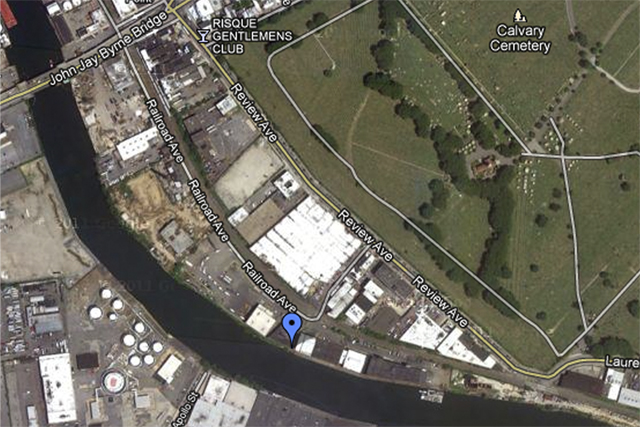
Modern day, (December 2011) google maps screen capture, click here or the image above for the dynamic google map. This is an industrial cul de sac today, accessed by a private driveway. The companies which use this space are largely waste management oriented, warehouse operations, furniture refinishing, or other truck based businesses. Despite the presence of freight tracks through the middle of the site, few of these companies utilize their sidings. Calvary Cemetery and the Kosciuszko Bridge loom large and distinguish the area.

1924 view of the area, screen capture from “NYCityMap” at nyc.gov.
The oil tanks in the center of the site betray the presence of the “Queens County Oil Works” of Charles Pratt, which were also known as the “Standard Oil Blissville Works”. Blissville, of course, is the historic name of this part of Queens which was once a residential area.

Clear plans of the area in 1936 overlaid with the 1924 aerial projection from NYCityMap. Click here to see a large version of the overlay.

Detail view of the area, click here for larger incarnation. The works were here as late as 1951, but at this point, I still haven’t been able to confirm the date they were closed down.

– photo by Mitch Waxman (August 6, 2011)
In the summer of 2011, I was tasked with photographing a “Bulkhead Survey” which members of the Newtown Creek Alliance were conducting. The good folks at Riverkeeper volunteered to take our party out on the Newtown Creek onboard their patrol boat, and when we were passing by the former Queens County Oil Works, we noticed the presence of both containment booms on the water and petroleum product flowing freely from the shoreline itself.

– photo by Mitch Waxman (August 6, 2011)
The theory which has been advanced by knowledgeable sources is that when the steel bulkheads were installed, a process in which the plating is slid down into place and then secured, and that a sealed chamber or buried pipeline was likely ruptured during the construction process which freed “the product”.
I have been asked to mention (by Newtown Creek Alliance and Riverkeeper itself) that investigation of the situation is underway, and the State and City officials responsible for policing this sort of thing are fully and enthusiastically engaged in the process.

– photo by Mitch Waxman (August 6, 2011)
The story of Charles Pratt, his “Astral Oil”, and their involvement with John D. Rockefeller’s Standard Oil Trust will be discussed in a later posting on this subject, as the lengthy history would divert attention from this otherwise serious issue. Suffice to say that the Blissville works were some 18 acres in size, and suffered several “total loss” fires in the late 19th century.
Note that this is a distinct property (and event) from the adjacent State Superfund site which is referred to as the Quanta Resources site.

– photo by Mitch Waxman (November 19, 2011)
Again onboard a Riverkeeper patrol, this time in November of 2011, the overt visual presence and subtle aroma of petroleum was encountered. The black and yellow structure is what is known as a hard boom, and is designed to contain surface contamination and “floatables”. It extends to a few inches below the surface.

– photo by Mitch Waxman (November 19, 2011)
The steel plating at the site is painted with oil, undoubtedly splashed up by wave action during storms at high tide. The white objects which are saturated with petroleum products are absorbent booms, designed to wick up the free floating product.

– photo by Mitch Waxman (November 19, 2011)
The leaves in the shot above are literally stuck into the gluey residues of the oil. You can see the high tide mark left by the water on the cleaner bulkhead which is just beyond the hard boom. Perhaps this is the source of oil, which many have reported to me over the course of the last year, which has been witnessed as it floats toward the East River.

– photo by Mitch Waxman (November 19, 2011)
It is not news that there are environmental contaminants floating freely in this troubled waterway, nor is there any revelation to be found in the fact that petroleum products are commonly observed pooling and flowing about the Newtown Creek watershed.
What is news is that this is in Queens.

– photo by Mitch Waxman (August 6, 2011)
Much of the attention, and deservedly so because of the large and growing population of Greenpoint and Williamsburg, which Newtown Creek receives is all about Brooklyn. The north shore of the Creek in Queens is often left out of discussion (and from both remediation and environmental benefits funding) because of its relatively tiny population and industrial character. One of the questions which this blog has asked since day one has been “Who can guess all there is, that might be buried down there?”.
In the case of the Blissville Oil spill, the question might as well be “How much there might be?”.

– photo by Mitch Waxman (November 19, 2011)
This is just the beginning of a new Newtown Creek story, the tale of the Blissville Oil Spill. I fear it will be the first of many such stories, as we move into the Superfund era.
foetid darkness

– photo by Mitch Waxman
On Monday the 5th of December, the Newtown Creek Alliance had drawn me from the safety of Astoria to the wild streets of Brooklyn and far off Williamsburg’s Graham Avenue. I decided to walk, as the mists had begun to swirl. When the meeting ended, certain Greenpoint based members of the Alliance offered me a lift as far they were going and I gladly took their offer.That’s how I ended up on the Pulaski Bridge in the middle of an astounding weather event.
In the photo above, what is missing from the shot of Newtown Creek is Manhattan.
from wikipedia
Fog is a collection of water droplets or ice crystals suspended in the air at or near the Earth’s surface. While fog is a type of stratus cloud, the term “fog” is typically distinguished from the more generic term “cloud” in that fog is low-lying, and the moisture in the fog is often generated locally (such as from a nearby body of water, like a lake or the ocean, or from nearby moist ground or marshes).

– photo by Mitch Waxman
Even the nearby spires of Tower Town in Long Island City were obscured, lost in some primal soup. The sound was eerie, as well, and our Lady of The Pentacle (who is British) informs me that her countrymen would often remark that sound doesn’t travel the same way through fog as it does in clear air and great caution should be exercised when moving around in it.

– photo by Mitch Waxman
Looking toward Dutch Kills along Borden Avenue, which trails along the malefic Newtown Creek, the enormous advertising sign mounted upon the “Fresh Direct” facility (which recently was, but I’m not sure if it still is, the nations largest illuminated sign) was creating quite a lightshow in the mist.

– photo by Mitch Waxman
This thing plays through several advertisements for the Internet green grocer, and spotlights key products and offers to passing drivers on the Long Island Expressway, which it towers above. Depending on when in the repeating reel of ads you were, the mist either looked like this…

– photo by Mitch Waxman
…Or like this!

– photo by Mitch Waxman
Additionally, here’s one from earlier in the day, at Maspeth Creek, looking toward the Kosciuszko Bridge.


