Archive for the ‘Lower Manhattan’ Category
irrepassable gate
– photo by Mitch Waxman
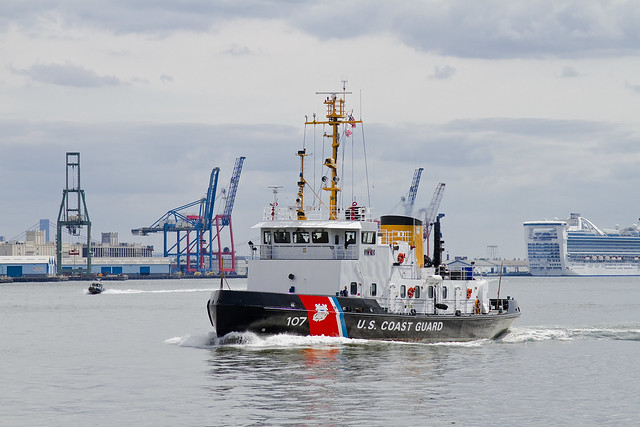
Awhile back, I posted this series of shots to Flickr, and an enigmatic shipping enthusiast from the vast interweb hive mind immediately commented “140′ Bay Class Icebreaking Tug USCGC PENOBSCOT BAY WTGB-107 homeport Bayonne, NJ.”.
From wikipedia
The USCG Bay-class icebreaking tug is a class of 140-foot (43 m) icebreaking tugs of the United States Coast Guard, with hull numbers WTGB 101 through to WTGB 109.
They can proceed through fresh water ice up to 20 inches (51 cm) thick, and break ice up to 3 feet (0.91 m) thick, through ramming. These vessels are equipped with a system to lubricate their progress through the ice, by bubbling air through the hull.

– photo by Mitch Waxman
When focusing in on this ship, I just thought it looked cool. Turns out that this class of vessels has a long and storied past.
Here’s a Coast guard shot of Penobscot Bay in action during the winter…
Here’s the official story, courtesy United States Coast Guard:
from uscg.mil
The 140-foot Bay-class Cutters are state of the art icebreakers used primarily for domestic ice breaking duties. They are named after American Bays and are stationed mainly in Northeast U.S. and Great Lakes.
WTGBs use a low-pressure-air hull lubrication or bubbler system that forces air and water between the hull and ice. This system improves icebreaking capabilities by reducing resistance against the hull, reducing horsepower requirements

– photo by Mitch Waxman
Note: I should mention that members of the USCG have offered me very good, yet unofficial, advice on appropriate maritime footwear in the past- which may render some personal bias on my part for the organization.
The USCG also maintains a short history page on this ship, which can be accessed here.
grotesquely gnarled

– photo by Mitch Waxman
As described in a prior posting– certain anonymous parties had contacted me about- and a meeting at St. Patrick’s Old Cathedral in Manhattan was arranged- to discuss and finally gain possession of information which would lead to a certain location in First Calvary Cemetery which has denied all attempts at discovery.
Arriving at the venerable church early, however, the individual with whom this appointment was arranged arrived with confederates of a seeming rough character, and the notion that I had stumbled into some sort of conspiratorial snare of malign intent terrified me. Your humble narrator fell into “one of my states”, and the scene was fled in a stuporous panic.
Several hours later, when able to recompose myself, it was discovered that the memory card of my camera was nearly full, and this is the second of a series of postings attempting to reconcile the hundreds of photos I found with my episode of “missing time”.
from wikipedia
Missing time is a proposed phenomenon reported by some people in connection with close encounters with UFOs and abduction phenomena. The term missing time refers to a gap in conscious memory relating to a specific period in time. The gap can last from several minutes to several days in length. The memory of what happened during the missing time reported is often recovered through hypnosis or during dreams.

– photo by Mitch Waxman
Based on the series of photos, it is presumed that my route took me down Mulberry on a southern declination, before turning east on Kenmare and ultimately to Delancey. The warren of streets which defy and predate the Manhattan grid, which is two centuries old this year– I would add- have been massively altered from their historic patterns by the attentions of urban planners and DOT engineers since the time of the Bloody Sixth Ward.
Partially, this was to accommodate the “automobile city” of the early 20th century, but no small effort was spared to eliminate the alleyways and so called “courts” which denied easy policing and access by fire and sanitation inspectors in this region of the Shining City.
It was in these courts and alleys that the street gangs of the 19th century were allowed to fester and swell, an offensive and dangerous situation to the progressives and reformers of the post civil war era “City Beautiful”.
from wikipedia
The City Beautiful Movement was a reform philosophy concerning North American architecture and urban planning that flourished during the 1890s and 1900s with the intent of using beautification and monumental grandeur in cities. The philosophy, which was originally associated mainly with Chicago, Detroit, and Washington, D.C. allegedly promoted beauty not for its own sake, but rather to create moral and civic virtue among urban populations. Advocates of the philosophy believed that such beautification could thus promote a harmonious social order that would increase the quality of life.

– photo by Mitch Waxman
My trusty camera seems to have been pointed in the direction of the 2nd of the three East River Bridges to have been erected, which we know as the Williamsburg. 100 years ago, I might have boarded a street car or horse drawn wagon to carry me over the span and boarded it at Bowery and Delancey. Were I cognizant of my surroundings, rather than stumbling in a panic, I might have caught an electric light rail- which is referred to as a “subway”- but instead and inexorably I marched forward into “Jewtown”.
from HOW THE OTHER HALF LIVES By JACOB A. RIIS, courtesy google books
THE tenements grow taller, and the gaps in their ranks close up rapidly as we cross the Bowery and, leaving Chinatown and the Italians behind, invade the Hebrew quarter. Baxter Street, with its interminable rows of old clothes shops and its brigades of pullers-in—nicknamed “the Bay ” in honor, perhaps, of the tars who lay to there after a cruise to stock up their togs, or maybe after the “schooners” of beer plentifully bespoke in that latitude— Bayard Street, with its synagogues and its crowds, gave us a foretaste of it. No need of asking here where we are. The jargon of the street, the signs of the sidewalk, the manner and dress of the people, their unmistakable physiognomy, betray their race at every step. Men with queer skull-caps, venerable beard, and the outlandish long-skirted kaftan of the Russian Jew, elbow the ugliest and the handsomest women in the land. The contrast is startling. The old women are hags; the young, houris. Wives and mothers at sixteen, at thirty they are old. So thoroughly has the chosen people crowded out the Gentiles in the Tenth Ward that, when the great Jewish holidays come around every year, the public schools in the district have practically to close up.

– photo by Mitch Waxman
The politics of modern city dwellers prefers not to attach ethnic sobriquets to neighborhoods where any single population crowds out other mention anymore, but in the 19th century no such prohibition applies. Early subway maps refer to this section of Delancey east of the Bowery as “the Ghetto” for instance. Such description signifies the magnetic appeal of the tenement neighborhood to the vast Yiddish speaking populations which made good their escape from the “the Pale” in the 19th century.
These largely weren’t the Orthodox Jews of today, of course, as the Hasidic and Lubavitcher sects – typified by an outdated style of dress and clannish separation from their surrounding environs – are a fairly modern path which only began to gather real steam in the 19th century (just like most fundamentalist religions) and in the 20th century these groups still represent only a tiny fraction of the larger ethnic population.
Instead the majority were religious but secular peasants from the countryside, suddenly finding themselves in New York City living next door to a sophisticated citizen from the Austro Hungarian- or Russian- or Ottoman- empires. It was these transplanted urbanites who founded the Forverts and other Yiddish language newspapers.
from wikipedia
The Forward (Yiddish: פֿאָרווערטס; Forverts), commonly known as The Jewish Daily Forward, is a Jewish-American newspaper published in New York City. The publication began in 1897 as a Yiddish-language daily issued by dissidents from the Socialist Labor Party of Daniel DeLeon. As a privately-owned publication loosely affiliated with the Socialist Party of America, Forverts achieved massive circulation and considerable political influence during the first three decades of the 20th Century. The publication still exists as a weekly news magazine in parallel Yiddish (Yiddish Forward) and English editions (The Jewish Daily Forward).

– photo by Mitch Waxman
The synagogues of Eastern and Southern Europe which have survived into modernity have all the appearances of a fortified house or town, and go to some lengths to blend into the surrounding communities. In the United States, however, the desire to show off and build a palace to the almighty was not limited to the Catholics or Episcopalians. Such aspirations were present amongst the Jews as well.
On the corner of Delancey and Forsyth one may find the former “Forsyth Street Synagogue, Poel Zedek Anshei Illia (Doers of Good, People of Illia)“. In modernity, it serves as a place of worship for the Seventh Day Adventists, which grew out of the millennialist Millerites in the years following the “Great Disappointment” 1844.
from wikipedia
October 22, 1844, that day of great hope and promise, ended like any other day to the disappointment of the Millerites. Both Millerite leaders and followers were left generally bewildered and disillusioned. Responses varied: some Millerites continued to look daily for Christ’s return, others predicted different dates—among them April, July, and October 1845. Some theorized that the world had entered the seventh millennium, the “Great Sabbath”, and that, therefore, the saved should not work. Others acted as children, basing their belief on Jesus’ words in Mark 10:15, “Truly, I say to you, whoever does not receive the kingdom of God like a child shall not enter it.” O. J. D. Pickands used Revelation 14:14-16 to teach that Christ was now sitting on a white cloud, and must be prayed down. Probably the majority however, simply gave up their beliefs and attempted to rebuild their lives. Some members rejoined their previous denominations while a substantial number became Quakers.

– photo by Mitch Waxman
An unknown structure to me, online accounts describe it as having passed from Hebraic hands during the long 20th century decline of the neighborhood and speak of its resurrection when it began to serve as a church to some of modern Christianity’s more charismatic adherents. It is odd to see the Mogen David bisected by the rood outside of the esoteric or gnostic traditions.
Delancey street, I would mention, always figured prominently in the adages and folkloric warnings that my grandmother would hand out when I was a young but already humble narrator. A product of the Pale herself, she found work in America in that jewish garment trade which once flourished here, and even into extreme old age she practiced her craft. She always referred to Delancey and the environs as a home to midwives and fortune tellers (kabbalists) and shmata men.
When queries as to how lucrative the shmata (rag) trade was, and who could possibly need enough rags to keep a merchant employed full time- her response was “vat doz yu tink yu viped yur arse mit? Dere vas no terlet papah beck den”.
from wikipedia
Adventism is a Christian movement which began in the 19th century, in the context of the Second Great Awakening revival in the United States. The name refers to belief in the imminent Second Coming (or “Second Advent”) of Jesus Christ. It was started by William Miller, whose followers became known as Millerites. Today, the largest church within the movement is the Seventh-day Adventist Church.
The Adventist family of churches are regarded today as conservative Protestants. While they hold much in common, their theology differs on whether the intermediate state is unconscious sleep or consciousness, whether the ultimate punishment of the wicked is annihilation or eternal torment, the nature of immortality, whether or not the wicked are resurrected, and whether the sanctuary of Daniel 8 refers to the one in heaven or on earth. The movement has encouraged the examination of the New Testament, leading them to observe the Sabbath.

– photo by Mitch Waxman
Uncertainty exists in my mind as to whether or not my trance induced scuttling and the photographic record thereof bears any kind of narrative thread or not. It would seem that my subject matter and focal point of view remained steady with normal pursuits, chasing esoteric and disabused touchstones of the oft occluded past, and noticing the small details hidden amongst the centuries old tapestry.
One wonders if I might have wandered into this storefront psychic and what Gypsy legend would have been offered. Perhaps I did, but in my trance state, who can venture as to what might have occurred in the moments between photos?
from wikipedia
Romani mythology is the myth, folklore, religion, traditions, and legends of the Romani people (also known as Gypsies). The Romanies are a nomadic culture which originated in India during the Middle Ages. They migrated widely, particularly to Europe. Some legends (particularly from non-Romani peoples) say that certain Romanies are said to have passive psychic powers such as, empathy, precognition, retrocognition, or psychometry. Other legends include the ability to levitate, travel through astral projection by way of meditation, invoke curses or blessings, conjure/channel spirits, and skill with illusion-casting.
Burial: Romanies pushed steel or iron needles into the body’s heart and put pieces of steel in the mouth, over the eyes, ears, and between the fingers. Hawthorn was placed on the legs, or driven through the legs. They would also drive stakes, pour boiling water on the grave, and behead or burn the body. All this preparation was to ward off vampires.
Afterlife: Romanies had a concept of Good and Evil forces. Dead relatives were looked after loyally. The soul enters a world like the world of the living, except that death does not exist. The soul lingers near the body and sometimes wants to live again.

– photo by Mitch Waxman
The River of Sound awaited, and a vast steel span was to be crossed.
Tomorrow is Williamsburg, where Brooklyn’s Grand Street will be attained and the puzzling series of shots found on my camera card will be further explored at this… Your Newtown Pentacle.
from medical-dictionary.thefreedictionary.com
compulsive walking
affected animals walk oblivious to their surroundings. They appear to be blind, walk into objects, headpress against them and stay in this position for long periods, are oblivious to danger and may die of misadventure. They may attempt to climb a wall and fall over backwards. Common causes are hepatic encephalopathy and increased intracranial pressure.
unending steps

– photo by Mitch Waxman
By email, I was contacted by a personage who claimed that the long desired location of a certain interment at First Calvary Cemetery in Queens- the burial site of “he who must not be named“- was in his possession. Further, it was asserted that while anonymity and certain other odd conditions were required, the occluded information so long sought would be mine for the taking.
A meeting was hastily arranged at St. Patrick’s Old Cathedral on Manhattan’s Mulberry street, and your humble narrator scuttled off to the Bloody Sixth Ward and the House of Dagger John.
What greeted me was not to my liking.
from saintpatrickscathedral.org
The recent elevation of New York as an Episcopal see with its own bishop inspired the increasing Catholic population to build the original Cathedral of New York under the name of Ireland’s patron saint, Saint Patrick. The site chosen belonged to the corporation of Saint Peter’s Church and was located on Mulberry Street in lower Manhattan. The cornerstone was laid in June 1809.

– photo by Mitch Waxman
As is habit and curse, an early arrival was attempted and achieved, and a hidden vantage point amongst the venerable pews was attained. The odd fellow who had contacted me described his aspect and appearance accurately, and recognition was instant when he strode confidently into the ancient church. He did not arrive alone, as he had implied in his missives, however.
The disturbing aspect of his companions, leathery creatures best described as men, and the hushed instructions he seemed to be offering them, brought me to a peak of nervous excitedness and a panic set in upon me. Stupidly, I had walked directly into a spiders web, lured in by forbidden fruit.
Had some sort of diabolical plot, hatched by those malign forces whose secretive occupations and desires and unguessed at existence has been inadvertently hinted at and offended by this- your Newtown Pentacle, been set in motion to snare and silence me?
from wikipedia
Until 1830, the Cathedral was the ending place of the annual St. Patrick’s Day parade. After that, it ended on Ann Street at the Church of the Transfiguration, whose pastor, Father Varela, was Cuban, but was a fervent nationalist and the chaplin of the Hibernian Universal Benevolent Society. Eventually, the parade moved uptown to pass in front of the new St. Patrick’s Cathedral.
In 1836, the cathedral was the subject of an attempted sack after tensions between Irish Catholics and anti-Catholic Know-Nothing nativists led to a number of riots and other physical confrontations. The situation worsened when a brain-injured young woman wrote a book telling her “true” story – a Protestant girl who converted to Catholicism, and was then forced by nuns to have sex with priests, with the resulting children being baptized then killed horribly. Despite the book being debunked by a mildly anti-Catholic magazine editor, nativist anger at the story resulted in a decision to attack the cathedral. Loopholes were cut in the church’s outer walls, which had just recently been built, and the building was defended from the rioters with muskets.

– photo by Mitch Waxman
As previously described, vast physical inadequacy and cowardice are my hallmarks. The least of all men, my only recourse is flight, and I seem to have descended into some sort of fugue state.
I remember leaving the sepulchral darkness and unnatural cool of the old Cathedral, but from the moment that the burning thermonuclear eye of god itself shone upon me, it’s a total blank.
My next conscious memory is that of having arrived back at HQ in Astoria some hours later with blistered feet and chafed thighs, and an odd crusty residue around my eyes reminiscent of the dehydrated tears which adorn the occulum of a recently awakened sleeper.
During this multi hour episode, I seem to have been taking hundreds of pictures as I scuttled instinctually and inexorably homeward.
I’ve pieced my somnambulist route together from the shots on my camera card and for some reason, seemed to be subconsciously following an ancient street car route, the one that went to Calvary via Williamsburg as I later scried.
In 1850 a line of two horse stages was running from Grand Street ferry past the Dutch Church on the Old Woodpoint Road out to Newtown. Grape arbors extended from Leonard Street to Humboldt Street.
Martin J. SUYDAM ran a stage from Peck Slip and Grand Street. Ferries through Grand Street and Metropolitan Avenue to Newtown.
The Grand Street and Newtown Railroad Co., was chartered in 1860. At the foot of the street was the office of the Houston Street Ferry Association and later of the Nassau Ferry Co. A long wooden stairway led from the ferry to the American Hotel, latter, #2 & 4, kept by Jackson HICKS.

– photo by Mitch Waxman
Some sort of odd symmetry presents itself, of course, in this dreamt of photowalk. The vast numbers who lie within the emerald devastations of Laurel Hill made the same journey themselves, although most did not take the Williamsburg Bridge- rather a connecting ferry and streetcar line which would have joined some forgotten 19th century Manhattan pierage (near its own Grand Street) with the gentry of Brooklyn. Don’t forget, in the 19th century, Manhattan was a pestilential hell hole of factories and open sewers populated by a starving horde of refugees- Brooklyn was in it’s own golden age.
The Bridge didn’t come along until 1883 after all, and First Calvary was nearly full by then.
I suppose there are and have been worse conditions of life, but if I stopped short of savage life I found it hard to imagine them. I did not exaggerate to myself the squalor that I saw, and I do not exaggerate it to the reader. As I have said, I was so far from sentimentalizing it that I almost immediately reconciled myself to it, as far as its victims were concerned. Still, it was squalor of a kind which, it seemed to me, it could not be possible to outrival anywhere in the life one commonly calls civilized. It is true that the Indians who formerly inhabited this island were no more comfortably lodged in their wigwams of bark and skins than these poor New-Yorkers in their tenements. But the wild men pay no rent, and if they are crowded together upon terms that equally forbid decency and comfort in their shelter, they have the freedom of the forest and the prairie about them; they have the illimitable sky and the whole light of day and the four winds to breathe when they issue into the open air. The New York tenement dwellers, even when they leave their lairs, are still pent in their high-walled streets and inhale a thousand stenches of their own and others’ making. The street, except in snow and rain, is always better than their horrible houses, and it is doubtless because they pass so much of their time in the street that the death rate is so low among them. Perhaps their domiciles can be best likened for darkness and discomfort to the dugouts or sod huts of the settlers on the great plains. But these are only temporary shelters, while the tenement dwellers have no hope of better housing; they have neither the prospect of a happier fortune through their own energy as the settlers have, nor any chance from the humane efforts and teachings of missionaries, like the savages. With the tenement dwellers it is from generation to generation, if not for the individual, then for the class, since no one expects that there will not always be tenement dwellers in New York as long as our present economical conditions endure.

– photo by Mitch Waxman
As evidenced in the shot above, I seem to have proceeded south along Mulberry Street, past the high walls of the Old Cathedral which were erected by Dagger John and the Hibernians to protect the sanctuary from the violent attentions of Nativist rioters during those starry years when this neighborhood was known as “the bloody sixth ward”.
from History of the Second company of the Seventh regiment By Emmons Clark, courtesy google books
The Sixth Ward was noted for its disorderly character, and the frequent skirmishes which took place within its borders, with the consequent black eyes and bloody noses, gave it the well-known sobriquet,—”the Bloody Sixth.” On the first day of the election, in the spring of 1834, it was said that the anti-bank, Democratic, and Irish citizens of the Sixth Ward, had blockaded the polls and prevented the Whigs from voting. On the second day, the Whigs from other districts rallied in large numbers to the Sixth Ward, resolved to break the blockade and give their friends an opportunity to cast their ballots. The result was a series of engagements, in which both parties maintained their positions in the field until the polls closed for the day. A ship, mounted on wheels and adorned with Whig banners, was drawn through the ward, and used to convey voters to the polls, and this insulting invasion of the Democratic stronghold increased the excitement.

– photo by Mitch Waxman
This grand walk carried me, in a seemingly dream like state, through the lower Manhattan neighborhoods known to Dagger John and his compatriots as either “Jewtown” or “the Ghetto”, over the Bridge, into Williamsburg, through Bushwick and then Maspeth in Brooklyn and Queens respectively, into Berlin and then Blissville in the Creeklands, and ultimately Calvary Cemetery itself. Over the next few days, and from the comfort and safety of a well fortified Newtown Pentacle HQ (which sports a cadre of Croatian Varangians dedicated to my health and well being, should these malign forces decide to visit… as well as other… more esoteric defenses) I’ll be presenting the fruits of this journey. As mentioned, I somehow kept shooting the whole way.
from wikipedia
Basil II’s distrust of the native Byzantine guardsmen, whose loyalties often shifted with fatal consequences, as well as the proven loyalty of the Varangians, led him to employ them as his personal bodyguards. This new force became known as the Varangian Guard (Greek: Τάγμα των Βαράγγων, Tágma tōn Varángōn). Over the years, new recruits from Sweden, Denmark, and Norway kept a predominantly Scandinavian cast to the organization until the late 11th century. So many Scandinavians left to enlist in the guard that a medieval Swedish law from Västergötland stated that no one could inherit while staying in “Greece”—the then Scandinavian term for the Byzantine Empire. In the eleventh century, there were also two other European courts that recruited Scandinavians: Kievan Rus’ c. 980–1060 and London 1018–1066 (the Þingalið). Steven Runciman, in The History of the Crusades, noted that by the time of the Emperor Alexios Komnenos, the Byzantine Varangian Guard was largely recruited from Anglo-Saxons and “others who had suffered at the hands of the Vikings and their cousins the Normans”. The Anglo-Saxons and other Germanic peoples shared with the Vikings a tradition of faithful (to death if necessary) oath-bound service, and after the Norman Conquest of England there were many fighting men who had lost their lands and former masters and looked for a living elsewhere.
Additionally, for those who might be interested in a FREE boat tour of Newtown Creek on City of Water Day – which is Saturday, July 16th- this web page bears monitoring.
maniacal force and fury

– photo by Mitch Waxman
Special Note: I’m going to fill in for Newtown Creek Alliance’s Michael Heimbinder at the DEP speaker series tomorrow night at the Newtown Creek Wastewater Treatment Plant. Mike has a family obligation to fulfill, and Shawn Shaffner of the POOP project asked me to sit in his chair. For more on the (free) event in Greenpoint, Brooklyn on Thursday the 23rd of June, click here. The official press release text follows:
Newtown Creek: Past, Present, and Future
When: Thursday, June 23rd, 6:30-8:30pm
Where: Newtown Creek Wastewater Treatment Plant Visitor Center, 329 Greenpoint Ave.
Join us for the NYC Dept of Environmental Protection’s speaker series where we will be hearing from Michael Heimbinder (Founder and Executive Director, HabitatMap), Kate Zidar (Coordinator, SWIM Coalition) and Paul Parkhill (Director, Place in History). The panel discussion will be moderated by Shawn Shaffner of the The People’s Own Organic Power Project.
Now, on with the Pentacle:
As mentioned in yesterday’s post, I had participated in Working Harbor Committee’s “student cruise” (an effort to introduce the concept of maritime career opportunities to kids from the landlocked core of the City who might otherwise never consider such a path) and found myself with several hours to kill before a second Working Harbor trip in the evening which would be leaving from South Street Seaport and Pier 17.
Luncheon at “the Frying Pan” was achieved, and your humble narrator found himself enjoying the Hudson River Park’s amenities and scenic possibilities. When I lived in Manhattan, of course, I seldom left the apartment except for the bacchanal nights spent at certain favorite bars.
For most of the 1990’s my place was Hogs and Heifers, which was opened by a buddy of mine in a desolate and dangerous stretch of the west side known as the “meat packing district”.
from wikipages.com
The bar was started by Michelle Dell’s husband, Allan Dell, in 1992, when the Meat Packing District was known for transvestite hookers and crack, not fancy restaurants and clubs. Dell slowly built the business, and in the process helped to turn around an entire neighborhood, turning Hogs and Heifers into a major tourist destination, and the Meat Packing District into one of the hottest club and restaurant destinations in the world.
Allan Dell died on June 7th, 1997, at age 31. Michelle Dell continues to operate the bar as its sole proprietor, as well as operating the much larger location, opened in 2005, in Las Vegas, NV.

– photo by Mitch Waxman
A friend of mine from art school, who was a confidant and companion of the infamous Lydia Lunch, gave this neighborhood the unforgettable motto “we’ve got the reddest, we’ve got the rawest, just step inside” and the place was no joke “back in the day”. The high line was the worlds longest homeless camp, and the baser elements of New York society stalked the streets untrammeled by the attentions of police or polite society. Things have changed here, as everywhere else, in the Shining City.
Debauchery and drunkenness is much beloved by the uniformed services of our City, and the early bar soon became a magnet for off duty cops, firefighters, and representatives of the various trade unions. After 911, however, I found myself going there less and less. Not to run away from what had happened of course, but simply speaking- my life had changed when Our Lady of the Pentacle arrived on the scene and my nightlife activities had been tapering off anyway as age began to set in.
from wikipedia
The West Side Highway (officially the Joe DiMaggio Highway) is a mostly surface section of New York State Route 9A (NY 9A) that runs from West 72nd Street along the Hudson River to the southern tip of Manhattan. It replaced the West Side Elevated Highway, built between 1929 and 1951, which was shut down in 1973 due to neglect and lack of maintenance, and was dismantled by 1989. The term “West Side Highway” is often mistakenly used, particularly by the news media traffic reporters, to include the roadway north of 72nd Street which is properly known as the Henry Hudson Parkway.
The current highway, which was completed in 2001, but required some reconstruction due to damage sustained in the 9/11 attacks, utilizes the surface streets that existed before the elevated highway was built: West Street, Eleventh Avenue and Twelfth Avenue. A short section of Twelfth Avenue still runs between 129th and 138th Streets, under the Riverside Drive Viaduct.

– photo by Mitch Waxman
Of course, the demographics of the neighborhood began to change as well, as the success of Hogs had spawned dozens of other- more upscale- watering holes which catered to an entirely different population of fashionable and moneyed customers. You didn’t see Celebrities slumming anymore, they came here instead “to be seen”.
Basically, it just stopped being fun in the meat packing district, in the same manner that the Lower East Side ceased in the late 80’s. In my mind, Manhattan as a whole is no fun anymore, just expensive.
Recently, I noted that a fruit cart on Park Avenue in the lower 20’s was selling oranges at $1 each. A dollar for an orange?
from wikipedia
In 1900, Gansevoort Market was home to 250 slaughterhouses and packing plants, but by the 1980s, it had become known as a center for drug dealing and prostitution, particularly transsexuals. Concurrent with the rise in illicit sexual activity, the sparsely populated industrial area became the focus of the city’s burgeoning gay BDSM subculture; loosely embracing the business model of disco impresario David Mancuso, over a dozen sex clubs — including such notable ones as The Anvil, The Manhole, and the heterosexual-friendly Hellfire Club — flourished in the area. At the forefront of the scene was the members-only Mineshaft on Little West 12th Street. A preponderance of these establishments were under the direct control of the Mafia or subject to NYPD protection rackets. In 1985, The Mineshaft was forcibly shuttered by the city at the height of AIDS preventionism.
Beginning in the late 1990s, the Meatpacking District went through a transformation. High-end boutiques catering to young professionals and hipsters opened, including Diane von Furstenberg, Christian Louboutin, Alexander McQueen, Stella McCartney, Theory, Ed Hardy, Puma, Moschino, ADAM by Adam Lippes, Jeffrey New York, the Apple Store; restaurants such as Pastis and Buddha Bar; and nightclubs such as Tenjune, One, G-Spa, Cielo, APT, Level V, and Kiss and Fly. In 2004, New York magazine called the Meatpacking District “New York’s most fashionable neighborhood”.

– photo by Mitch Waxman
I’ve been watching the so called Freedom Tower rising from the pit of national despair, an aspirant memorial and architectural experiment. Like the towers that were raised by the Rockefellers in the 70’s or the Newsboy Governor’s Empire State Building, it’s meant to connote that no matter how hard times get, NYC will always grow higher and farther than any other city.
What is odd for me, however, are the throngs of tourist pilgrims who make a point of visiting the construction site. During this Hudson walk, I was diverted from my path by the construction project and I found myself taking a sit down break on the gated wall in front of St. Paul’s on Church and Vesey.
Amazing, the numbers of foreign tourists, who make their way here from across the globe.
from wikipedia
The design of 1 WTC generated controversy due to the limited number of floors in the previous design (82) that were designated for office space and other amenities. The overall office space of the entire rebuilt World Trade Center will be reduced by more than 3,000,000 square feet (280,000 m2) as compared with the original complex. The floor limit was imposed by Silverstein, who expressed concern that higher floors would be a liability in another major accident or terrorist attack. In a subsequent design, the highest space that could be occupied became comparable to the original World Trade Center.
An unofficial movement to rebuild the lost towers instead of building a single tower, called The Twin Towers Alliance, collected more than seven thousand signatures supporting the rebuilding of the Twin Towers. Developer Donald Trump proposed a twin building design called World Trade Center Phoenix (Twin Towers II). The twin design would look similar to the original twin towers, but the buildings would be considerably taller with improved safety measures and would feature much larger windows.
Former New York Governor George Pataki faced accusations of cronyism for supposedly using his influence to get the winning architect’s bid picked as a personal favor for a close friend.
The base of the tower (fortified because of security concerns) has also been a source of controversy. A number of critics (notably Deroy Murdock of the National Review) have suggested that it is alienating and dull, and reflects a sense of fear rather than freedom, leading them to dub the project “the Fear Tower”.
In May 2011, detailed floor plans of the tower were displayed on New York City’s Department of Finance website resulting in an uproar from the media and citizens of the surrounding area who questioned the potential use of the plans for a future terrorist attack. New York Police Department Chief Ray Kelly described One World Trade Center as “the nation’s number one terrorist target”.

– photo by Mitch Waxman
My own travels in Europe have often been illuminating, for when these folks are comfortable in their own environment, they discuss the United States in the same context as they would Nazi Germany and I’ve been told by English, Dutch, and Frenchman alike that “we had it coming”.
I find it paradoxical, as there is some truth to their point of view- the same Rockefeller money that built the first World Trade Center was generated by Standard Oil, whose worldwide operations supported and in many cases created the oppressive North African and Arabian governments which would prove to be so friendly to the petrochemical industry back in the 1950’s.
Conversely, the so called “American hegemony” which allowed the petrol companies to guarantee cheap energy to the “west” also created the longest period of peace in European history. The economics of maintaining a large military, or not, is what allowed the shattered landscape of post war Europe to be rebuilt- and many of the modern European birthrights- free or relatively cheap higher education, great roads, and universal health care- are what you can have if you don’t have to maintain a standing army.
from wikipedia
The “Seven Sisters” was a term coined in the 1950s by Italian businessman Enrico Mattei to describe the seven oil companies which formed the “Consortium for Iran” and dominated the global petroleum industry from the mid-1940s to the 1970s. The group comprised Standard Oil of New Jersey and Standard Oil Company of New York (now ExxonMobil); Standard Oil of California, Gulf Oil and Texaco (now Chevron); Royal Dutch Shell; and Anglo-Persian Oil Company (now BP).
In 1973 the members of the Seven Sisters controlled 85% of the world’s petroleum reserves but in recent decades the dominance of them and their successor companies has been challenged by the increasing influence of the OPEC cartel and of state-owned oil companies in emerging-market economies.
betwixt the horns

– photo by Mitch Waxman
Call me paranoid, but the Fireboat Three Forty Three seems to be following me around. Everywhere I go these days, there it is. Has anyone ever been stalked by a crewed ship on its shakedown cruise?
Perhaps.
from wikipedia
140-foot, 500-ton, $27 million dollar boat will be the country’s largest fireboat with a maximum speed of 18 knots. The Three Forty Three will provide the FDNY with the latest technology available for Marine vessels, including the capability of pumping 50,000 gallons of water per minute; nearly 30,000 gallons more than its predecessor. The need for this increased pumping capacity was graphically displayed as FDNY’s existing fireboats supplied the only water available for many days after the September 11, 2001 attack on the World Trade Center. However, the technological advances of these new boats do not end there. The boat’s original design by Robert Allan Ltd. of Vancouver, B.C. will catapult FDNY’s Marine Division into the 21st century and beyond.
Because of the very real threat of additional terrorist attacks after 9/11, the boats will also be capable of protecting firefighters from Chemical, Biological, Radiological, Nuclear agents (CBRN). While performing in any of these hostile environments, the crew will be protected in a pressurized area that will also have its air supply filtered by special charcoal and HEPA filters. Assistance on the design of the CBRN system was provided by engineers from the U.S. military’s Joint Program Executive Office for Chemical and Biological Defense and Naval Sea Systems Command. United States Navy.

– photo by Mitch Waxman
Day two of a particularly interesting summer cold, and as you’re reading this (assuming it’s daylight) your humble narrator is most likely aboard a Circle Line and talking on the microphone describing the sights and hidden meanings of NY Harbor to a group of 700 Octa, Nona, and Centenarians.
Such odd moments in life are, of course, owed to the Working Harbor Committee and the Borough President of Manhattan, who makes money available for his constituents in nursing homes to “get out for a day”.
from mbpo.org
Scott M. Stringer, a native New Yorker, is the 26th Manhattan Borough President.
Since taking office at the start of 2006, he has dedicated himself to making Manhattan more affordable, livable…and breathable – preserving the sense of neighborhood for the 1.6 million residents of what is best known as a world capital of culture and commerce.
The foundation for much of the borough president’s work is the change he’s brought to Manhattan’s community boards. Energizing these formal institutions of neighborhood democracy was a top priority of Stringer’s upon becoming borough president. A new merit selection process, combined with an infusion of badly needed resources – such as dedicating to each board a graduate student from the city’s architecture and planning schools – has served to strengthen the voice of Manhattan’s neighborhoods in debates over city planning.

– photo by Mitch Waxman
It was actually a recent Working Harbor trip, this time a program for kids in which representatives of certain maritime organizations like Coast Guard and Port Authority commune with a group of “city kids” onboard a boat, which had brought me to the Hudson on the day these shots were taken. The goal is to introduce to them the idea of a career on the harbor, something not often considered in the wilds of central Brooklyn or Queens.
Another maritime engagement would require me to be at South Street Seaport in the evening, and I had a few hours to kill so I decided to walk from 42nd street to South Street the long way, around the Battery.
from wikipedia
Battery Park is a 25-acre (10 hectare) public park located at the Battery, the southern tip of Manhattan Island in New York City, facing New York Harbor. The Battery is named for artillery batteries that were positioned there in the city’s early years in order to protect the settlement behind them. At the north end of the park is Castle Clinton, the often re-purposed last remnant of the defensive works that inspired the name of the park; Pier A, formerly a fireboat station; and Hope Garden, a memorial to AIDS victims. At the other end is Battery Gardens restaurant, next to the United States Coast Guard Battery Building. Along the waterfront, ferries depart for the Statue of Liberty and Ellis Island, and there is also a New York Water Taxi stop. The park is also the site of the East Coast Memorial which commemorates U.S. servicemen who died in coastal waters of the western Atlantic Ocean during World War II, and several other memorials.
To the northwest of the park lies Battery Park City, a planned community built on landfill in the 1970s and 80s, which includes Robert F. Wagner Park and the Battery Park City Promenade. Together with Hudson River Park, a system of greenspaces, bikeways and promenades now extend up the Hudson shoreline. A bikeway might be built through the park that will connect the Hudson River and East River parts of the Manhattan Waterfront Greenway. Across State Street to the northeast stands the old U.S. Customs House, now used as a branch of the National Museum of the American Indian and the district U.S. Bankruptcy Court. Peter Minuit Plaza abuts the southeast end of the park, directly in front of the South Ferry Terminal of the Staten Island Ferry.

– photo by Mitch Waxman
In planning my route, however, I forgot to factor in the Freedom Tower and the 911 site, which is something I normally avoid like the plague. As a rule, I stay away from this subject, don’t discuss my dead friends who were Port Authority cops or Fire Fighters, and don’t engage in conversational speculation about the event with either the “Truthers” or the conspiracists.
On the other hand, I think that naming a Fireboat “Three Forty Three” is extremely appropriate while the term “Freedom Tower” is just silly and smacks of bad comic book writing.
from wikipedia
One World Trade Center (1 World Trade Center), more simply known as 1 WTC and formerly known as the Freedom Tower, is the lead building of the new World Trade Center complex in Lower Manhattan in New York City. The tower will be located in the northwest corner of the World Trade Center site, and will occupy the location where the original 8-story 6 World Trade Center once stood. The north side of the tower runs between the intersection of Vesey and West streets on the northwest and the intersection of Vesey and Washington streets on the northeast, with the site of the original North Tower/1 WTC offset to the southeast. Construction on below-ground utility relocations, footings, and foundations for the building began on April 27, 2006. On March 30, 2009, the Port Authority confirmed that the building will be known by its legal name of ‘One World Trade Center’, rather than the colloquial name ‘Freedom Tower’. Upon completion, One World Trade Center will be the tallest building in the United States, standing at a height of 1,776 feet (541.3 m), and among the tallest buildings in the world. It will be taller than the Empire State Building, and will be completed by the beginning of 2014.


 The Newtown Pentacle