Archive for the ‘Manhattan’ Category
fulgent images

– photo by Mitch Waxman
This is not the world you know, this 3.8 mile long cataract of water which forms the currently undefended border of Brooklyn and Queens, whose mouth is found directly opposite the Bellevue Psychiatric Hospital in Manhattan. The very air you breathe is a poisonous fume, and beneath the languid ripples of its mirrored surface hide a morass of centuries old poisons which have been allowed to agglutinate and congeal in fuligin depths. This is where the industrial revolution actually happened, around the canalized bulkheads of the infamous Newtown Creek.

– photo by Mitch Waxman
Great fortunes have arisen here- the Pratts, and Rockefellers, even Peter Cooper- all grew fat at this banquet table. Five great cities arose around the Creek- Williamsburg, Long Island City, Greenpoint, Bushwick, and New York- and by 1900 a thriving maritime industry saw more cargo cross this tiny waterway than could be found on the entire Mississippi river. The vast populations of those five cities found employment here, in titan rail yards and factory mills whose smokestacks blotted out the light cascading down from the burning thermonuclear eye of god itself. This is where the bill came due in the early 20th century, as you cannot have a “Manhattan” without causing a “Newtown Creek”.

– photo by Mitch Waxman
Thought irredeemable, this place became a dumping ground, with raw sewage and every imaginable kind of filth allowed to pool and mingle with the water. By the end of the 20th century, it was a literal backwater and forgotten by all but those cursed to live nearby. Petroleum swirls about beneath the ground, mingling with the esoteric byproducts of early chemical factories and one and a half centuries of breakneck industrial growth. The top soil is impregnated by heavy metals, asbestos, and tons of soot deposited daily by automotive exhaust. Along the rotting bulkheads, sediment mounds of sewage rise from the water, and from forgotten pipelines unknown chemical combinations drip and drool. Who can guess, all there is, that might be buried down there?

– photo by Mitch Waxman
Hope rises, however, at the start of the Superfund era. Federal authorities have begun the laborious process of analyzing and categorizing those sediments which lie fifteen to twenty feet thick on the bottom of the waterway, colloquially referred to as “Black Mayonnaise”. The Superfund legislation which governs their actions has compelled them to remove and remediate these sediments, and deliver Newtown Creek to the future in a healthier condition. Community groups, industrial stakeholders, and officials from both the State and City have begun the task of planning the Newtown Creek of future times. This is the literal backbone and center of New York City.
mighty dome

– photo by Mitch Waxman
Queensboro beckons as always, when business in the Shining City calls. It is best not to muse about Friday the 13th of April, which is one of those special dates which have been remarked upon in the past at this- your Newtown Pentacle, rather than engage in simple triskaidekaphobia. Simply put, there are certain dates on the calendar during which momentous events just seem to cluster. Births, deaths, the fall of empires. For instance, in 1204 AD, Crusaders conquered Constantinople, eradicating the joy which the date had brought to the citizenry of the Eastern Roman Empire (the Romoloi, as they would have called themselves) as the anniversary of the death of a legendary King of the Bulgars and implacable enemy of the second Rome- Krum the Horrible- who died in 814 AD.
from wikipedia
While Nikephoros I and his army pillaged and plundered the Bulgarian capital, Krum mobilized as many soldiers as possible, giving weapons even to peasants and women. This army was assembled in the mountain passes to intercept the Byzantines as they return to Constantinople. At dawn on July 26 the Bulgarians managed to trap the retreating Nikephorus in the Vărbica pass. The Byzantine army was wiped out in the ensuing battle and Nikephorus was killed, while his son Staurakios was carried to safety by the imperial bodyguard after receiving a paralyzing wound to the neck. It is said that Krum had the Emperor’s skull lined with silver and used it as a drinking cup.

– photo by Mitch Waxman
This is the birthday of Thomas Jefferson and Butch Cassidy, and the traditional New Years day in Laos, Cambodia, and Thailand- referred to as Chaul Chnam Thmey in Khmer, Songkan in Laotian, and Songran in Thai. Additionally, this is the anniversary of an oxygen tank exploding on the Apollo 13 spacecraft in 1970, while enroute to the moon.
from wikipedia
Apollo 13 was the seventh manned mission in the American Apollo space program and the third intended to land on the Moon. The craft was launched on April 11, 1970, at 13:13 CST from the Kennedy Space Center, Florida, but the lunar landing was aborted after an oxygen tank exploded two days later, crippling the service module upon which the Command Module depended. Despite great hardship caused by limited power, loss of cabin heat, shortage of potable water, and the critical need to jury-rig the carbon dioxide removal system, the crew returned safely to Earth on April 17.

– photo by Mitch Waxman
Handel’s Messiah was performed for the first time in 1742, Fort Sumter surrendered to Confederate forces in 1861, starting the American Civil War. All of this, and lots more, happened on April 13th, which in 2012 falls on a Friday. None of these events though, explain the crude cruciform graffiti recently observed on the Queensboro Bridge pedestrian walkway.
from wikipedia
The Queensboro Bridge is a double cantilever bridge, as it has two cantilever spans, one over the channel on each side of Roosevelt Island. The bridge does not have suspended spans, so the cantilever arm from each side reaches to the mid-point of the span. The lengths of its five spans and approaches are as follows:
- Manhattan to Roosevelt Island span length (cantilever): 1,182 ft (360 m)
- Roosevelt Island span length: 630 ft (190 m)
- Roosevelt Island to Queens span length (cantilever): 984 ft (300 m)
- Side span lengths: 469 and 459 ft (143 and 140 m)
- Total length between anchorages: 3,724 ft (1,135 m)
- Total length including approaches: 7,449 ft (2,270 m)

– photo by Mitch Waxman
Perhaps the folks in the Shining City know something about what might be lurking in Western Queens, scuttling about in the night, and have opted to install wards and sigils on the crossing to keep it out of Manhattan.
from wikipedia
The term sigil derives from the Latin sigillum, meaning “seal”, though it may also be related to the Hebrew סגולה (segula meaning “word, action, or item of spiritual effect, talisman”). The current use of the term is derived from Renaissance magic, which was in turn inspired by the magical traditions of antiquity.
In medieval ceremonial magic, the term sigil was commonly used to refer to occult signs which represented various angels and demons which the magician might summon. The magical training books called grimoires often listed pages of such sigils. A particularly well-known list is in The Lesser Key of Solomon, in which the sigils of the 72 princes of the hierarchy of hell are given for the magician’s use. Such sigils were considered to be the equivalent of the true name of the spirit and thus granted the magician a measure of control over the beings.
tones and accents

– photo by Mitch Waxman
Sauntering suspiciously through the hinterlands of Maspeth, along the malign fence lines of Rust Street, your humble narrator suddenly sensed a cacophony of ringing bells which occluded all reason. Assuming that one of my states was coming on, those hours of panic and terror brought on by a weakened constitution and the numerous afflictions which plague me, my first instinct was to monitor both pulse and temper.
Suddenly I realized that this ringing in my ears, now accompanied by a clattering and approaching ruckus, heralded the nearness of a train!
Note: Train folks, if you’ve got anything to say or link to regarding the actual model of locomotive, please use the comments link for this post. Every time a train photo is displayed here, I get at least a couple of emails telling me something cool about the locomotive. Please share, and leave a comment.
A
from wikipedia
Tinnitus can be perceived in one or both ears or in the head. It is usually described as a ringing noise, but in some patients, it takes the form of a high-pitched whining, electric buzzing, hissing, humming, tinging or whistling sound, or as ticking, clicking, roaring, “crickets” or “tree frogs” or “locusts (cicadas)”, tunes, songs, beeping, sizzling, sounds that slightly resemble human voices or even a pure steady tone like that heard during a hearing test. It has also been described as a “wooshing” sound, as of wind or waves. Tinnitus can be intermittent, or it can be continuous, in which case it can be the cause of great distress. In some individuals, the intensity can be changed by shoulder, head, tongue, jaw, or eye movements.

– photo by Mitch Waxman
This was once one of the busiest stretches of rail in New York, let alone the United States. The Long Island Railroad (in its various guises, incarnations, and corporate forebears) have maintained their “road” here since the 1860’s. A shame, these tracks are a shadow of their former self and it’s not all that frequently that one sees traffic along the route. Hurling myself across the busy truck route, your humble narrator quickly sprang onto that fence which vouchsafe the track from trespass and interference, and whipped out the camera and began clicking away.
from wikipedia
The LIRR chartered the New York and Jamaica Railroad on September 3, 1859, and a supplement to the LIRR’s charter passed March 12, 1860 authorized it to buy the NY&J and extend to Hunters Point. The LIRR carried through with the NY&J purchase on April 25, along with the purchase of a short piece of the Brooklyn and Jamaica at Jamaica, and the next day it cancelled its lease of the Brooklyn and Jamaica, but continued to operate over it. The Brooklyn Central and Jamaica Railroad, a consolidation of the B&J with the new Brooklyn Central Railroad, began operating from South Ferry over the top of the tunnel, along the B&J tracks to Flatbush Avenue, and south on the new Fifth Avenue Line in August 1860. The new line to Hunters Point was officially opened on May 9, 1861, with regular service starting May 10. A ferry connection (Hunter’s Point Ferry) was initially advertised to James Slip; connecting boats began running to East 34th Street Pier in October. he BC&J soon began operating horse cars over the old line from South Ferry, connecting with LIRR trains at Jamaica. The tunnel was closed off in December.
– photo by Mitch Waxman
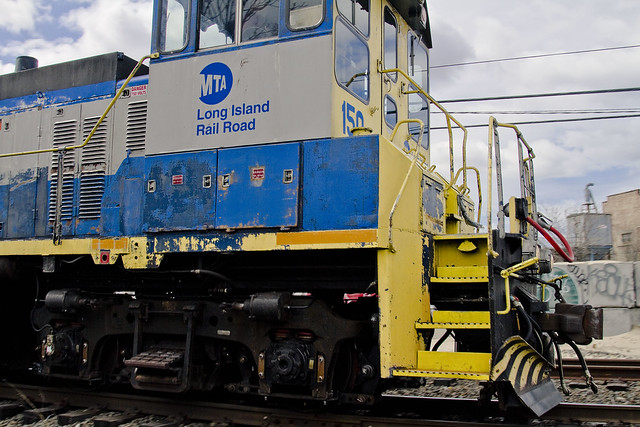
This double engine was hurtling along, which was somewhat remarkable. When I do see trains along this route, 9 times out of 10 they are NY & Atlantic freight trains which lumber along at a fairly tepid pace compared to this blue and gold comet which roared past me. Sadly, a diminished capacity for joy and low threshold for excitation allow one to consider the witnessing of this passing locomotive to be the high point of the day. Juvenile in character despite advanced years, it does not take much to impress one such as myself.
from wikipedia
Federal regulators limit the speed of trains with respect to the signaling method used. Passenger trains are limited to 59 mph and freight trains to 49 mph on track without block signal systems. (See dark territory.) Trains without “an automatic cab signal, automatic train stop or automatic train control system” may not exceed 79 mph. The order was issued in 1947 (effective 31 Dec 1951) by the Interstate Commerce Commission following a severe 1946 crash in Naperville, Illinois involving two Chicago, Burlington & Quincy Railroad trains. Following the 1987 Chase, Maryland train collision, freight trains operating in enhanced-speed corridors have been required to have locomotive speed limiters to forcibly slow trains rather than simply alerting the operator with in-cab signals. The signal panel in the Maryland crash had been partially disabled, with a muted whistle and a missing light bulb.

– photo by Mitch Waxman
Undoubtedly, as these tracks lead toward the Long Island City yard- which offers connections to both Manhattan and the gargantuan Sunnyside Yard- it is impossible to speculate on their final destination, but these engines were headed to somewhere in Long Island City.
for more on the twisting trackways of the Montauk Cutoff, check out this trainsarefun.com page

– photo by Mitch Waxman
On the Queens side of the Newtown Creek, a loathsome flood plain typified by concreted devastation and the relicts of the industrial revolution, the Long Island Railroad has long been the proverbial “800 pound gorilla” and as such- goes wherever it wants to go.
For visual orientation to more familiar locales, notice that dagger in the heart of Queens- the Sapphire Megalith- embedded in the innocent soil of Court Square in LIC, or the distant Freedom Tower under construction in lower Manhattan.
from wikipedia
“800 pound gorilla” is an American English expression for a person or organization so powerful that it can act without regard to the rights of others or the law. The phrase is rooted in a riddle:
“Where does an 800 lb. gorilla sleep?”
The answer:
“Anywhere it wants to.”
Also,

Obscura Day 2012, Thirteen Steps around Dutch Kills
April 28th, 10 a.m.
Your humble narrator will be narrating humbly at this year’s Obscura Day event on April 28th, leading a walking tour of Dutch Kills. The tour is already half booked up, and as I’m just announcing it, grab your tickets while you can.
“Found less than one mile from the East River, Dutch Kills is home to four movable (and one fixed span) bridges, including one of only two retractible bridges remaining in New York City. Dutch Kills is considered to be the central artery of industrial Long Island City and is ringed with enormous factory buildings, titan rail yards — it’s where the industrial revolution actually happened. Bring your camera, as the tour will be revealing an incredible landscape along this section of the troubled Newtown Creek Watershed.”
For tickets and full details, click here :
obscuraday.com/events/thirteen-steps-dutch-kills-newtown-creek-exploration
rarest flowers
A number of “Things to do” have materialized of late, so it is time for your Newtown Pentacle calendar of April events and/or fun things to do.

– photo by Mitch Waxman
There are a whole lot of things in the planning phases which I can’t tell you about yet, but suffice to say that this should be an amazing summer. Diversions on land and water will soon be announced, including boat tours of Newtown Creek and the greater harbor beyond.

– photo by Mitch Waxman
First up, today there will be a protest in Manhattan concerning recent City plans- via newtowncreekalliance.org
Rally to oppose Thermal “Waste-to-Energy” Facilities
April 9th, 2012
On Monday, April 9th at 10am, environmental justice groups, environmental organizations, community leaders and elected officials from Brooklyn, the Bronx and Manhattan will rally to oppose the Bloomberg administration’s plan for thermal “Waste-to-Energy” facilities (a.k.a. incinerators). Two of the proposed sites for this facility are on the shores of Newtown Creek, and our communities host 40% of the city’s waste transfer facilities, so we are adding our voice to the cause. Click here for our previous post on the issue, and download two fact sheets on Waste-to-Energy here and here.

– photo by Mitch Waxman
Secondly, from workingharbor.com
All About Tugs—Inside the Tugboat Industry
Tuesday, April 17 at 6.p.m.
Special evening program will feature documentary films with commentary by tug captains and crew presenting an insider’s look at the tugboat industry—its colorful history, present-day work, and vital importance.
Community Church of New York, 40 East 35th Street, Manhattan
Tickets are $25 ($20 for seniors). They can be purchased at www.workingharbor.com and include a reception with food, beer, wine and other beverages.
New York, NY, April 2, 2012 — Everybody loves tugboats, those iconic little workhorses that push ships ten times their size through narrow waterways and tow barges laden with fuel oil through busy harbors. “It is like the “Little Engine That Could,” or the mouse that pulled the thorn out of the lion’s paw,” said filmmaker Tom Garber, whose documentary, Tugging Through Time: The History of New York Harbor Tugboats, will be featured, The Working Harbor Committee (WHC), a not-for-profit organization dedicated to educating the public about the history and present-day importance of the Port of New York and New Jersey, is sponsoring the presentation. Since 2002 WHC has taken more than 20,000 people on Hidden Harbor® boat tours to visit behind-the-scenes waterfront places that most people never get the chance to see. “Tugboats are always the biggest hit,” said Captain John Doswell, the organization’s executive director. WHC also runs the annual New York Harbor Tugboat Race. “People always ask what it is like to be on board. Our ‘All About Tugs’ program will answer that question.”

– photo by Mitch Waxman
Third, also from newtowncreekalliance.org
Earth Day BYO Picnic Lunch at the Newtown Creek Nature Walk
Sunday, April 22nd at 1 p.m.
Come join in for this casual celebration of the victory that is the Newtown Creek Nature Walk. Bring your own brown bag lunch and join the Newtown Creek champions who worked hard for years to win this unique waterfront park.
Sunday, April 22nd at the Newtown Creek Wastewater Treatment Plant Nature Walk between 1pm – 2pm.

– photo by Mitch Waxman
Fourth, another NCA event, which I for one am pretty stoked about:
April NCA meeting hosts Dr. Eric Sanderson
April 26, 2012 at 6pm
Ridgewood Democratic Club, 6070 Putnam Avenue, Ridgewood, NY 11385
In addition to important updates from our members – in particular the Bioremedition Workgroup has been very busy! – we will be hosting a special presentation on the “Historical Ecology of Newtown Creek”.
Dr. Eric Sanderson, senior conservation ecologist at the Wildlife Conservation Society and author of “Mannahatta: A Natural History of New York City” (Abrams, 2009), will describe recent studies of the historical ecology of Newtown Creek, describing the original wetlands, creek channels, topography and vegetation of the area. He will show a series of 18th and 19th century maps of the watershed of the creek and discuss the process of synthesizing them into an integrated ecological picture that can be used to inform and inspire natural restoration and cultural appreciation of the Newtown Creek watershed. This work is part of the Welikia Project (welikia.org), an investigation into the historical ecology of the five boroughs of New York City and surrounding waters.
Finally,
Obscura Day 2012, Thirteen Steps around Dutch Kills
April 28th, 10 a.m.
Your humble narrator will be narrating humbly at this year’s Obscura Day event on April 28th, leading a walking tour of Dutch Kills. The tour is already half booked up, and as I’m just announcing it, grab your tickets while you can.
“Found less than one mile from the East River, Dutch Kills is home to four movable (and one fixed span) bridges, including one of only two retractible bridges remaining in New York City. Dutch Kills is considered to be the central artery of industrial Long Island City and is ringed with enormous factory buildings, titan rail yards — it’s where the industrial revolution actually happened. Bring your camera, as the tour will be revealing an incredible landscape along this section of the troubled Newtown Creek Watershed.”
For tickets and full details, click here :
obscuraday.com/events/thirteen-steps-dutch-kills-newtown-creek-exploration
primitive ruins
– photo by Mitch Waxman
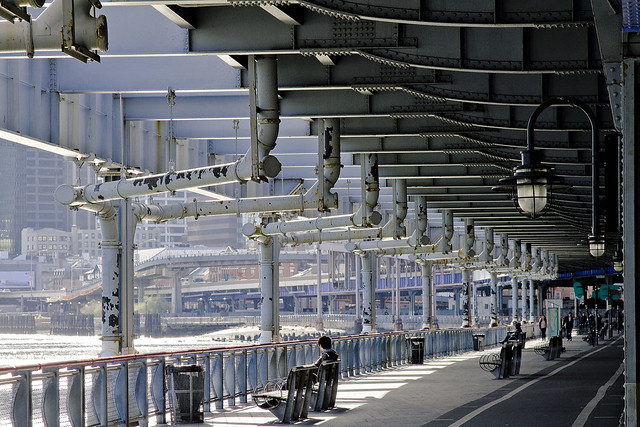
Recent business brought me to Manhattan, and an opportunity to walk along the East River while moving downtown presented itself. A spectacular promenade has recently emerged along the coast of the Shining City, much of which is unfortunately cement. Shiny and new, the sections above Corlears Hook made me a little nervous, as if one had wandered into an architect’s drawing populated by spandex wearing fitness models riding bicycles and running determinedly. Downtown, between East River Bridge Two and One (Manhattan and Brooklyn) this waterfront parkland was just grungy and old enough to feel lived in, by ordinary folk.

– photo by Mitch Waxman
It is difficult to complain about these open air trottoirs, which allow the citizenry a chance to gaze at the splendors of the harbor, especially given what these areas were like a mere 20-30 years ago. Trash strewn and off limits, New York had left its waterfront to rot away. The great shame of it all, and this is where the kvetching and Monday morning quarterbacking comes in, is that the infrastructure of docks and wharfs which literally made New York great is gone- never to return. Once something becomes a park, it is virtually impossible for it to return to other usage. No ship will be arriving here ever again.

– photo by Mitch Waxman
It’s the way of things, of course, and long ago was it decided that maritime interests were unimportant to Manhattan. So few are the docks on the island nowadays that it is scantly possible to find a berth. Word has it that the various waterfront vision plans include the usage of “temporary” or “floating” docks at some point in the future, but the days when a ship could unexpectedly arrive in the City- laden with some mysterious cargo from the south seas- seem to be over.


 The Newtown Pentacle