Archive for the ‘Maspeth’ Category
ratstravaganza or “I am not that demon swineherd”

– photo by Mitch Waxman
The voice was familiar, polished by Marlboro and inflected by origin and experience in Astoria, when it asked “Do you want to take pictures of rats… I mean a whole lot of rats?”. One of my buddies, employed by a mid size garbage haulage company based in Maspeth, described the scene to me in lurid detail- when his trucks returned to the garage from a weekly garbage run (they normally specialize in certain recyclable materials, but also handle organics) rats would pour out of them and claim free reign over the enormous structure for a few hours. A home grown colony of rats, as well, were known to come spilling out of the walls when the lights went down.
from wikipedia, and note- this isn’t the company “waste management”, just the subject
Waste management is the collection, transport, processing, recycling or disposal, and monitoring of waste materials. The term usually relates to materials produced by human activity, and is generally undertaken to reduce their effect on health, the environment or aesthetics. Waste management is also carried out to recover resources from it. Waste management can involve solid, liquid, gaseous or radioactive substances, with different methods and fields of expertise for each.
Waste management practices differ for developed and developing nations, for urban and rural areas, and for residential and industrial producers. Management for non-hazardous residential and institutional waste in metropolitan areas is usually the responsibility of local government authorities, while management for non-hazardous commercial and industrial waste is usually the responsibility of the generator.

– photo by Mitch Waxman
Dark and effluent, the garage is a multiple acre building with 40-50 foot ceilings and cinder block walls. Industrial equipment is installed directly into concrete flooring, and in places there are pits and deep channels that allow the automated equipment room to operate. An amiable Brooklynite agreed to accompany me around the place, and steer me from hazardous drops familiar to him after a life time of occupation at the facility. I had to rely on flash photography and high ISO settings, as the quick moving rodents shied away from any attempt at lighting.
from wikipedia
Rats are known to burrow extensively, both in the wild and in captivity, if given access to a suitable substrate. Rats generally begin a new burrow adjacent to an object or structure, as this provides a sturdy “roof” for the section of the burrow nearest to the ground’s surface. Burrows usually develop to eventually include multiple levels of tunnels, as well as a secondary entrance. Older male rats will generally not burrow, while young males and females will burrow vigorously.
Burrows provide rats with shelter and food storage as well as safe, thermoregulated nest sites. Rats use their burrows to escape from perceived threats in the surrounding environment—for example, rats will retreat to their burrows following a sudden, loud noise or while fleeing an intruder. Burrowing can therefore be described as a “pre-encounter defensive behavior”, as opposed to a “post-encounter defensive behavior”, such as flight, freezing, or avoidance of a threatening stimulus.

– photo by Mitch Waxman
Scurriers abound in this cairn of municipal waste management, which is built in the industrial heartland of the Newtown Creek. Concentric layers of factory and mill are pancaked beneath the structures that have survived into modernity. Beneath the ground, collapsed crawl spaces and forgotten pipelines rifle through the poison soil. Memory of these voids beneath Maspeth is long dead, and the architectural plans that detail their course have long since turned to dust… or have been recycled.
from wikipedia
Industrial archaeology, like other branches of archaeology, is the study of material culture from the past, but with a focus on industry. Strictly speaking, industrial archaeology includes sites from the earliest times (such as prehistoric copper mining in the British Peak District) to the most recent (such as coal mining sites in the UK closed in the 1980s). However, since large-scale industrialisation began only in the eighteenth century it is often understood to relate to that and later periods. Industrial archaeologists aim to record and understand the remains of industrialisation, including the technology, transport and buildings associated with manufacture or raw material production. Their work encompasses traditional archaeology, engineering, architecture, economics and the social history of manufacturing/extractive industry as well as the transport and utilities sector.
The term ‘industrial archaeology’ was coined in the 1950s in Birmingham, England by Michael Rix (academic) although its meaning and interpretation has changed. Its development as a separate subject was further stimulated by the campaign to save the Euston Arch. Palmer and Neaverson (Industrial Archaeology Principles and Practice, 1998) defined it as: “the systematic study of structures and artefacts as a means of enlarging our understanding of the industrial past.”
Initially practiced largely by amateurs, it was at first looked down upon by professional archaeologists. However, it has now been welcomed into mainstream archaeology. Since the timeframe of study is usually relatively recent, industrial archaeology is often (but not always) able to achieve a more reliable and absolute recording of past behaviour than is possible for the more remote past.

– photo by Mitch Waxman
Urban explorers have brought reports of this underworld to the surface, but they will only discuss the subject after a series of stiff drinks. Following the natural course of water, voids in the subsurface are found and accessed through sewer and electrical utility vaults. Compass readings and radio telephony are impossible beneath the streets, and hushed allusions to a pair from East Williamsburg who are rumored to have never returned from the sepulchral depths verge on urban legend. As one proceeds closer to the Newtown Creek, vast middens of rats are mentioned, living amidst and in some cases feeding on an oozing black jelly whose vile smell vaguely suggests vaseline mixed with ham.
from wikipedia
Petroleum jelly, petrolatum or soft paraffin[1], CAS number 8009-03-8, is a semi-solid mixture of hydrocarbons (with carbon numbers mainly higher than 25), originally promoted as a topical ointment for its healing properties. Its folkloric medicinal value as a “cure-all” has since been limited by better scientific understanding of appropriate and inappropriate uses (see Uses below). However, it is recognized by the U.S. Food and Drug Administration (FDA) as an approved over-the-counter (OTC) skin protectant and remains widely used in cosmetic skin care.
The raw material for petroleum jelly was discovered in 1859 in Titusville, Pennsylvania, United States, on some of the country’s first oil rigs. Workers disliked the paraffin-like material forming on rigs because it caused them to malfunction, but they used it on cuts and burns because it hastened healing.
Robert Chesebrough, a young chemist whose previous work of distilling fuel from the oil of sperm whales had been rendered obsolete by petroleum, went to Titusville to see what new materials had commercial potential. Chesebrough took the unrefined black “rod wax”, as the drillers called it, back to his laboratory to refine it and explore potential uses. Chesebrough discovered that by distilling the lighter, thinner oil products from the rod wax, he could create a light-colored gel. Chesebrough patented the process of making petroleum jelly by U.S. Patent No. 127,568 in 1872. The process involved vacuum distillation of the crude material followed by filtration of the still residue through bone char.
Chesebrough traveled around New York demonstrating the product to encourage sales by burning his skin with acid or an open flame, then spreading the ointment on his injuries and showing his past injuries healed, he claimed, by his miracle product.
He opened his first factory in 1870 in Brooklyn, United States. The brand name “Vaseline” has been anecdotally claimed to be from the German word for water, wasser (pronounced vahser), and the Greek word for oil, elaion, but this is unconfirmed.
The part of Brooklyn Chesebrough located his factory in, incidentally, was Red Hook and it was at Columbia and Delevan Streets.

– photo by Mitch Waxman
My guide in the garage informed me that these rats were nearly impossible to control via the use of baited traps and poisons. It was his supposition that the whole place was poisoned, afflicted with some sort of chemical overdose, and pointed out the stunted trees that dot the area. I mentioned “the colour” and he said that was as good a name for it as any. He went on to say that the only thing which has alleviated the rat population in the garage at all is a raccoon which has taken up residence in the place.
That’s a raccoon, -which just showed up- in Maspeth, a few blocks from Newtown Creek.
from wikipedia
The area known today as Maspeth was chartered by Dutch and English settlers in the mid-17th century. The Dutch had purchased land in the area known today as Queens in 1635, and within a few years began chartering towns. In 1642 they settled Maspat, under a charter granted to Rev. Francis Doughty. Maspat became the first European settlement in Queens. The settlement was leveled the following year in an attack by Native Indians, and the surviving settlers returned to Manhattan. It wasn’t until nine years later, in 1652, that settlers ventured back to the area, settling an area slightly inland from the previous Maspat location. This new area was called Middleburg, and eventually developed into what is now the town of Elmhurst, bordering Maspeth. Following the immigration waves of the 19th century, Maspeth was home to a shanty town of Boyash (Ludar) Gypsies between 1925 and 1939, though this was eventually bulldozed.

– photo by Mitch Waxman
As we headed back for the office section of the facility, where my buddy awaited, my guide pointed out the cinder block wall and the apertures chewed through it by the rats. The rats are in the walls… there are rats in the walls, the rats… in… the… walls…
Just then, my buddy walked out and asked if I enjoyed my “ratstravaganza”.
from HP Lovecraft’s “Rats in the walls” at wikisource
When Dr Trask, the anthropologist, stopped to classify the skulls, he found a degraded mixture which utterly baffled him. They were mostly lower than the Piltdown man in the scale of evolution, but in every case definitely human. Many were of higher grade, and a very few were the skulls of supremely and sensitively developed types. All the bones were gnawed, mostly by rats, but somewhat by others of the half-human drove. Mixed with them were many tiny bones of rats — fallen members of the lethal army which closed the ancient epic.
I wonder that any man among us lived and kept his sanity through that hideous day of discovery. Not Hoffman nor Huysmans could conceive a scene more wildly incredible, more frenetically repellent, or more Gothically grotesque than the twilit grotto through which we seven staggered; each stumbling on revelation after revelation, and trying to keep for the nonce from thinking of the events which must have taken place there three hundred, or a thousand, or two thousand or ten thousand years ago. It was the antechamber of hell, and poor Thornton fainted again when Trask told him that some of the skeleton things must have descended as quadrupeds through the last twenty or more generations.
Horror piled on horror as we began to interpret the architectural remains. The quadruped things — with their occasional recruits from the biped class — had been kept in stone pens, out of which they must have broken in their last delirium of hunger or rat-fear. There had been great herds of them, evidently fattened on the coarse vegetables whose remains could be found as a sort of poisonous ensilage at the bottom of the huge stone bins older than Rome. I knew now why my ancestors had had such excessive gardens — would to heaven I could forget! The purpose of the herds I did not have to ask.
roadside shrine

– photo by Mitch Waxman
The Brooklyn Queens Expressway rudely occludes the sky at Laurel Hill Blvd. and 58th street in Queens, drowning the ancient lane in supernal shades. The Boulevard transits through the hallowed ground of Calvary Cemetery, between the second and third sections. Often I’ve wondered if the street itself is on hallowed ground.
from encarta.msn.com
hal·lowed [ hállōd ]
adjective. Definition:
- sanctified: holy or kept for religious use- buried in hallowed ground
- respected: regarded with great respect or reverence- the hallowed pages of our country’s history

– photo by Mitch Waxman
A cool and breezy place, as the eye of god itself never shines upon this asphalt, it is a route I favor when returning from sojourns in Maspeth or East Williamsburgh to the remote and troubled hillocks that my beloved Astoria is arrayed upon.
from nycroads.com
SERVING INDUSTRIAL AND DEFENSE NEEDS: In 1940, New York City arterial coordinator Robert Moses recommended that the road, which he saw as a gap in the metropolitan arterial system, “should be filled immediately as an aid to the national defense.” He went on the make the following case for the expressway:
In 1940, Robert Moses recommended that the road, which he saw as a gap in the metropolitan arterial system, “should be filled immediately as an aid to the national defense.” He further went on as follows:
With the completion of through arteries under construction in Brooklyn and Queens, more traffic will be funneled into the Williamsburg and Manhattan bridges than the streets tapping these bridgeheads can carry. The present streets are narrow and congested, with crossings at every block. The crazy quilt pattern of the streets inherited from the villages that grew together to form the present borough adds to the difficulty of travel.
This proposed artery should be built for six lanes of express traffic, separated for most of its length from service roads by malls. It is estimated that construction will cost $5,100,000. This project would require the acquisition of land assessed at approximately $7,000,000, and utilize city-owned property assessed at $345,00

– photo by Mitch Waxman
Encountering a roadside shrine is always an interesting experience, and such tributes are normally found at or near the site of a vehicular accident that claimed lives. In this case, the evidence presented would seem to indicate that 3 men in their 20’s died here- named Tommy, Arturo, and Eric according to the graffiti- although police reports differ from the scrawls on the name of the third man and call him Pedro.
Apparently, the accident occurred nearly one year ago, and made the news at NY1 and at ABC.
from forumnewsgroup.blogspot.com
Three men died last Thursday night when their car slammed into a concrete barrier on Laurel Hill Boulevard after skidding across the road. Police say the driver lost control of his 1992 Volvo while trying to pass another car at a high rate of speed.
A bottle of vodka and small amount of cocaine were later found inside the obliterated car, according to Deputy Inspector Thomas Kavanagh, commanding officer of the 108th Precinct. There was a witness to the crash, which happened at about 10:30 p.m. near 58th Street, where the boulevard runs beneath the expressway and through the cemetery.
The driver, 26-year-old Pedro Sanchez of Brooklyn, and his two passengers, Thomas Owens and Eric Sanguenette, both 27 of Woodside, were pronounced dead at Elmhurst Hospital.

– photo by Mitch Waxman
Increasingly common in the last decade, such roadside shrines have been commented on before at this- your Newtown Pentacle. Another tragic accident that snuffed out young lives due to automotive excess was discussed in the post “A shrine in Greenpoint“.
from usatoday.com
Once an occasional sight along the nation’s highways, roadside memorials have sprouted in recent years like wildflowers after spring rains. There were 42,800 traffic fatalities in the USA last year. No statistics exist on memorials, though one national survey this year by the Maryland Department of Transportation estimates markers are erected after 10% to 20% of fatal crashes.
Family and friends increasingly want to mark the spot, and that can be a problem for everything from motorist safety to road maintenance to those who oppose religious symbols on public land.

– photo by Mitch Waxman
Newtown Pentacle, on behalf of our readers, offers our sympathies to the family and friends of the occupants of the car.
from wikipedia
Roadside memorials have been placed for centuries.
The origin of roadside crosses in the United States has its roots with the early Hispanic settlers of the Southwestern United States, and are common in areas with large Hispanic populations. Formerly, in funerary processions where a group would process from a church to a graveyard carrying a coffin, the bearers would take a rest, or “descanso” in Spanish, and wherever they set the coffin down, a cross would be placed there in memory of the event. The modern practice of roadside shrines commemorate the last place a person was alive before being killed in a car crash, even if they should die in the hospital after the crash.
In the southwestern United States, they are also common at historic parajes on old long distance trails, going back to the roots of the tradition, and also marked the graves of people who died while traveling. A descanso may be decorated specially for the holidays, and for significant anniversaries in the person’s life. A descanso for a child may be decorated with special toys, even toy vignettes of family life, and votive candles may be placed there on special nights.
opiate peace

– photo by Mitch Waxman
This is not a dead place, this Creek which forms the currently undefended border between much of Brooklyn and Queens, despite wholly inaccurate statements to the contrary recently presented by major publications. To begin with, there is the teeming human infestation, whose population is in the millions. Additionally- migratory birds, invertebrate and vertebrate water fauna, and an enormous hidden population of higher mammals lurk amongst the canalized shorelines of the Newtown Creek.
from the nytimes.com– an article that gets a lot of things completely wrong, which is surprising for the times, and seems to be shilling against “Big Oil”
People don’t often think of urban creeks as biodiverse waterways, but Newtown Creek was once a rich tidal estuary popular among hunters and fishermen. Starting in the 1870s, however, Standard Oil and other refineries began spilling or dumping excess fuels and toxic chemicals into the water or onto the soil, slowly poisoning the ecosystem.

– photo by Mitch Waxman
Famously and recently, a Dolphin’s appearance near the Pulaski Bridge excited the neighboring communities, but such extravagances of nature would have a difficult time at Newtown Creek. There are ocean going and brackish water fish that get swept into the Creek by the East River’s irresistible tidal cycles, which actually drown in the oxygen poor water, but I’ve observed other things swimming in its shallow depths. Weird squamous things that defy description, burrowers and soft bodied tunnelers which thrive in the putrid muds that line its soft bottom. Perhaps, when the federal EPA superfund work begins, studies of these uncommented organisms will commence.
Hey, not everything that lives is beautiful, but against all the odds- life is tenacious and nature will find a way to get by.
from epa.gov
Newtown Creek is a part of the New York – New Jersey Harbor Estuary that forms the northernmost border between the New York City boroughs of Brooklyn and Queens. In the mid 1800s, the area adjacent to the 3.8 mile Newtown Creek was one of the busiest hubs of industrial activity in New York City. More than 50 refineries were located along its banks, including oil refineries, petrochemical plants, fertilizer and glue factories, sawmills, and lumber and coal yards. The creek was crowded with commercial vessels, including large boats bringing in raw materials and fuel and taking out oil, chemicals and metals. In addition to the industrial pollution that resulted from all of this activity, the city began dumping raw sewage directly into the water in 1856. During World War II, the creek was one of the busiest ports in the nation. Currently, factories and facilities still operate along the creek. Various contaminated sites along the creek have contributed to the contamination at Newtown Creek. Today, as a result of its industrial history, including countless spills, Newtown Creek is one of the nation’s most polluted waterways.
Various sediment and surface water samples have been taken along the creek. Pesticides, metals, PCBs, and volatile organic compounds (VOCs), which are potentially harmful contaminants that can easily evaporate into the air, have been detected at the creek.
In the early 1990s, New York State declared that Newtown Creek was not meeting water quality standards under the Clean Water Act. Since then, a number of government sponsored cleanups of the creek have taken place. The New York City Department of Environmental Protection has sampled sediment and surface water at a number of locations along the creek since 1980. In 2009, EPA will further sample the sediment throughout the length of Newtown Creek and its tributaries. The samples will be analyzed for a wide range of industrial contaminants. EPA will use the data collected to define the nature of the environmental problems associated with Newtown Creek as a whole.
Project Firebox 1

Project Firebox, 2447 – photo by Mitch Waxman
Found in Maspeth, across the street from a string of late in the game Matthews Model Flats.
Whoops… I am told this is actually in Elmhurst, not Maspeth.
the king in yellow, brick

Matthews Model Flats, Astoria – photo by Mitch Waxman
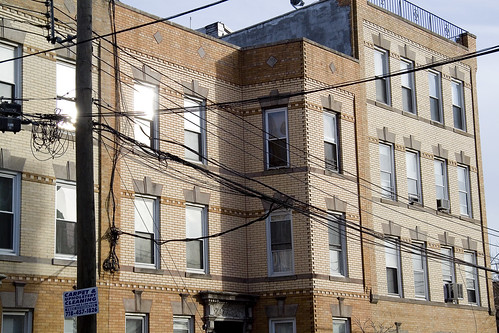
As mentioned in the past, Newtown Pentacle HQ is embedded within one of the few corner to corner blocks of Matthews Model Flats remaining in Astoria, Queens. This is also one of the postings where I’m thinking out loud, so if your humble narrator is in error, let me know.
Yellow bricks, which once distinguished much of western Queens, compose the street faces of these buildings. This particular stretch of Matthews flats in Astoria is just about a hundred years old (1911), as is a lot of the building stock in what I’ve been told was called “the German Section”- “back in the day”. Model tenements, as they were known, and while walking my little dog Zuzu one morning I began to ponder those bricks. Those yellow bricks.
Everywhere you go, from Ridgewood to Greenpoint, Maspeth and Astoria- you see those bricks.
from an EXCELLENT illustrated history of Brick manufacturing in the New World at brickcollecting.com
The first bricks in the English colonies in North America were probably made in Virginia as early as 1612. New England saw its first brick kiln erected at Salem, Massachusetts in 1629. The Dutch colonists in New Amsterdam imported yellow bricks from Holland, which imparted a Dutch character to the architecture of the city. The excellent quality and abundance of local clays in the colonies made it unnecessary to import bricks from across the Atlantic. Brick-making centers developed in Fort Orange (what is now Albany), New York; near Philadelphia, Pennsylvania; and Burlington and Trenton, New Jersey, as well as along the Raritan River.

Grand 30th avenue, Astoria – photo by Mitch Waxman
One of the real pleasures encountered when working on postings for this, your Newtown Pentacle, are the moments when I suddenly have to research something mundane because I realize that I actually know nothing about the subject. In this case, it’s bricks.
A couple of years ago, I pursued knowledge of industrial Honey production– How, exactly, do all those millions of gallons of honey get to the little bottles in your supermarket? What can the industrial process be, I asked. The answers are pedantic, complex, and suffice to say that China is the world’s Honey superpower and that Honey was arguably the first industrial commodity.
The story of these yellow Kriescher bricks however, has something for everyone.
also from brickcollecting.com
The Manhattan Fire Brick and Enameled Clay Retort Works (as described in New York Illustrated (New York: D.Appleton & Co., 1876) was located on East 15th Street near the East River. Henry Maurer learned the fireclay manufacturing business in his uncle’s firm, Maurer & Weber, and then established his own firm which relocated from New York and Staten Island to Maurer, New Jersey, in 1874
There were several firms in New York City that took advantage of the nearby deposits of fire clay and manufactured both clay retorts and fire bricks. In 1845 Balthazar Kreischer established a fire-brick works in Manhattan, later known as the New York Fire Brick and Clay Retort Works; Kreischer acquired a fire-clay deposit on Staten Island in 1852 and established a works there which eventually replaced the Manhattan factory (his son’s house, the Charles Kreischer House and the workers’ houses for the company, the Kreischerville Worker’s Houses are both designated New York City Landmarks). Joseph K. Brick established the Brooklyn Clay Retort and Fire Brick Works in 1854. The Maurer & Weber Company later known as the Manhattan Fire Brick and Enameled Clay Retort Works, opened in 1863.
In 1868 John Cooper established a business, later known as the Greenpoint Fire Brick and Sewer Pipe Works, at 413-421 Oakland Street, Brooklyn. While there were 350 fire brick manufacturers in the United States in 1895, the New York-New Jersey area remained one of the major fire brick manufacturing centers.
Matthews Houses – photo by Mitch Waxman
19th century businessmen were either merchant princes or robber barons, depending on your point of view. Both are accurate, but suffice to say that communities of labor would cluster around the industrialist, corollary industry would arise to support growing populations around the main mill, and even competitors would often locate in their vicinity to take advantage of locale and the skilled worker population. This is why you find financial, garment, and flower districts in Manhattan and its also why Astoria is visually distinct from the neighborhoods around it.
William Steinway was here, and his interests were larger than just pianos. Steinway was a primal force in digging the first Subway Tunnel from Queens to Manhattan (completed by Michael Degnon, of course), and was a major player in the Queens Trolley business. Wealthy, philanthropic, and well regarded by all reports- Steinway’s Piano mill pulled a population to it. Out on Staten Island, Balthazar Kreischer worked a somewhat coarser but technologically sophisticated operation that made… Bricks.
from boards.ancestry.com
…trying to find the descendants of Balthasar KREISCHER (3.13.1813-8.15.1886) of the Kreischer & Sons Brick Company of Staten Island, and interred in The Green-Wood Cemetery of Brooklyn, New York.
Descendants/Family include his 4 daughters Catherine KREISCHER-WEBER, Fredricka P. KREISCHER, Louisa Albertina KREISCHER-STEINWAY and Caroline L. KREISCHER-ELLIS and his 3 sons: Charles C. KREISCHER, Edward B. KREISCHER and George F. KREISCHER. Some Kreischers settled into Brooklyn.
Louisa Albertina KREISCHER-STEINWAY (d. 6.30.1926) married Albert STEINWAY (b. 6.10.1849- d. 5.14.1877), the youngest son of of Steinway & Sons Piano Mfgr. of Astoria, New York, and had 2 daughters: Henrietta Julia STEINWAY and Ella Frederica STEINWAY. Louisa, Albert and Frederick P. Kreischer are interred in the Steinway mausoleum in Green-Wood Cemetery of Brooklyn, NY.

Maspeth Matthews Houses – photo by Mitch Waxman
Both great men were successful and accepted, rich beyond avarice, and had children. Steinway’s son Albert married Kreischer’s daughter Louisa, connecting the two families in business and standing. Both men also had holdings and interests in the burgeoning railroad business, Kreischer an investor in the Vanderbilt’s Staten Island Railroad and Steinway a rail mogul in Queens. Many of these yellow brick homes, so typical of ancient Queens, lie along the route that trolley tracks once followed.
My supposition is that Kreischer received a family discount for moving his product around on Steinway’s rails, and use of Kreischer Brick in a new project bought some good will from the Steinways- known for their generous nature and political connections in New York, Newtown, and the upstart Long Island City with its scandalous political class.
This is theory, of course, but sounds kind of like the way things worked in 19th century New York when the “old boys” club ruled. Again- theory.
from astorialic.org
“It was reported on the street on Friday that Gleason had sold his railway interests to the Steinway syndicate for $275,000. It has been reported for a long time that the Gleason roads did not pay. The road up Borden Avenue to Calvary Cemetery [in Woodside] was not well patronized. There are not many people who go to Blissville [Sunnyside] unless it is to visit the dead. The Blissville people as a rule do not travel much and when they do they patronize the Greenpoint line in preference to Gleason’s, thus his exchequer has suffered, and again the cars to the cemetery are cold this winter, and the conductors lugubrious on account of the scarcity of pennies and passengers, and a traveler after a survey of one of the cars, is tempted to foot it in preference to riding in an open car, as they had to do on Christmas Day.”

St. Joseph’s RC Church, Grand 30th avenue, Astoria – photo by Mitch Waxman
Louisa’s brother Edward, it seems, met a tragic end.
Check out this page at thecabinet.com, which tells a detailed story of that Kreischer Mansion where Edward lost his life, which describes ghostly phenomena and the violent history experienced by those who have inhabited it since.
Also, don’t miss forgotten-ny’s page on the Steinways and Kreischer’s


 The Newtown Pentacle