Archive for the ‘Maspeth’ Category
The Newtown Creek Community Health Harm Narratives Project

– photo by Mitch Waxman
Andrea Muraskin of the CHHNP asked if I could post this and help get the word out about this project, all text by CHHNP-
Attention Residents of Greenpoint, East Williamsburg, and Maspeth:
Are you worried about health problems caused by the pollution in your neighborhood?
Would you like the opportunity to tell your story?

– photo by Mitch Waxman
If yes, then you may want to be interviewed for a community health project that aims to document the public health concerns of individuals residing in communities along Newtown Creek in NYC. If you live, or have ever lived in Greenpoint or East Williamsburg, Brooklyn or Maspeth, Queens, you are invited to participate in the Newtown Creek Community Health and Harm Narrative Project, as study which hopes to capture residents’ experience with illness and environmental pollution in their neighborhoods.
Participation will provide you with an opportunity to have your story documented in your own words. With your permission, the information you disclose will be displayed in written and audio format on the website http://www.habitatmap.org and in a written report that will be disseminated to community members, media outlets, elected officials, and other interested parties.

Community involvement is important. Make your voice heard!
If you have any questions or are interested in participating, please contact Yvonne Kodl at:newtowncreekstudy@gmail.com or
(718) 566-1359.
Please note: The study is in the concluding portion of its interview phase. If you are interested, please contact us as soon as possible.
The Newtown Creek Community Health and Harm Narrative Project is a collaboration between the Urban Public Health Department of Hunter College, HabitatMap, and the Newtown Creek Alliance.
Media Links
Television: Brooklyn Community Access Television ,
Radio: Leonard Lopate on WNYC
Newspaper: NY Daily News http://www.nydailynews.com/ny_local/brooklyn/2009/06/22/2009-06-22_newtown.html
Blog:http://www.nylcv.org/ecopoliticsdaily/20091112_newtown_creeks_neighbors_speak_out_on_health_concerns

– photo by Mitch Waxman
Tales of Calvary 8- the Abbot

– photo by Mitch Waxman
While wandering through Calvary Cemetery recently, I came upon a curious monument whose sculptural elements included a life sized portrait, and whose dedication was meant to honor a man named Florence Scannell. The stone additionally bore a curious screed- “The Abbot”. “Dedicated to the memory of Florence Scannell by his brother John J.” is displayed prominently on its face. This stirred a sleeping memory, and I tried to remember why the name Scannell is so important. I said it out loud- John J. Scannell?
Wait a minute… John J. Scannell was the first chief of the NYFD, grand sachem of Tammany Hall, and a notorious turn of the century raconteur who became “king of the hill” in the often violent political world of 19th century New York City politics.
Bare knuckled, the electoral system back then resembled modern gang wars. Bearded men were paid to vote, taken to a barber shop for a shave and a shot of whiskey, and then paid to vote again. Paid armies of volunteers rousted saloons and bars that supported their political enemies. With political bosses paying the tab, taverns became organizing points for local “get out the vote” efforts. The poor didn’t care, for a day they could drink enough to forget and even eat a real meal- with meat, and all they had to do was vote the way they were told. The bosses were the bosses, and your place in “the line” could be revoked at any time if you fell out of favor with them. There was no “safety net”, so you had to just “go along”. Sometimes the other party would send gangs of street toughs into their opponents establishments- “bar busting”.
For more on the milieu of political life for the working class of the 19th century, I would suggest a gander at “The Jungle” Upton Sinclair’s “progressive” propaganda piece, or taking a peek at Jacob Riis’s “How the Other Half Lives“.
The Scannell brothers are described as having been engaged in such “bar busting” activities in 1869, when brother Florence ran for Alderman from the 18th ward against a Tammany candidate. At 23rd st. and second avenue, on Dec. 3rd, a Tammany man named Thomas Donaghue ran afoul of the Scannells, who were employed to “clean out” and “bust” the saloon he owned and operated.
from pbs.org
The year 1898 ushered in a new era of firefighting. On midnight of January 1, 1898, Greater New York was formed by uniting the five boroughs, Manhattan, Brooklyn, Queens, the Bronx, and Staten Island. The Board of Fire Commissioners was replaced by a single Commissioner, John J. Scannell, who had been head of the Board since 1894 and was appointed by Mayor R.A. Van Wyck. All of the area’s volunteer departments were to be replaced by the FDNY, and Chief Hugh Bonner assumed control of three paid departments: New York, Brooklyn, and Long Island; 121 engines, 46 trucks, one horse wagon, and a water tower; in all, 309 square miles of firefighting territory.

– photo by Mitch Waxman
The Scannells and a dozen of their men produced weapons and engaged in a fierce battle with Donaghue’s own crew of toughs. Gunfire erupted and Florence Scannel was shot in the back, the bullet embedding itself in his spinal column. Rushed to the nearby Bellevue Hospital, Florence suffered a lingering death, finally passing on July 10, 1870, with his brother John at his side. John J. Scannell swore an oath to avenge his brother, and kill the man who shot him in the back– the Tammany man, Thomas Donaghue.
Donaghue’s handlers fixed things up with the courts, and he returned to his familiar Saloon on 23rd st. and second avenue.
On Sept. 19th, at the corner of 17th and third, an odd looking man wearing a slouched hat and fake beard stepped out of the shadows and blasted a hole in Donaghue’s chest with a derringer pistol. Donaghue ultimately survived this attempt on his life, and Scannell discarded his disguise as he escaped his pursuers fleeing through Irving Place and Union Square. John J. later surrendered to a Police Sgt. after taking refuge on Long Island, and was indicted by a Grand Jury for the crime, but was never charged and released on $10,000 bail.
That’s $10,000 in 1870…
In November of 1872, Donaghue was attending an auction at the Apollo Theatre on 28th street, and a man wearing a cloak and slouch hat approached him. A large caliber pistol was produced and the middle of Donaghue’s face disappeared. Four more shots, three in the face, were pumped into the now prostrate Donaghue. The killer fled and was apprehended by a Police Captain named McElwain, who immediately identified the assassin as John J. Scannell. Such quick identification of Scannell was possible only because the arresting officer had been the one who arrested him for the the earlier attempt on Donaghue, when he was a Sgt.
The event was seminal, for as John J. Scannell sat in a gaol called “The Tombs”, another sat beside him. That night, John J. Scannell met Richard Croker. Someday, they would become “The Big Two” at Tammany Hall and rule over New York City.

– photo by Mitch Waxman
John J. Scannell was born on the lower East Side of Manhattan and found early work as a horse dealer- moving on to Saloon Keeper and then Professional Gambler. Charged with the murder of Donaghue, he pled insanity, and after a 3 month stint in an asylum in Utica, returned to local politics. He owned horses and raced them on the national circuit, as did Richard Croker. Rising in Tammany with his partner Croker, Scannell ran the 25th electoral district in Manhattan for many years, and desired the post of NYFD commissioner in that newly unified pile of gold called “the City of Greater New York”. Protests were recorded citywide, but Mayor Van Wyck appointed him chief of the newly unified citywide firefighting brigades. He served in that capacity until 1901, and fought corruption charges associated with his appointment until 1906 in court. At 67, in 1907, Scannell was sued for $15,000 for kissing the daughter of his housekeeper 3 times without consent.
Scannell died at 78 in Jamaica, Queens- far from his retirement estate in Freeport, L.I.
The Abbot, as it turns out, is a Horse.

– photo by Mitch Waxman
Scannell paid the scandalous amount of $26,500 at a Madison Square auction, the highest ever paid for a single Horse to that time, to purchase the Abbott.
That’s $26,500 in 1900…
The obituary for the Horse is actually longer than the one for the owner. The fact that Scannell engraved a Horse’s name on the monument to his dead brother, and his own eventual grave marker, shows the esteem felt by Scannell himself for the animal. Oddly enough, and this is a rare thing for Calvary Cemetery, The NYTimes once did an article on the raising of this monument which happened in 1914.
Hey, you never know what you’re going to find at Calvary Cemetery.
Tales of Calvary 7

– photo by Mitch Waxman
I just can’t sit on this one anymore. After a spree of “all cemetery” postings in November and December, I decided to take a step back from the grave, but I just can’t stop myself…
Promises would be offered to you, lords and ladies of Newtown, not to spend too much time amongst the dead in these first days of the new year, but I’d probably break them.
Paper fades, buildings fall, but Calvary is eternal and undying. Dripping in its centuried silence and nitre choked glory, the emerald desolations of Calvary Cemetery offer a pastoral transit between tumultuous neighborhoods in the Newtown Pentacle, and that weird old man in the filthy black raincoat you might glimpse as you drive by is often your humble narrator.

– photo by Mitch Waxman
On this particular day, a sunny Saturday (Thanksgiving weekend in 2009), I wasn’t transiting Calvary.
I had come here with a definite purpose, searching for the grave of a man who died in the early 30’s rumored to have been involved with the illegal smuggling of strange statuettes into the United States in the 1920’s from some impossibly remote pacific island. This man, a Massachusetts merchant named Gilman, was killed in a freak nocturnal accident, apparently by a bale of paper which had fallen out of some warehouse window along the Newtown Creek. His oddly deformed body was found by workmen the next morning, and the Coroner pronounced the death accidental. The victim was buried in Calvary’s public section as an act of charity, and under the assumption that Gilman was an Irish name. His belongings and personal valuables, made from some queer kind of gold sculpted into wild and heretical forms, were collected by a schooner captain whose three masted ship appeared unbidden at the Penny Bridge docks one night during an unnaturally thick fog. The Captain, a Massachusetts trader named Marsh, paid for a custom and eccentric grave marker to be erected for this Gilman fellow somewhere in Calvary. It remains elusive, but I shall find it- I found Al Smith!
As is often the case, my befuddled and inept investigations were swept wildly off course by a highly suggestible and credulous nature which makes me vulnerable to wild flights of shivering cowardice and shameful paranoia. Such timidity does not suit one who stands and stares into whatever abyss happens to be before him, and what I saw chilled me with its wild possibilities. It was Thanksgiving weekend, and Calvary was as quiet as… well… a tomb.

– photo by Mitch Waxman
As seen in the above shots, the overgrown monument with its vine covered cupola intrigued and drew my attention. In accordance with usual methods, the object was photographed from many angles, and my path led me widdershins around it. As mentioned in the last paragraph, thanksgiving weekend had evinced a general evacuation of the area surrounding that bulkheaded duct of urban horror called the Newtown Creek, and like their counterparts in the spires of Manhattan it would seem that the workers of Calvary got off early on the previous Wednesday. Just dropped their shovels, as it were.
That’s when I saw it, said “oh. oh… no… just keep walking… don’t take any pictures of…”. Unfortunately, my finger was already depressing the button on my camera. I had lost all control, and still can’t stop myself from posting about it weeks later… I’m all ‘effed up.
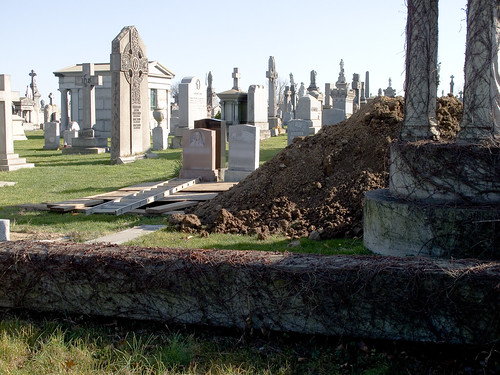
– photo by Mitch Waxman
In the interest of full disclosure, the names on the two grave markers are obscured as they were modern burials. If a grave is at least older than me, I feel fine about publishing a photo or talking about who it holds. If it’s an early 1900’s burial- fair game. (note: a cool thing happened recently- a sepulchral portrait, randomly chosen and published in the Mt. Zion series of postings, resulted in a certain Pentacle reader seeing his grandmother’s face for the first time) These interments, however, date from the early 1990’s and later. The context of this post demands some discretion, and censoring the names of the deceased whose graves are seen is definitely the right thing to do.
Now on to something you don’t normally see… and I am cognizant that the presentation of the following is vulgar and in very bad taste. I just can’t stop myself… Its like some alien thing is controlling me…

– photo by Mitch Waxman
There is a limited amount of time that one can tolerate solitary exposure to Calvary Cemetery, as the marble crown of Laurel Hill is a sort of psychic Chernobyl. It preys upon you- this place- in subtle ways, and comes at you in a manner not unlike the gradual stupefaction brought on by liquor. On New Year’s Eve, someone offered me three plots here for free, and withdrew the offer when I explained what a gravesite in Old Calvary is actually worth. Coincidence? hmmm… The place has noticed me, and it is trying to draw me further in…
Like ionizing radiation, whose damage to healthy living flesh is calculated by a multiplex of intensity and duration, whatever it is that lurks in the aether of Calvary is invisible, insidious, and real. Looking into an open grave like this, in this place, carries the comparable psychic risks of unshielded exposure to the thermonuclear eye of god itself.

– photo by Mitch Waxman
What I can’t do, is use my favorite catch phrase. The “who can guess…” one. Horrors too horrible for the graves holding lurk into the abyss, and loathsomeness waits below, but…
That’s what I was thinking as I passed out, again, in a dead faint. Luckily I fell backwards.
Calvary Cemetery Section
I’ve done so many posts on the place that I thought a catch-all page was in order- This will live in the menus to the right of the screen, and will be added to as more posts on the place are added.
Walking Widdershins to Calvary
-photo by Mitch Waxman
Click here to preview this photowalk in a google map
Hunters Point avenue intersects with the ancient course of Greenpoint Avenue at the degenerate extant of Long Island City. The Queens Midtown Expressway also comes back down to earth here, feeding Manhattan vehicular traffic to all points east. This is a very busy intersection, so be mindful of traffic, as fellow pedestrians are rare.
As with anyplace else in Queens you’d want to see, Forgotten-NY has been through here before. Click here for their page on Blissville and Laurel Hill.

– photo by Mitch Waxman
Addled as we are by the manipulations of the political class during the 20th century, with its “ism’s” and “movements“, Newtownicans have lost sight of the fact that the Newtown Creek was the center of the world for those who dwelt here in the 19th century. Before the American Civil War, the banks of the Newtown Creek were lined with homes built to the highest aesthetic standard, and peppered with grand hotels which catered to the sportsman and recreational fisherman. It was into this pastoral wildrness that the Calvary Cemetery was embedded in 1848, and which it sought to blend into with its fine arboreal stock and tasteful mastery of the art of landscaping.
It seems odd to us- sitting in our comfortable climate controlled and fully electrified homes and offices, to put a cemetery like this- with its ornate stonework and elaborate masonry, so close to the polluted industrial zones of the nearby Newtown Creek. Calvary spreads atavistically across a deserted and blasted landscape in our 21st century, surrounded by the trampled nest and discarded remnants of the industrial revolution.

Calvary Cemetery at 48th street – photo by Mitch Waxman
As one proceeds up the glacier carved hillocks that define northwestern Queens- climbing away from the terrors of Laurel Hill and leaving the malefic secrets of Maspeth and the Newtown Creek behind, the intrepid pedestrian will pass under and above an arcade of highways and find second Calvary.
Old Calvary is the original cemetery- second, third, and fourth Calvary are the metastasized and sprawling additions to the venerable original- and a significant portion of the Cemetery Belt.

-photo by Mitch Waxman
Just across the street from the site of the former LIRR Penny Bridge station. Easily accessed via the street, upon crossing the gates of Calvary, one will find a staircase carven into the hill by whose ascent the Newtown acropolis may be obtained. Cresting over the surrounding neighborhoods, and soaring over the Newtown Creek’s former wetlands, Calvary Cemetery keeps its secrets buried in centuried silence. Looking south toward Brooklyn, the Kosciuszko bridge approach of the Brooklyn Queens Expressway looms over its passage, carrying millions of vehicles over and across the necropolis of New York City.

Tales of Calvary 1 – The O’Briens
– photo by Mitch Waxman
Hallowmas, or All Saints Day, is coincident with the running of the NYC Marathon’s tumult laden course. The secular spectacular merely whets the appetite of your humble narrator for the open skies and sacred vantages found along those unhallowed backwaters of an urban catastrophe called the Newtown Creek.Calvary Cemetery– dripping in centuried glory- sits incongruously in an industrial moonscape stained with aqueer and iridescent colour. It’s marble obelisks and acid rain etched markers landmark it as a necropolis of some forgotten civilization.
Today, I determined to ignore the psychic effects of the graveyard, which are both palpable and remarkable. Resolving to climb to the highest point on this Hill of Laurels, my aim was to discover whose grave would occupy such a socially prominent spot. Secretly, I hoped to discover some celebrity or famous mobster’s resting place. Instead I found the O’Brien’s.

Tales of Calvary 2 – Veterans Day
-photo by Mitch Waxman
21 Roman Catholic Union soldiers are interred amongst the 365 acres of first Calvary Cemetery in Queens, nearby the cuprous waters of the much maligned Newtown Creek.
The wars of the 20th century, terrible in scope and vulgar in effect, cause us to overlook these men whovouchsafed the American Republic in the 19th century as we focus in on the veterans of the second thirty years war which modernity myopically calls World Wars One and Two. Woodrow Wilson proclaimed a federal holiday called Armistice Day in 1919, celebrating the anniversary of the legal end of the first World War in 1918. Congress agreed, seven years later, and then took six years to pass an act which made Armistice day an official United States federal holiday celebrated on November 11 annually.
Ed Rees, a populist Representative from the state of Kansas during the post World War 2 era, spearheaded a successful campaign in 1953 to have “Armistice Day” reclassified as “All Veterans Day” so as to include the veterans of WW2, and the ongoing conflicts fought by our “permanent government” on the world stage.

Tales of Calvary 3 – Rumors and stories
-photo by Mitch Waxman
Swirling, my thoughts.
A vast and byzantine pattern which extends beyond even the coming of the Europeans into the mist of olden days, traced by rail and road, reveals itself step by step as the burning eye of god itself leads me to and fro across the glass strewn Newtown Pentacle.
Bits of information, nuggets of pregnant fact, theosophical themes and mystic iconography obfuscating itstruths and meaning, a maelstrom of barking black dogs crowds my mind. Cowardly and infirm, I run to the grave.
Solace is found amongst the tomb legions, and the nepenthe of their silence.

Tales of Calvary 4 – Triskadekaphobic Paranoia
– photo by Mitch Waxman
Near the crest of one of Calvary Cemetery’s hills, can be found what I’ve described in previous posts as “a tree that is fed by some morbid nutrition”.
A convenient afternoon vantage point for photographing the Johnston mausoleum and a frequent destination, a Hallowmas (nov. 1) stroll through Calvary revealed some interesting goings on beneath the swollen boughs of this loathsome landmark.

Tales of Calvary 5 – Shade and Stillness
– photo by Mitch Waxman
In the past, the desolating loneliness and isolation which define my internal dialogue have been described to you simply – I’m all ‘effed up.
Shunned by those considered normal, my human– all too human- nature forces visceral desires for companionship. Lacking fellowship amongst the the living, one instinctively reaches out for those things which are no longer- or have never been- alive. That odd man in the filthy black raincoat that you might glimpse as you drive past the graveyard, scuttling along taking pictures of sewers and odd boxes in the Cemetery Belt- might very well be your humble narrator.
I was at Calvary Cemetery, intent on investigating the puzzling knots I had observed, beneath a hilltop tree- fed by some morbid nutrition, when I came across the Sweeney monument.

Tales of Calvary 6 – The Empire State Building and the Newsboy Governor.
– photo by Mitch Waxman
Looming, in this place, is the megapolis. Here lies Tammany, gazing eternally upon their work. The city. The great city.
The greatest and last of their projects is promontory above the shield wall of Manhattan, a familiar vista of Calvary Cemetery offered as an iconic representation by most.
The tower called the Empire State building was built, almost as an act of pure will, by a former newsboy from South Street.

Mt Zion 6- Crystal Oblivion

– photo by Mitch Waxman
Awakening from the dead faint which had ended my ruminations on those oppressions suffered by both Jew and Roma in a war torn exemplar of peasant ignorance and malign oligarchy which is the European Peninsula, your humble narrator noticed the gloaming of late afternoon settling upon the centenarian graveyard and realized that one way or another- an escape must be hazarded from the oblivion of Mount Zion cemetery if I ever desired to return to the yellow brick lanes of Astoria.

– photo by Mitch Waxman
The curious singsong chant of those odd children had stopped, and echoing along the tombstones was the sound of wholesome and cheerful laughing. From my vantage, I could discern that the first group of children were fleeing from a second, whose colorful clothing and raven hair marked them as the picturesque crowd I had spotted earlier on 53rd avenue. The flabby jowled, unblinking, scaly group of youths which had been tormenting me- and whose apparent leader was a girl carrying a curiously polydactyl cat whose aspect “I did not like”- were running off in the direction of that stygian cataract called the Newtown Creek.

– photo by Mitch Waxman
Regaining my composure, I realized that I had found the highest spot in Zion, and watched as the group of dark haired and festively adorned children jeered the fleeing “others”. I turned for a moment, looking south toward Brooklyn, along the gates of a Sanitation Dept. Garbage truck depot. This is a lonely spot, tragic and shunned.

– photo by Mitch Waxman
Populated by graves of children, often stillborn, this is the highest point of elevation in Mt. Zion by my estimation. I resolved to make my way for the gates, and felt an eerie tiredness take over me. Cemeteries are uncomfortable places not because of the omnipresent reminders of mortality, but because they remind us that anonymity is the ultimate fate of nearly all of us.

– photo by Mitch Waxman
All they were, and had done, and built- the ultimate meaning of themselves- led to centuried silence and the anonymity of the tomb. I’ve been asking myself, lately, why I’ve been so compelled to spend my time with them, instead of amongst the living. A lot of wise old jewish grandmothers are buried here, and my own would say that this recent pursuit is “no good for you, go see a movie instead”.
She also told me, when I told her I intended to follow a career in visual arts, that “all I wanted was to be a bum in the village with a needle in my arm”.

– photo by Mitch Waxman
Mission Statements – 1 – Breaking character
One of my quasi mystical opinions is that by telling a story, transmitting the lore of civilization from one generation to another, you keep the subject of the story alive- in a sense. We know the story of Beowulf, and Christ, and Churchill. In my ham handed and alliterative patois of pop cultural imagery and historical allusion, this notion of “telling the hero’s story” (with the “hero” being the working class) is part of my motivation behind these explorations. In a sense, I fancy myself as C-3PO telling the story of Luke and Leia to the Ewoks.

– photo by Mitch Waxman
Mission Statements – 2 – Horns and Dilemmas
A vast and shining monument to future archaeology is what I see the Cemetery Belt of western Queens and North Brooklyn as, awaiting the end of living memory and improved imaging technology. Vast dilemmas of conscience often plague me as I make the “selects” from the hundreds of shots I’ll gather at just one of the many locations explored at the Newtown Pentacle. That’s an identifiable face, or corporate trademark, or the ridiculous laws which require the owner of a skyscraper to approve the publication of an image of their structure. The graveyard stuff is touchy, and I attempt to only show graves of those who died well out of “living memory”, which is a flexible topic for me.

– photo by Mitch Waxman
Mission Statements – 3 – Contradictions and Logic
Problematic, because it’s self defined, my “living memory” concept is roughly this- if the stone is older than the second world war- I consider it fair game and part of the public record. Saying that, if you’ve seen a gravestone of a relative in one of my shots that you’d really rather not have public, contact me and it’s pulled (I’m not a dick)- just know that the shot was chosen for either its odd qualities or historical significance (like the O’Brien monument in Old Calvary), or because it’s a beautiful piece of sculpture that was chosen to illustrate the esthetic or political milieu of an era I’m trying to describe. Any editorial implications of the accompanying quoted references (from abc.com, in italics) or “humble narrator” copy should be discarded as the product of a sick, cowardly, and weary man who is “all ‘effed up”. No one will visit my grave, Lords and Ladies of Newtown, except to gloat and defecate.
I also never trespass, enter onto Railroad properties uninvited, or use transportation of any kind other than my feet when I’m out on one of my little missions. Kissing the right posterior and being “nice” offers tremendous access to these places, “legally”, and brings insight and opportunity. Why make trouble?

– photo by Mitch Waxman
Back to the post:
When I passed out of the ancient cemetery, through the western section’s gates, I saw that group of gaily dressed children who had chased off those menacingly mutant urchins that had caused me to faint three times as I hid in the shadows of this garden of obelisks.
One of the oddest moments of the day occurred when a waste hauler’s truck sped down Maurice Avenue at top speed, occluding my view of them for a few seconds, during which they disappeared. Puzzled, I scuttled back to the waiting arms of Astoria, and the entire way I thought I heard the creaking agony of wooden carriage wheels.


 The Newtown Pentacle