Archive for the ‘DUGABO’ Category
Project Firebox 38

– photo by Mitch Waxman
The ignominy of metallic pallor disguises this guardian of the public good as it hangs in vigil amongst the myriad ecstasies of Blissville in Queens. Deep below the cement and soil of this ancient village surge the ground waters of the Newtown Creek, and in nearby Greenpoint titan industries form the energy and wastewater backbone of New York City. Never quiet, Greenpoint Avenue is its home and the hoary byway is ennobled by its long and thankless service.
aerial ocean

– photo by Mitch Waxman
Just a short one today, some of the interesting odds and ends observed during my travels over the last few weeks. The shot above is from 58th rd. in Maspeth, once known as the Maspeth Plank road and paved with crushed oyster shells. It led to Furman’s Island, a notorious spit of muddy land that was legendary in its time for the offensive industries located there.

– photo by Mitch Waxman
This curious collection of women’s shoes, singles not pairs, was spotted on Provost in Greenpoint, Brooklyn. The mind boggles at where the mated shoes might have been dumped, but these are found on the street named for one of the “OG’s” – the Original Greenpointers. They were named Provoost rather than Provost, of course, but Dutch words seldom translate unscathed into english.

– photo by Mitch Waxman
Also in Greenpoint, this time nearby Manhattan Avenue. Manhattan is a double wide street because there was a street car or Trolley line that ran down it, which broke off from the East River to Calvary line which plied Greenpoint Avenue. The Manhattan Avenue line went over the Vernon Avenue Bridge and connected with Long Island City. The street art or graffiti depicted in this shot is signed “Mara” and a humble narrator is glad that some of the conclusions I’ve drawn about Newtown Creek are seemingly being noticed by others.
warm and fragrant

– photo by Mitch Waxman
An appointment in Greenpoint carried me across the Greenpoint Avenue Bridge last Tuesday, and as my habit is to be early to meetings, some time was available for photography. It was an unusual and foggy day, and the mists were creating an enormous depth of field atmospherically. Always a visual pleasure, the GPA bridge offers views of the former Tidewater pumping station on the Queens bank as well as the tank farms of Lukoil and Metro fuel on the Brooklyn bank- which are pictured above.
That’s when I noticed something disturbing.

– photo by Mitch Waxman
We are lucky that we live in the age we do, when an oil slick moving down the languorous Newtown Creek is a remarkable sight. Once upon a time, such visualizations were commonly extant and regularly observed. Luckily, due to regulation and improved industrial practices, such events happen far less frequently than they once did.

– photo by Mitch Waxman
The standard protocol to follow when you observe an oil slick on the Newtown Creek, or anywhere in New York Harbor, is to first document it by taking a picture using your cell phone or digital camera. Make a note of your location and the time. Next, call 311 to alert city authorities, followed by a call to the State DEC spill hotline- 1 (800) 457-7362.
They take these matters quite seriously.

– photo by Mitch Waxman
Take note of whether the tide is coming in or going out, as this will help authorities to pinpoint the source of the contaminants. On this day, the tide was ebbing and the oil slick was flowing toward the East River along the tepid current. It should be mentioned that the obvious petroleum industry presence found alongside the Greenpoint Avenue Bridge is maintained by fairly responsible parties in modernity, and the shot above is not meant to indite or should be viewed as indicative of being responsible for the event depicted in this post.
The slick was coming from the other direction, flowing east to west and traveling beneath the bridge toward them.

– photo by Mitch Waxman
Later that afternoon, after having accomplished my intended goals in Greenpoint, and returning home via the Pulaski Bridge to Queens- a new feature on the lower Creek was noticed. A temporary or floating dock installed nearby the Vernon Avenue Street End, and one of two “work boats” was traveling eastward from it and moving under the Pulaski.
It moved too fast for me to ready the camera, but it bore the screed “spill response boat” upon it.

– photo by Mitch Waxman
Everybody’s friends at Riverkeeper, whom I informed of my observations upon returning home, made inquiries with DEC officials about the nature and extent of this possible spill event. DEC sent back word that the slick was no spill, rather it was likely a result of sediment sampling efforts being carried out by the Federal EPA as part of the ongoing discovery phase of the Superfund process. It seems that while dredging up small quantities of the so called “Black Mayonnaise” which lines the bed of the creek for study, some effluent might have been released into the waterway.
sitting alone

– photo by Mitch Waxman
All ‘effed up.
In one of those odd moments which often cause my steps to falter, whilst walking down hoary Kingsland Avenue in ancient Greenpoint, this discarded workman apparel seemed to be trying to tell me something.
Clearly, it was pointing at something.
from wikipedia
Ideas of reference and delusions of reference involve people having a belief or perception that irrelevant, unrelated or innocuous phenomena in the world refer to them directly or have special personal significance: ‘the notion that everything one perceives in the world relates to one’s own destiny’.
In psychiatry, delusions of reference form part of the diagnostic criteria for psychotic illnesses such as schizophrenia, delusional disorder, or bipolar disorder during the elevated stages of mania. To a lesser extent, it can be a hallmark of paranoid personality disorder. Such symptoms can also be caused by intoxication, especially with hallucinogens or stimulants like methamphetamine.

– photo by Mitch Waxman
For a moment, the ridiculous notion that its missing owner was in mid gesture and then suddenly dissolved away struck me. The fence seen behind the glove is laden with signs that promise electrocution to those who might attempt trespass of the property it surrounds, and I thought that perhaps its owner had ignored these warnings and had been consumed by torrents of voltage and the sole survivor of the man was this garment.
That’s when I thought “perhaps it’s trying to tell me to look behind me, and offering a warning”.
People suffering from persecutory delusions believe that they are being conspired against or persecuted in some way. Common manifestations include the belief that one is being followed, that one’s mail is being opened, that one’s room or office is bugged, that the telephone is tapped, or that police, government officials, neighbors, or fellow workers are harassing the subject.

– photo by Mitch Waxman
Luckily, nothing was amiss, and your humble narrator remained the lord of his near vicinity.
“I’m all ‘effed up” was all I said, out loud, and then continued walking back to Queens.
also from movementdisorders.org
The subject’s behavior is unusual, bizarre, or fantastic. For example, the subject may urinate in a sugar bowl, paint the two halves of his body different colors, or kill a litter of pigs by smashing their heads against a wall. The information for this item will sometimes come from the subject, sometimes from other sources, and sometimes from direct observation. Bizarre behavior due to the immediate effects of alcohol or drugs should be excluded. As always, social and cultural norms must be considered in making the ratings, and detailed examples should be elicited and noted.
lethal foliage

– photo by Mitch Waxman
Would that a humble narrator might tell you that these shots were captured whilst riding upon some Hedorah like cacodaemon, but it was actually during one of last fall’s Newtown Creek Tours and onboard an entirely mundane NY Water Taxi that the subject of this “Maritime Sunday” posting was photographed.
As you can see, something was advancing toward us on the Newtown Creek that day, something newly born.
from epa.gov
Newtown Creek, located in the City of New York, is a part of the New York – New Jersey Harbor Estuary and forms the northern border of the Borough of Brooklyn and the southern border of the borough of Queens. In the mid 1800s, the area adjacent to the 3.8 mile Newtown Creek was one of the busiest hubs of industrial activity in New York City. More than 50 refineries were located along its banks, including oil refineries, petrochemical plants, fertilizer and glue factories, sawmills, and lumber and coal yards. The creek was crowded with commercial vessels, including large boats bringing in raw materials and fuel and taking out oil, chemicals and metals.

– photo by Mitch Waxman
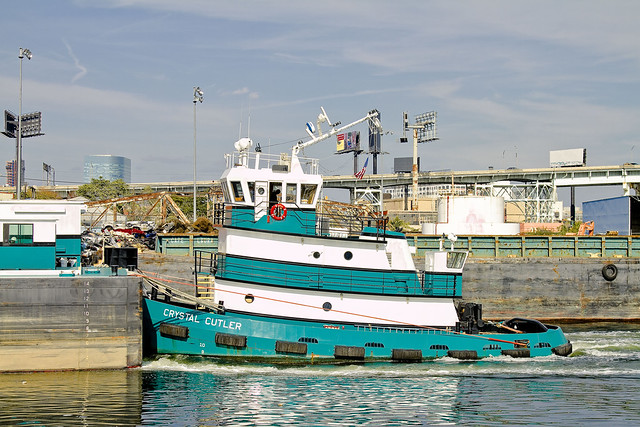
Built Nov. 04, 2010- this is the tugboat Crystal Cutler and her articulated barge (the Patricia E. Poling) plying the Newtown Creek. The article linked to below will tell you everything you could possibly ask about this tug and those who Captain and command her.
What mysteries they might have witnessed along the Creek, however, are not discussed in this profile.
The 70-foot, 1,500-hp twin-screw tug Crystal Cutler has been pushing and occasionally towing a 15,000-barrel clean oil barge since the tug was introduced in 2010. The tug places a high demand on her captains and crews as she ventures into shallow rivers and estuaries, moving about in a highly dynamic harbor with loads of gasoline, fuel additives or heating oil for small oil terminals.

– photo by Mitch Waxman
Amongst the larger harbor community, Newtown Creek is seldom referred to in glowing terms. There are those who dispute its role and historical significance to the maritime industry- as their eyes and hearts are drawn to the Brooklyn Navy Yard, the West Side of Manhattan, and the gargantuan modern ports in New Jersey.
Many would like to abandon it as an industrial corridor entirely, saying that its day as a working waterway is done, and give it over to kayaking and other recreational occupations.
Founded in 1995, Poling Cutler began operations near the time the former Poling Transportation went out of business.
The Founders of the new company were Ed Poling, whose grandfather started the former Poling company, and Gary Cutler who spent years working in the financial world before getting involved in Marine Transportation.
– photo by Mitch Waxman
One of the greatest sins along the Newtown Creek is precisely how few of its docks are utilized today. Most of the modern business along the Creek looks toward truck transportation to bring their goods to market and for the delivery of raw materials, ignoring their valuable docking rights and imprimature. Miles of bulkheads, expensively installed during prior generations, are allowed to rot away.
What a wasted opportunity.
Moving essential bulk materials by barge is more efficient economically and environmentally. From what we hear, a single barge has the same capacity as 28 – 56 long haul trucks, depending on the industry. Compared to other transportation modes, barge transport of bulk materials is safer in terms of worker injuries and generates far fewer emissions of particulate matter, hydrocarbons, carbon monoxide, CO2 and nitrous oxide on a per ton mile moved basis.
Despite the critical importance of barge transport as a best practice for industries on Newtown Creek, much of the bulkhead along this waterway is in disrepair. Overall bulkhead condition reveals a trend of disinvestment in maritime transit and a decline in related industries. According to Army Corps of Engineers, there were 19 businesses with working docks in 1999, compared to the nine that remain active today, as of January 2011.

– photo by Mitch Waxman
When you boil it down, the whole purpose of the Newtown Creek in its current form is to bring bulk goods into New York City by barge. Admittedly, the days of Standard Oil, Phelps Dodge, and the great Lumber interests are long gone- but… imagine some farmers in upstate New York loading their harvest goods onto a barge, and sending a floating green market directly to Long Island City or Greenpoint or even Maspeth. The barge could return to the farmer laden with cash and whatever else might be needed for the next harvest, completing a virtuous circle.
Imagine standing on the shoulders of giants, rather than rifling through their corpses like so many bugs.
from dot.ny.gov
Commercial and industrial development along Newtown Creek began circa 1854-60 and accelerated rapidly, spurred by low land values, water access for ships and boats, and relative remoteness from populated areas or regulations. The first kerosene refinery in the United States (1854) and modern oil refinery (1867) helped transform Newtown Creek into an industrial waterway. The first few industries also included a distillery near the Newtown side of the Penny Bridge, and the Peter Cooper glue factory relocated from elsewhere in Greenpoint to a site in Bushwick north of Maspeth Avenue10. The influx of industry and jobs, aggressive real estate development in and around Hunter’s Point, including LIRR’s presence on the creek in 1861, and the explosive growth of refined petroleum products all enhanced Newtown Creek’s attractions and helped transform the drainage into an industrial waterway circa 1860-1880. At the Industrial Revolution’s height, Newtown Creek’s industries were flourishing, bringing thousands of people to work at its plants and factories.

– photo by Mitch Waxman
The United States Coast Guard sometimes refers to Newtown Creek as part of “America’s Maritime Superhighway”, a vital industrial waterway which must be protected from the interests of those too short sighted to realize its potential to reinvigorate the economies of those communities through which it flows. It is the very definition of the future, and New York’s destiny is and has always been directly linked to it.
It’s heart warming to see clear eyed mariners like those onboard the Crystal Cutler plying its waters.
from nycppf.org
Significant Maritime and Industrial Area
Newtown Creek, at over 780 acres the city’s largest SMIA, abuts portions of the Greenpoint, Williamsburg, Long Island City, and Maspeth industrial areas. The waterfront area is characterized by heavy industry and municipal facilities, many of which are water- dependent. Newtown Creek is also the largest SMIA in terms of employment.
Although from 1992 to 2008 the SMIA lost roughly half its jobs, from 2000 to 2008 the number of jobs in the SMIA grew by nearly 1,400 to reach a total of approximately 15,000 jobs. Nearly half of the jobs in 2008 were in transportation and warehousing and wholesale trade. However, the business mix is becoming much more diverse. In the eight-year period examined, non-industrial jobs grew by more than 35 percent.


 The Newtown Pentacle