Archive for the ‘DUKBO’ Category
constantly consulting

– photo by Mitch Waxman
Gilman, Gilman, Gilman.
Idiotic, your humble narrator cannot break loose of the compulsion which drives me toward destruction, which will be the result of locating a certain grave amongst Calvary Cemetery’s emerald devastations. Weak of will and enslaved by fevered thoughts, once more do my feet fall upon a carpet of grass fed by a morbid nutrition, stumbling across and into the city of the dead. On the subject at hand, which is the attempt to locate a tiny needle in a gigantic hay stack- a needle not even certain to still exist in this age- let’s recap:
As mentioned in the post “Searching for Gilman“:
“Somewhere in the viridian depths of Calvary Cemetery lies an unremarked merchant from Massachusetts, who died in an accident along the delirious Newtown Creek in 1931. No obituary I can find discusses him, and Gilman slid unnoticed into the hallowed loam of Calvary’s charitable sections. His anonymity came to an end when, according to neighborhood sources and contemporary diarists, a relict 3 masted schooner arrived at the Penny Bridge docks and ordered an eccentric monument be erected on Gilman’s resting place. The captain of that black ship, a leathery bastard named Marsh, collected Gilman’s belongings and sailed via Newtown Creek to the East River, turning North toward Hell Gate- ultimately disappearing into the mists of Long Island Sound heading for New England.”
from epa.gov
The first survey of Newtown Creek was completed by Dutch explorers in 1613-1614, and the Dutch acquired the area from the local Mespatches tribe shortly thereafter. Initially, the Newtown Creek area was used primarily for agriculture, but following the Revolutionary War, it became industrialized with glue and tin factories, rope works, tanneries, and the Sampson Oil Cloth Factory operating along Newtown Creek and its tributaries. There was a shift to shipbuilding in the Pre-Civil War Period. Following the Civil War, textile manufacturing and oil refining replaced shipbuilding along Newtown Creek and its tributaries.

– photo by Mitch Waxman
It has been established, circumstantially, that the accident which claimed Gilman was definitively in Blissville, and happened westward of Penny Bridge but east of the Greenpoint Avenue crossing. Additionally, disturbing intonations that the packs of feral dogs which were contemporaneously described as endemic to the area avoided the cadaver, but that the local rodent population did not find itself constrained from feasting.
from the posting “A World Yet Inchoate“:
“Enigma, my search for the elusive final resting place of the Massachusetts based dealer in far eastern art has taken me to distant and forgotten sections of the City of Greater New York. I have consulted with asiatic mystics in Manhattan’s Chinatown, visited a heretical Kabbalist in Brooklyn, and have drawn the ire of certain extant allies of the dead man whose influence and reach extend into the federal government and modernity itself who wish me to remain silent on the subject.”
from 1892’s History of the Catholic Church in the United States, By John Gilmary Shea – courtesy google books
The burial place for the Catholic dead of the great city now required, apparently, a vast extent of ground. The little plot around St. Peter’s Church had been the first, but a nook in Trinity Church yard held, and still holds, some Catholic dead. Then the ground around St. Patrick’s Cathedral was used, and in time a cemetery was purchased on Eleventh Street. These had all proved insufficient. Bishop Hughes looked beyond the limits of the city for a spot not likely to be reached for many years by the rapid growth of population, yet comparatively easy of access. Thirty acres of the Alsop farm, on Newtown Creek, Long Island, were purchased, and the ground was solemnly blessed by Rt. Rev. Bishop Hughes, as Calvary Cemetery, July 27, 1848, and in a few days the first interment took place. The cemetery has been enlarged by subsequent purchases, till it now contains more than a hundred acres.

– photo by Mitch Waxman
Problematic in locating even a general area to search within, for the obsequious and gauche monument which the eponymous Capt. Marsh installed within the cemetery in remembrance of the fallen Gilman would have been in one of the so called “poor sections” of the polyandrion. Imagine, the sheer volume of dead bodies shipped out from Manhattan in that era, reported at the time as nearly one hundred on an average day (and far higher in times of fever, plague, and riot). These poor, or charity, sections saw hundreds of interments per week. Could it be possible that the monument to Gilman actually adorned his own grave, or that it might somehow still exist within the walls of Calvary?
from the posting “marble glories”
“Of course, this is a Roman Catholic cemetery, which suggests that the multitudes who lie here were sealed off- magickly- by the sacrament of “Extreme Unction” from suffering such macabre experiences as walking about the earth seeking living victims in some post mortem half life. The heritage of the Catholics extends back through time to the Dagon devotees of Syria and the tomb worshipping Etruscans, and the Romans spent enough time in Egypt and North Africa to have picked up and incorporated many of the Magicks they found into the syncretic system of beliefs and rites known as and inherited by modernity as Catholicism. The mysteries of the church are many, and varied, and more has been forgotten or lost over the centuries than any single lifetime can recover.”
from 1890’s HOW THE OTHER HALF LIVES, By JACOB A. RIIS –courtesy google books
Life in the tenements in July and August spells death to an army of little ones whom the doctor’s skill is powerless to save. When the white badge of mourning flutters from every second door, sleepless mothers walk the streets in the gray of the early dawn, trying to stir a cooling breeze to fan the brow of the sick baby. There is no sadder sight than this patient devotion striving against fearfully hopeless odds. Fifty “summer doctors,” especially trained to this work, are then sent into the tenements by the Board of Health, with free advice and medicine for the poor. Devoted women follow in their track with care and nursing for the sick. Fresh-air excursions run daily out of New York on land and water; but despite all efforts the grave-diggers in Calvary work over-time, and little coffins are stacked mountain – high on the deck of the Charity Commissioners’ boat when it makes its semi-weekly trips to the city cemetery.
dared consciously

– photo by Mitch Waxman
Loathsome, the only place one such as myself can truly feel at peace is amongst the emerald devastations of First Calvary Cemetery, in the company of the tomb legions. Lousy, my thoughts grow increasingly unordered and chaotic, as melancholy and regret rule my every step. Lost, revelation is sought, as I struggle not to say that forbidden name.
And over all, the thing which cannot possibly exist in the Sapphire Megalith watches bemusedly.

– photo by Mitch Waxman
Morose, peregrinations of primal fear rack my mind, remembering that “as above, so below” can have many meanings. Monstrous, the consequences of uttering those hateful syllables eat at my thoughts in the manner and urgency of an addiction. Montresor would understand the compulsion, and the nagging hunger to abandon all caution and restraint.
Perhaps I should join with some cult of Arabian Hasish eaters, or develop a taste for the distillates of the poppy, just in the name of finding some relief.

– photo by Mitch Waxman
Violent and horrible, the reprisals for resuming the quest would be Jovian in character, striking from the heights with demoniac fury. Vengeance, previously forsworn by those powers and potentates who conspire and corrupt as they sail the endless sea, will undoubtedly be horrible. Victory for them would come if their overt warnings and admonitions were ignored.
The spring has brought violets to the surface, here in Calvary, and their nepenthe like perfume has emboldened me to take a foolish chance.

– photo by Mitch Waxman
Let them come, for I care not anymore. Lovers of that unholy thing which cannot possibly persist in the cupola of the Sapphire Megalith, these unholy acolytes can stay my tongue no longer with their threats. What can they take which has not already been lost, stripped away, or erased? At long last, the question must be asked out loud, and damned be the consequences.
Also, from newtowncreekalliance.org

– photo by Mitch Waxman
Earth Day BYO Picnic Lunch at the Newtown Creek Nature Walk
Sunday, April 22nd at 1 p.m.
Come join in for this casual celebration of the victory that is the Newtown Creek Nature Walk. Bring your own brown bag lunch and join the Newtown Creek champions who worked hard for years to win this unique waterfront park.
Sunday, April 22nd at the Newtown Creek Wastewater Treatment Plant Nature Walk between 1pm – 2pm.
Finally,

Obscura Day 2012, Thirteen Steps around Dutch Kills
April 28th, 10 a.m.
Your humble narrator will be narrating humbly at this year’s Obscura Day event on April 28th, leading a walking tour of Dutch Kills. The tour is already two thirds booked up, so grab your tickets while you can.
“Found less than one mile from the East River, Dutch Kills is home to four movable (and one fixed span) bridges, including one of only two retractible bridges remaining in New York City. Dutch Kills is considered to be the central artery of industrial Long Island City and is ringed with enormous factory buildings, titan rail yards — it’s where the industrial revolution actually happened. Bring your camera, as the tour will be revealing an incredible landscape along this section of the troubled Newtown Creek Watershed.”
For tickets and full details, click here :
obscuraday.com/events/thirteen-steps-dutch-kills-newtown-creek-exploration
tones and accents

– photo by Mitch Waxman
Sauntering suspiciously through the hinterlands of Maspeth, along the malign fence lines of Rust Street, your humble narrator suddenly sensed a cacophony of ringing bells which occluded all reason. Assuming that one of my states was coming on, those hours of panic and terror brought on by a weakened constitution and the numerous afflictions which plague me, my first instinct was to monitor both pulse and temper.
Suddenly I realized that this ringing in my ears, now accompanied by a clattering and approaching ruckus, heralded the nearness of a train!
Note: Train folks, if you’ve got anything to say or link to regarding the actual model of locomotive, please use the comments link for this post. Every time a train photo is displayed here, I get at least a couple of emails telling me something cool about the locomotive. Please share, and leave a comment.
A
from wikipedia
Tinnitus can be perceived in one or both ears or in the head. It is usually described as a ringing noise, but in some patients, it takes the form of a high-pitched whining, electric buzzing, hissing, humming, tinging or whistling sound, or as ticking, clicking, roaring, “crickets” or “tree frogs” or “locusts (cicadas)”, tunes, songs, beeping, sizzling, sounds that slightly resemble human voices or even a pure steady tone like that heard during a hearing test. It has also been described as a “wooshing” sound, as of wind or waves. Tinnitus can be intermittent, or it can be continuous, in which case it can be the cause of great distress. In some individuals, the intensity can be changed by shoulder, head, tongue, jaw, or eye movements.

– photo by Mitch Waxman
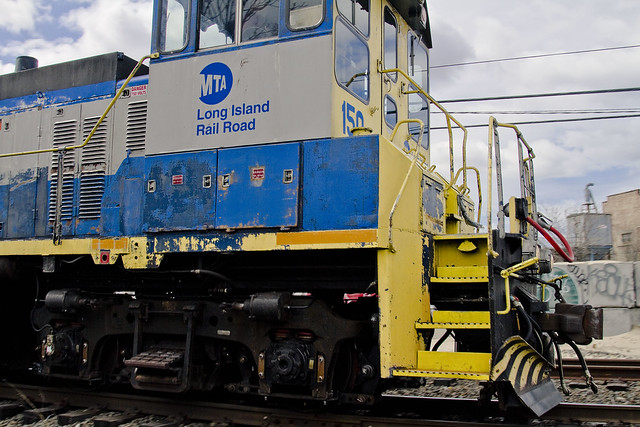
This was once one of the busiest stretches of rail in New York, let alone the United States. The Long Island Railroad (in its various guises, incarnations, and corporate forebears) have maintained their “road” here since the 1860’s. A shame, these tracks are a shadow of their former self and it’s not all that frequently that one sees traffic along the route. Hurling myself across the busy truck route, your humble narrator quickly sprang onto that fence which vouchsafe the track from trespass and interference, and whipped out the camera and began clicking away.
from wikipedia
The LIRR chartered the New York and Jamaica Railroad on September 3, 1859, and a supplement to the LIRR’s charter passed March 12, 1860 authorized it to buy the NY&J and extend to Hunters Point. The LIRR carried through with the NY&J purchase on April 25, along with the purchase of a short piece of the Brooklyn and Jamaica at Jamaica, and the next day it cancelled its lease of the Brooklyn and Jamaica, but continued to operate over it. The Brooklyn Central and Jamaica Railroad, a consolidation of the B&J with the new Brooklyn Central Railroad, began operating from South Ferry over the top of the tunnel, along the B&J tracks to Flatbush Avenue, and south on the new Fifth Avenue Line in August 1860. The new line to Hunters Point was officially opened on May 9, 1861, with regular service starting May 10. A ferry connection (Hunter’s Point Ferry) was initially advertised to James Slip; connecting boats began running to East 34th Street Pier in October. he BC&J soon began operating horse cars over the old line from South Ferry, connecting with LIRR trains at Jamaica. The tunnel was closed off in December.
– photo by Mitch Waxman
This double engine was hurtling along, which was somewhat remarkable. When I do see trains along this route, 9 times out of 10 they are NY & Atlantic freight trains which lumber along at a fairly tepid pace compared to this blue and gold comet which roared past me. Sadly, a diminished capacity for joy and low threshold for excitation allow one to consider the witnessing of this passing locomotive to be the high point of the day. Juvenile in character despite advanced years, it does not take much to impress one such as myself.
from wikipedia
Federal regulators limit the speed of trains with respect to the signaling method used. Passenger trains are limited to 59 mph and freight trains to 49 mph on track without block signal systems. (See dark territory.) Trains without “an automatic cab signal, automatic train stop or automatic train control system” may not exceed 79 mph. The order was issued in 1947 (effective 31 Dec 1951) by the Interstate Commerce Commission following a severe 1946 crash in Naperville, Illinois involving two Chicago, Burlington & Quincy Railroad trains. Following the 1987 Chase, Maryland train collision, freight trains operating in enhanced-speed corridors have been required to have locomotive speed limiters to forcibly slow trains rather than simply alerting the operator with in-cab signals. The signal panel in the Maryland crash had been partially disabled, with a muted whistle and a missing light bulb.

– photo by Mitch Waxman
Undoubtedly, as these tracks lead toward the Long Island City yard- which offers connections to both Manhattan and the gargantuan Sunnyside Yard- it is impossible to speculate on their final destination, but these engines were headed to somewhere in Long Island City.
for more on the twisting trackways of the Montauk Cutoff, check out this trainsarefun.com page

– photo by Mitch Waxman
On the Queens side of the Newtown Creek, a loathsome flood plain typified by concreted devastation and the relicts of the industrial revolution, the Long Island Railroad has long been the proverbial “800 pound gorilla” and as such- goes wherever it wants to go.
For visual orientation to more familiar locales, notice that dagger in the heart of Queens- the Sapphire Megalith- embedded in the innocent soil of Court Square in LIC, or the distant Freedom Tower under construction in lower Manhattan.
from wikipedia
“800 pound gorilla” is an American English expression for a person or organization so powerful that it can act without regard to the rights of others or the law. The phrase is rooted in a riddle:
“Where does an 800 lb. gorilla sleep?”
The answer:
“Anywhere it wants to.”
Also,
Obscura Day 2012, Thirteen Steps around Dutch Kills
April 28th, 10 a.m.
Your humble narrator will be narrating humbly at this year’s Obscura Day event on April 28th, leading a walking tour of Dutch Kills. The tour is already half booked up, and as I’m just announcing it, grab your tickets while you can.
“Found less than one mile from the East River, Dutch Kills is home to four movable (and one fixed span) bridges, including one of only two retractible bridges remaining in New York City. Dutch Kills is considered to be the central artery of industrial Long Island City and is ringed with enormous factory buildings, titan rail yards — it’s where the industrial revolution actually happened. Bring your camera, as the tour will be revealing an incredible landscape along this section of the troubled Newtown Creek Watershed.”
For tickets and full details, click here :
obscuraday.com/events/thirteen-steps-dutch-kills-newtown-creek-exploration
inner horrors

– photo by Mitch Waxman
I’ve been fascinated by this structure in West Maspeth, or Berlin if you’re of a certain mind, for some time. It’s 4411 54th avenue, and it looks as if things have taken an ominous turn for this old girl. According to the public record, this is a 2,030 ft. multi family dwelling which was erected in 1915. Real estate industrial complex sources price it at around a half million bucks, which is an incredible number given its neighborhood of heavy industry, highways, cemeteries, and a nearby superfund site. Additionally, the Kosciusko Bridge reconstruction will be happening just a block away, which promises ample nighttime noise due to construction.

– photo by Mitch Waxman
The hill of Laurels, literally covered in Laurel trees, was what Calavry cemetery was carved into in a period between (roughly) 1848 and 1860. The modern day Laurel Hill Blvd, and the present Kosciusko travel through the shallow valley which separated it from the next hill- Berlin Hill. This house on 54th avenue was built in a time when the area was still called that, before the first world war made such nomenclature less popular. I’ve heard the neighborhood referred to as either West Maspeth (or just plain Maspeth) by people who live here, so I guess that’s good enough for me.

– photo by Mitch Waxman
Personally, I always think of western Maspeth as the area around the Clinton Diner, with DeWitt Clinton’s mansion and St. Saviours and the town docks nearby at the head of Maspeth Creek which was at one of those tripartite corners you can find only in Queens- 56th and 56th and 56th. At any rate, this building has one of those fire department boxed hash marks painted on its wall, the one that says don’t risk a life trying to save this place. It’s a shame, really, imagine what this shunned house on the hill must have looked like “back in the day”.
aerial ocean

– photo by Mitch Waxman
Just a short one today, some of the interesting odds and ends observed during my travels over the last few weeks. The shot above is from 58th rd. in Maspeth, once known as the Maspeth Plank road and paved with crushed oyster shells. It led to Furman’s Island, a notorious spit of muddy land that was legendary in its time for the offensive industries located there.

– photo by Mitch Waxman
This curious collection of women’s shoes, singles not pairs, was spotted on Provost in Greenpoint, Brooklyn. The mind boggles at where the mated shoes might have been dumped, but these are found on the street named for one of the “OG’s” – the Original Greenpointers. They were named Provoost rather than Provost, of course, but Dutch words seldom translate unscathed into english.

– photo by Mitch Waxman
Also in Greenpoint, this time nearby Manhattan Avenue. Manhattan is a double wide street because there was a street car or Trolley line that ran down it, which broke off from the East River to Calvary line which plied Greenpoint Avenue. The Manhattan Avenue line went over the Vernon Avenue Bridge and connected with Long Island City. The street art or graffiti depicted in this shot is signed “Mara” and a humble narrator is glad that some of the conclusions I’ve drawn about Newtown Creek are seemingly being noticed by others.


 The Newtown Pentacle