Archive for the ‘newtown creek’ Category
Working Harbor Committee 6/15/09 tour part 2

Statue of Liberty at Dusk -Photo by Mitch Waxman
In the first part of this post: The hired Circleline company’s Zephyr Catamaran departed Pier 16 at the South Street Seaport, passed the Brooklyn Piers and moved south in the Buttermilk Channel between Brooklyn & Governors Island, passing Atlantic Basin. We went further south and nosed into Erie Basin, crossed Upper New York Harbor, passing numerous moored barges and tugs to the entrance to the Kill Van Kull, passing tanker terminals, tug yards, and a large ship repair facility with floating drydocks. We proceeded westerly and passed under the Bayonne Bridge, turning north to enter Newark Bay.
This amazing experience is being offered by the Working Harbor Committee. These esteemed maritime enthusiasts will be hosting 3 more of these narrated excursions over the course of this summer of 2009. (some of the copy above paraphrased from the Working Harbor Committee website)

Bayonne Bridge, New Jersey side -Photo by Mitch Waxman
Newark Bay is a tidal back bay formed by the confluence of the Passaic and Hackensack rivers, and part of New York Harbor. Its waters are a poisonous stew of arsenic, cadmium, mercury, copper, PCB’s, PAH’s, Pesticides, VOC’s, and Dioxin. Fishing is limited by law and common sense, and the harvesting or consumption of Crab or Lobster from these waters is prohibited by State and Federal authorities.
In 1958, a spectacular train crash happened at Newark Bay- when a passenger railroad ran a “stop” signal causing a derailment. The derailed train SLID OFF of the since demolished Newark Bay Lift Bridge and into the water. The first two cars of the train sunk immediately, killing 43. The third car hung over the edge before it too fell into the bay.

Port Newark-Elizabeth Marine Terminal -Photo by Mitch Waxman
Natural wetlands until as late as the 20th century, the City of Newark began to dredge the shipping channel in 1914 that would eventually be widened and deepened into the modern Port of Newark. 15th busiest cargo port on Earth, and largest on the eastern seaboard of the United States- the combined “Port Newark” and “Elizabeth Marine Terminal” operation is controlled by the Port Authority of New York and New Jersey.

Ships loading at Port Newark-Elizabeth Marine Terminal -Photo by Mitch Waxman
A container port, the cyclopean scale of the machinery found in this place was both notable and mind boggling. How the arts of man have progressed. This particular container ship is the Ever Reward, run by a global outfit based out of Taiwan called Evergreen Marine Corp. Evergreen got into some trouble, back in 2005, and got hit with $25 million in fines.
from the United States Department of Justice:
“Charges include making false statements, obstruction of Coast Guard inspections, failing to maintain an accurate Oil Record Book, and one negligent violation of the Clean Water Act relating to the discharge in the Columbia River. Following the guilty pleas, U.S. District Judge Terry J. Hatter, Jr. ordered the company to pay $25 million to be divided equally among the five judicial districts involved”
The Ever Reward seems to have had a troubled life, as just two years earlier- in 2003, the International Longshoreman’s Association shut down all Evergreen operations here at the Maher Terminal in the Port Newark-Elizabeth Marine Terminal. The strike also spread to other ports.
The Ever Reward is an astounding 294,13 meters long, which can move at 23.5 knots (that’s around 28 miles an hour) when fully loaded- was built in 1994 at Mitsubishi Kobe, in Japan- and is owned by Greencompass Marine S.A. (Evergreen), Panama, and is a Panamanian flagged ship.

Ship loading, Port Newark-Elizabeth Marine Terminal -Photo by Mitch Waxman
That’s the CSCL Jakarta, a relatively small and slow cargo ship built in 2001 at Stocznia Gdynia, Poland– in the Pomeranian Voivodeship. Notice the smaller scale of the Container Cranes on this side of the dock. It’s operated by China Shipping Container Lines Co.,Ltd, a company founded in 1997 in Shanghai, in the People’s Republic of China. Jakarta is one of the 152 vessels maintained as part of their active fleet.

Cranes at work, Port Newark-Elizabeth Marine Terminal -Photo by Mitch Waxman
As we continued along, the sense shattering size of the place struck again and again. The cargo containers- familiar gypsy’s that wander through city street and country lane- being stacked like so many children’s blocks by a gulliverian mantis.
The world’s largest manufacturer of these WHEELED and DRIVEABLE machines, which may move about on the pier to the obtain the most advantageous spots for loading and unloading, is in China. It is the Shanghai Zhenhua Port Machinery Company, which is a subsidiary of the China Communications Construction Company,which is the largest government owned corporation in the People’s Republic of China.
note, editorializing…
The P.R.C. is the world’s worst and most repressive government and there’s absolutely nothing that anyone who doesn’t live there can do about it. But…
(I’m warning you, there is brutal disturbing stuff you will see if you click the next 3 links, but this is who we are doing business with)
go to google images and type in “chinese executions”
-estimates (according to Amnesty International) are that 7,500 people a year go out this way.
That’s all I have to say, except that to me- those pics look a lot like this. Peace at any price, indeed.

Cargo ship Sunset, Port Newark-Elizabeth Marine Terminal -Photo by Mitch Waxman
Capacity of Container Ships is measured in TEU, or twenty-foot equivalent unit. The largest containers can weigh as much as 67,200 pounds- which is apparently reckoned as 2.65 TEU. An intermodal (rail/truck/ship) steel box that conforms to size and weight restraints, the shipping container is a byproduct of the Korean War (in which the People’s Republic of China participated). The United States Army developed a shipping system called CONEX to speed the delivery of supplies to the incalculably distant Port of Pusan.

Maher terminal dock, Port Newark-Elizabeth Marine Terminal – Van -Photo by Mitch Waxman
The motto on this van says: Safety is a standard… not an option. There were lots of guys buzzing around in these seemingly tiny trucks. Again, the incredible breath taking scale of the place emerges. How many millions of hours of labor are represented in these photos?

Port Newark-Elizabeth Marine Terminal Straddle Carrier -Photo by Mitch Waxman
The large container cranes, whose self actuating wheels can be seen in the shot below, are skyscraper sized machines. The “smaller” orange machine is a straddle carrier. This particular model seems to be the Kalmar ESC 350 front cabin twinlift, which would give it a lift capacity of 2.65 TEU. Capable of stacking shipping containers up to 4 units high, they can move up to 30 kph (which is just under 19 mph) while loaded with a full shipping container.

Port Newark-Elizabeth Marine Terminal Straddle Carrier -Photo by Mitch Waxman

Container Cranes, Port Newark-Elizabeth Marine Terminal -Photo by Mitch Waxman
The equinox not withstanding, it was getting late, and the Zephyr had to return to its berth at South Street Seaport. We bid our hosts adieu, and wished them all the luck that their titanic endeavors will undoubtedly bring. This enormous facility, of which we visited the tiniest fraction, is less than 20 miles from Times Square.

The tug Margaret Moran -Photo by Mitch Waxman
As the Zephyr moved back toward the Kill Van Kull, the frenetic movements of channel traffic continues. Seemingly having someplace to get to quickly, the Margaret Moran came zipping past. Operated by Moran Towing Corp., the Margaret Moran is a 149 ton, 3,300 horsepower twin screw tugboat built in 1979 at the McDermott Shipyard in Amelia, LA. It participated in the evacuation of the World Trade Center site. Here’s a neat shot of the MM assisting the Queen Mary 2 into port.

Bayonne Bridge, Staten Island side -Photo by Mitch Waxman
I didn’t make a big deal of the Bayonne Bridge on the way into Newark Bay because the sun wasn’t with me from that angle. The fourth largest steel arch bridge on Earth with a height of 150 feet over the water, it connects Bayonne, New Jersey’s Chemical Coastline with Staten Island. It’s primary mission is to allow vehicular traffic access to Manhattan via the Holland Tunnel.

Bayonne Bridge -Photo by Mitch Waxman
The Bayonne Bridge was designed by a man who helped design the Hell Gate rail bridge on the East river- and was principal designer for the Verrazano bridge over the Narrows, The George Washingston Bridge over the Hudson River, the Bronx Whitestone Bridge over the East River, the Throgs Neck Bridge over the East River. He was brought in to simplify the design of mighty Triborough– which is actually a bridge and highway complex spanning multiple waterways and islands. A swede, Othmar Amman worked for Gustavus Lindenthal (designer of the the Queensboro and Hell Gate Bridges), and took over as head bridge engineer at the New York Port Authority in 1925. He also directed the planning and construction of the the Lincoln Tunnel.
He was Robert Moses’s “guy”.

Kill Van Kull traffic jam -Photo by Mitch Waxman
Lucky for us, a traffic jam was forming up behind a couple of large ships- which by necessity had to move extra slow in the narrow channel. This was lucky, because the Zephyr was running late, and the failing light coupled with a swiftly moving catamaran would soon render photography a futile pursuit. Slowing down to a crawl as we commuted from New Jersey to Manhattan felt oddly familiar, but it allowed for longer exposures. Directly in front of us was the Tug Joan Turecamo. A 192 ton barge mover born in 1981, it was built at the Matton Shipyards here in New York State.

Chemical Coast -Photo by Mitch Waxman
You had to know there was no way that Standard Oil would’nt involved.
The Chemical Coast is a section of New Jersey that faces Staten Island that contains an unusual concentration of petrochemical refineries and storage plants, amongst other heavy industries.Railroad workers gave the name to the place as early as 1926, by which time Standard Oil had already burrowed its way into the mud. John D. Rockefeller bought a large patch of land here, on which he built the Bayway Refinery in 1907. The Standard subsidiary in this part of New Jersey is the company that would one day be Exxon.

The Tug Buchanan 1 -Photo by Mitch Waxman
As we were exiting the Arthur Kill, the tug Buchanan 1 came shooting past. Just like me, it was built in 1967 and weighs 191 tons. Home sweet hell looms on the horizon, its spires scraping sky.

Chemical Coast Moran Tugs, Kill Van Kull -Photo by Mitch Waxman
From left- the tug Linda Moran (a brand spanking new, 2008 vintage, 5,100 horsepower articulated Tug built by Washburn & Doughty in Maine), the barge Houston (a 118,000 barrel articulated fuel barge), and the tug Kimberly Turecamo ( a 3,000 horsepower tug which was involved in the accidental grounding of the Container Ship New Delhi Express in the Kill Van Kull back in 2005).

Statue of Liberty sunset-Photo by Mitch Waxman

Lower Manhattan at Dusk from East River -Photo by Mitch Waxman
The Zephyr showed its speed and power after we cleared the Kill Van Kull, and the Captain gunned it back to Manhattan. He offered us ample time at Liberty Island, but the one rule in a busy harbor is sticking to your schedule. Very nice experience over all, and there was a free drink!
Adventures upon the East River 2

The Tug Pegasus, doing Tourist duty- Photo By Mitch Waxman
From the Tug Pegasus Preservation Project website (be sure to check out the blueprints):
“The tugboat Pegasus was built in 1907 as S. O. Co. No. 16, for the Standard Oil Company of New Jersey, by the Skinner Shipbuilding Yard of Baltimore, Maryland.
The Skinner yard had a long history. There had been shipbuilding on that site at the foot of Federal Hill since 1783. Zachariah Skinner established his yard there in 1832 to build small schooners for the Bay and coastal trades. By the 1870s, the yard had produced some of the finest steamboats operating on Chesapeake Bay.
The yard survived into the 1980s, at the end under the ownership of the Bethlehem Steel Company. Bethlehem preserved most of the Skinner plans from the early twentieth century, including many for No. 16 and her sisters. These plans are now in the collection of the Baltimore Museum of Industry.”
Interesting how Standard Oil, so long after its day, is still on the river. John D. Rockefeller is still one of New York’s influential citizens.

NYFD fireboat, which (I’m fairly sure) is the Firefighter- Photo By Mitch Waxman
The Firefighter is a National Historic Landmark. Built in 1938, this was the NYFD’s most powerful diesel-electric fireboat when she joined the fleet. Serving as Marine Company 9, Firefighter participated in putting out over 50 major maritime fires in the last 71 years- including the SS Normandie Disaster, the collision of the Esso Brussels and the SS Sea Witch. Firefighter also helped to quench the fires of September 11, 2001. Firefighter is scheduled for a well deserved retirement this year.

Staten Island Ferry- Photo By Mitch Waxman
The Staten Island Ferry pulling into its Manhattan docks. This particular ferry is the “Spirit of America”- whose spirit, I guess, can be expressed-metaphorically– as a giant orange boat.
This particular giant orange boat is a “Molinari” class ship that can carry 4,500 passengers and 40 vehicles. The docks are called South Ferry, and serve as a transportation hub with connections to both IND and BMT subway tracks. The City’s fleet of ferries makes the 5 mile trip to Staten Island in 22 minutes. Vehicles used to use the Ferry to transit to the St George terminal on the far side, but fear of terrorism has reduced the ferry to passenger only service since September 11th. For the full story on the Staten Island Ferry, check out the wikipedia article here, and the official NYC website here.
Interesting note…
the original Ferry service, the one that was bought in 1838 by Cornelius Vanderbilt, was bought by the B&O railroad in 1884. B&O- as in Canton Iron- as in Peter Cooper– as in Cooper’s Glue from the Newtown Creek. Also, as the story progresses, B&O, through acquisitions and mergers morphs into the Pennsylvania Railroad which ends up owning the Long Island Rail Road running freight to Manhattan along the Newtown Creek.

Brooklyn Bridge, from the East River, Manhattan Tower and skyline.- Photo By Mitch Waxman
Built in 1883, the iconic span was slapped with its current moniker because of a letter to the editor at the Brooklyn Daily Eagle, and officially pronounced “da Brooklyn Bridge” in 1915. For all the history on this, watch the Ken Burns documentary or hit the the wikipedia page.

Brooklyn Bridge, from the East River, Manhattan Tower and skyline.- Photo By Mitch Waxman
What I can tell you is this place holds a weird reputation, and has claimed a lot of lives over the years. Its a favorite spot for suicides, and some woman on the Manhattan side claims to have been abducted by a ufo- from her apartment. Said apartment is behind the largish white building to the right of the bridge. I knew a couple of Goth girls that liked to come down under the FDR drive by the tower, back during the 80’s, to play witch. They said it was “a place of power”, got high, and lit candles inside a sidewalk chalk circle.

Brooklyn Bridge, from the East River- Photo By Mitch Waxman
NYPD doesn’t keep an official record of suicides, at least not publically. Once, it was quite in vogue to jump from the bridge. A fellow named Donaldson tried to jump 3 times before construction was even finished, a professional daredevil named Odlum learned a few fatal facts about physics in 1885, and then… there was Steve Brodie.

Brooklyn Bridge, from the East River- Photo By Mitch Waxman
As I’ve mentioned before, I’m from Brooklyn. The part of Brooklyn that says “Erl Cumpnie”, and “Doity Boid”- a place where the “F word” is simultaneously a verb, noun, synonym, term of affection, and adjective. When using the “F word in polite” company, one uses “effin”. The pizza is very, very good there. So are the bagels.
Steve Brodie was some kind of weird iconic figure to my dad and uncles, who grew up during the Great Depression. Brodie, apparently was bookie. He jumped off the Brooklyn Bridge to win a bet. When you’re from Brooklyn, and someone dares you to do something, and you have money on the line, you either do it or you’re an effin… well that’s another use of local vernacular. Brodie, of course, turns up in a Bugs Bunny cartoon as well.
image from wikipedia


Manhattan Bridge, from the East River- Photo By Mitch Waxman
The steel colossus next door to the Brooklyn Bridge- this thing carries 7 lanes of cars and truck traffic and also has 4 subway tracks, and a couple of pedestrian/bicycle ramps. It connects Manhattan’s lower east side to the Fulton Landing in Brooklyn, now called DUMBO.
from nycroads.com
PLANNING “SUSPENSION BRIDGE NUMBER 3”: The Manhattan Bridge was first planned as a traditional wire-cable suspension bridge to be used exclusively by trains. In 1892, elevated railway magnate Frederick Uhlmann proposed this span just north of the present site of the Manhattan Bridge. The bridge was planned in conjunction with another one of his proposals, the Williamsburg Bridge. While Uhlmann’s railroad bridge was never constructed, the Williamsburg Bridge was approved in 1895 to handle mixed traffic.

This tug, the Dorothy J, is pushing a barge of shredded autos, most likely coming from the Newtown Creek, down the East River. Manhattan Bridge in background- Photo By Mitch Waxman
Moving under the Manhattan Bridge, our trusty vessel passed a tugboat, the Dorothy J. was threading a load up the East River. My friend, by whose largesse I was enjoying these splendid times on the waters surrounding New York, advised that it most likely coming from the auto salvage operations on the Newtown Creek. Inset below are images of just such a business on Newtown Creek, viewed from the Newtown Creek Wastewater Treatment Facility Nature Walk. Yes, you read that correctly. It’s actually sort of lovely.

Auto recycling at the Newtown Creek, from “newtown creek nature walk with George Trakas”- Photo By Mitch Waxman

This tug, the Paul Andrew, is pushing a barge of shreded autos down the East River. Most likely coming from the Newtown Creek. Williamsburg Bridge in background- Photo By Mitch Waxman
Soon, another Tugboat- the Paul Andrew passed by bearing a similar load of in the process of being recycled autos. Below can be found one of my controversial challenges to conventional orthodoxy and challenge to use “institutional memory” when thinking about modern times:
Something to consider, says wise Old Mitch, is that contrary to what most people think- recycling is probably the least “green” industry there is. Think the whole chain through- toxic materials, gathered from every festering hole that New Yorkers can stuff garbage into, loaded onto diesel trucks, and carried to concentration points in places like Greenpoint and Long island City and Maspeth. All around the Creek, industry reduces these materials to constituents, and in turn, the valuable elements are loaded onto barges and and eventually shipped to infinitely distant capitals in (currently) Asia for resale and manufacturing. So, ummm, what do you suppose happens to the stuff that nobody wants? The oil that drips, the printing inks, and all the little bits of paint? Where do you suppose that goes, and whose ground water is poisoned? Were the Night Soil docks green? And can I open a recycling center next door to your house?
I’m just saying…

Auto recycling at the Newtown Creek, from “newtown creek nature walk with George Trakas”- Photo By Mitch Waxman

Williamsburg Bridge, from the East River- Photo By Mitch Waxman
Not quite the monolith that Manhattan is, nor as stylish as the Brooklyn, the Williamsburg bridge connects Delancey Street with the tony Brooklyn neighborhood for whom the span is named. To any longtime Brooklynite, of course, calling Williamsburg tony always brings a smile. Up until yesterday, this was one of the skeeviest parts of Brooklyn. Bedford and Grand was four corners of brick lots with naked hookers roaming the deserted streets. A small community of Hasids lived here, with most of the population in the projects. It was so bad in the late 80’s that my friends wouldn’t even drive down here, and a threat was “I’ll leave you in Williamsburg…”.

Williamsburg Bridge, from the East River- Photo By Mitch Waxman
The bridge’s Manhattan landing is in another of New York’s 1980’s garden spots- the Lower East Side. Used to be dangerous and fun, now its safe and boring.

Empire state and public housing, former (today would be superfund) siting of part of the Gaslight District- Photo By Mitch Waxman
As we moved back up the river to our eventual docking at 23rd street, we passed by two more items of interest. Once, when it was its own lonely self with only part of the Bronx for company, Manhattan had to actually do all the nasty industrial stuff for itself- or pay through the nose to anyone in Brooklyn or Long Island City with their hands stuck out to generate power or handle sewage or manufacture things- which is the way Manhattan does it now. These buildings, which are public housing, sit either on or just south of the former location of Manhattan’s gas light district.
Editorializing again:
The “wild hunt” of the industrial revolution came in the night . Amongst their number were cholera, and tuberculosis, and the timeclock- and the period after the civil war was their first real attempt at subjugating nature. and first real chance at the complete destruction of the nature of mankind. The tenements fed the bosses labor, hapless mendicants who were consumed by the “dark satanic mills”. If a worker was sick, or killed, 10 more were waiting for “their place”. Industry ran wild in Manhattan during this time. Hell’s Kitchen on the west side got it’s name from just such a gas work as the ones that were sited here. Matter of fact, the people who swept away all the bad stuff down here in the early twentieth century, they were named Rockefeller. The electric industry grew out of the gas industry. They grew on top of it, and sold all the properties they didn’t need anymore- the reeking tanks and leaky pipes could be someone else’s problem.

United States Coast Guard’s ship, Katherine Walker- Photo By Mitch Waxman
Below 14th street and above Delancey, the east side was bristling with docks and sailing vessels being fed textiles, and iron, and manufactured goods of every kind from a vast industrial zone. Today, there was just us and a Coast Guard ship.
The power plant behind the ship is the East River Generating Station, and the ship is the Coast Guard’s Katherine Walker.
from Sorabji, a member of our Flickr Gorup
This is a comment reply to my “The Cemetery Belt” posting a while back, and I didn’t want it to get buried in the comments. I started up a Newtown Pentacle Flickr Group (please join us as a member and post your stuff) and met Sorabji there. Here’s his comments and links out to some great photos from Old Cavalry.
I have been roaming Old Calvary for years, and have done a fair amount of research into the mighty Johnston Mausoleum, as well as the Civil War Memorial — the latter is one of my favorite cemetery finds in New York, while the mausoleum is an ongoing fascination of mine.
The War Memorial is in bad shape after 150 years of exposure to the elements but in 2007 Parks began a restoration of the work, starting with a coat of paint placed on one of the 4 life-size statues. I may be in a small minority when I say this but I was excited to see this charming memorial get some sorely needed attention, and I anticipated that the job would mirror the restoration of a similar monument (by the same family of sculptors) at Green-Wood Cemetery several years earlier.
Alas, the work begun on the Calvary War Memorial in 2007 seems to have halted, probably for want of financing to continue the project, and now the marker is decidedly lopsided with three of the statues looking like pulverized metal with just one of them sporting a coat of dark green paint. It seems further unfortunate that the work done on that one statue appears to be wearing away already. It is an unfortunate situation but in these strained financial times I guess it is not surprising that a relatively obscure project like this might fall off the radar of the city’s attention.
I have several pictures of the War Memorial (maybe a few too many pictures) at this address:
http://www.sorabji.com/pictures/cemeteries/Calvary_Veterans_Memorial/
I plan to summarize the research I’ve shared in those pages into a single page, and I hope to open it up for discussion on a new message board I’m setting up at sorabji.com.
The War Memorial is only one of the many items I have followed with interest at Calvary over the years. I love that place.
Later today, look for the second installment of “Adventures upon the East River” and the 3rd LIC post is STILL in the works. I’m having issues with conflicted sources, and with significant amounts of the information sourcing back to copyrighted materials. Working on it, and its coming soon.
Getting ahead of the curve
Haunted? I’m desirous to collect up a series of Newtown Ghost stories for Halloween. A blood curdling tale of “the white lady” of East Astoria is already in the works, which I acquired from amongst the stout Croatians who populate this part of the Newtown Pentacle.
Got anything for Old Mitch?
Stories will be posted during the weeks preceeding Halloween, and attributed however you want me to. Any experiences with the demon that chases trespassers on the Hellgate bridge during adolescent rites of passage? Any encounters with the shades of the General Slocum disaster? Ever meet a ghoul in Greenpoint?
Send your stories to this email.
(what does this have to do with history? Not much, but ghost stories are Folklore, and add texture to our Newtown story)
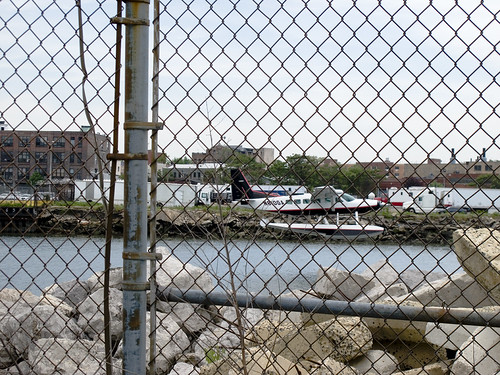
Seaplane landing at Newtown Creek
This one’s a little light, still working on part 3 of the Long Island City history (part 1 here, part 2 here). Did you know there was a “newsboy legion” which hung around Vernon and Jackson and did the bidding of a mayor named “Battle-Ax Gleason”? Or that Thomson Avenue was named for the president of the Long Island Rail Road?
On a Friday, May 22, I was riding my bike around the Pentacle and decided that I would chance going past the security booth at the end of 2nd street in Hunter’s Point, down in Long Island City. This is the former site of the Budweiser distributor, and future home of 2,200 middle and high income apartments and a 350 room hotel.
Citynoise has an interesting post about what an Urban Explorer found on the other side of some of these fences (no endorsement, DO NOT BREAK THE LAW).
It was a gray, not good for photography kind of day, but I was taking a few shots anyway. I heard an engine over my shoulder and caught this sequence. (zoomed in for clarity in shot 1)

photos by Mitch Waxman
A seaplane just flew over Greenpoint, and was looping around for an approach to the water over Long Island City on its way across the East River to the seaplane port in Manhattan (at 23rd street and FDR drive). Interesting, New York has some of the most crowded air on earth, yet seaplanes come and go on filed flight plan only (no air traffic controllers). If you’re rich enough, I guess…

There’s a lot of history involving New York and seaplanes. Here’s a NY times article from 2003, which is admittedly a puff piece.

New York used to have a lot more options, air travel wise, than it does today. That was of course, before the Port Authority turned North Beach into LaGuardia.
Apocryphal, but authoritative, someone who is “in the know” about the Creek and East River told me ” they ferry rich guys back and forth between the hamptons, fire island, and the city. They try to keep it quiet and not let people know that you can get to the eastern tip of Long Island in only 35 minutes. Its only for the rich, celebrities, and wall street types though”.
Wonder if the rich realize they’re landing in the Newtown Creek?


