Archive for the ‘Photowalks’ Category
unctuous haggling
Banal pedantry, Northern Blvd., and the carriers of cars – in today’s post.

– photo by Mitch Waxman
Wandering about in the dark along the Carridor, or Northern Blvd. as most people call it, one was recently contemplating his place in the world and the meaning of everything. Given that any long hard look in the mirror only depresses a humble narrator, I tend to avoid turning my famously incisive vision upon myself for fear of what I may see in a pane of silvered glass. I’ve taken to wandering about in the dark these days, suffering the lapsing of the lonely hours one must endure before the beckoning of the grave becomes irresistible, and in darkness so as to spare others a chance meeting with one so aberrant.
How’s that for holiday season depression? Pretty good, huh?

– photo by Mitch Waxman
This section of the Northern Blvd. Carridor is distinguished by gargantuan used car lots, and the biggest one is owned and operated by Major Auto World. There’s a couple of smaller players, but if you’re between 43rd and 47th streets and spot a car lot, the odds are that the auto retailer is owned or franchised by Major.
The good news is that unlike Northern Astoria or Maspeth, no mob of torch wielding peasants has ever chased me around these parts. A monster does have feelings, y’know.

– photo by Mitch Waxman
One became fascinated watching the dark of night show as multiple car carriers disgorged their cargo to the various car lots for display and eventual sale. Car Carriers are endlessly engaging and curious vehicles to me, although the ones I’m truly occupied by are the ones that carry trucks to the car lots. The whole idea of a truck which carries trucks appeals to me, but – after all – I am an idiot.
At any rate, the ones spotted recently at the Carridor were carrying cars, not trucks.

– photo by Mitch Waxman
The amazing part of all of this action on Northern Blvd. – to me – was the haphazard manner in which it was conducted. Spending as much time as I do around union guys – my neighbor Mario sets up safety cones when we BBQ – it is startling to see the car carriers unloaded right into the middle of oncoming traffic with nothing more than the truck’s hazard lights to indicate to oncoming traffic that a sticky situation is about to be entered.
What do I know, however? It’s all banal, isn’t it?

– photo by Mitch Waxman
The trucker unloading this car carrier rig noticed me taking pictures and shot me what would have been called – in my old neighborhood in Brooklyn – as the “hairy eyeball.” Not really caring too much, and hoping for some sort of antagonist provocation to break through the numb pedantry of my daily round, I kept shooting.
Nothing happened, though, and it was decided that my existential boredom hadn’t peaked yet.

– photo by Mitch Waxman
One last shot, captured whilst scuttling away to the west.
The whole “night photography thing” continues to excite me, as you may have noticed. A couple of new “digital darkroom” tricks I’ve worked out and have begun to institute in pursuance of conquering the digital “noise” inherent in lowlight shots are also proving highly interesting.
Saying that, I’m still not exactly in love with my results, but I’m starting to get close to where I want to go.
– photo by Mitch Waxman
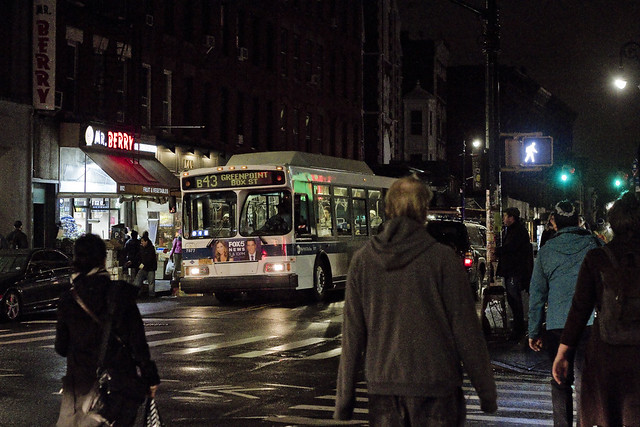
To wit, this shot from Greenpoint, which is the sort of “range of human vision” effect that I’m pursuing.
Something to do in the dark, I guess. It’s all pretty depressing, though.
“follow” me on Twitter- @newtownpentacle
furnace tendings
Banal pedantry, Newtown Creek, and the Feds – in today’s post.

– photo by Mitch Waxman
Ever since the Simpsons movie came out a few years back, whenever the subject of the Federal Environmental Protection Agency comes up, Our Lady of the Pentacle begins to shout out “EEPAH, EEPAH, EEPAH.” Given the amount of time I spend at, on, and around Newtown Creek – Our Lady oft finds herself repeating “EEPAH, EEPAH, EEPAH.”
Last week, one found himself out in the rain with the EPA Superfund team. We were trying to help them site a series of warning signs, which will be installed at the handful of Newtown Creek “public access” spots which are hidden along the bulkheads and visited by anglers or lookie loos (that includes you kids from Apollo Street), signage whose missive would advise against the catching of or consumption of the fish who populate the lugubrious and heavily polluted depths of the Newtown Creek. “EEPAH,” indeed.

– photo by Mitch Waxman
The EPA team requested counsel on the placement of their signage from the Newtown Creek Alliance Project Manager – Will Elkins – who asked me to come along as well. We accompanied”EEPAH” on a somewhat grand tour of the Newtown Creek, hitting a bunch of spots where either Will or myself had seen people fishing over the years. The Feds figured out where they place their signage, marked stuff down, and generally did “EEPAH” stuff. I did my thing too.
Whilst at the Brooklyn side Maspeth Avenue street end, the tug Mary H. was spotted.
Mary H. services the Bayside brand oil tanks you’ll notice adjoins the Metropolitan Avenue Bridge, barging in bulk product which is then distributed to their end customers via heavy truck. The amazing part of this – and it is somewhat amazing – is that the Bayside distribution facility is about 3.1 miles back from the East River, at the border of industrial Maspeth and Bushwick East Williamsburg.
Tugboats, barging cargo three entire miles into Brooklyn – it boggles.

– photo by Mitch Waxman
Metropolitan Avenue was formerly known as the Williamsburgh and Jamaica Turnpike, and it connected Newtown in Queens with the Eastern District of Brooklyn – Bushwick, Williamsburg, and Greenpoint. The crossing of Grand and Metropolitan was also one of the stops on the New York and Manhattan Beach Railroad, its depot would have found at the foot of Greenpoint’s Quay Street in 1912.
The Brooklyn side of Maspeth Avenue follows the northern path of the Maspeth Toll Bridge Co.’s Plank Road, and I was standing on what was once known as Furman’s Island while I was shooting the Mary H. tug. The Plank Road bridge last crossed the Newtown Creek in 1875, during the Presidential Administration of Ulysses S. Grant. Connecting the colonial communities of Maspeth and Newtown via the hellish expanse of Furmans Island (home to Peter Cooper’s Glue Factory, Conrad Wissel’s Night Soil and Offal Dock, and Kalbfleisch and sons, amongst other notorious or malodorous occupants), the Plank Road today exists as a destination for Newtown Creek devotees and fetishists. Also, the Feds.
On the Queens or Maspeth side, Newtown Creek Alliance has a major shoreline rehabilitation project underway, which is being run by the aforementioned Will Elkins. There’ll be a “Don’t eat the fish” sign there too.
“EEPAH.”
“follow” me on Twitter- @newtownpentacle
preliminary session
Sometimes, you have to let the crazy out and let it play.

– photo by Mitch Waxman
One’s life experience displays a certain dichotomy which is often hard to reconcile. For the first two thirds of my time on this planet, if someone spotted me lurking around their periphery they’d begin to batten down the hatches. Ladies would grasp at their purse, gentlemen would assume a proactively aggressive posture, and Policemen would eye me suspiciously. One has never understood this, as I’ve always been what law enforcement personnel would describe as “harmless.” By and large, however, I’ve always been reviled and rejected.
It’s always been an issue for me to remain curiously upright, since any accusation about a humble narrator is easy to believe. “Hey, I just saw Mitch running up and down Houston street wearing a clown suit and screaming about invading aliens. He also had a goat with him.” Most people would just say “yeah, I could see that.”
For the last third of my life, there’s been people who seem to actually want me to hang around them, occasionally. It’s weird, because I’m the same sort of objectionable fellow that I’ve always been. Maybe I’ve just figured out how to sugar coat it, or put some lipstick on this pig, or maybe I’m just getting old and they’re humoring me.

– photo by Mitch Waxman
The weird part of the particular stage of life I’m in – I’ll be turning fifty (hopefully) in 2017 – is the physical transition which I can’t see but which is quite visible to everybody else. My beard used to be dark brown, for instance, and my eyes are looking out of a face which doesn’t chime in with what I think I look like. Also, I make a noise when settling into a chair now, a pained exhortation which sounds like “uhhhhhnnnnnnk” that is coupled with a staccato popping of the ligaments as they stretch along decaying joints with their cartilage deficits.
If I was a late model car, the mechanic would probably tell me that with a regular maintenance schedule, there’d probably be 15-20 thousand miles left before the junk yard beckoned. Saying that, my shocks and struts are shot, and I regularly fail on my emissions tests. I routinely describe my aches and pains as due to the presence of a “pain squirrel” which spends its time running from branch to branch over the course of the day. Today, the squirrel is on the left foot, tomorrow the right arm.

– photo by Mitch Waxman
Over the years, I’ve been accused of being a lot of things, including being “an environmentalist,” a “shill for the real estate guys,” and a “historical preservationist.” The latter bit is an assumption on the part of certain of my friends and colleagues. What I’m actually about – and everything I’ve been doing here at your Newtown Pentacle over the last seven years – is documenting the transformation of the ancient neighborhoods of Western Queens and North Brooklyn which surround the Newtown Creek as they transition from post industrial to residential. My researches into the subjects have revealed a paucity of the last age of transformation around the Creek, which occurred roughly a century ago. My plan is to leave behind some sort of record of what was here, before it’s all replaced by luxury condos. Hopefully, some future history kid will be able to make something out of it all.
I wish I got started sooner than I did, but kay sera sera.

– photo by Mitch Waxman
In the midst of all of this man-o-pausal angst, my wanderings have begun to carry me to places whose pavement I haven’t darkened in several dozen months. My experiential desires at the moment are for the desolate, the wind blown, the discarded. Especially, I want to be alone while I’m walking the earth, for an interval.
Other people suck.

– photo by Mitch Waxman
Luckily, there is no shortage of lonely locations in the concrete devastation, and it is filthy black raincoat weather again.

– photo by Mitch Waxman
Queens is talking to me, can’t you hear her too?
“follow” me on Twitter- @newtownpentacle
engulfed in
Stealing the Sky, in today’s post.

– photo by Mitch Waxman
Last week, one was headed for Queens Plaza and accordingly marched down Jackson Avenue. The startling rapidity of construction going on in the area claws at my sanity, as in nearly half a century spent in NYC, I’ve never met anyone who said “Man, I really want to live in Queens Plaza.” Queens Plaza? Really?
The shot above is from about a week ago, specifically the morning of the 19th of November in 2016.

– photo by Mitch Waxman
The shot above is from June of 2015, and represents approximately the same point of view as the one above – although I was a little further west on Jackson Avenue than I was in the 2016 shot, and the N train is crossing the POV. LIC is one of the few spots in NYC these days where you can produce a “now and then” shot that only covers a 17 month interval.
Woof!

– photo by Mitch Waxman
The two furthest buildings are going up on the site of the former West Chemical factory, which is classified as a NYS Brownfield Opportunity Area – meaning there’s a bunch of “yuck” in the ground left over from the age of industry. According to various sources, this construction you’re looking at – in Queens Plaza – will bring something like 1,800 apartments online in the next couple of years, and represents more than a million square feet of development. That’s a lot of toilets flushing into the decrepit Bowery Bay sewer plant, which overflows into Newtown Creek.
Stealing the sky, indeed.
“follow” me on Twitter- @newtownpentacle
blasphemous disturbance
Evil lurks, in darkness.

– photo by Mitch Waxman
One has long decried the presence of a horde of vampires in Queens Plaza, where they spend their days hiding in the steel of the elevated subways. The presence of the Baltic Strigoi and the Cretan Kalikantzaros in Astoria, the Liches and the syncretic wizardry of South America observed at St. Michael’s Cemetery, the Egyptian Djinn of Steinway Street, those curious Celtic creatures lurking in the post industrial subterrene voids of Blissville, and the unmentionable Dibbuks of the Chabad in Williamsburg have all been discussed in the past. These are all immigrant imps, however, carried to Brooklyn and Queens by the European masses. Supernatural immigrants from old world to new.
Occluded, however, are the belief systems of the original inhabitants of western Long Island.
from wikipedia
Kishelemukong is the creator god, not involved in the daily affairs of the Lenape. Instead, he directed the manitowak, the life-spirits of all living things, which were created by Kishelemukong. The manitowak were venerated in ceremonies, rituals, dreams, visions, games and ohtas (see below), as well as through the interventions of the Metinuwak, who were healers, spiritual and emotional guides, and religious leaders; they could communicate with the manitowak.

– photo by Mitch Waxman
Living, as we do, in a time when the 19th and 20th cultures of Brooklyn and Queens are being dismantled and burned away in the crucible of “development,” one has been ruminating of late about the aboriginal cultures which were similarly dismantled by the Manhattan people during earlier eras. The “Lenapehoking” pre conquest era has captured my interest, but I’m dismayed at the primary source materials which I’ve been able to lay my hands on. Unfountuntely, much of the early source material on the subject I’ve scanned propagates the mythology of the “Noble Savage” and what Kipling called “The White Man’s Burden.”
Problem is that almost everything I’ve been able to find on the Lenape – and their various cultural splinters around New York Harbor – was written by the very same people who decimated and conquered them. It’s a bit like reading a Nazi history of the Second World War, or a British history of their empire in the Raj. I’m looking for some guidance on the subject, books to read, scholars to query. I’ve already reached out through my social network to modern day members of the surviving Lenape nation, but that’s a set of relationships I’m just beginning to develop. Any suggestions on “what to read” would be greatly appreciated, if you happen to be clever about the subject, and I’d ask you to share links and suggestions “with the group” by dropping links into the comments link below.
from wikipedia
A noble savage is a literary stock character who embodies the concept of an idealized indigene, outsider, or “other” who has not been “corrupted” by civilization, and therefore symbolizes humanity’s innate goodness. In English, the phrase first appeared in the 17th century in John Dryden’s heroic play The Conquest of Granada (1672), wherein it was used in reference to newly created man. “Savage” at that time could mean “wild beast” as well as “wild man”. The phrase later became identified with the idealized picture of “nature’s gentleman”, which was an aspect of 18th-century sentimentalism.

– photo by Mitch Waxman
This line of inquiry was initiated for me by an argument I found myself in with an academic ignoramus who decided to describe the Lenape to an audience of students not too long ago. Her version of the Native Americans of New York Harbor was a composite of Hollywood representations of the Cree and Lakota cultures, which included teepees and solar worship.
I am quite familiar with the Native cultures of northern and central Mexico, as a note. The Mexica – or Aztec – imperial culture of Lake Texcoco is something which I’ve studied in great depth for instance. I can actually offer quotations of Aztec poetry, speak intelligently about their economy and agricultural systems, and have a more than passing knowledge of the complexity of their religious traditions. If the Mexica Triple Alliance Empire – Aztec is a Spanish word – had another hundred years to develop, the Europeans would have encountered an analogue of Cesarean Rome when they landed at Vera Cruz, and the story of the North American continent would have turned out VERY different than it did.
Wisdom of crowds time, lords and ladies – what and who should I be reading?
from wikipedia
The Lenape (/ləˈnɑːpɛ/) are a Native American tribe and First Nations band government. They are also called Delaware Indians and their historical territory included present day New Jersey and eastern Pennsylvania along the Delaware River watershed, western Long Island, and the Lower Hudson Valley.
Most Lenape were pushed out of their homeland during the 18th century by expanding European colonies, exacerbated by losses from intertribal conflicts. Lenape communities were weakened by newly introduced diseases, mainly smallpox, and violent conflict with Europeans. Iroquois people occasionally fought the Lenape. Surviving Lenape moved west into the upper Ohio River basin. The American Revolutionary War and United States’ independence pushed them farther west. In the 1860s, the United States government sent most Lenape remaining in the eastern United States to the Indian Territory (present-day Oklahoma and surrounding territory) under the Indian removal policy. In the 21st century, most Lenape now reside in the US state of Oklahoma, with some communities living also in Wisconsin, Ontario (Canada) and in their traditional homelands.
“follow” me on Twitter- @newtownpentacle


 The Newtown Pentacle