Archive for the ‘Photowalks’ Category
H.P. Lovecraft’s “The Festival”

– photo by Mitch Waxman
text quoted from H.P. Lovecraft’s “The Festival”, courtesy wikisource, where you can read the whole story
I was far from home, and the spell of the eastern sea was upon me. In the twilight I heard it pounding on the rocks, and I knew it lay just over the hill where the twisting willows writhed against the clearing sky and the first stars of evening. And because my fathers had called me to the old town beyond, I pushed on through the shallow, new-fallen snow along the road that soared lonely up to where Aldebaran twinkled among the trees; on toward the very ancient town I had never seen but often dreamed of.

– photo by Mitch Waxman
It was the Yuletide, that men call Christmas though they know in their hearts it is older than Bethlehem and Babylon, older than Memphis and mankind. It was the Yuletide, and I had come at last to the ancient sea town where my people had dwelt and kept festival in the elder time when festival was forbidden; where also they had commanded their sons to keep festival once every century, that the memory of primal secrets might not be forgotten. Mine were an old people, and were old even when this land was settled three hundred years before. And they were strange, because they had come as dark furtive folk from opiate southern gardens of orchids, and spoken another tongue before they learnt the tongue of the blue-eyed fishers. And now they were scattered, and shared only the rituals of mysteries that none living could understand. I was the only one who came back that night to the old fishing town as legend bade, for only the poor and the lonely remember.

– photo by Mitch Waxman
Then beyond the hill’s crest I saw Kingsport outspread frostily in the gloaming; snowy Kingsport with its ancient vanes and steeples, ridgepoles and chimney-pots, wharves and small bridges, willow-trees and graveyards; endless labyrinths of steep, narrow, crooked streets, and dizzy church-crowned central peak that time durst not touch; ceaseless mazes of colonial houses piled and scattered at all angles and levels like a child’s disordered blocks; antiquity hovering on grey wings over winter-whitened gables and gambrel roofs; fanlights and small-paned windows one by one gleaming out in the cold dusk to join Orion and the archaic stars. And against the rotting wharves the sea pounded; the secretive, immemorial sea out of which the people had come in the elder time.

– photo by Mitch Waxman
Beside the road at its crest a still higher summit rose, bleak and windswept, and I saw that it was a burying-ground where black gravestones stuck ghoulishly through the snow like the decayed fingernails of a gigantic corpse. The printless road was very lonely, and sometimes I thought I heard a distant horrible creaking as of a gibbet in the wind. They had hanged four kinsmen of mine for witchcraft in 1692, but I did not know just where.

– photo by Mitch Waxman
As the road wound down the seaward slope I listened for the merry sounds of a village at evening, but did not hear them. Then I thought of the season, and felt that these old Puritan folk might well have Christmas customs strange to me, and full of silent hearthside prayer. So after that I did not listen for merriment or look for wayfarers, kept on down past the hushed lighted farmhouses and shadowy stone walls to where the signs of ancient shops and sea taverns creaked in the salt breeze, and the grotesque knockers of pillared doorways glistened along deserted unpaved lanes in the light of little, curtained windows.
pitying smiles

– photo by Mitch Waxman
Inveterate pedestrians who frequent the primary arteries of Queens will tell you that are few City streets like Jackson Avenue in Long Island City.
As the ancient thoroughfare slides past the Megalith at Court Square, one might observe- if atmospheric condition and time of day permit- the curious reflections cast by the mirror skin of the towering structure. Not long ago, a member of the cultural intelligentsia named Heidi Neilson published her novel and intriguing “Long Island City Sundial” concept, which describes the inverse of the what you’re seeing above.

– photo by Mitch Waxman
At Queens Plaza, where the first phase of the titan “Gotham Center” construction envisioned by the Tishman Speyer corporation nears completion, I’ve noticed a similarly reflective affect taking place as the burning thermonuclear eye of god itself plays across the polished and curiously curved mirror glass serving as its architectural facade (and curtain wall) which is tangentially similar to that observed at Court Square, just a few blocks away.
As a note, the recent posting “progress” follows the construction of the structure from the ground up and from every corner of the Newtown Pentacle in a slideshow format.

– photo by Mitch Waxman
Queens Plaza is a notoriously difficult environ for the photographer with it’s rich collection of elevated and shadow gathering steel trackways and their cyclopean aspect- it’s dark and dirty and the very air you breathe is a poisonous fume (due, no doubt, to the uncountable number of vehicles transiting it at any given moment). Vast inventories of vehicles, variegated and numerous, move in short bursts as they ache in traffic in order to transit to and from Queensboro.
What the place has always needed, required in fact, is merely better lighting!

– photo by Mitch Waxman
The seamless robe of that gloom and soot and hurried transit which 150 years of breakneck growth hath wrought seems to have finally been rent by the reflective light emanating from the new structure, illuminating the dimly lit and misunderstood bridge plaza. Lighting like this would be too expensive for the ordinary photographer or cinema “Auteur” to manufacture, especially given that at this location, and as the day progresses- the relections follow and present the inverse position of the burning thermonuclear eye of god itself as it rolls across the sky.
I would add that it is extremely uncomfortable to be in the direct path of these reflections or wander into one unexpectedly, as (given the permanent twilight around the rest of Queens Plaza) one’s pupils contract precipitously in the same manner as they might if a sudden camera flash erupted in an otherwise comfortably lit room.

– photo by Mitch Waxman
Strobing, the light returned from the reflective “blue with a hint of green” colored glass of the Gotham Center building is cool in temperature.
Studies in “color psychology” conducted by municipalities all around the world suggest that public area illumination accomplished and designed to utilize the blue frequencies of visible radiation suffer fewer incidents of public disobeyance, misdemeanor and felony incidents, and that other beneficial psychological effects are evidenced. For instance, the Keihin Electric Express Railway Co. of Yokohama (amongst others in Japan) installed blue lights at stations with high numbers of suicide attempts, Glasgow is apparently all about the blues, and the Police in Nara, Japan report a 9% drop in crime under blue lighting.
Perhaps this gigantic soft box in Queens Plaza is actually a mechanism designed to help quiet anticipations of a restive future population? It is meant to house the City’s Department of Health, after all.
This sounds like hippie talk to a humble narrator, however.
of antique workmanship

– photo from “King’s views of New York City, A.D.1903” a public domain ebook courtesy Google Books

– photo by Mitch Waxman
Perusing the catalogs of historic photos which I routinely harvest from antiquarian sources such as the “google books” service over the holidays, I came across this image of the Stern Brothers store on 23rd street between 5th and 6th avenues in a 1903 photo survey of New York. For one reason or another, I’ve spent a lot of time marching up and down 23rd street and have always been curious about the structure (which currently houses a largish “Home Depot”).
from wikipedia
Stern Brothers was founded in 1867 by Issac, Louis and Benjamin Stern, sons of German Jewish immigrants. In 1867 they began selling dry goods in Buffalo, New York. From these humble beginnings the Stern Brothers became an important merchandising family in New York City.
In 1868 they moved to New York City and opened a one room store at 367 Sixth Avenue. In 1877 the store was again relocated to larger quarters at 110 West 23rd. Street. Outgrowing the store at 110 West 23rd. Street, Stern Brothers erected a new structure at the same location which became the new flagship store in 1878. It was noted for its cast-iron facade at 32 to 36 West 23rd. Street & 23 to 35 West 22nd. Street.
The building was designed by Henry Fernbach. It was enlarged according to a design by W.M. Schickel in 1892. The enormous, six story building was executed in the Renaissance Revival style. W.M. Schinckel’s typically 19th. century addition tripled the dimensions of the original structure on the eastern portion of the site. The tall central section of this addition animates the long and delicately detailed facade. The company’s monogram is still located above the central arch. (This structure is still in use today. The first floor houses a Home Depot, while the upper floors are showrooms.) The entire Sterns family worked in this store, which carried both luxury goods and merchandise the working classes. It was an elegant store noted for its fashionable clothes. Ladies from all over the city came to Stern Brothers for their Paris fashions. This enterprise was distinguished by its elegant door men in top hats and the generous and friendly service of the Sterns themselves.

A “longer” version of the same subject – photo by Mitch Waxman
On Tuesday, on my way to a client’s office on 23rd street to pick up a job, I made it a point of trying to find a similar vantage point to the one in the historic photo- although the 1903 version is clearly shot from the elevated landing of a staircase, or perhaps, the first story window of some long gone structure.
What remains in Manahattan these days is corporatized, commercialized, bland, and privatized- who would blame these stalwart titans of economic might for shunning and denying the requests of some shabby man with a camera who is unprofitably seeking the past?
the stinking shallows

– photo by Mitch Waxman
As mentioned in yesterday’s posting, aimless wandering around the Dutch Kills tributary of Newtown Creek was how your humble narrator spent Monday afternoon. The stealthy ones… let’s just call them Cats… pointed me in this direction, and low tide was observed.
Strewn, the 29th street roadside coast of the canal is a favored location for illegal dumping of both construction debris and putrescent garbage- which- when combined with the stagnant conditions which are typical of this water and factoring the recent snow melt…
-let’s just say that the smell here is a tangible and seemingly sentient thing.

– photo by Mitch Waxman
It was low tide when I stood there, my attentions drawn to exposed sediments and that curiously decayed steel which composes the hull of a long stranded barge- both of which are remarkable. Casting my lens around, I noticed the sickly trees adorning the filth bearing shore and began thinking about the posting “a creeping run” which was presented here- at your Newtown Pentacle- just days ago.
Hyperbolic, the post pondered the presence of organochemical mutagens in the water, swirling about in that vast cocktail of industrial runoff– whose whispered effects have been studied only as individual constituents rather than “in solution” or “in concert”- not just here, but all along that cautionary tale known as the Newtown Creek.
The trees.

– photo by Mitch Waxman
Let me state three things here…
first- “simulacra” is a term I use to describe the appearance to the human eye of patterns in organic and random shapes. Certain contrasts in entirely random shapes might suggest a “man in the moon” or a “dragon in the clouds” or “Jesus on a pancake” or “Allah’s name inside an apple” or any of the usual visual coincidences experienced by people when confronted with a well done puppet or artistically wrought doll. It’s the way our eyes and brains work, ultimately. I don’t know what other people call it, but that’s what is meant when I say it.
second- I’m a professional photo retoucher in the New York City advertising world, and routine tasks call for me to create composite images which blend multiple exposures into a single illusory image (as well as taking the mustaches off the pretty ladies). This is the creation of a lie in photographic form, featuring distortions of anatomy and removal of a subjective series of perceived flaws in the subject matter. One of the tricks of the trade is understanding how to manipulate that sense of “simulacra”. In other words, I am quite capable of faking something, photographically speaking.
third- As a statement of principle and duty to the record- the photos which occur during these postings are unaltered except for color and exposure correction and sharpening. Whenever it’s a “trick image” like an “HDR” or “stitched panorama” or “tilt shift”- I endeavor to label it as such.
The Trees.
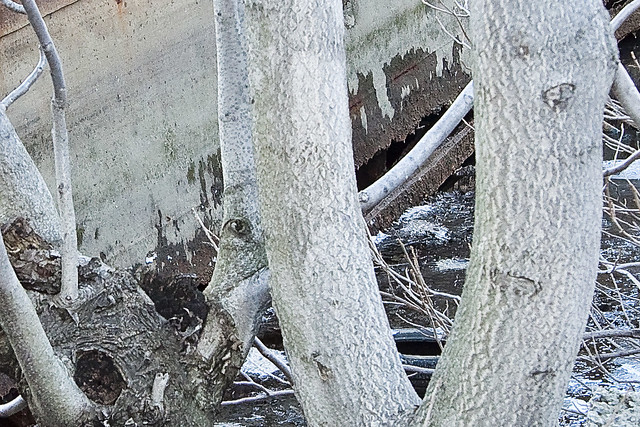
– photo by Mitch Waxman
This shot is un-messed around with, a simulacra caused by a broken branch or a parasitic infection… it must be…
For even around the malignant Dutch Kills…
Even when deeply sunken roots are drinking in some mutagenic stew of petroleum byproducts, sewage borne pharmaceutical runoff, and unmentionable organocoppers…
Even in these unmentionable and shunned waste meadows of the Creekland…
The Trees…
The Trees… are not meant to have eyes.
Guess what

– photo by Mitch Waxman
So, I went out for a walk today. My only intention was to begin carving off some of the lard which has been quickly accumulating about my midsection during the gluttonous holiday season, but found my steps drawn toward the flat marshlands of Hunters Point and Long Island City as I descended from the swollen hills of Astoria. Following my shadow, it wasn’t long before I started seeing… the Cats… again. My odd habit of turning left whenever a feline shape presents itself led me directly to the Borden Avenue Bridge…
WHICH WAS OPEN TO TRAFFIC!!!
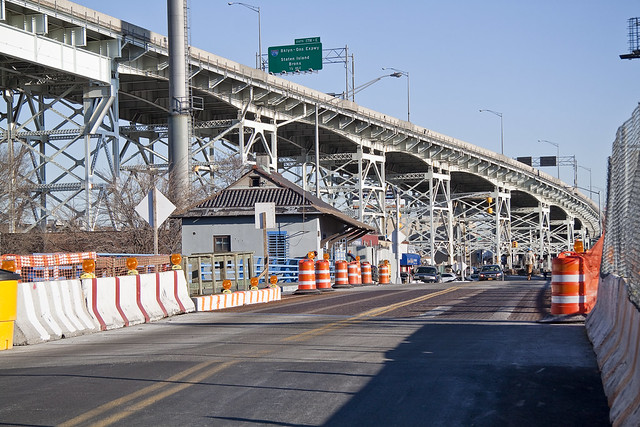
– photo by Mitch Waxman
There was still construction activity going on, but a quick check with one of the guys in high visibility colors revealed that the structure’s roadway was available. The sidewalks were still being worked on, and safety barriers were present- but the long running project seems to be nearing an end. I’m not sure if the bridge is “officially open”, but at least today it was.
Thank you, weird Cats of the Creeklands.

– photo by Mitch Waxman
I should mention that this structure is one of my favorite locations along the Dutch Kills tributary, from a photographic point of view, and an uncharacteristic giddiness seems to be filling me at the near return of a long cherished vantage point. Check out what I mean here.

– photo by Mitch Waxman
The official truth, from the NYC DOT site is:
Borden Avenue is a two-lane local City street in Queens. Borden Avenue runs east-west extending from Second Street at the East River to Greenpoint Avenue. The Borden Avenue Bridge over Dutch Kills is located just south of the Long Island Expressway between 27th Street and Review Avenue in the Sunnyside section of Queens. Borden Avenue Bridge is a retractile type moveable bridge. The general appearance of the bridge remains the same as when it was first opened in 1908. The bridge structure carries a two-lane two-way vehicular roadway with sidewalks on either side. The roadway width is 10.5m and the sidewalks are 2.0 m. The west approach and east approach roadways, which are wider than the bridge roadway, are 15.3m and 13.0m respectively. The bridge provides a horizontal clearance of 14.9m and a vertical clearance in the closed position of 1.2m at MHW and 2.7m at MLW.
As part of the construction of Borden Avenue in 1868, a wooden bridge was built over Dutch Kills. This bridge was later replaced by an iron swing bridge, which was removed in 1906. The current bridge was opened on March 25, 1908 at a cost of $157,606. The deck’s original design consisted of creosote-treated wood blocks, with two trolley tracks in the roadway. Character-defining features of this bridge include the stucco-clad operator’s house, four pairs of rails, and a rock-faced stone retaining wall. The gable-on-hip roof of the operator’s house retains the original clay tile at the upper part. Although alterations have been made, the bridge is a rare survivor of its type and retains sufficient period integrity to convey its historic design significance.
The Department of Transportation has identified a pocket of contaminated soil which has been classified as “contaminated non-hazardous”. As such, it poses no significant health risk to workers or the surrounding community. However, precautionary measures will be taken and every effort is being made to remove and dispose of the contamination quickly, yet safely, within all New York City and State guidelines. A Corrective Action Plan (CAP) for the removal and disposal of the contamination has been submitted to the NYS Department of Environmental Conservation (NYSDEC) for review and approval. Upon receipt of the NYSDEC approval, the contractor will prepare a new construction schedule and commence work under the terms of the permits. At this time, a date for the resumption of work is unknown which precludes an accurate prediction of a new anticipated completion date, although every effort will be made to complete the project in the late Fall of 2010. All posted detours will remain in effect until further notice.
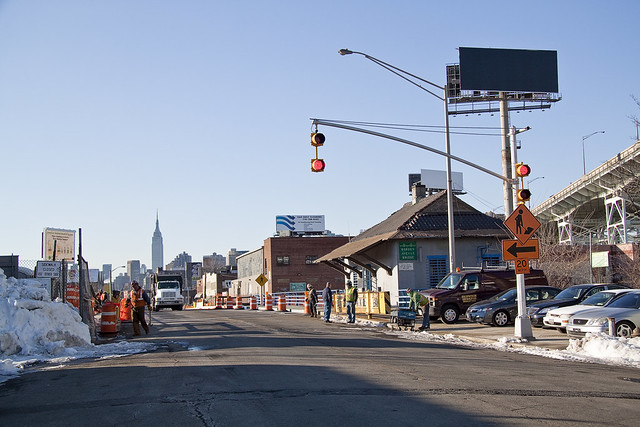
– photo by Mitch Waxman
Further official truth is found in the DOT’s Weekly Traffic Advisory of Saturday January 1, 2011 to Friday January 7, 2011
Borden Avenue Bridge over Dutch Kills (at 27th Street): This Bridge was closed December 31st 2008 for emergency reconstruction and reopened December 24, 2010 to two-way traffic. This closure was to necessitate NYCDOT Bridge major construction activity. Single lane closures will resume after January 2, 2011 to complete sidewalk and punch list work.


