Archive for the ‘Pickman’ Category
repeated lapses

– photo by Mitch Waxman
A new park is open in Queens Plaza, so your humble narrator decided to take a look. I’m probably going to be pilloried for this posting by members of the antiquarian community here in Queens, and excoriated by members of the Manhattan elites, as controversy has surrounded this construction- some of which I’ve been directly involved with. Saying that, read into this post whatever political prejudice or predilection you might, none is intended.
The “editorial policy” of this blog, a term which is often mocked by those offended by this or that posting, has always been “it’s not good, nor bad, it just is”.

– photo by Mitch Waxman
To begin with, the Mayor himself recently held a press event here, unveiling the name of the new park as “Dutch Kills Green”. Unfortunately, I was engaged with other things and was unable to cover the event, but luckily personnel from “Gothamist“, amongst others, were able to make it.

– photo by Mitch Waxman
The park itself is built along modernist principles, and offers certain laudable features. Stormwater remediation is built into the design, as are the use of native species. Queens Plaza has historically not been a friendly place for pedestrians, and the new park offers a chance to sit down, which is a rare thing.

– photo by Mitch Waxman
Environmental noise from elevated subway and never ending vehicular traffic is endemic, of course, and the clouds of automotive exhaust can be overwhelming. Saying that, such conditions are endemic in Western Queens and one of the great complaints offered by area wags is the lack of open space available to the public.

– photo by Mitch Waxman
The detailing in the park is curious, and designed to appear quite “urban”.
One is reminded of set pieces from the science fiction movie “Planet of the Apes” by the consciously rough hewn patina of the place. There are several little touches to the place that confirm careful thought went into its design and implementation. Observation of the spot over recent weeks has revealed that it has already found devotees in groups of teenage students and local office workers.

– photo by Mitch Waxman
It is an absolutely brilliant spot for photographing trains and the operations of the MTA at Queens Plaza, which has long fascinated a humble narrator, and offers a nearly 240 degree visual sweep of the enterprise for inspection and contemplation.
Additionally, as the place is a bit above grade, new angles of view are possible.

– photo by Mitch Waxman
Were it not for the damned noise, this could be a really interesting place to hang out, and I’ve already decided to use this as a meeting point for some future walking tour. It makes for a ready landmark in a neighborhood unfamiliar to most except as a transit hub.

– photo by Mitch Waxman
The Long Island City Millstones are back as well, although due to a lack of signage indicating their historical meaning or context, they appear to be just another accoutrement. One would hope that if the municipality is not forthcoming with such signage, local civic groups or historical societies might be able to fill in the gaps. Such signage might be forthcoming, but I haven’t heard anything about it.

– photo by Mitch Waxman
The mill stones are artifacts of colonial Queens, and were centrally figured in the controversy mentioned at the beginning of this post. Their presence distinguishes Dutch Kills Green, a welcome addition to the concrete devastations of Western Queens.
Also,

Obscura Day 2012, Thirteen Steps around Dutch Kills
April 28th, 10 a.m.
Your humble narrator will be narrating humbly at this year’s Obscura Day event on April 28th, leading a walking tour of Dutch Kills. The tour is already half booked up, and as I’m just announcing it, grab your tickets while you can.
“Found less than one mile from the East River, Dutch Kills is home to four movable (and one fixed span) bridges, including one of only two retractible bridges remaining in New York City. Dutch Kills is considered to be the central artery of industrial Long Island City and is ringed with enormous factory buildings, titan rail yards — it’s where the industrial revolution actually happened. Bring your camera, as the tour will be revealing an incredible landscape along this section of the troubled Newtown Creek Watershed.”
For tickets and full details, click here :
obscuraday.com/events/thirteen-steps-dutch-kills-newtown-creek-exploration
yellow rays

– photo by Mitch Waxman
Recorded recently in the neighborhood of Dutch Kills, not the waterway but the neighborhood which the waterway once flowed into. It’s confusing, as the waterway is often cited or mentioned in these postings and is “way over there” from the perspective of the neighborhood- which is found between Ravenswood, the East River, and Astoria. Large hotels are on the rise in the area, and there’s a whole lot of construction underway. For street artists, this is a bit of a playground.

– photo by Mitch Waxman
Personally, this is my kind of stuff. Garish in color and whimsical, not like the dark sarcasm and obviate ideations often observed in Brooklyn. Moreover, where one would expect to find elaborate renderings of “tags”, figurative cartooning trumps.

– photo by Mitch Waxman
A fairly even temper hangs about the brow of a humble narrator today, and this splash of color is much appreciated by this withering shadow.
primitive ruins
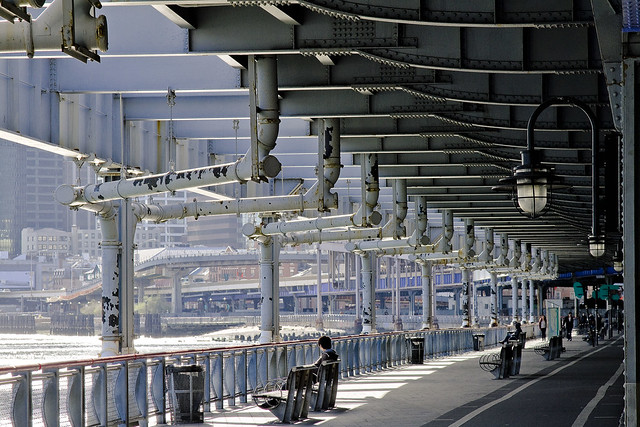
– photo by Mitch Waxman
Recent business brought me to Manhattan, and an opportunity to walk along the East River while moving downtown presented itself. A spectacular promenade has recently emerged along the coast of the Shining City, much of which is unfortunately cement. Shiny and new, the sections above Corlears Hook made me a little nervous, as if one had wandered into an architect’s drawing populated by spandex wearing fitness models riding bicycles and running determinedly. Downtown, between East River Bridge Two and One (Manhattan and Brooklyn) this waterfront parkland was just grungy and old enough to feel lived in, by ordinary folk.

– photo by Mitch Waxman
It is difficult to complain about these open air trottoirs, which allow the citizenry a chance to gaze at the splendors of the harbor, especially given what these areas were like a mere 20-30 years ago. Trash strewn and off limits, New York had left its waterfront to rot away. The great shame of it all, and this is where the kvetching and Monday morning quarterbacking comes in, is that the infrastructure of docks and wharfs which literally made New York great is gone- never to return. Once something becomes a park, it is virtually impossible for it to return to other usage. No ship will be arriving here ever again.

– photo by Mitch Waxman
It’s the way of things, of course, and long ago was it decided that maritime interests were unimportant to Manhattan. So few are the docks on the island nowadays that it is scantly possible to find a berth. Word has it that the various waterfront vision plans include the usage of “temporary” or “floating” docks at some point in the future, but the days when a ship could unexpectedly arrive in the City- laden with some mysterious cargo from the south seas- seem to be over.
fear eclipses

– photo by Mitch Waxman
The warmth was welcome, but the mists and fog were not. Multiple journeys into and out of the concrete devastations of the Newtown Creek watershed in recent weeks have garnered nothing but terror for your humble narrator. What unknown things, too small to notice, might have been carried aloft by those vapors? After all, if you can smell something… you are breathing it in.
That thing which cannot possibly exist in the cupola of the Sapphire Megalith was surely unaffected by those whose flapping and flopping might be observed only with the aid of microscopy, in its perch high above the mists.
I’m all ‘effed up.
from wikipedia
Delusional parasitosis, also known as Ekbom’s syndrome, is a form of psychosis whose victims acquire a strong delusional belief that they are infested with parasites, whereas in reality no such parasites are present. Very often the imaginary parasites are reported as being “bugs” or insects crawling on or under the skin; in these cases the experience of the sensation known as formication may provide the basis for this belief.
The alternative name of Ekbom’s syndrome derives from Swedish neurologist Karl Axel Ekbom, who published seminal accounts of the disease in 1937 and 1938. This term is also used interchangeably with Wittmaack-Ekbom syndrome, another name for restless legs syndrome (RLS). Although delusional parasitosis and RLS were both researched by Ekbom, and RLS sufferers sometimes describe some of their symptoms as if they have, for example, “ants in my veins”, they are distinctly different disorders. RLS is a physical condition with physical causes, whereas delusional parasitosis is a false belief.

– photo by Mitch Waxman
Intimate associates and clandestine confidants have been acting oddly since those foggy days during the third week of March, leading me to experience entirely uncontrollable and unpermissive pulsations of paranoid wondering. It was so odd, experiencing the weather of early summer at this stage of the year, imparting a sensation to me that we had all somehow skipped ahead a month or two in time according to the whim of some extra dimensional overlord- but only for a short interval.
Perhaps time itself has come undone.
from wikipedia
The Capgras delusion theory (or Capgras syndrome) is a disorder in which a person holds a delusion that a friend, spouse, parent, or other close family member has been replaced by an identical-looking impostor. The Capgras delusion is classified as a delusional misidentification syndrome, a class of delusional beliefs that involves the misidentification of people, places, or objects. It can occur in acute, transient, or chronic forms. Cases in which patients hold the belief that time has been “warped” or “substituted” have also been reported.

– photo by Mitch Waxman
Mayhaps it was was the influence of whatever it was that arose on the billowing fog that caused my reason to falter and imaginings to take on a sinister cast. The miasmic clouds which blanketed and caressed could not have been anything more than mere humidity, not some noxious atmosphere of industrial exhaust and foul microscopic life clinging to those tiny water droplets hanging suspended in the air. Such wonderings are merely paranoia, but one wonders… and more than wonders…
from wikipedia
Between people of different faiths, or indeed between people of the same faith, the term omnipotent has been used to connote a number of different positions. These positions include, but are not limited to, the following:
- A deity is able to do absolutely anything, even the logically impossible, i.e., ( 2 ) pure agency.
- A deity is able to do anything that it chooses to do.
- A deity is able to do anything that is in accord with its own nature (thus, for instance, if it is a logical consequence of a deity’s nature that what it speaks is truth, then it is not able to lie).
- Hold that it is part of a deity’s nature to be consistent and that it would be inconsistent for said deity to go against its own laws unless there was a reason to do so.
- A deity is able to do anything that corresponds with its omniscience and therefore with its worldplan.
Under many philosophical definitions of the term “deity”, senses 2, 3 and 4 can be shown to be equivalent. However, on all understandings of omnipotence, it is generally held that a deity is able to intervene in the world by superseding the laws of physics, since they are not part of its nature, but the principles on which it has created the physical world. However many modern scholars (such as John Polkinghorne) hold that it is part of a deity’s nature to be consistent and that it would be inconsistent for a deity to go against its own laws unless there were an overwhelming reason to do so.

– photo by Mitch Waxman
Your humble narrator must simply be drinking too much coffee.
from wikipedia
Caffeine overdose can result in a state of central nervous system over-stimulation called caffeine intoxication (DSM-IV 305.90), or colloquially the “caffeine jitters”. The symptoms of caffeine intoxication are comparable to the symptoms of overdoses of other stimulants: they may include restlessness, fidgeting, anxiety, excitement, insomnia, flushing of the face, increased urination, gastrointestinal disturbance, muscle twitching, a rambling flow of thought and speech, irritability, irregular or rapid heart beat, and psychomotor agitation. In cases of much larger overdoses, mania, depression, lapses in judgment, disorientation, disinhibition, delusions, hallucinations, or psychosis may occur, and rhabdomyolysis (breakdown of skeletal muscle tissue) can be provoked.
ALSO:
Your humble narrator will be narrating humbly at this year’s Obscura Day event on April 28th, leading a walking tour of Dutch Kills. The tour is already a third booked up, and as I’m just announcing it, grab your tickets while you can.
“Found less than one mile from the East River, Dutch Kills is home to four movable (and one fixed span) bridges, including one of only two retractible bridges remaining in New York City. Dutch Kills is considered to be the central artery of industrial Long Island City and is ringed with enormous factory buildings, titan rail yards — it’s where the industrial revolution actually happened. Bring your camera, as the tour will be revealing an incredible landscape along this section of the troubled Newtown Creek Watershed.”
For tickets and full details, click here :
obscuraday.com/events/thirteen-steps-dutch-kills-newtown-creek-exploration
Veneralia

– photo by Mitch Waxman
Technically speaking, this post is day late and a dollar short, as the holiday of Veneralia was traditionally observed by the Romans on April 1. Given the prankster traditions of our modern culture that revolve around the date, however, it was decided to run an acknowledgement of the holiday today- if the story of Troy has taught us anything, it’s “Don’t mess around with the Goddess of Love”.
from wikipedia
Venus was offered official (state-sponsored) cult in certain festivals of the Roman calendar. Her sacred month was April (Latin Mensis Aprilis) which Roman etymologists understood to derive from aperire, “to open,” with reference to the springtime opening of trees and flowers.
Veneralia (April 1) was held in honour of Venus Verticordia (“Venus the Changer of Hearts”), and Fortuna Virilis (Virile or strong Good Fortune), whose cult was probably by far the older of the two. Venus Verticordia was invented in 220 BC, during the last tears of Rome’s Punic Wars, in response to advice from a Sibylline oracle, when a series of prodigies was taken to signify divine displeasure at sexual offenses among Romans of every category and class, including several men and three Vestal Virgins.

– photo by Mitch Waxman
Veneration… the very root of the word comes from her name, this Roman deity named Venus. She wore many hats, and was worshipped in several aspects. The one which we at Newtown Pentacle HQ revere is the personification of Venus Cloacina, goddess of the main drain. Myrtle adorns the entranceway to that ceremonial room with ceramic tiles which we maintain, and rhyming prayers will be offered before a porcelain altar.
from wikipedia
In Roman mythology, Cloacina (Latin, cloaca: “sewer” or “drain”) was the goddess who presided over the Cloaca Maxima (“Great Drain”), the main trunk of the system of sewers in Rome. She was originally derived from Etruscan mythology. The Cloaca Maxima said to be begun by one of Rome’s Etruscan kings, Tarquinius Priscus, and finished by another, Tarquinius Superbus.
Titus Tatius, who reigned with Romulus, erected a statue to Cloacina as the spirit of the “Great Drain”. As well as controlling sewers, she was also a protector of sexual intercourse in marriage. Despite her Etruscan origins, she later became identified with Venus.

– photo by Mitch Waxman
Towering above the lowest point of New York City in Greenpoint, at the bottom of a geologic soup bowl (as it were), is the greatest temple of this goddess. If fancy strikes, as you drive along the BQE or traverse the streets of our ancient neighborhoods, remember to offer the ancient prayer:
“O Cloacina, Goddess of this place,
Look on thy suppliants with a smiling face.
Soft, yet cohesive let their offerings flow,
Not rashly swift nor insolently slow.
– courtesy sewerhistory.org
ALSO:
Your humble narrator will be narrating humbly at this year’s Obscura Day event on April 28th, leading a walking tour of Dutch Kills. The tour is already a third booked up, and as I’m just announcing it, grab your tickets while you can.
“Found less than one mile from the East River, Dutch Kills is home to four movable (and one fixed span) bridges, including one of only two retractible bridges remaining in New York City. Dutch Kills is considered to be the central artery of industrial Long Island City and is ringed with enormous factory buildings, titan rail yards — it’s where the industrial revolution actually happened. Bring your camera, as the tour will be revealing an incredible landscape along this section of the troubled Newtown Creek Watershed.”
For tickets and full details, click here :
obscuraday.com/events/thirteen-steps-dutch-kills-newtown-creek-exploration


