Archive for the ‘Pickman’ Category
cry fowl, and let slip…

– photo by Mitch Waxman
This threesome was observed recently, hanging around industrial Queens. Two males and a female, it seemed that they were up to no good, and didn’t have a reason for being in the neighborhood. There was nothing specific that drew my suspicions, let’s just call it instinct.
from wikipedia
The Mallard (Anas platyrhynchos), the best-known and most recognizable of all ducks, is a dabbling duck which breeds throughout the temperate and sub-tropical areas of North America, Europe, Asia, Africa, New Zealand (where it is currently the most common duck species), and Australia. It is strongly migratory in the northern parts of its breeding range, and winters farther south. For example, in North America it winters south to Mexico, but also regularly strays into Central America and the Caribbean between September and May.
The Mallard is the ancestor of all domestic ducks, except the few breeds derived from the unrelated Muscovy Duck (Cairinia moschata).

– photo by Mitch Waxman
When confronted and questioned, they claimed that coming here during the winter months is a family tradition. The place isn’t what it was in the time of their grandparents or great grandparents, they asserted, but nostalgia compels them to visit the area annually. Additionally, the subjects said that the place was once a paradise.
from birdguides.com
The Mallard is our commonest duck, the one you are most likely to be greeted by if you throw out food at your local park pond. Some Mallards have been domesticated and so you may also see Mallard-like hybrids showing bewildering colours from khaki brown to pure white. The displaying male Mallard shows his colours very clearly as well as the diagnostic curly black uppertail feathers. The female Mallard is the standard dabbling duck against which all the others should be compared. Mallard in flight can be told by their relatively large size, the contrastingly dark-chested appearance of the males and the fact that the white borders on either side of the dark blue speculum are both equally obvious.

– photo by Mitch Waxman
They alleged that just before the civil war, there were oysters, deer, and forests in the area- and their extended family would join them here for feasts and bacchanal.
from wikipedia
Ducks exploit a variety of food sources such as grasses, aquatic plants, fish, insects, small amphibians, worms, and small molluscs.
Diving ducks and sea ducks forage deep underwater. To be able to submerge more easily, the diving ducks are heavier than dabbling ducks, and therefore have more difficulty taking off to fly.
Dabbling ducks feed on the surface of water or on land, or as deep as they can reach by up-ending without completely submerging. Along the edge of the beak there is a comb-like structure called a pecten. This strains the water squirting from the side of the beak and traps any food. The pecten is also used to preen feathers.
A few specialized species such as the smew, goosander, and the mergansers are adapted to catch and swallow large fish.
The others have the characteristic wide flat beak designed for dredging-type jobs such as pulling up waterweed, pulling worms and small molluscs out of mud, searching for insect larvae, and bulk jobs such as holding and turning headfirst and swallowing a squirming frog. To avoid injury when digging into sediment it has no cere. but the nostrils come out through hard horn.

– photo by Mitch Waxman
But, their story doesn’t feel right, they were up to something. Call it a hunch, but I don’t trust those ducks at Dutch Kills. Not the first time that a duck has been involved with trouble around these parts.
from the annals of Newtown
The barn of Thomas Woodward, a worthy inhabitant, who lived where Mr. Victor now does, in Newtown village, was used by the enemy as a hospital for the sick soldiery. On a winter’s night Mr. Woodward was aroused by a noise among his ducks, at the rear of the house. Opening the back door, he could see no one, for the night was foggy. He however discharged his gun at a venture, expecting only to frighten the intruder, but the next morning a soldier was found dead a short distance from the house, with a duck under his coat. The soldiers were so exasperated at Woodward, that he continued to be in great fear for his life. It has been said that he was not called to account for this deed, but from the nature of the act, and the wrath excited, such an omission would have been extraordinary. Besides, I find him arraigned “a prisoner” before a court-martial, April 26th, 1782, though unfortunately the offence is not stated. He was favored in this case by the intercession of Serj. Major B. Rathbone, of the grenadiers, who had quartered at his house.
…like a veritable mendicant

– photo by Mitch Waxman
Facile and easily led, your humble narrator was nevertheless in Sunset Park recently, attempting to pry information on the enigmatic “turn of the last century merchant trader” named Gilman (whose grave I’ve been searching for at Calvary Cemetery here in the heart of our Newtown Pentacle) out of a hysterical levantine who had refused my offer of electronic correspondence. This man, a member of some dire cultic offshoot of the Hasidic movement whose disturbing interpretation of the Kabballist mysteries has rendered them outcasts in their own communities, operates from a dust choked office housed in a former industrial warehouse.
from wikipedia
As compared with other Jewish movements, Hasidic Judaism tends to focus on the role of the Rebbe as an elevated spiritual leader and intercessor, a renewed emphasis on prayer, cameraderie, and deeds of kindness, and the study of tangible mystical texts. This replaced Talmudic legalism as the main traditional activity, and offered the unlearned closeness to God through joy and fervour in daily life. It sought to add to required standards of ritual observance, while relaxing others where inspiration predominated. Its communal gatherings celebrated soulful song and storytelling as forms of mystical devotion. Each dynasty follows its own principles; thus Hasidic Judaism is not one movement, but a collection of separate individual groups with some commonality. There are approximately 30 larger Hasidic groups, and several hundred minor Hasidic groups exist. Though there is no one version of Hasidism, individual Hasidic groups often share with each other fundamental philosophy, worship styles, dress, songs, etc.

– photo by Mitch Waxman
His national inheritance was Dutch. Fleeing the inquisition during the religious wars of the 16th and 17th centuries, his forebears found themselves in Bruges, and after that noble city’s Zwin Channel silted up- Amsterdam. Staunch advocates of the Hebrew religion, this family nevertheless adopted a Dutch name- Suydam- and founded a business that imported Syriac, Greek, and Sufi religious texts to the merchant city. Their trade in Christian and Pagan scrolls and books allowed them access to ancient caches of Hebrew mysticism which had been captured, explored, and expanded upon by the Mohammedans.
from wikipedia
The Sephardim (so-called Spanish Jews) had been expelled from Spain and Portugal years earlier, but many remained in the Iberian peninsula, practising Judaism in secret (see crypto-Jews or Marranos). The newly independent Dutch provinces provided an ideal opportunity for the crypto-Jews to re-establish themselves and practise their religion openly, and they migrated, most notably to Amsterdam. Collectively, they brought trading influence to the city as they established in Amsterdam.
In 1593 these Marranos arrived in Amsterdam after having been refused admission to Middelburg and Haarlem. These Jews were important merchants and persons of great ability. They labored assiduously in the cause of the people and contributed materially to the prosperity of the country. They became strenuous supporters of the house of Orange and were in return protected by the stadholder. At this time the commerce of Holland was increasing; a period of development had arrived, particularly for Amsterdam, to which Jews had carried their goods and from which they maintained their relations with foreign lands. Thus they had connections with the Levant and with Morocco. The Emperor of Morocco had an ambassador at The Hague named Samuel Pallache (1591-1626), through whose mediation, in 1620, a commercial understanding was arrived at with the Barbary States.

– photo by Mitch Waxman
A branch of the family moved to New York shortly after the American Civil War, and are mentioned as living on Martense Street in an 1890 census. Near the Borough Hall, on Clinton Street, was where the family business operated from a parlor room. They provided Jewish religious and funerary goods imported from North Africa and the Ottoman empire, and were a shipping address for certain medieval copies of ancient scrolls which had been hidden away from the inquisitors when Moorish Iberia gave way to Catholic Spain. A side line for the Suydams was found in the 19th and 20th century fashion trends that demanded far eastern textiles and faux ceramics in the adornment of domestic rooms.
from wikipedia
The first Jews to come to New York arrived in what became New York City around September in 1654. They arrived on a ship from Recife, a city in what became Brazil. There were 23 Jewish men, woman, and children refugees among the passengers on the boat, whose captain was Jacques de la Motthe.
There was initial hostility and Peter Stuyvesant attempted to evict the Jews from his town. Jewish stockholders in Amsterdam prevailed on the Dutch West India Company to order the governor to let them remain. In 1655, a few Sephardic Jewish families immigrated to the city with a Torah scroll, possibly indicating the start of a private synagogue. Stuyvesant, determined to drive the Jewish settlers out of New Amsterdam, made efforts to restrict their trade, prohibited their owning property, and taxed them to pay for the town watch. In 1655, the Jews applied for a plot of land for a cemetery, but the governor denied the request, pointing out that no one had yet died. The following year the death of one of the Jews compelled him to designate “a little hook of land” beyond the town wall. This site has long since disappeared.
Stuyvesant’s recalcitrance and the extreme cold of New Amsterdam’s winters led the Sephardic Jews to depart for Amsterdam, London, or the Caribbean, where relatives were better established. By 1663, the Torah scroll had been returned to Amsterdam. In 1664 a large British fleet forced Stuyvesant to surrender without firing a shot, and all residents who remained in what was now New York were required to sign an oath of allegiance to the English crown.[1] The one Jewish name on the list was Asser Levy’s. He seems to have maintained the only Jewish presence of record in British New York until he was joined in 1680 by relatives from Amsterdam. Levy’s death on February 1, 1681/82 and burial in the old cemetery unquestionably led Sephardi Joseph Bueno de Mesquita to purchase a separate burying ground for his own family and for a growing group of Sephardim in the community.

– photo by Mitch Waxman
The European part of the family was exterminated during the genocidal rampage of the last known Antichrist during the 1940’s, and the Suydams faded into Brooklyn obscurity during the 1950’s. The man I contacted, named Ari Suydam, is the last of his line. The old Dutch business records were lost, along with a cache of valuable paintings and other rare collectibles (including the legendary De Vermiis Mysteries, and a fragment of the Pnakotic Manuscripts- supposedly), whose recovery via international law and United Nations treaty is the man’s sole obsession. A significant amount of the documentation about a critical phase in the development of Long Island City was lost in a courthouse fire in 1904, including the critical location of Gilman’s Grave at Calvary.
In 1939 there were some 140,000 Dutch Jews living in the Netherlands, among them some 25,000 German-Jewish refugees who had fled Germany in the 1930s (other sources claim that some 34,000 Jewish refugees entered the Netherlands between 1933 and 1940, mostly from Germany and Austria)…
…In 1945 only about 35,000 of them were still alive. The exact number of “full Jews” who survived the Holocaust is estimated to be 34,379 (of whom 8,500 were part of a mixed marriage and thus spared from deportation and possible death in the Nazi concentration camps); the number of “half Jews” who were present in the Netherlands at the end of the Second World War in 1945 is estimated to be 14,545, the number of “quarter Jews” 5,990

– photo by Mitch Waxman
Suydam, it is rumored, has a unique ledger in his possession that contains the otherwise immolated information sought. Unfortunately, a bizarre and exclusionary form of an other wise wholesome orthodoxy called Hasidism that the man adheres to will not allow him to deal with anyone who is not Jewish. When informed that I was raised Jewish, Bar Mitzvah and all, Suydam scornfully informed me that I wasn’t Jewish enough and ordered me to vacate his premise. He said that there were certain things that only Kohanim should know.
Thwarted, I left and walked out into the sunset.
from wikipedia
The kohanim formed a holy order. For the purpose of protecting them against ritual defilement, the Torah imposed on them the following rules for ritual purity, which are still maintained to a certain degree in Orthodox Judaism.
- Kohanim are forbidden to come in contact with dead bodies, nor are they permitted to perform the customary mourning rites. They are commanded, however, to become defiled for their closest relatives: father, mother, brother, unmarried sister, child or wife.
- A kohen is forbidden to enter any house or enclosure, or approach any spot, in which a dead body, or part of a dead body, may be found.
- Practical examples of these prohibitions include: not entering a cemetery or attending a funeral; not being under the same roof (i.e. in a home or hospital) as a dismembered organ. The exact rules and regulations of defilement are quite complex, but a cursory rule of thumb is that they may not enter a room with a dead person or come within a few feet of the body. Proximity to the corpse of a non-Jew is less serious and may only be an issue if actual contact is established.
- A male kohen may not marry a divorcee, a prostitute, a convert, or a dishonored woman.[14] Any kohen who enters into such a marriage loses the entitlements of his priestly status while in that marriage. The kohen is not allowed to “choose to forego his status” and marry a woman prohibited to him.
- According to the Talmud, if a kohen marries in disregard of the above prohibitions, his marriage is still effective. Any children born of the union are legitimate and not mamzer. However, these children are termed chalal (“disqualified”) and lose their kohen status permanently.
- The Kohen Gadol must marry a virgin.
- During the period of the Holy Temple, kohanim were required to abstain from wine and all strong drink while performing their priestly duties.

– photo by Mitch Waxman
Third Avenue is dominated by the steel of the Gowanus Expressway where it joins the Belt Parkway. Fourth Avenue and beyond seemed to be a residential angle between neighborhoods, an immigrant clime whose residents displayed neither sin pitted countenances of old world inheritance nor sullen malignancy. Many eating establishments were observed, and a tremendous amount of vehicular traffic. Second Avenue is where you’ll find the remains of the Bush Terminal, which is the second largest interior space I’ve ever experienced. The cyclopean summit is held by the Vehicle Assembly Building at the Kennedy Space Center in Florida, so large that it forms its own weather system.
from wikipedia
After the Verrazano Narrows Bridge, I-278 continues into Brooklyn on the Gowanus Expressway. Immediately after the bridge, the freeway comes to an eastbound exit and westbound entrance for the Belt Parkway. After this, a full interchange serves 92nd Street at which point I-278 becomes a single-level six-lane freeway. Along this road, one of the eastbound lanes serves as a high-occupancy vehicle lane.[9] The Gowanus Expressway continues northeast into urban residential neighborhoods and reaches an eastbound interchange at Fort Hamilton Parkway and a westbound interchange at 86th Street. Turning more to the north, I-278 comes to a partial interchange at 65th Avenue, with an exit eastbound and entrance westbound. The road curves northwest at this point and comes to a directional interchange providing access to 3rd Avenue and the Belt Parkway.[3][4] The Gowanus Expressway turns northeast again at this interchange and continues along an elevated alignment through urban residential and commercial areas.[3] Along this viaduct, I-278 has interchanges with 38th Street/39th Street and the western terminus of NY 27 (Prospect Expressway). After the NY 27 interchange, the freeway widens to eight lanes and heads north, coming to an interchange with the Brooklyn-Battery Tunnel approach (I-478), with the exit ramps splitting from the median of I-278. Westbound access to the tunnel is provided by the Hamilton Avenue exit.

– photo by Mitch Waxman
Gilman… where is Gilman?
…this one’s for the birds

– photo by Mitch Waxman
Washington, whose actual birthday is on February 22, would have avoided shopping on this holiday- I would think.
Have no doubt that the American Augustus had significant material aspirations and enjoyed a lifestyle that could only be maintained by a subjugate army of slaves, but I’d like to believe that he would be resistant to having his birthday celebrated with a crass and consumerist bacchanal.
I like to think he’d be embarrassed, but as I’m a non-slaver, it’s difficult for me to imagine the mindset of the “founding fathers”.
from wikipedia
Titled Washington’s Birthday, the federal holiday was originally implemented by the United States Congress in 1880 for government offices in the District of Columbia (20 Stat. 277) and expanded in 1885 to include all federal offices (23 Stat. 516). As the first federal holiday to honor an American citizen, the holiday was celebrated on Washington’s actual birthday, February 22. On 1 January 1971, the federal holiday was shifted to the third Monday in February by the Uniform Monday Holiday Act. This date places it between February 15 and 21, which makes the name “Washington’s Birthday” a misnomer, since it never lands on Washington’s actual birthday, February 22. A draft of the Uniform Holidays Bill of 1968 would have renamed the holiday to Presidents’ Day to honor the birthdays of both Washington and Lincoln, but this proposal failed in committee and the bill as voted on and signed into law on 28 June 1968, kept the name Washington’s Birthday.

– photo by Mitch Waxman
February 15th is also Susan B. Anthony‘s birthday, who is at least as important to our republic as its founder. If Washington was indeed Augustus, Anthony was Trajan. Speaking of pagan times, incidentally, today is the third day of Lupercalia – a Roman spring cleaning ritual that is also known as Februa. The particular deity of this ancient rite is Februus– an Etruscan god of malaria- although its the ritual that lends its name to the calendrical month, not the god.
Closer to home, February 15th is also the birthday of a man who sired one of Astoria’s most important families– Heinrich Engelhard Steinweg.
from wikipedia
Because of the unstable political climate in Germany, Steinweg decided to leave the country. He emigrated from Braunschweig to New York City in 1851 with four of his sons, but before leaving he gave the company to his son, Theodor Steinweg. Once in New York, he anglicized his name to Henry E. Steinway, and he and his sons worked for other piano companies until they could establish their own production under the name of Steinway & Sons in 1853.
The overstrung scale in a square piano earned the Steinway Piano first prize at the New York Industrial Fair of 1855.[3] In 1862 they gained the first prize in London in competition with the most eminent makers in Europe; and this victory was followed in 1867 by a similar success at the Universal exposition in Paris. According to Franz Liszt, Anton Rubinstein, and other high authorities, the Steinways have done more to advance the durability, action, and tone-quality of their instruments than any other makers of Europe or America.
He and his wife, Juliane, had seven children: Albert Steinway, Charles H. Steinway, Christian Friedrich Theodor Steinweg, Doretta Steinway, Henry Steinway, Jr., Wilhelmina Steinway and William Steinway.
Shoosh… Be Very Quiet… I’m hunting rabbits…

– photo by Mitch Waxman
Hunting for the elusive gravesite of a man called Gilman, one frigid afternoon spent within the 365 acres of First Calvary Cemetery proved the existence here of a race of burrowing things- mud caked groundlings with glowing red eyes.
Somewhere, nearby I would suspect, is a subterranean warren kept warm by the swarming masses of their hairless and blind progeny. Squirming, these sweaty holes dug into the frozen graveyard force the adults to brave the bright dangers of the surface world to forage.
from wikipedia:
The lagomorphs are the members of the taxonomic order Lagomorpha, of which there are two families, the Leporidae (hares and rabbits), and the Ochotonidae (pikas). The name of the order is derived from the Greek lagos (λαγος, “hare”) and morphē (μορφή, “form”).
Though these mammals can resemble rodents (order Rodentia), and were classified as a superfamily in that order until the early twentieth century, they have since been considered a separate order. For a time it was common to consider the lagomorphs only distant relatives of the rodents, to whom they merely bore a superficial resemblance.
The earliest fossil lagomorphs, such as Eurymylus, come from eastern Asia, and date to the late Paleocene or early Eocene. The leporids first appear in the late Eocene, and rapidly spread throughout the northern hemisphere; they show a trend towards increasingly long hind limbs as the modern leaping gait developed. The pikas appear somewhat later, in the Oligocene of eastern Asia.

– photo by Mitch Waxman
Prey by nature, the foragers are fast and smart and alert. The gods of the sky, the claws of the stealth demons, the brutal agonies of the dog- all are found on the surface. Designed to eat the ruggose fibers of grass and seed, quickly and as much as possible in one go, they are swift and nervous. Fed on the morbid nutrition offered up by the loam of Calvary Cemetery, the glowing red eyes of these burrowers scan constantly for danger.
from wikipedia:
The rabbit lives in many areas around the world. Rabbits live in groups, and the best known species, the European rabbit lives in underground burrows, or rabbit holes. A group of burrows is called a warren. Meadows, woods, forests, thickets, and grasslands are areas in which rabbits live. They also inhabit deserts and wetlands. More than half the world’s rabbit population resides in North America. They also live in Europe, India, Sumatra, Japan, and parts of Africa. The European rabbit has been introduced to many places around the world.

– photo by Mitch Waxman
Merely a part of some vast ecosystem occluded by the marble and sorrow, these burrowers are prized game for the higher mammals and avian predators which frequent the bulkheaded shorelines of the Newtown Creek. It is difficult, with modern eyes, to imagine the world of the unspoiled Creek.
Once, this was part of a rich swampy marshland, and abundant game and wildlife drew sportsmen from the great cities of Brooklyn and Manhattan for hunting and fishing to the rural extants of the Newtown Creek. Nearby, aboriginal tribes of Lenape (the Maspeatche) made their camps near Mt. Zion cemetery and when the europeans came- great hunting lodges and hotels were erected along its banks to service the tourist trade from the two island cities. That was before the industries, before the Rural Cemeteries Act, and before the 800 pound gorilla came to town.
from wikipedia:
Jugged Hare (known as civet de lièvre in France), is a whole hare, cut into pieces, marinated and cooked with red wine and juniper berries in a tall jug that stands in a pan of water. It traditionally is served with the hare’s blood (or the blood is added right at the very end of the cooking process) and Port wine.
Jugged Hare is described in the influential 18th century cookbook, The Art of Cookery by Hannah Glasse, with a recipe titled, “A Jugged Hare,” that begins, “Cut it into little pieces, lard them here and there….” The recipe goes on to describe cooking the pieces of hare in water in a jug that it set within a bath of boiling water to cook for three hours. Beginning in the nineteenth century, Glasse has been widely credited with having started the recipe with the words “First, catch your hare,” as in this citation. This attribution is apocryphal.

– photo by Mitch Waxman
Your humble narrator appreciates the irony that New York City’s nature preserves are entirely accidental. The nearby Ridgewood Reservoir, an eidelon of municipal malfeasance and neglect, has transformed into a significant bird sanctuary and houses a teeming ecosystem ranging from rodent to raptor. The cemeteries of Queens similarly house a niche ecology, providing a refuge for ghoulish reprobates and rabbit alike. Some effort has been made at finding a scientific sampling of biota at these locations, but if it exists, my meager skills at the art of detection have been unable to uncover such data.
for a third person perspective on how my encounter with this manifest avatar of the Lepus specie went, please click here- its pretty much the way that the whole thing “went down”.
Tales of Calvary 10- The Hatch

– photo by Mitch Waxman
Your humble narrator, amongst other failings, has a certain preference for the grandiose statuary of the late 19th and early 20th century at First Calvary Cemetery here in Queens. Baroque expressions such as these appeal to the comic book fan in me, looking for all the world like a Jack Kirby or Jim Steranko rendering. One half expects a concrete angel to… well, I stray…
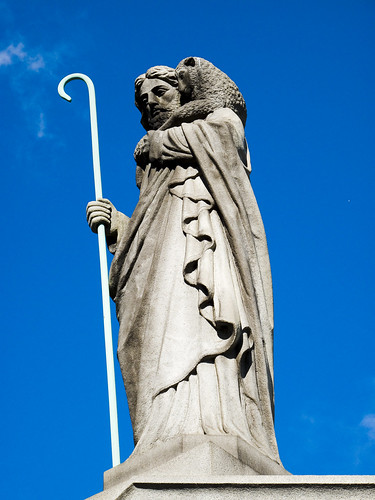
– photo by Mitch Waxman
The southern section of First Calvary, found atop the cyclopean masonry observed on Review Avenue, offers glimpses of the Newtown Creek and panoramic views of industrial Brooklyn. Framing the open horizon of marshy western Queens and the forges of Brooklyn is the Kosciuszko Bridge, heroically carrying a vehicular river called the Brooklyn Queens Expressway over the infamous cataract. The elevation of these walls is actually quite high, an arcing and non euclidean structure which must be 2 to 3 stories at its apogee.
Am I overestimating? Check out this shot from the “street level” declination, aimed at the downward slope from halfway down Review Ave.–
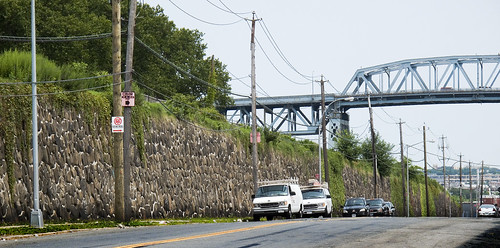
And the shots below are from the other side of it, the topside of the wall.

– photo by Mitch Waxman
You won’t find the grandiose tombs or obsequious monuments to the famous on this side of First Calvary. This is where the “regular people” are buried- in their multitudes- in neatly defined rows of plots. The northwestern sections of Calvary, where the main gates are, and the northeastern- along Laurel Hill Blvd.- (both “High Ground”) are where you can find the princes of the 19th century city. Here, along Review Avenue, is where the middle and working class rest.

– photo by Mitch Waxman
My reasons for coming to this section must remain hidden, for now, suffice to say that I am still hunting for the grave of a man named Gilman (see “Tales of Calvary 7” for more speculation on this mysterious merchant from Massachusetts). Enjoying the relative quiet, I noticed one of the concrete pillboxes which I’ve also alluded to in earlier posts. These structures are all over Calvary, are often padlocked, and have aroused no small amount of curiosity in your humble narrator.

– photo by Mitch Waxman
Several conjectures -an access point to buried family mausoleums, a storage unit for groundskeepers, some sort of equipment shed- have assailed me as I observed these structures with their heavy iron lids and stout cement construction. An avid devotee of the macabre, I’ve often wondered aloud about just what is is that may be down there.

– photo by Mitch Waxman
This particular structure, as you can see, had been left unlocked. In fact, its heavy lid was just resting on the cement and its hinges had long ago stopped functioning.

– photo by Mitch Waxman
Nudging the lid back a few inches, a better than six foot drop was observed, which put its bottom some 4 feet below the surface as observed in the shot above. I activated the camera flash and illuminated quite a bit of airborne dust when the camera performed its intended action. As you can see, there were two modern shopping carts and part of a lamp down there. Puzzling- not for being trash, but… for… why, how, when, etc. You’d expect shovels or spades, but shopping carts and a lamp?

– photo by Mitch Waxman
Were I still the youthful and robust physical specimen I once was, I might have more to say about this, as I would have entered the yawning mystery for a closer look. However, as an aged physical coward and feckless quisling given to emotional stupor and irrational panic, the miasmal odor of the open hatch drove me backwards and I nearly passed into one of my episodes. Fighting off a faint, I labored to close the heavy lid and made for the Penny Bridge gates found on Laurel Hill Blvd. to escape the implications of that smell, which reminded me of an aquarium in need of filtration.
What can it be, that might be down there?


