Archive for the ‘Queens’ Category
elysian realm

– photo by Mitch Waxman
This Saturday, for a change, we’re not going to present a “Project Firebox” posting, and will instead talk a little bit about the holiday weekend. What the British (or most of the rest of the world) might call a “bank holiday”, the truth of what the three day weekend represents is lost within the dross usage and little understood idioms of the modern tongue.
The truth of the term is met by merely sounding it out. This is a secular holiday, a “holi” “day”, or holy day.
From a representative democratic point of view and sensibility, this “holiday” is meant to be like Yom Kippur or Good Friday- serious business.
from a November 2009 posting, “Tales of Calvary 2- Veterans Day“, about the antipode of this seasonal holiday- Veteran’s Day (which discusses the monument in some detail)–
The statues here at Calvary’s Soldiers Monument seem to have been the original castings of a much reproduced statuary design. Placed here in 1866, they predate the identical statues found at Green-Wood Cemetery, and exact issuance of the mold has been confirmed in New England, North Carolina, and all over New York State. As early as 1875, fumes from a nearby Ammonia Factory at Newtown Creek were graving pitted marks into them.

– photo by Mitch Waxman
The original intent of the holiday was to honor the dead of the Civil War… well, all wars, supposedly… but they were really talking about the Civil War in 1868 when Memorial Day (then Decoration Day) appeared on the American Calendar. Someday the eleventh of September will replace Labor Day, as the term “Union” will mean little to future generations, and summer will end “officially” in the second week of the ninth month rather than the last of the eighth. Some politician will have assigned it a name by then- “Never Forget Day” or something, I’d wager.
There are some wounds which will never heal, even in the fullness of time.
from wikipedia
Memorial Day is a federal holiday observed annually in the United States on the last Monday of May. Formerly known as Decoration Day, it originated after the American Civil War to commemorate the fallen Union soldiers of the Civil War. (Southern ladies organizations and southern schoolchildren had decorated Confederate graves in Richmond and other cities during the Civil War, but each region had its own date. Most dates were in May.) By the 20th century Memorial Day had been extended to honor all Americans who have died in all wars. Memorial Day is a day of remembering the men and women who died while serving in the United States Armed Forces. As a marker it typically marks the start of the summer vacation season, while Labor Day marks its end.
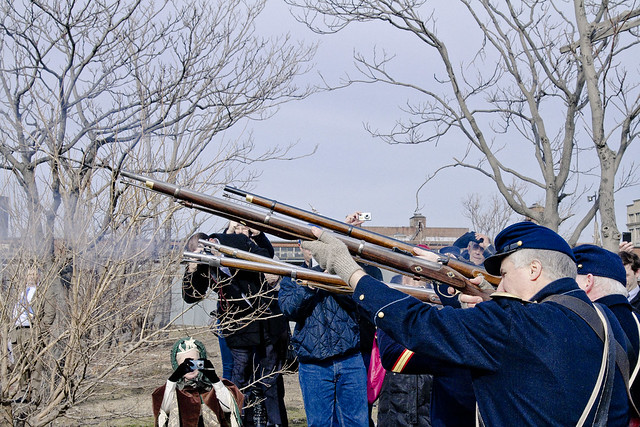
– photo by Mitch Waxman
The smell of BBQ will rise above Queens and Brooklyn, as always, and the Manhattan people will order take out Chinese and I really couldn’t tell you what will be happening in the Bronx and Staten Island. There will be parades of Veterans, kids will skin their knees playing ball, and many of their Moms and Dads will get way too drunk. Fatty meats and cold drinks will swell many bellies.
All the kids will get sunburns, and go to bed knowing that the freedom of summertime has finally arrived.
Somewhere far away, however, other American kids with rifles in their hands will nervously stare out into the darkness of the desert, or listen intently for movement at mountain passes, and desperately hope that this will be a quiet night. Their BBQ is back at base, and like freedom- home is infinitely far away.
from usmemorialday.org
Memorial Day was officially proclaimed on 5 May 1868 by General John Logan, national commander of the Grand Army of the Republic, in his General Order No. 11, and was first observed on 30 May 1868, when flowers were placed on the graves of Union and Confederate soldiers at Arlington National Cemetery. The first state to officially recognize the holiday was New York in 1873. By 1890 it was recognized by all of the northern states. The South refused to acknowledge the day, honoring their dead on separate days until after World War I (when the holiday changed from honoring just those who died fighting in the Civil War to honoring Americans who died fighting in any war). It is now celebrated in almost every State on the last Monday in May (passed by Congress with the National Holiday Act of 1971 (P.L. 90 – 363) to ensure a three day weekend for Federal holidays), though several southern states have an additional separate day for honoring the Confederate war dead: January 19 in Texas, April 26 in Alabama, Florida, Georgia, and Mississippi; May 10 in South Carolina; and June 3 (Jefferson Davis’ birthday) in Louisiana and Tennessee.

– photo by Mitch Waxman
The Memorial Day holiday was created by those who would implicitly understand the situation of the latter. They suffered the same sort of dysentery, horror, and mission- and also watched friends get cut down by anonymous artillery fire in some faraway land.
By the end of the Civil War, there were no victors, only survivors. These survivors wanted us to learn from their trials, and set an annual date for us to sit and think- long and hard- about how high a price certain things are worth.
The same can be said of the veterans of every mechanized “modern conflict” fought since the advent and introduction of the war machines in the 1860’s.
from nycgo.com
Memorial Day isn’t just an excuse for springtime sales and a three-day weekend—it is, first and foremost, a time to honor those citizens who’ve served the United States in times of war. NYC honors our fallen heroes with parades all over the City. The Little Neck–Douglaston parade in Queens is reputedly the largest of its kind. You can also attend Brooklyn’s Memorial Day Parade (145 years old!), which begins at Third Avenue and 87th Street. In Manhattan, head uptown for a smaller parade in Inwood that begins at Broadway and Dyckman Street. Check the City’s events calendar for a full list of events and start times.

– photo by Mitch Waxman
Given that this is also “Fleet Week”, might a humble narrator suggest that if you see a Marine or Sailor at the bar- have the bartender anonymously send over a beer on your tab.
Thanks of a grateful nation, and all that.
uncorporeal life

– photo by Mitch Waxman
Torment and dread dog my steps, while an inescapable clarion of shame and self doubt provides texture to an otherwise fetid expanse of despair. The person which one pretends to be in the company of others is mere facade, a vainglorious edifice erected solely for the selfish aggrandizement of a fool. In the cold realities and jurisprudence of inquisition, your humble narrator is little more than some assassin of joy, an avatar of meaningless experience, and chronicler of topics best forgotten or swept away.
from wikipedia
Anthropophobia is an extreme, pathological form of shyness and timidity. Being a form of social phobia, it may manifest as fears of blushing or meeting others’ gaze, awkwardness and uneasiness when appearing in society, etc. A specific Japanese cultural form is known as taijin kyofusho.
Anthropophobia can be best defined as the fear of people in crowded situations, but can also go beyond and leave the person uncomfortable when being around just one person. Conditions vary depending on the person. Some cases are mild and can be handled while more serious cases can lead to complete social withdrawal and the exclusive use of written and electronic communication.

– photo by Mitch Waxman
Vastly inadequate both personally and physically, the quaking surety of an intangible manifestation of malice lurking at my perceptual threshold is omnipresent, and solipsism rules. Extant paranoia and newfound phobias paint the landscape in thick impasto, with remote possibility and hazardous outcome providing chiaroscuro and contrast. Behind every unopened door or unexamined alley will surely lurk some horrible and quivering menace, perched lewdly on the threshold of sanity.
Truly- who can guess, all there is, that might be buried down there?
from wikipedia
Panphobia (from Greek πᾶν – pan, neuter of “πᾶς” – pas, “all” and φόβος – phobos, “fear”) also called omniphobia, pantophobia, or panophobia, is a phobia known as a “non-specific fear” or “the fear of everything” and is described as “a vague and persistent dread of some unknown evil”.

– photo by Mitch Waxman
Abandoned, bereft, confused, disillusioned, entangled, fragile, grandiose, histrionic, ipovlopsychophobic, jealous, kainophobic, limp, manic, narcissistic, onerous, passive, quadrumanous, repellant, sophistic, trite, unctuous, venal, xanthophobic, yonderly, and zoocytious- this is how your humble narrator spells his “abc’s”.
I’m all ‘effed up.
from wikipedia
In cognitive models of social anxiety disorder, social phobics experience dread over how they will be presented to others. They may be overly self-conscious, pay high self-attention after the activity, or have high performance standards for themselves. According to the social psychology theory of self-presentation, a sufferer attempts to create a well-mannered impression on others but believes he or she is unable to do so. Many times, prior to the potentially anxiety-provoking social situation, sufferers may deliberately go over what could go wrong and how to deal with each unexpected case. After the event, they may have the perception they performed unsatisfactorily. Consequently, they will review anything that may have possibly been abnormal or embarrassing. These thoughts do not just terminate soon after the encounter, but may extend for weeks or longer.
occasionally titanic

– photo by Mitch Waxman
Obsequious sarcasm will no doubt greet this posting, given the notion propagated by area wags that the Newtown Creek watershed is irrevocably poisoned, but early last week an expedition was mounted along the bulkheads whose express goal was to count and identify those avian lifeforms which inhabit its legend haunted shores.
Organized by the Newtown Creek Alliance Executive Director herself, our small party met in the wee hours of the morning at a coffee shop familiar to all residents of Long Island City and sallied forth.

– photo by Mitch Waxman
Two field experts consented to this mission, both familiar with the mores of ornithological clade and classification. Our group visited several sites which have often displayed a surprising diversity of birds, and over the course of our little expedition they described eleven distinct specie.
Every time that your humble narrator attempts to name a bird, corrections flood in, and accordingly this link is offered to the birdsbugsbuds.com blog by Shari Romar (who was one of the folks who undertook this trip) for genus, family, or common name. Additionally, Ross Diamond wrote a description of the day at this Newtown Creek Alliance page (wonder who that weirdo in the red baseball cap is, standing on the fence like he owns the place).

– photo by Mitch Waxman
One of the spots decided on for this mission was obvious, as the multiple decade long abandonment of the Maspeth Creek tributary by industrial interests has resulted in the formation of significant “habitat” along its wooded shorelines. Cursed by a large CSO (Combined Sewer Outfall) at its terminus, Maspeth Creek often exhibits large slicks of garbage, fats, and other sediments which find their way into the wastewater flow. Nevertheless, the decaying shorelines provide ample purchase for coastal grasses and other marsh plants to grow.
This vegetation, in turn, offers hiding places for small fish and crustacea which attract birds.

– photo by Mitch Waxman
Maspeth Creek has been, and often still is, used as an illegal dump- of course. These sunken automobiles are de facto “iconic” Newtown Creek shots, and often photographed by thrill seeking urban explorers- including your humble narrator.
What made my morning, however, was the cormorant hunting in the waters amongst them. As described in earlier posts, and by all accounts, there is a startling diversity of benthic and littoral life to be found here- in waters recently described by at least one NY State environmental official as “anoxic, and a dead sea”.

– photo by Mitch Waxman
Firmly held, your humble narrator clings to the belief that if the human infestation could only forget about finding new ways to exploit Newtown Creek and it’s tributaries- whether it be burning garbage to generate electricity, or the installation of vast new populations along its shores, or just finding a way to not have raw sewage belch filth directly into the water every time it rains– that nature itself would and could perform the necessary remediation of its poisons.
Adaptation and the evolutionary process, rather than some cold and industrial methodology, might be all that is required.
On the other hand, some mutant race of atavist cormorants might arise from the Newtown Creek, leading to the extinction of mankind itself so maybe we should just pave over the place- as suggested by certain members of the aforementioned community referred to as “area wags” at this, your Newtown Pentacle.
breakers lacerated

– photo by Mitch Waxman
Last Saturday, after conducting a walking tour of Dutch Kills for a group of enthusiasts, your humble narrator found himself walking up 35th street, and upon arriving at the street’s intersections with both 38th avenue and Northern Blvd.- I was moving past the titan Packard building.

– photo by Mitch Waxman
Engaged in conversation with Our Lady of the Pentacle, who helped out with the tour, I suddenly felt as if someone might be throwing crumpled up bits of paper at my back. Spinning around to confront my attacker, this swarm of bees was observed.
It had been bees bouncing off my back!

– photo by Mitch Waxman
One of the things I’ve learned about Queens is this- if something “should be done or said”, no one is going to do it, so you’d better do it yourself. Our Lady of the Pentacle sighed at this point and walked up the block to find a shady spot to sit down while I crossed the street and yelled “BEEs” at anyone who approached this spot.
After many years of marriage to one such as myself, she knew that the following would take a while and she might as well get comfortable.

– photo by Mitch Waxman
I called 911, and told the operator that there were a lot of bees swarming on the same corner as a subway stop, and was told that that’s not an emergency and that I should call 311. With a hearty “yes ma’am” I hung up and called 311.
The operator listened to my description of the situation, and asked me if I had contacted the property owner about the situation.
Attempting to explain that I was attempting to report a dangerous situation here on the streets of Queens, she interrupted me and chided that “I wasn’t letting her talk”. There no way, of course, that this situation would have been dealt with differently if I was calling about such a situation in say… Manhattan.
She continued that “bees are part of nature and that the City of New York doesn’t mess with nature”.
swept chill

– photo by Mitch Waxman
Laurel Hill Blvd. slouches roughly as it descends toward Review Avenue, where the Penny Bridge once stood and the Long Island Railroad once maintained a station and the Roman Catholic funeral ferries docked. Thrice damned, the Kosciuszko Bridge occupies the shallow valley between the so called Laurel Hill and an easterly elevation known as Berlin Hill. The whole zone was called Maspeth, or “bad water place”, by an aboriginal Lenape tribe called the Maespetche who are said to have coined this term for the marshy wetlands that lay between Sunswick and Newtown Creeks.
Native Americans as a people, it should be remembered, are famed for an ironic and well developed sense of humor, and these Maespetche just might have been having some sardonic fun at the expense of the naive Europeans who had just paid them a fortune for an insect infested swamp.

– photo by Mitch Waxman
Lonely and desolate, one such as myself can only feel succor in this kind of place. A hinterland not too far from the geographic center of a megalopolis whose tendrils stretch out hundreds of miles in every direction called New York City, this is one of the least walked stretches of pavement in the entire metropolitan zone. It’s where the Alsops, Brutnells, and Wandells chose to locate their farming operations and just up the hill from where a few hundred British soldiers were garrisoned during the revolutionary war.

– photo by Mitch Waxman
To the west lies Calvary, First Calvary, where Dagger John consecrated the soil of Protestant Newtown for the use of the Roman Catholic church. The elevation of Laurel Hill is quite apparent, here, as the 9 story General Electric Vehicle Company factory’s roofline is at eye level, and it is found at Borden Avenue and Starr- only a few blocks away. The hill was once a bit higher, but the construction of the cemetery in the 19th century removed a few hundred million tons of topsoil from it (the subject of a lawsuit in state court, wherein the farmers of Newtown sued the RC church, as the topsoil was shipped by to Jamaica Queens for use on the catholic plantations there).

– photo by Mitch Waxman
Turning widdershin, the first aperture available for transit into the most literal interpretation of the term “DUKBO”, literally “Down Under the Kosciuszko Bridge Onramp” is 54th avenue. Not unlike the sensation experienced on the spiral footbridge examined in the two postings preceding this one- “maddeningly untransmissable” and “danger-widespread“- the inveterate pedestrian feels as if a corridor of transition has been arrived at. One world exists at the entrance and something totally different will be found on the other side.
A titanic vibration is sensed rather than heard here, no doubt due to the pulsating waves of vehicular traffic crossing overhead.

– photo by Mitch Waxman
Nondescript and strictly utilitarian, there is nevertheless something quite unnerving about this overpass unrelated to any measurable stimuli. An odd sensation of loathing and imminent danger, as if some cackling, untoward, and quite unimaginable fiend was about to swing down from the overhead steelwork and claw at passerby. Despite this discernible and distasteful atmosphere of paranoid wondering, however, there is virtually nothing to see under here. The cement slab on the left of the shot is a sort of water catchment device.
Like all parts of DUKBO, there are businesses which operate in the underpinnings of the bridge, or in the shadow over the creek which has been cast from it since the 1930’s.

– photo by Mitch Waxman
Behind these oddly sinister gates are a couple of trucks and what appears to be a few “storage cubes” or small shacks, but nothing out of the ordinary or in any way noteworthy. Oddly enough, this street is routinely crossed by a city bus, which has a stop on the next corner. Speculation would be served if one was to postulate that this might have been the pathway which workers from Sunnyside or Woodside would have taken enroute to shift work at Phelps Dodge or Alloco, down by the Creek.

– photo by Mitch Waxman
The continuation of 43rd street, which was last tread on the other side of the highway in Celtic Park, begins at this point, after the cloverleaf onramps which provide the singular intersection of the Long Island Expressway and Brooklyn Queens Expressway complete themselves. This stretch of 43rd street will someday be the new DUKBO, and easement purchases for the new bridge have already seen nearby homes and business buildings shuttered and demolished.

– photo by Mitch Waxman
Reason and logic seldom count for much in the neighborhoods surrounding Newtown Creek, but one assumes that there exists an ancient municipal regulation which designates or zones this area as “the Crane district”.
Every block or two, it would seem, there is a corporate yard which hosts the sort of enormous building industry derricks commonly seen at work around the city. There’s one or two in Long Island City, of course, but there are a lot of these companies located in this neighborhood once known as Berlin- but now called either Laurel Hill or West Maspeth.

– photo by Mitch Waxman
Bizarre associations are often a curse for your humble narrator, and on the day I was walking through here- entering Berlin- I couldn’t help but notice that the cranes here bore the colors of the tricolor flag of the modern Deutche.
We’re going to leave DUKBO at this corner for the moment, but will continue along this route next week. Remember- the Kosciuszko Bridge project will be starting in 2013- this summer and fall will be your last chance to see this district of the Insalubrious Valley of the Newtown Creek as it is and has been.
August 23rd, 2012 will be likely be the last birthday of the Kosciuszko Bridge.


