Archive for the ‘Queens’ Category
Walking Tours in June

– photo by Mitch Waxman
Despite my loathsome appearance, abhorrent personality, and an unwholesome nature which engenders disdain from strangers- the walking tours of the Newtown Creek Watershed I’ve been conducting have all proved to be quite popular and in fact- have sold out. There have been one or two that I’ve publicized, and a few that were privately organized.
Demand has dictated that an expanded schedule of these walks, albeit punctuated by my incessant prattle, be offered.
To wit:
June 16th, 2012- Newtown Creek Alliance Dutch Kills walk

– photo by Mitch Waxman
The Newtown Creek Alliance has asked that, in my official capacity as group historian, a tour be conducted on the 16th of June- a Saturday. This walk will follow the Dutch Kills tributary, and will include a couple of guest speakers from the Alliance itself, which will provide welcome relief for tour goers from listening to me rattle on about Michael Degnon, Patrick “Battle Ax” Gleason, and a bunch of bridges that no one has ever heard of.
for June 16th tickets, click here for the Newtown Creek Alliance ticketing page
June 23rd, 2012- Atlas Obscura Thirteen Steps around Dutch Kills walk

– photo by Mitch Waxman
Additionally- the “Obscura Day” Thirteen Steps around Dutch Kills tour proved that the efficacy and charms of the Newtown Creek’s least known tributary, with its myriad points of interest, could cause a large group to overlook my various inadequacies and failings. The folks at Atlas Obscura, which is a fantastic website worthy of your attentions (btw), have asked me to repeat the tour on the 23rd of June- also a Saturday.
for June 23rd tickets, click here for the Atlas Obscura ticketing page

– photo by Mitch Waxman
The tours will cover similar ground, but approach the subject from differing angles. Both share the same dire warnings about traffic and footwear and the “boiler plate” offer is included below. As a rule, walkups are allowed, but be warned- when the group get to a certain size, I’m forced to refuse additional participants.
Buying a ticket in advance is your best bet.
Join Newtown Creek Alliance Historian Mitch Waxman for an intense exploration of Newtown Creek’s Dutch Kills tributary — found less than one mile from the East River. Dutch Kills is home to four movable (and one fixed span) bridges, including one of only two retractile bridges remaining in New York City. Dutch Kills is considered to be the central artery of industrial Long Island City and is ringed with enormous factory buildings, titan rail yards — it’s where the industrial revolution actually happened. Bring your camera, as the tour will be revealing an incredible landscape along this section of the troubled Newtown Creek Watershed.
Be prepared: We’ll be encountering broken pavement, sometimes heavy truck traffic, and moving through a virtual urban desert as we cross the currently undefended border of Brooklyn and Queens. Dress and pack appropriately for hiking, closed toe shoes are highly recommended.
Bathroom opportunities will be found only at the start of the walk, which will be around three hours long and cover approximately three miles of ground.
Meetup – At the Albert E. Short Triangle park found at the corner of Jackson Avenue and 23rd Street in Long Island City, Queens. This is the Court Square MTA station, and served by the 7, G, and M lines. Additionally, the Q39 and B62 buses have nearby stops. Check MTA.info as ongoing construction at Queens Plaza often causes delays and interruptions.
Drivers, it would be wise to leave your vehicle in the vicinity of the Pulaski Bridge in either Greenpoint or Long Island City.
June 30th, 2012- Working Harbor Committee Kill Van Kull walk

– photo by Mitch Waxman
My various interests out on the sixth borough, NY Harbor, have brought me into association with the Working Harbor Committee. A member of the group’s Steering Committee- I also serve as the “official” group photographer, am chairman and principal narrator of their annual Newtown Creek Boat Tour, and occasionally speak on the microphone during other tours (mainly the Brooklyn one). This year, the group has branched out into terrestrial explorations to compliment the intense and extant schedule of boat tours, and I’m going to be leading a Kill Van Kull walking tour that should be a lot of fun.
The Kill Van Kull, or tugboat alley as its known to we harbor rats, is a tidal strait that defines the border of Staten Island and New Jersey. A busy and highly industrialized waterfront, Working Harbor’s popular “Hidden Harbor – Newark Bay” boat tours provide water access to the Kill, but what is it like on the landward side?
Starting at the St. George Staten Island Ferry terminal, join WHC Steering Committee member Mitch Waxman for a walk up the Kill Van Kull via Staten Islands Richmond Terrace. You’ll encounter unrivaled views of the maritime traffic on the Kill itself, as well as the hidden past of the maritime communities which line it’s shores. Surprising and historic neighborhoods, an abandoned railway, and tales of prohibition era bootleggers await.
The tour will start at 11, sharp, and you must be on (at least) the 10:30 AM Staten Island Ferry to meet the group at St. George. Again, plan for transportation changes and unexpected weirdness to be revealed to you at MTA.info.
For June 30th tickets, click here for the Working Harbor Committee ticketing page
The Blissville Oil Spill, update

– photo by Mitch Waxman
Queries were sent out to various parties about the status of the Blissville Oil Spill on the Newtown Creek, and this statement was received from the good folks at Riverkeeper:
“Riverkeeper is concerned about the apparent lack of maintenance of both the hard and absorbent booms that are supposed to be keeping oil from seeping into the Creek,” said Phillip Musegaas, Hudson River Program Director at Riverkeeper. “We take any oil pollution in the Hudson River and NY Harbor extremely seriously, and fully expect DEC and the site owner to do the same.”
As an admission, these shots were gathered on board the Riverkeeper patrol boat, whose Captain was gracious enough to consent to my request to get close to the Blissville site.

– photo by Mitch Waxman
The situation of the Northern Bank of the Newtown Creek, in Queens, was first commented on at this- your Newtown Pentacle- in the December of 2011 posting “An oil spill… in Queens“, and further views were presented in March of 2012 in “Blissville Update“.
Kate Zidar, executive director of the Newtown Creek Alliance (a group of which I am a member and for which I serve as historian) said:
“If we have learned anything from the Greenpoint Oil Spill it should be that seepage from the bulkhead can indicate a much larger issue for the adjacent neighborhood. We can’t claim ignorance of what the seepage at this Blissville Site could indicate. We need to understand the extent of this contamination and get the right mitigations in place ASAP.”

– photo by Mitch Waxman
It should be mentioned that private conversations with State and City officials have continued, but not too much seems to be happening. The investigation into the matter is seeking out culpable parties, and deciding on a course of action to follow. In their defense, the officialdom referred to above very well might be legally constrained from public comment at this point, so I’m willing to give them a pass.
For now.
Of course, while everyone is figuring out who to sue, oil is still seeping out into the water.

– photo by Mitch Waxman
It’s no secret that the short end of the stick, from a municipal point of view, is offered routinely to Queens (and the Bronx) by the powers that are. Neither is it a revelation that if this were an ongoing event on the Hudson River that everybody from the Mayor and Governor on down would be posing next to it and rendering funding to seal things up tight.
This is however- the Newtown Creek- and in particular on the side of the Creek where the borough motto should be “Welcome to Queens, now go fuck yourself”, and I said that.

– photo by Mitch Waxman
A recent posting at the Newtown Creek Alliance website, detailing what Riverkeeper’s patrol experienced during a rain event on the Newtown Creek, showed that these booms are easily swept out of position but “Welcome to Queens”. This event has been ongoing since mid 2011 but “Welcome to Queens”. Wells sunk at nearby properties already administered by environmental officials have revealed some seven feet of oil sitting over the water table, but “Welcome to Queens”.

– photo by Mitch Waxman
Lords and Ladies, how long is long enough for oil to be directly seeping into area waterways?
Look at what is happening on the surface here and ask yourself the familiar question- Who can guess, all there is, that might be buried down there?
smoking gulf

– photo by Mitch Waxman
Ask anyone who lives here and they’ll tell you- Astoria Queens rules.
It’s one of the last places in New York City that actually still looks like New York City, and people who live here are generally idiosyncratic and gregarious types who enjoy life’s simpler pleasures wholeheartedly. The ancient village has its problems- of course, too much traffic, a disturbing amount of public inebriation, and when “it hits the fan” around here- things quickly tend to get messy.

– photo by Mitch Waxman
Our streets seem to be collapsing, our sewers back up routinely, everything costs too much, and the new neighbors are noisy. The kids have no respect for the older folks, and litter in a casual manner. The deli guys let bums drink in the back yards of their storefronts, and the social contract which dictates that one should find an appropriate commode for the elimination of bodily wastes seems to have been forgotten. We still haven’t forgotten about the “Great Astoria Blackout of 2006” or the week we spent in the dark while a proverbial “Emperor Nero” fiddled away in City Hall and claimed nothing was wrong.
City services are applied haphazardly (at best) here, except in the case of handing out fines to homeowners and businesses- something handled by the authorities in a fashion best described by the aphorism of “Russian Efficiency”.

– photo by Mitch Waxman
A background hum- caused by highways and rail yards and millions of air conditioners, automobile engines, and oscillating fan blades- colors the air. There is always some sort of yelling, invariably in some foreign tongue, within earshot. Alternatively- kids are playing and squealing with delight, old ladies shuck beans on their stoops, and old men gather in loose groups to complain about the Mets and Rangers or brag about their grandkids.
Everywhere, one might find sidewalk cafes and tavernas glistening with vibrant crowds.
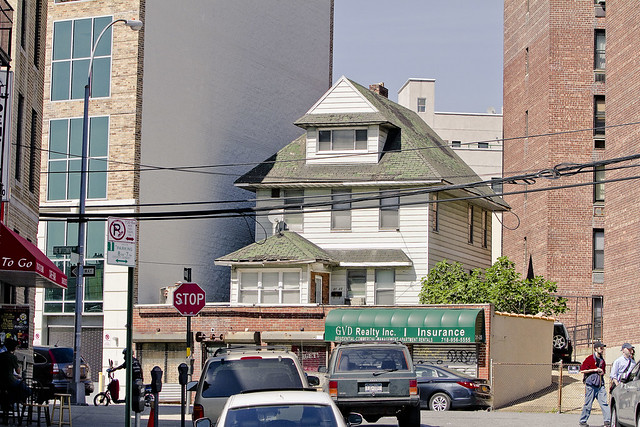
– photo by Mitch Waxman
Indecent development by the real estate industrial complex crowds in on the older building stock, disillusioning long time residents and inflaming the passions of preservationists, but what are you going to do about it? People have a right to do what they want with their own property, and the Astoria way is to mind your own business, unless something directly affects you. The interesting thing about Astoria, as well, is that the whole “race thing” isn’t so much of an issue here. The kids in the neighborhood don’t run in ethnic packs like they do in other parts of the city, it’s more a block by block sort of thing. Brazilian, Irish, Italian, Greek, Korean, Egyptian, whatever- they’re all just “one of the boys” from this avenue or that block or those buildings. Doesn’t matter- as they’re all spoiled rotten, don’t know how good they’ve got it, won’t amount to anything, had it too easy, and all the other things that the old ladies say while making a “tsk tsk” sound.
This is what one might see on the streets, what it’s like to actually live here, and this posting is a response to something someone said to me a couple of weeks ago while I was over in the city- the actual quotation was: “Astoria, I love it there, it’s so diverse”.

– photo by Mitch Waxman
What does that mean? Every description I’ve ever heard of Astoria starts with the “diverse” thing, which connotes that the standard for the rest of the world is rigid social segregation along racial and ethnic lines, and that Astoria is some sort of gulag for foreigners who haven’t figured out that they should shop for clothes at JC Penny at the mall on Queens Blvd. and learn to lose the accent. Additionally, on the “diversometer”, do we score higher than Flushing or Ridgewood or Greenpoint?
If one more Manhattanite asks me if I’ve ever been to a) Elias’s Corner, b) the Bohemian Hall, or c) the Museum of the Moving Image- a humble narrator might just go screaming off into the night.
Anyway, Astoria Queens rules.
You got a problem with that?
momentary panic

– photo by Mitch Waxman
I’ve got a boo-boo.
On May 12, your humble narrator conducted a walking tour of Dutch Kills and Newtown Creek which ended at the Newtown Creek Nature Walk in Brooklyn. Having concluded the day’s exertions, the pathway back to benighted Astoria followed the familiar route of crossing the Pulaski Bridge.
At mid span, I noticed a tugboat- the Franklin Reinauer- waiting for the bridge to open, and decided to take advantage of its static position to gather a few shots.

– photo by Mitch Waxman
Franklin Reinauer has been featured here in prior postings, and in an attempt to capture a slightly different angle of the vessel (as I’ve taken virtually identical shots of it from this very spot in the past), I decided to climb up on the weird wooden “art thing” which is installed mid span on the bridge.
Happy with the quality of light and the positioning of the ship in my shot, I noticed that the DOT bridge crew had shown up to open the Pulaski and allow the tug access to the Newtown Creek. Desire to get shots of the tug entering the Creek from below infected me and I tucked away my gear and attempted to dismount the “wooden art thing”.
That’s when it happened.

– photo by Mitch Waxman
The injury wasn’t severe enough to preclude me from flying down the stairs and getting the shots I desired, as evinced above and below, but the swelling had already started.
As I was climbing down from the “wooden art thing”, I put my left hand down to steady myself as I descended back to the deck. My left thumb then exceeded its normal course and bent approximately forty five degrees in the wrong direction. While I didn’t hear the cracking sound familiar to anyone who has broken a bone, there was a distinct and rather disturbing “pop” that travelled up my arm.
It immediately began to swell.

– photo by Mitch Waxman
By the time that the shot above was captured, an ugly and redolent bruise was spreading around the joint, and the big muscle at the heel of my hand (where the thumb joins the wrist) had swollen up and it appeared as if I had an apricot growing in the shallow part of my palm. Ibuprofen and an ice pack were applied back at HQ, and the swelling subsided after a day or two. Full range of motion, and normal gripping strength, were confirmed and no doctoring seemed to be required. Today, it is still sore, but on the mend.
This is the tale of my boo-boo.
At least I got my shots.
stately height

– photo by Mitch Waxman
Last week, the Saint Demetrios Cathedral here in Astoria held their annual street fair, and I had an opportunity to enter the church and wave my camera around a bit. Greek, or Eastern Orthodox as adherents would prefer, churches are a particular favorite of mine to visit due to the literally byzantine artwork and lavish ornamentation.
from saintdemetriosastoria.com
Saint Demetrios was born in Thesaloniki, Greece in 270 AD. He came from a wealthy family and because he was athletic in appearance and heroic in spirit, he became a high-ranking officer in the Roman Army at a very young age. (This is why he is depicted in Byzantine icons in military dress, either standing or riding a horse.) He considered himself a soldier of Christ first, and a military soldier second. He spent most of his time as a devout missionary, preaching the Gospel at secret meetings and converting pagans to the Christian faith.

– photo by Mitch Waxman
Every time that I do a posting about a church, someone invariably accuses me of being ignorant or attempting to smear an institution somehow. Seriously, this could not be further from the truth, as the last thing I want to argue with anyone about is religion. Politics yes, but religion no.
Funnily enough, the Greeks pretty much invented both politics and religion, as well as “arguing”.
also from saintdemetriosastoria.com
The very first organized meeting of Greeks included also the residents of Corona and took place on December 18, 1923 at the Archdiocese which was then located on 30th Drive in Astoria. Immediately following these few Greek families received permission from the then, Archbishop Rodostolou to attend services in the Archdiocesan chapel of St. Athanasios on 30th Drive. At that time, the first Greek School was established.
The people then felt a need to organize their own Church and in 1927 the ground on which St. Demetrios stands today, was purchased for $3,500. An architect was engaged and a $25,000 structure was agreed upon which could later serve as a basement for the someday completed structure of their dream.

– photo by Mitch Waxman
I’m not entirely sure if it was ok to be taking pictures in the Cathedral, and an older Hellenic woman was watching me carefully. If you don’t know any older Hellenic women, trust me on this, you don’t want them angry at you.
It ends badly.
The lady, however, did not adjure me to cease photographing, so I kept on clicking.
from holy-ny.com
In terms of architectural style, the building itself is reminiscent of older Byzantine churches. Its high arching stained glass windows are also reflective of a distinctly American style. Greek characters adorn each wall, and flags of Greece stand tall throughout.
The church offers a variety of different services, ranging from blessing a new office or home to holding services for those about to go to war. Funeral services are also provided, as well as exorcisms.

– photo by Mitch Waxman
A lovely stained glass window dominates the cathedral, depicting the annunciation. The last time that I was in this structure, a young priest described the windows as being the work of a famous artist and that it was a great coup for this congregation to possess them, however I can supply little additional detail on the artist.
from wikipedia
In Eastern Christianity Mary is referred to as Theotokos (Θεοτόκος=”God-bearer”). The traditional Troparion (hymn for the day) of the Annunciation which goes back to Saint Athanasius of Alexandria is:
Today is the beginning of our salvation,
And the revelation of the eternal mystery!
The Son of God becomes the Son of the Virgin
As Gabriel announces the coming of Grace.
Together with him let us cry to the Theotokos:
“Rejoice, O Full of Grace, the Lord is with you!”
The Feast of the Annunciation is one of the twelve Great Feasts of the church year. As the action initiating the Incarnation of Christ, Annunciation has such an important place in Eastern theology that the Festal Divine Liturgy of St. John Chrysostom is always celebrated on March 25, regardless of what day it falls on—even if it falls on Pascha (Easter Sunday) itself, a coincidence which is called Kyriopascha. The only time the Divine Liturgy may be celebrated on Great and Holy Friday is if it falls on March 25. Due to this, the rubrics regarding the celebration of the feast are the most complicated of all in Eastern liturgics. The Annunciation is called Euangelismos (Evangelism) in Greek, literally meaning “spreading the Good News”.

– photo by Mitch Waxman
In 2007, the Saint Demetrios congregation was robbed of a relic of the saint himself, which was later returned. While looking around for information on the Saint- I became interested in Myrrh, a term I’ve heard all my life but have never been quite sure what it meant. A sort of tree resin, I’m told it is used extensively by both Catholic and Orthodox churches for incense and other ritual usage.
Having grown up in the Jewish culture, such usage of resinous incense wasn’t part of the program, as we had Pastrami.
from nytimes.com
Detectives in Queens have cracked the case of a stolen church reliquary, the police said.
The reliquary — a sterling silver box containing a saint’s ankle bone — was stolen from the solea, a sanctuary platform, in front of the altar of St. Demetrios Greek Orthodox Cathedral in Astoria between noon and 2 p.m. on Tuesday, the police said. Church elders discovered the theft early on Wednesday, during morning prayers, said Fr. Dionysios Anagnostopoulos, who is the church’s archimandrite, a clerical dignitary ranking below a bishop.

– photo by Mitch Waxman
Informal and entirely incidental reading has suggested to me that both Myrrh and Frankincense were a standard carry for soldiers in the Roman military serving in the theaters of North Africa and the Near East. In a world without antibiotics, the two substances were used to treat wounds incurred in the field.
from wikipedia
One theory is that his veneration was transferred from Sirmium when Thessaloniki replaced it as the main military base in the area in 441/442 AD. His very large church in Thessaloniki, the Hagios Demetrios, dates from the mid-5th century, so he clearly had a large following by then. Thessaloniki remained a centre of his veneration, and he is the patron saint of the city.
After the growth of his veneration as saint, the city of Thessaloniki suffered repeated attacks and sieges from the Slavic peoples who moved into the Balkans, and Demetrius was credited with many miraculous interventions to defend the city. Hence later traditions about Demetrius regard him as a soldier in the Roman army, and he came to be regarded as an important military martyr. Unsurprisingly, he was extremely popular in the Middle Ages, and along with Saint George, was the patron of the Crusades.


