Archive for the ‘Queens’ Category
Tales of Calvary 12- The Lynch monument

– photo by Mitch Waxman
A magnificent and somewhat unique example of mortuary sculpture found at First Calvary Cemetery here in Queens is the Lynch monument. The screeds engraved on it indicate the presence of several generations of the family, and the quality of the stone work indicates that the Lynches were notable figures during their time. As mentioned in the past, however, when one is searching for information on individuals with a “common” name (particularly a common Irish surname) – things get a little hazy. There have been a lot of folks, both famous and infamous, named “James Lynch”.
Here’s what I’ve been able to positively attribute to this James Lynch, and a promising (tantalizing actually) but false lead…

– photo by Mitch Waxman
When James Lynch’s will was read, it caused quite a stir- it seems that the inheritance he left for his widow and children was in excess of 1.5 million dollars (in 1873, mind you), or so says the NYTimes.com archives. Now, 1.5 million in 1873 was a heck of a lot more money then than now- which means that this fellow was “somebody”. But who?
The archive article denoting the disposition of his will puts the family residence at 129 East 21st street in Manhattan- a tony and somewhat aristocratic address in 1873 (and today) located near Gramercy Park. Teddy Roosevelt, for instance, was born around the corner in 1858 and other neighbors included Samuel Tilden, Peter Cooper, and George Templeton Strong.

– photo by Mitch Waxman
The false lead– I suspected that this might be the same James Lynch (of Tammany) who aroused the ire of the future “paper of record” with a controversial order to the Warden of Bellevue Hospital in 1860 that remanded the bodies of the poor to scientific study (medical schools) and the inquiry of the vivisectionists (coroners).
quoth from the nytimes.com archives
All non-professional men who have ever had occasion to visit a dissecting-room, can well understand the intense loathing and horror with which even condemned malefactors shrink from that portion of the death-sentence which delivers over their bodies after execution to be dissected for the instruction of medical students. No sight can be imagined more revoltingly hideous and horrible than the scientific shambles in which human carcases are cut up, disemboweled, torn limb from limb, dissected and tossed from hand to hand by the young acolytes of surgical science. Half a dozen bodies in this way come to be mingled together in one disgusting mass of flesh, bone, tissues, hair and bowels. Different students carry off particular limbs or organs for home dissection; and then the mingled remains are placed in sacks and carted away at midnight, to be dumped out of sight in whatever sinks or holes the surgeons may have selected for this purpose.
But, alas, I was incorrect.

– photo by Mitch Waxman
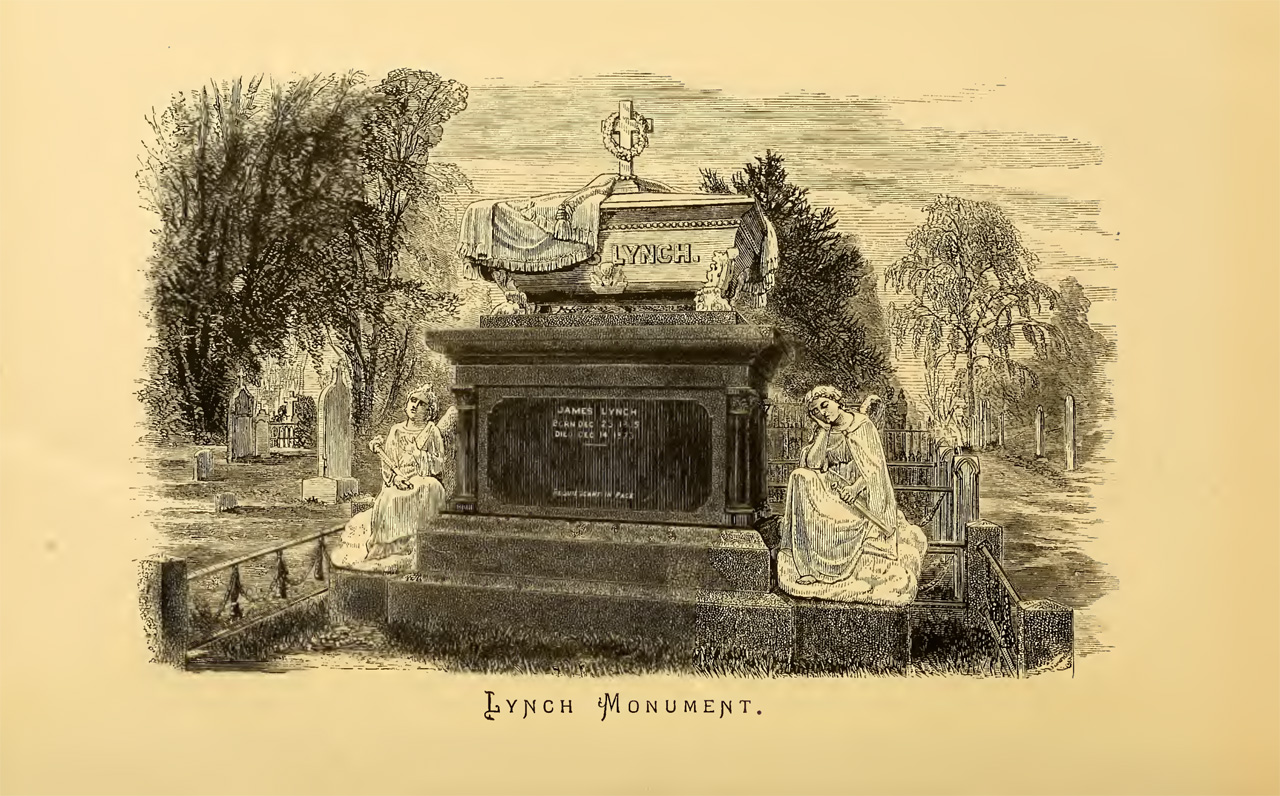
click image for a larger and more detailed incarnation
The illustration above, as well as the following text originate in John J. Foster’s “Visitor’s Guide to Calvary Cemetery” published in 1873
Plot O, Range 9, which is a little to the north of the resident clergyman’s dwelling, (and of which we give an illustration).
It is in the classic style, and consists of a superstructure of solid Quincy granite, in the form of a tomb, with polished columns supporting its entablature, surmounted by a draped sarcophagus, in one entire piece, of the finest Carrara marble. At each end of the base of the tomb, seated on clouds, is an angel, one with a trumpet, to call to judgment; the other emblematic of immortality. These figures are separate memorials. The former having been erected to the memory of the late Miss Katie Lynch, and the latter to the late Miss Agnes Lynci, his two daughters.
The whole work rests on a vault constructed after the style of the old Roman catacombs.
Mr. James Lynch was born December 23, 1805, and died December 14, I873. For nearly thirty years he devoted his attention to the grocery business on an extensive scale, in the city of New York, and retired with a competency in the year 1853. He was a favorite with all who enjoyed his acquaintance, and was well known to the public through his good offices and his manifold services in the advancement of all wise and charitable undertakings that came to his notice. The lively interest he excited in all who knew him secured for him many constant friends who now mourn his loss. His good deeds still survive him. The name of such men should be preserved.

– photo by Mitch Waxman
Clicking on the 1873 illustration, one observes that the only name on this monument when it was drawn was that of the sire of the clan. Scrutiny of the image also reveals an extensive series of footing stones, rails, and decorative plot demarkations which have not survived the century. Additionally, the entire family seems to be accounted for on the monument, with the last interment (Mary Ann) listed as 1922.
I was able to find a scant mention of Emily F. Lynch in the obituaries of the NYTimes.com archives. She lived at 405 Park Avenue, and died there as well.

– photo by Mitch Waxman
In addition to the remarkable centerpiece of the monument, one observes the presence of two weeping angels at the tomb, the presence of which are described in the quoted text as having been installed as separate monuments to Mr. Lynch’s daughters.
Like many of the fine marbles and ornate carvings extant at Calvary Cemetery, long exposure to the toxic atmospheres produced by the industries of the nearby Newtown Creek has badly damaged these sculptural elements, imparting an impression that the stone is melted or rotting away.
This isn’t far from the truth- the nearby Phelps Dodge (then called General Chemical) was actually sued by Calvary’s Board of Trustees in the late 19th century regarding the airborne exhaust of their brimstone based acid manufacturing business and its noxious effluents, and the concept of petrochemical pollution creating “acid rain” is well known to modernity.
from queenslibrary.org
On the plant grounds, General Chemical erected the tallest chimney in the United States to blow the smoke and gases from its furnace away from the neighborhood. For the past number of years neighbor surrounding the plant complained vociferously about the pollution from the factory. Only after a study found that nitric, muriatic, and sulphuric acids from the plant were destroying local cemeteries’ tombstones did the company try and alleviate the problem by building the chimney. This same year the company filed plans with the New York City’s Department of Buildings in Queens to build another 150 foot chimney, an ore breaker, a storage tank, a boiler house, and a stable.

– photo by Mitch Waxman
The NYTimes archives also present a short death notice for Peter W. Lynch, of 253 west 62nd street, whose death corresponds with the date ascribed to Peter W. Lynch on the stone. I have no way of determining if this is the same man, however.
I could find nothing on Katie, but this is not uncommon for the era, as women seldom received mention if they weren’t scandalous, married to, or the mother of a famous man.

– photo by Mitch Waxman
James D. Lynch died at a 120 West 21st street address in 1917, just down the block from the patriarch’s house. Mary Ann and E. Louise seem to have escaped notice when they passed.
Like many of the older plots at Calvary, which once sat long avenues and lanes which were meant to remain as such, the Lynch monument is surrounded by more modern graves. Such is the lot of older cemeteries, whose financial realities demand that new interments must be made in order to maintain the ongoing operations of the enterprise.
A plot purchased in the 1860’s, after all, hardly figured in the cost of 150 years of groundskeeping. This created no small amount of controversy in the past amongst the descendants of those who lie here, but in the end, Calvary prevailed. This is why you’ll often observe modern grave markers peppering around the edges of grandly august Mausolea.

– photo by Mitch Waxman
Hey, you never know what you’re going to find at Calvary Cemetery in Queens.
for silver
“Newtown Creek for the Vulgarly Curious” is a fully annotated 68 page, full-color journey from the mouth of Newtown Creek at the East River all the way back to the heart of darkness at English Kills, with photos and text by Mitch Waxman.
Check out the preview of the book at lulu.com, which is handling printing and order fulfillment, by clicking here.
Every book sold contributes directly to the material support and continuance of this, your Newtown Pentacle.
Project Firebox 15

– photo by Mitch Waxman
The seldom trammeled but often traversed intersection of Skillman Avenue, 43rd Avenue, and 32nd Place alongside the titan Sunnyside Yard is home to this wounded veteran. Here’s a google maps “street view” shot of it in happier times.
A cursory examination of the nycfire.net forums has at last revealed a discussion of the prevailing logic governing the odd numbering system which codifies the alarm boxes, and discusses why you’ll often see the base and stump of an alarm box left in place years after the actual alarm has been removed. Check it out here.
gentle manner

Combined Sewer Outfall BB-013, from the Pulaski Bridge – photo by Mitch Waxman
To begin- I warn you- this post will most likely “gross you out”.
In 1674, Boyle said: “I have often suspected, that there may be in the Air some yet more latent Qualities or Powers differing enough from all these, and principally due to the Substantial Parts or Ingredients, whereof it consists. For this is not as many imagine a simple and elementary body, but a confused aggregate of ‘effluviums’ from such differing bodies, that, though they all agree in constituting by their minuteness and various motions one great mass of fluid matter, yet perhaps there is scarce a more heterogeneous body in the world”.
When the pithy observation was recorded, “effluviums” were the central notion behind the miasmatic theory of disease.

CSO Outfall NC-077, Maspeth Creek, discharges 288.7M gallons per year into English Kills – photo by Mitch Waxman
The viewpoint of the learned classes in prior ages held that when certain noxious vapors produced by a mingling of soil with that standing water typically found about marsh, swamp, and sewer- then mixed with the cool night air- form so called miasmas (which is an ancient greek for pollution, I’m told).

CSO Outfall NC-077, Maspeth Creek, Tier 2 outfall – photo by Mitch Waxman
These miasmas- or “epidemic influences”- were believed to be the cause of Cholera and Typhus– and all the other plagues which would one day scythe through the crowded 18th and 19th century cities of the Industrial Revolution.
Vitruvius, in the 1st century BCE, said: “For when the morning breezes blow toward the town at sunrise, if they bring with them mist from marshes and, mingled with the mist, the poisonous breath of creatures of the marshes to be wafted into the bodies of the inhabitants, they will make the site unhealthy.”

CSO Outfall NC-077, Maspeth Creek, Ranked 25 out of over 400 in terms of volume – photo by Mitch Waxman
The air produced by, in, and around a sewer is typically an aerosol of whatever liquid solution might be floating through it. Hydroden sulfide, carbon dioxide, methane, ammonia and a host of other constituent compounds mingle and form what is generically known as “Sewer Gas”. Typically, this gas has the sulfurous smell commonly associated with rotten eggs. Otherwise lacking and poor, the average human’s sense of smell can discern this odor when its concentration in the surrounding air is minor- which speaks to an evolutionary quirk.
Obviously- our ancestors who could not detect this aerosol, or miasma, died off while while those who could detect them passed on these sensitivities on to future generations.

CSO Outfall BB-026, Dutch Kills – photo by Mitch Waxman
If you suffer from Obsessive Compulsive Disorder, this would probably be a good time to stop reading this post, incidentally. Things are about to get ugly.
As an example- When a toilet is flushed, and there is scientific evidence to back this, a plume of microscopic droplets- an aerosol– erupts from the water. These droplets carry microbes and virus particles, which then settle on surfaces around the commode facilitating the “surface to hand to mouth” vector of infection. Modern plumbing does its best to minimize this bioaerosol in the house, but routine antimicrobial maintenance with bleach and other chemicals is necessary to sterilize the potential infections which might otherwise occur.
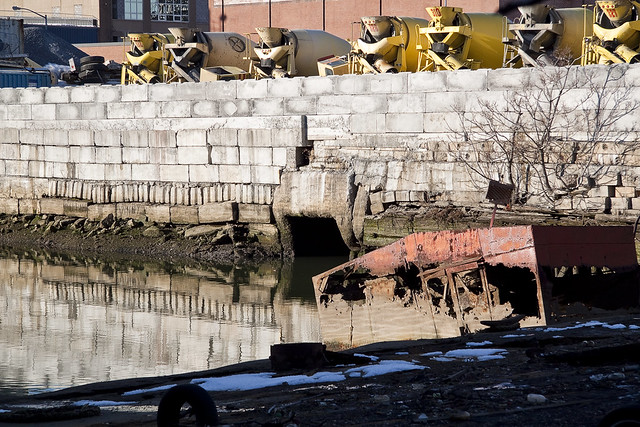
CSO Outfall BB-026, Dutch Kills – photo by Mitch Waxman
Of course, these cleaning chemicals- along with non neutralized microbes- end up in the wastewater flow, and make their way into the sewers… just like the petroleum products, volatile organic chemicals, and everything else that the human hive produces… where they swirl about beneath the streets and follow gravity to low lying areas. A properly designed system intercepts these waters, but in the case of a “CSO”, a lot of the poison makes it into the mud.

CSO Outfall BB-026, Dutch Kills – photo by Mitch Waxman
A classic example of a bacterium whose spread is defined by such aerosol dissemination is Legionella, but heavy metals and other contaminants may also find a pathway into the human body via such aerosols (let’s just call it vapor or fog). Additionally, fibers of toxic manmade substances- Asbestos for instance- are left behind during evaporation. Such deposits are then picked up on the wind, as are the dusty remains of the putrescent particulates which escape treatment by wastewater industries like the Newtown Creek Wastewater Treatment plant in Greenpoint or the Bowery Bay facility in Astoria.
During heavy rain events, some untreated sewage reaches the rivers, but a large percentage of it- the lion’s share- oozes out from the bulkheads of that assassination of joy called the Newtown Creek.

CSO Outfall NCB-632 – photo by Mitch Waxman
The Newtown Creek and its tributaries are indeed waterways, but no one ever discusses this plume of disease and contamination in the air. Fingers are pointed at certain chimneys and infamous underground lakes of petroleum and chemicals, heated discussions of when it might be safe to kayak or swim in the water are offered by interested parties, and odd admissions that there are some who actually fish in and consume the catch from these waters (which according to the EPA, are offering this catch for sale in area restaurants) both shock and titillate area wags- but what about the miasmas?

CSO Outfall NCB-632 – photo by Mitch Waxman
The sewer system of New York City is a composite beast, marrying together the municipal infrastructure of multiple communities into a single system. The cities of Brooklyn, Queens, and Manhattan (the historically agrarian and until modernity- lightly populated – Bronx has almost always been ruled over by Manhattan) each had their own standard, staring elevation, and set of regulations governing the sewers.
This NYTimes.com article from 2008 discusses recent attempts to consolidate and digitize the municipal record, and make sense out of the byzantine network of pipes which underlie the city.

CSO Outfall NCB-632 – photo by Mitch Waxman
Who can guess, all there is, that might be buried down there?
Who can speculate, all there is, which might be wafting out from these deep channels of filth and what strange aerosols are carried upon the gentle breeze- here in the Newtown Pentacle?
pitying smiles

– photo by Mitch Waxman
Inveterate pedestrians who frequent the primary arteries of Queens will tell you that are few City streets like Jackson Avenue in Long Island City.
As the ancient thoroughfare slides past the Megalith at Court Square, one might observe- if atmospheric condition and time of day permit- the curious reflections cast by the mirror skin of the towering structure. Not long ago, a member of the cultural intelligentsia named Heidi Neilson published her novel and intriguing “Long Island City Sundial” concept, which describes the inverse of the what you’re seeing above.

– photo by Mitch Waxman
At Queens Plaza, where the first phase of the titan “Gotham Center” construction envisioned by the Tishman Speyer corporation nears completion, I’ve noticed a similarly reflective affect taking place as the burning thermonuclear eye of god itself plays across the polished and curiously curved mirror glass serving as its architectural facade (and curtain wall) which is tangentially similar to that observed at Court Square, just a few blocks away.
As a note, the recent posting “progress” follows the construction of the structure from the ground up and from every corner of the Newtown Pentacle in a slideshow format.

– photo by Mitch Waxman
Queens Plaza is a notoriously difficult environ for the photographer with it’s rich collection of elevated and shadow gathering steel trackways and their cyclopean aspect- it’s dark and dirty and the very air you breathe is a poisonous fume (due, no doubt, to the uncountable number of vehicles transiting it at any given moment). Vast inventories of vehicles, variegated and numerous, move in short bursts as they ache in traffic in order to transit to and from Queensboro.
What the place has always needed, required in fact, is merely better lighting!

– photo by Mitch Waxman
The seamless robe of that gloom and soot and hurried transit which 150 years of breakneck growth hath wrought seems to have finally been rent by the reflective light emanating from the new structure, illuminating the dimly lit and misunderstood bridge plaza. Lighting like this would be too expensive for the ordinary photographer or cinema “Auteur” to manufacture, especially given that at this location, and as the day progresses- the relections follow and present the inverse position of the burning thermonuclear eye of god itself as it rolls across the sky.
I would add that it is extremely uncomfortable to be in the direct path of these reflections or wander into one unexpectedly, as (given the permanent twilight around the rest of Queens Plaza) one’s pupils contract precipitously in the same manner as they might if a sudden camera flash erupted in an otherwise comfortably lit room.

– photo by Mitch Waxman
Strobing, the light returned from the reflective “blue with a hint of green” colored glass of the Gotham Center building is cool in temperature.
Studies in “color psychology” conducted by municipalities all around the world suggest that public area illumination accomplished and designed to utilize the blue frequencies of visible radiation suffer fewer incidents of public disobeyance, misdemeanor and felony incidents, and that other beneficial psychological effects are evidenced. For instance, the Keihin Electric Express Railway Co. of Yokohama (amongst others in Japan) installed blue lights at stations with high numbers of suicide attempts, Glasgow is apparently all about the blues, and the Police in Nara, Japan report a 9% drop in crime under blue lighting.
Perhaps this gigantic soft box in Queens Plaza is actually a mechanism designed to help quiet anticipations of a restive future population? It is meant to house the City’s Department of Health, after all.
This sounds like hippie talk to a humble narrator, however.


