Archive for the ‘Things to do’ Category
A walk around Hallet’s Cove
Feel like taking a walk? Bring your camera, and ID…

the grill on the dome light says “the lordship”- photo by Mitch Waxman
Hallet’s Cove is the area surrounding the Noguchi Museum and Socrates Sculpture Garden at the border of Astoria and Ravenswood, although it was once the name for the entire village that became Astoria.
Well known to the residents of modern Queens due to the presence of a warehouse operation called Costco, and to its ancient citizens for the ferries to Blackwells Island and Manhattan- Hallet’s Cove is less well known for its industrial history, and the machinations of real estate interests in the locale are obvious to the knowing eye. The times are a-changing, indeed.
from wikipedia
Beginning in the early 19th century, affluent New Yorkers constructed large residences around 12th and 14th streets, an area that later became known as Astoria Village (now Old Astoria). Hallet’s Cove, founded in 1839 by fur merchant Steven Halsey, was a noted recreational destination and resort for Manhattan’s wealthy.
During the second half of the 1800s, economic and commercial growth brought about increased immigration from German settlers, mostly furniture and cabinet makers. One such settler was Heinrich Engelhard Steinweg, patriarch of the Steinway family who founded the piano company Steinway & Sons in 1853, which today is a worldwide piano company. Afterwards, the Steinways built a sawmill and foundry, as well as a streetcar line. The family eventually established Steinway Village for their workers, a community that provided school instruction in German as well as English.
In 1870, Astoria and several other surrounding villages, including Steinway, were incorporated into Long Island City. Long Island City remained an independent municipality until it was incorporated into New York City in 1898. The area’s farms were turned into housing tracts and street grids to accommodate the growing number of residents.

Socrates Sculpture Park – photo by Mitch Waxman
Socrates Sculpture Park presents the picture that the modern City wants you to believe about these “up and coming” corners of river front property. Middle and upper class citizens improving their minds and bodies in a clean and safe environment of esthetic esteem- the epitome of the physical culture movement’s dreams for the urban environment. Nothing wrong with that, of course, and for sporting pursuits and cookouts- the nearby Rainey Park is available to their coarser neighbors from the Ravenswood or Astoria Houses who might not be interested in Yoga- but the neighborhood is becoming a little too “Ayn Rand” for my tastes. There is another side to this place, of course, off the beaten path.
from wikipedia
Socrates Sculpture Park is an outdoor exhibition space for sculpture. It is located at the intersection of Broadway and Vernon Boulevard in the neighborhood of Long Island City, Queens, New York City, United States, North America. In addition to exhibition space, the park offers an arts education program and job training.

A block away from Socrates Sculpture Park – photo by Mitch Waxman
Aboriginal swamplands were conquered in the late 19th century, as the floods of the Sunswick Creek and the East River were tamed by the enterprise of engineers. The industrial mills and combines of Long Island City and Ravenswood extended all the way to Astoria Point, exploiting the valuable river front. In modernity, this is another corridor of dirty industry being swept aside to make room for an urban population bursting at the seams, with little regard for the past or present. Deemed underutilized, experts have named the area as an industrial relict, better demolished than preserved.
If one leaves the carefully mapped walking paths suggested by city planners, another picture emerges. Generations have quietly made lives here, in noble homes whose architectural influences suggest hints of the nautical culture of eastern Long Island and New England.
from socratessculpturepark.org
Socrates Sculpture Park was an abandoned riverside landfill and illegal dumpsite until 1986 when a coalition of artists and community members, under the leadership of artist Mark di Suvero, transformed it into an open studio and exhibition space for artists and a neighborhood park for local residents. Today it is an internationally renowned outdoor museum and artist residency program that also serves as a vital New York City park offering a wide variety of public services.
This is what the Queens waterfront used to look like, notice the small stature of the buildings, except for the Piano factory, since converted over to Condos.


Horror at Hallet’s Cove- Nelson’s Galvanizing site 2010- photo by Mitch Waxman
Across the Newtown Pentacle, where a speculative real estate bubble has recently burst, empty lots are fenced off from their environs. Unlike the abandoned lots of ground that peppered the landscape of New York in the 1970’s and 80’s before the bubble, these patches of shattered masonry are not abandoned- instead they are being held in reserve for future usage. Rapid demolition of these properties follows the quiet acquisition of said lots, to hasten the building process when economic times are better and to head off environmental or historical concerns about erasing possibly significant structures. In the case of this property, Newtown Pentacle readers may remember an examination of the “Nelson Galvanizing” site- titled “The Horrors of Hallet’s Cove“- and the multiple links to various environmental violations assigned to it by the City and State of New York. This is going to be the home of a future apartment house, incidentally.
photo from the “The Horrors at Hallet’s Cove posting”

Horror at Hallet’s Cove- Nelson’s Galvanizing site 2008 – photo by Mitch Waxman

Vernon Blvd. and Broadway – photo by Mitch Waxman
On the corner of Vernon Blvd. and Broadway, with the aforementioned Sculpture Park at my back, the comical Greenstreets sign on a traffic island- surrounded on all sides by “warehoused” former industrial building sites. Large tracts have been demolished to make way for future construction of multiple story, Manhattan style, apartment houses. Underserved by mass transit as it is, with a sewer system designed in the 1920’s, this is the Hallet’s Cove of 2010.
For the Hallet’s Cove of 1840, click here to check out a map and street necrology from pefagan.com

– photo by Mitch Waxman
Formerly one of the tallest residential buildings in the area, this enigmatic survivor of “the good old days” is dwarfed by the newly built tower rising menacingly some 2 blocks away. Just to make myself clear, I’m not anti anything, and regard such development work as inevitable and completely out of my hands. This angers and frustrates colleagues and friends in the antiquarian community, who view this pragmatism as acknowledging defeat, a tacit surrender to the princes of the city and their claims of oligarchal inevitability. In reality, I’m just trying to see all sides of the story.
Always, I must remain an Outsider.
from nydailynews.com
Undaunted by the floundering housing market, a New Jersey real estate firm is looking to build 2,400 residential units on the Astoria Peninsula, the Daily News has learned.
Lincoln Equities of East Rutherford has a contract to buy five parcels of land once used for manufacturing on First Ave., along the portion of the East River waterfront known as Hallets Cove.
Lincoln plans to bulldoze several warehouses on the land and build five residential buildings, one of which would rise 40 stories, company officials said.
“We don’t know what the market will indicate, but it is our intent to have a blend of rentals and condos,” said Hank Sheinkopf, a prominent Democratic political strategist who has been hired as a spokesman for the project.
The project, known as Hallets Point Development, would require the zoning be changed from manufacturing to residential.
Formal plans, which also could include ground-floor retail space, are expected to be submitted by the end of the year.
The proposal would join a growing list of high-density residential developments under construction or planned for the Long Island City waterfront – a list led by the state’s Queens West megadevelopment in Hunters Point and the city’s proposed Hunters Point South community.
Sheinkopf said 20% of the 2,400 units will be affordable housing, but it was unclear how the prices for the project, which is privately funded, would be determined.

– photo by Mitch Waxman
Ultimately, the shocking scale of these new structures dwarf the surrounding neighborhoods- blocking the panoramic views and open skies of a formerly 2 and 3 story cityscape, where a large structure was 5 stories. Philosophically, I tend to regard LeCorbusier style tower parks (and gated communities on the whole) as anti-democratic and very bad for the future of the Republic, as it tends to isolate political centers away from each other and foists an unsustainable population onto local streets and sewers. Like many of these new towers, parking amenities are planned into the structure, but that too brings more traffic onto the local streets which were not designed to handle the increased load. Quality of life in the City of New York is more than just law and order, lords and ladies of Newtown, it’s streets and sewers and electrical infrastructure.
The Hallets, from the Annals of Newtown
William Hallett, their ancestor, was b. in Dorsetshire, Eng., in 1616, and emigrating to New-England, joined in the settlement of Greenwich, Ct., whence he removed to Long Island, and acquired a large estate at Hellgate. (See pp. 29, 63.) In the fall of 1655 the Indians destroyed his house and plantation at Hallett’s Cove, which induced him to take up his residence at Flushing. Here he was appointed sheriff in 1656, but the same year was deposed by Stuyvesant, fined and imprisoned, for entertaining the Rev. Wm. “VVickenden from Rhode Island, allowing him to preach at his house and receiving the sacrament of the Lord’s Supper from his hands. Disgusted at this treatment, Mr. Hallett, on the revolt of Long Island from the Dutch, warmly advocated the claims of Connecticut ; and, being sent as a delegate to the general court of that colony/he was appointed a commissioner or justice of the peace for Flushing. Afterwards he again located at Hellgate, where he lived to the age of about 90 yrs. He had two sons, William- and Samuel,6 between whom, in 1688, he divided his property in Hellgate Neck.
2.. William Hallett, eldest son of William,1 received that portion of his father’s lands which lay south of the road now forming Greenoak, Welling, and Main streets, and Newtown avenue; which road divided his possessions from those of his brother Samuel on the north

– photo by Mitch Waxman
Shot from the Queensboro Bridge, with mighty Triborough and Hells Gate in the background, that’s Big Allis on the left- just for scale. Hallets Cove, where the Sunswick Creek once drained into the East River, is located roughly across the street from the large new building on the right.

– photo by Mitch Waxman
The strip of bare shoreline, a rarity along the East River, is the actual sandy beach of Hallets Cove. During the summer, kayaks are launched from here- I believe courtesy of the LIC Boathouse– but I may be incorrect. Looking south, one sees Blackwells- oops- I mean Roosevelt Island, and Manhattan commands the horizon. Interesting to some may be the observation that in New York, up until recent times, when an entrepreneur was building a new venture in an existing community, it was expected that other improvements would follow- whether roads, streets, or schools.
from the Greater Astoria Historical Society
HALSEY, Stephen Alling.
He donated a tract of land, 100 by 200 feet, extending from Academy street to First Avenue, for school purposes. A commodious school house was shortly afterwards erected on this site, which is to-day used by the Fourth Ward school. He invested in other property, in almost every instance showing his progressive spirit by laying out streets, grading them, &c. The ferry (then running to 86th street) was owned by him up to 1860, and he it was who placed the first modern ferryboat on the line.
He was a great lover of horticulture, and in the garden in front of Capt. Monson’s house on Fulton street may be seen some of the largest Magnolia trees on Long Island, 75 feet in height, planted by him. He had a particular admiration for shade trees which he gratuitously gave to parties desirous of planting shade trees in front of their property. The fine Elms on Washington street and Perrot Avenue still stand as specimens of his planting.

– photo by Mitch Waxman
Now, I go to a lot of places that most people would consider insane, but the folks at undercity.org have actually been down in the sewers beneath Astoria. Check out their gallery and adventures which truly do answer the question- who can guess what it is, that may be buried down there? – Click here.
The folks from watercourses have been through here as well- check out their Sunswick Creek page, with maps.
also, from the Greater Astoria Historical Society
Sunswick Creek. A drained marsh near the foot of Broadway. Scholars believe it may come from an Indian word “Sunkisq” meaning perhaps “Woman Chief” or “Sachem’s Wife.”

– photo by Mitch Waxman
Finally- check out this nytimes.com 1914 article, which describes following a “forgotten-ny” style mapping and exploration of the city along a path forged by by Sarah Comstock in 1849. The map she followed was called “12 miles around New York” (map at new york public library, of course- and check out Comstock’s “Old roads from the heart of New York” at archive.org). She starts with a journey on the Astoria Ferry from 86th street in Manhattan to Hallet’s point and continues through the Newtown Pentacle all the way to the ancient town of Flushing, as well as other destinations.
as it turns out, treadsoftly, a blog I like, rolled through here at the beginning of the week. Check it out.
A Great Machine

Queensboro Bridge and associated structures- “The Great Machine” – photo by Mitch Waxman
Queensboro, whose steel has cantilevered the flow of traffic to the shining city from the fabled vastness of the Long Island since 1909, is merely the focal point of a polyglot mechanism whose works spread into the east. The backbone of New York City runs through the marshy hillocks of western Queens.
As I’ve said in the past:
Airports, railroad yards, maritime facilities, petrochemical storage and processing, illegal and legal dumping, sewer plants, waste and recycling facilities, cemeteries. The borders of the Newtown Pentacle’s left ventricle are festooned with heavy industry and the toll taken on the health of both land and population is manifest. A vast national agglutination of technologies and a sprawl of transportation arteries stretching across the continent are all centered on Manhattan- which is powered, fed, and flushed by that which may be found around a shimmering ribbon of abnormality called the Newtown Creek.
Light rail (subway) and vehicle traffic focus toward Queens Plaza, and within a three mile radius of this place can be found- the East River subway tunnels, the Midtown Tunnel, multiple ferry docks, and the titan Sunnyside Rail Yard which connects to the Hells Gate Rail Bridge. This “Great Machine” is the motive engine that allows millions to enter and leave Manhattan on a daily and reliable schedule from North Brooklyn, Queens, Suffolk and Nassau Counties. The great endeavor called “The East Side Access Project” and its associated tunneling is also occurring nearby, which will terminate at a planned LIRR station sited for the corner of Queens Blvd. and Skillman Avenue.
from wikipedia:
The Queensboro Bridge, also known as the 59th Street Bridge, is a cantilever bridge over the East River in New York City that was completed in 1909. It connects the neighborhood of Long Island City in the borough of Queens with Manhattan, passing over Roosevelt Island. It carries New York State Route 25 and once carried NY 24 and NY 25A as well.
The Queensboro Bridge is the westernmost of the four East River spans that carry a route number: NY 25 terminates at the west (Manhattan) side of the bridge. It is commonly called the “59th Street Bridge” because its Manhattan end is located between 59th Street and 60th Streets.
The Queensboro Bridge is flanked directly on its northern side by the freestanding Roosevelt Island Tramway.

Queens Blvd. at Skillman Avenue – photo by Mitch Waxman

Queens Plaza multi level elevated train station – photo by Mitch Waxman
When Queensboro was built, it became the fastest way into town and horse drawn wagons still carried manufactured goods from the mill workshops of Long Island City and agricultural products from points East (hauled into LIC by the LIRR) into Manhattan. The subways tracks were attached to the superstructure of the bridge. Trucks replaced the horse wagons, and eventually made the cargo hauling operation unprofitable for the LIRR’s gantry docks at Hunters Point. The automobile route and light rail options also collapsed the old passenger and cargo ferry industry which sailed from LIC and Astoria (especially Hallets Point). As the population of Queens left its cradle in LIC and along the East River shoreline, moving ever eastward toward the open country of Long Island, the narrow streets of ancient Newtown were given over more and more to industry. The Great Machine reached further toward the dawn, straining to carry the ever increasing load.
note and minutiae: sartorial mention by learned experts has informed me that the myriad colors that the steel in Queens Plaza is painted reflects the particular line or system that it was erected to serve.

Queens plaza complex – photo by Mitch Waxman

Queens Blvd. at 32 pl. – photo by Mitch Waxman
Following the machine past Skillman Avenue, as it carefully skirts the titan Sunnyside Railroad Yards and the cyclopean Degnon Terminal, one finds the auspicious origin of Queens Boulevard. A primary local artery with an elevated subway track directly connected to the Queens Plaza complex, Queens Blvd. is a central viaduct of population movement away from Manhattan toward points east. Sunnyside, Flushing, Roosevelt, Corona exist in their modern incarnation because of this structure- which like many parts of New York City- must be considered from those hidden structures beneath the street in addition to the visible sections.
There are thousands of mechanisms down there, cables and pipes and electrical transformers, steel underpinnings of the road itself. Realize the complexity of designing a street that can carry fully loaded modern trucking without collapse or subsidence, absorb the vibration and crushing weight of active subway tracks, and also carry a subterranean network of sewer and wastewater systems that can handle the storm runoff from so many acres of concrete. Of course, this complexity was designed over generations of dedicated improvements, but it boggles the mind to… think about what it is… that may be… buried down there.
for a thorough history of the neighborhoods which lie along this section of Queens Blvd., complete with historic photography- check out the work of the masters at Forgotten-NY

End of Naked Steel, Queens Blvd. – photo by Mitch Waxman
After diverging from the Queens Plaza complex, the steel is soon observed as clad in artistic cement, and its pleasing appearance mirrors a Roman viaduct. Such architectural analogy, referencing the time before Caesar did away with pretense, was an artifice used extensively in the era of Progress. Look at the majesty of Washington DC, the Tweed courthouse in Manhattan, or Speer’s plans for the New Berlin during the reign of the last antichrist.
from wikipedia:
Queens Boulevard was built in the early 20th century to connect the new Queensboro Bridge to central Queens, thereby offering an easy outlet from Manhattan. It was created by linking and expanding already-existing streets, such as Thomson Avenue and Hoffman Boulevard, stubs of which still exist. It was widened along with the digging of the IND Queens Boulevard Line subway tunnels in the 1920s and 1930s, and in 1941, the city proposed converting it into a freeway, as was done with the Van Wyck Expressway, but with the onset of World War II, the plan was never completed.

Queens Blvd. looking west – photo by Mitch Waxman
This line of rail continues eastward, sending offshoots into extant neighborhoods. Enormous numbers transverse this street, so much so that it generates statistical norms that stand in contrast to surrounding streets only a block or two away. There is a high rate of just about every affliction or situational outcome possible along Queens Blvd., probability is altered by sheer force of numbers. Spikes in auto accidents or criminal activity far out of scale with surrounding neighborhoods has garnered the infamous “Boulevard of Death” nomen and results in scaled up traffic and transit police patrols all along the route. It’s a bit of a misnomer, as the “just passing through” population of any 1 block stretch on Queens Blvd. is easily the size of a small town. Subways, manhattan bound traffic, pedestrians, residents, shoppers, workers- fuhgeddabowdit.
from wikipedia:
This street hosts one of the highest numbers of New York City Subway services in the city. At any one time, six services—the E, F, G, R, V, and the 7—all use significant stretches of the right of way; only Broadway (nine services), Sixth Avenue (seven), and Seventh Avenue (seven) in Manhattan and Fulton Street (eight) and Flatbush Avenue (six) in Brooklyn carry more at any one time. In addition, the Q60 bus travels its entire length.

End of the line out in Corona – photo by Mitch Waxman

39th (Beebe) avenue elevated station – photo by Mitch Waxman
Another branch of the Great Machine slinks out of Queens Plaza along Northern Blvd. and turns at 31st street, carrying the N and soon to be defunct W lines. This structure continues into and provides the only rail link for the extant sections of Astoria found beyond the noble stature of Ditmars Blvd. This stop is the first on the line, serving Dutch Kills, and its nascent hospitality industry. Before long, this stop will be a primary port of embarkation for hordes of tourists returning from Manhattan. What will greet them, currently, is a coffee shop/greasy spoon and a series of auto garages. Most of the private homes along this block have shuttered windows and zero tenancy, undoubtedly being stockpiled for future large scale development.
from wikipedia:
The Astoria Line was originally part of the IRT, as a spur off the IRT Queensboro Line, now part of the IRT Flushing Line (which didn’t open to the north until April 21, 1917). The whole Astoria Line north of Queensboro Plaza opened on February 1, 1917, and was used by trains between 42nd Street–Grand Central and Astoria.

N Train on elevated BMT tracks – photo by Mitch Waxman

– photo by Mitch Waxman
This is one of those hotels, a Holiday Inn which was recently completed on 39th Avenue and 29th street. Eccentric in design, it is one of the larger buildings visible in western Queens, but is already being dwarfed by newer construction nearby. Greatest of all, the thing in the Megalith watches from on high, as Queens rises.
The European travel industry is a highly evolved entity, which sells “package holidays” combining lodging and travel into one flat rate. Profit is found by booking airline seats and hotel rooms in bulk, garnering discounts from suppliers, and reselling at a higher price to consumers. Its all very civilized, and results in a very competitive pricing strategy which offers real value. Imagine, a trip to New York, all-inclusive for a flat rate- and staying at a brand new hotel two stops from the Apple Store and Central Park!
Really, I’m not being sarcastic. If you’re going to Europe, buy a ticket for London and then put your trip together there. You’ll end up flying to Italy or Bruges on some crap airline, where the in flight entertainment is a non stop commercial selling duty free booze and you’re surrounded by the recently drunk, but who cares… you’ll save a bundle as compared to the ala carte system. The hotel will be downright crappy too, but you’re only sleeping there- you’re in Europe- go to a museum or something. That’s pretty much how most international tourists think about Hotels, that’s the market- hopefully the Hotel investments at Dutch kills can grab a piece of it. Really, I’m not being sarcastic, Queens needs those jobs, and this conversion is fairly inevitable.
I wish that nothing would ever change, and I’ll miss the quirky edges and small stature of this enigmatic little neighborhood, but nothing is going to stop this transformation. I just hope that artifacts of what once was, like the LIC millstones, can be preserved and experienced by the public.

– photo by Mitch Waxman
In Sunnyside, another rhiozome of the Great Machine juts eastward, carrying the 800 pound gorilla to eastern Long Island. This shot is just down the hill from the Queens Boulevard photo above labeled “Queens Blvd. looking west”, a mere 3 city blocks away. These tracks continue for miles, connecting with the brobdingnagian Jamaica Yard, and provide connections to the furthest reaches of Long Island. The tracks are elevated above the streets, and incorporate a series of bridges to span the local streets transversed. A tremendous amount of construction work is underway- as observed by your humble narrator during these endless explorations on foot- to shore up and cosmetically improve the narrow strips of land which surround the trackways. The properties had become overgrown, shoddy, and a favorite location for illicit activity and homeless camps.
from wikipedia:
The Main Line is a rail line owned and operated by the Long Island Rail Road in the U.S. state of New York. It begins in Long Island City and runs directly across the middle of Long Island, terminating in Greenport approximately 95 miles (153 km) from its starting point. Along the way, the Main Line spawns five branches. These branches, in order from west to east, are:
- Port Washington Branch (at Wood Interlocking in Woodside, Queens)
- Hempstead Branch (at Queens Interlocking along the Queens/Nassau County border)
- Oyster Bay Branch (at Nassau Interlocking in Mineola)
- Port Jefferson Branch (at Divide Interlocking in Hicksville)
- Central Branch (at Beth Interlocking at Bethpage)

entrance to the Sunnyside Yards – photo by Mitch Waxman
An entrance to the Sunnyside Yards offers a cutaway view of this Queens Plaza Great Machine complex, with the greenish steel structure bisecting the photo called to your attention. That’s Steinway Street where it becomes the 39th street (or Harold Avenue) bridge, and crosses over the Sunnyside Yard toward Queens Blvd. which is 2 blocks away ultimately terminating at 51st avenue by the BQE, just across the highway from old Calvary Cemetery which abuts the Newtown Creek. The great mills of Queens were once served by direct rail links to the Sunnyside Yard, Standard Motor’s stark industrial building with its no nonsense “daylight factory” windows is the luminous structure in the lower right corner, the Amtrak Acela barn is center, and the construction projects visible are at Queens Plaza. In the distance, Manhattan.
for a fascinating discussion of the legal status and deep history of the bridges over the Sunnyside yards, check out this article at dlapiper.com

– photo by Mitch Waxman
A garland of former industrial supremacy, the aforementioned Standard Building is just one of the enormous mills that once provided untold numbers of jobs to western Queens. Shadows, one of these giants now houses a Welfare office, and many have been converted to self storage facilities. On Northern Blvd., which is sited upon the ancient Jackson Avenue Turnpike, the Great Machine is underground. Subway tracks and other subterranean features reveal the entire surface here to be an artifice. Look at the entrance to the Sunnyside Yard shot above for the true grade of the land. This is the roof a structure, part of the Great Machine.
This Great Machine- an interconnecting system of bridges, roadways, and rail (along with power plants, sewers, and workers)- is the sum total of billions of hours of labor. When the remains of our civilization are scratched out of the sand in some future desert, one would hope that the collective work represented in this series of structures will merit some mention- a footnote next to the story of Manhattan.
from wikipedia:
NY Route 25A begins at its western terminus at Exit 13 (which is the first exit) off Interstate 495 (the Long Island Expressway) at Long Island City in the New York City borough of Queens. Route 25A is known in this area as 21st Street. As you follow 25A, it becomes Jackson Avenue and is a 4-lane road (and remains a 4-lane road well into Nassau County). Just past the intersection with Queens Boulevard (State Route 25), at the foot of the Queensboro Bridge, 25A becomes Northern Boulevard.
George Washington Bridge

– photo by Mitch Waxman
Way outside of the Newtown Pentacle, straddling the Hudson River, is found an artifice called the George Washington Bridge.
from wikipedia
Groundbreaking for the new bridge began in October 1927, a project of the Port of New York Authority. Its chief engineer was Othmar Ammann, with Cass Gilbert as architect. The bridge was dedicated on October 24, 1931, and opened to traffic the following day. Initially named the “Hudson River Bridge,” the bridge is named in honor of George Washington, the first President of the United States. The Bridge is near the sites of Fort Washington (on the New York side) and Fort Lee (in New Jersey), which were fortified positions used by General Washington and his American forces in his unsuccessful attempt to deter the British occupation of New York City in 1776 during the American Revolutionary War. Washington evacuated Manhattan by crossing between the two forts. In 1910 the Washington Chapter of the Daughters of the American Revolution erected a stone monument to the Battle of Fort Washington. The monument is located about 100 yards (91 m) northeast of the Little Red Lighthouse, up the hill towards the eastern bridge anchorage.

– photo by Mitch Waxman
Gleaming, the unclad steel of the GWB distinguishes it from the other bridges. A product of pure utility, its beauty is achieved in the simplicity of purpose.
from wikipedia
Othmar Ammann designed more than half of the eleven bridges that connect New York City to the rest of the United States. His talent and ingenuity helped him create the two longest suspension bridges of his time. Ammann was known for being able to create bridges that were light and inexpensive, yet they were still simple and beautiful. He was able to do this by using the deflection theory. He believed that the weight per foot of the span and the cables would provide enough stiffness so that the bridge would not need any stiffening trusses. This made him popular during the depression era when being able to reduce the cost was crucial.

– photo by Mitch Waxman
These sort of geometries are organic to my eye, familiar shapes cast in the key of nature, despite being manmade. Imaginings of structures of this scope, however, represent an epoch of advanced mathematics and titan industry.
from wikipedia
Cass Gilbert was one of the first celebrity architects in America, designing skyscrapers in New York City and Cincinnati, campus buildings at Oberlin College and the University of Texas, state capitols in Minnesota and West Virginia, the support towers of the George Washington Bridge, various railroad stations (including the New Haven Union Station), and the United States Supreme Court building in Washington, D.C.. His reputation declined among some professionals during the age of Modernism, but he was on the design committee that guided and eventually approved the modernist design of Manhattan’s groundbreaking Rockefeller Center: when considering Gilbert’s body of works as whole, it is more eclectic than many critics admit. In particular, his Union Station in New Haven lacks the embellishments common of the Beaux-Arts period, and contains the simple lines common in Modernism.

– photo by Mitch Waxman
Note: A little commented pedestrian walkway exists on the southern side of the bridge, which is largely populated by aggressive and speeding bicycle riders shouting “out of my way”. Encounters with this crowd and phenomenon here- and on the bridges which cross that emerald ribbon of concealment called the Newtown Creek- forces me to ask- Hey, since bicycles are now considered vehicles with their own lane and all, couldn’t the Cops start requiring registration, license plates, operators licenses, INSURANCE from bikers? City and State could probably extort a whole lot of “not taxes” and “revenue enhancements” from this source.
Militant Bikers… who ride bicycles… bicycles… have demanded and received fair treatment and roadway rights as legitimate vehicles- time for the responsibility. The sign says PEDESTRIAN.
I’m walking here.
from wikipedia
The George Washington Bridge is popular among sightseers and commuters traveling by foot, bicycle, or roller skates. The South sidewalk (accessible by a long, steep ramp on the Manhattan side of the bridge) is shared by cyclists and pedestrians, with a level surface from end to end. The entrance in Manhattan is at 178th Street, just west of Cabrini Boulevard which also has access to the Hudson River Greenway north of the bridge. The sidewalk is accessible on the New Jersey side from Hudson Terrace, where a gate open in daytime and evening allows pedestrians and bikes to pass. Also on Hudson Terrace, less than one hundred yards north of the bike/ped entrance, walkers will find the start of the Long Path hiking trail, which leads after a short walk to some spectacular views of the bridge, and continues north towards Albany, New York.

– photo by Mitch Waxman
From the walkway, looking south, late summer weekend traffic on the Hudson River. Below is a preview of one of my “stitched panoramas”, whose clicking will lead you to its Flickr page which, in turn, leads to larger incarnations of this ENORMOUS multi image shot showing the West Side of Manhattan and the Eastern Shore of New Jersey from up high.
from nydailynews.com
More than one in 10 people who kill themselves in Manhattan are “suicide tourists” – out-of-towners who choose New York City landmarks to take their lives.
Their deaths cluster around some of the most famous, scenic spots in the city: the Empire State Building, Times Square and the George Washington Bridge, a new study shows.

– photo by Mitch Waxman
from nycroads.com
The “Hudson River Bridge,” as the George Washington Bridge was called in the early days, was twice the length of any existing span, and it required an intricate system of access roads to handle large volumes of traffic.
The bridge’s two steel towers, embedded deep in rock and concrete, soar 604 feet into the sky, each as tall as some of Manhattan’s great skyscrapers. They contain more than 43,000 tons of steel. Rope cables were strung from anchorages on each shore and draped in an arc between towers, like a giant silver braid. When 36 of them had been placed, catwalks were erected to provide walking platforms.

– photo by Mitch Waxman
Until just yesterday, since 911, it would not have been possible to obtain these shots due to security restrictions. I would suspect that a higher level of security is in place now than formerly, and that mere photography of public areas no longer poses the threat it once did. Back in 2001, NYPD didn’t have a single attack helicopter or unmanned aerial drone, after all.
The big question about 911 is not “was it a conspiracy”, its why the de facto Capital City of the United States had no air defense. The fence was left open.
from myfoxny.com
- In the aftermath of the Sept. 11 attacks, the Port Authority restricted photography on the bridge for security reasons (the rules have since been relaxed).
- In 2005 and 2006, the agency installed cylindrical bomb shields on the lower the section of the bridge’s suspension cables.
- More than 105 million vehicles crossed the George Washington Bridge in 2008, according to the Port Authority, making it one of the busiest spans in the world.

– photo by Mitch Waxman
The old city was wide open, and criminally so. You can still just walk on in to too many places, crawl through too many fences. I personally observed construction gates at the Sunnyside yards left absent mindedly open over Thanksgiving weekend in 2009.
from nycroads.com
In 1955, after nearly a decade of explosive traffic growth, Robert Moses chaired the Joint Study of Arterial Facilities between the Port Authority and the Triborough Bridge and Tunnel Authority. The Joint Study was developed to spearhead construction of new bridges and expressways, including an unbuilt Hudson River Bridge between 125th Street in Manhattan and Edgewater, New Jersey. One of the proposals called for the addition of a six-lane lower level to the George Washington Bridge.
Construction of the $20 million lower deck began in 1959. The construction of the lower deck followed Ammann’s original design. Without interruption to the eight traffic lanes above, 76 structural steel sections were hoisted onto the bridge from below. The lower deck was designed with a minimum clearance of 15 feet between the upper and lower deck roadways. Even with the addition of the lower deck, the bridge had a clearance of 213 feet over the Hudson River. Stiffening trusses were incorporated into the design of the lower deck to provide additional stability against torsion. The additional weight required a slight adjustment on the rollers atop the towers.

– photo by Mitch Waxman
As longtime readers of this Newtown Pentacle may have guessed by now, I’m into infrastructure. Big stuff, meta stuff, supranormal. My senses reel at scale and scope, which is how I quantize and manage reality. Parts, which fit together, forming dynamic systems and “chain of falling dominos” networked causalities.
On the aforementioned Sept. 11, one of the things that kept going through my head were numbers. How many desks, houseplants, mops, toilet fixtures, light bulbs, shoes?

– photo by Mitch Waxman
Just then, the leader of this municipal adventure over the GWB gestured toward the river, and at an approaching ship.

– photo by Mitch Waxman
The John J. Harvey Fireboat was returning from Poughkeepsie and its Fourth of July duties. The Harvey, of course, was one of the ships that fought those fires.
Back amongst the living

Wasn’t it nice of this movie production (an Angelina Jolie flick no less) to be setting up for a shoot at the end of the Queenboro Centennial Parade? – photo by Mitch Waxman
Newtown Pentacle Cemetery Month went a little long, by about an extra month and a half, sorry. We’ll be out and amongst the living city for a awhile. I promise.
Although I’ve got a few Calvary Cemetery posts “in my pocket”, I’m going to hold off the graveyard stuff for a bit, and need to go do some shooting and research at Mount Olivet anyway.
Here’s a few interesting links, including a “things to do” happening in the Subway.
- A page on Review Avenue’s Pennybridge Station came to my attentions- although I seem to be the last person to have found this site:
Check out Arthur John Huenke’s Flushing Railroad Company and Penny Bridge Station. - Occult Crime: A law enforcement Primer, from the State of California
- A special event will be happening down in the Subway on the V line in December, Vintage Cars. Click here for more.
- Check out this reportage of the Tammany Club carving up Queens into a recognizably modern shape in a 1901 NYTimes.com article
- Although this was a “summer thing”, I still bust a gut when I see this.
Things you learn from being a ghoul

St. Michael’s Cemetery- photo by Mitch Waxman
As has been mentioned in the past, your humble narrator suffers from a serious health condition, which necessitates regular physical exercise be performed as a curative. These long walks around the Newtown Pentacle, prescriptive in their origins, have made me curious about the things I encounter. Notwithstanding the industrial wonders of Newtown Creek or that clockwork malevolence of marching progress evidenced in Long Island City, desire arises in my heart for quiet… peace… and the company of some semblance of nature.
Here in northwestern Queens, the closest thing to a sylvan glade available to the public for peaceful perambulation are graveyards.

St. Michael’s Cemetery- photo by Mitch Waxman
Despite my great affection for the viridian devastation of Calvary Cemetery, it is quite a long walk from ruby lipped Astoria to the blighted hillocks of Blissville, and in these days of approaching winter- the sun’s journey ends in late afternoon. Calvary will consume you, if you stray too far from the light, and the wise visit it early in the day.
A mere half mile from Newtown Pentacle HQ, however, can be found St. Michael’s. 88 acres of manicured grounds, St. Michael’s is an island of calm in the middle of Astoria. Unlike Calvary, St. Michael’s is a nonsectarian burial ground, and exhibits the legendary diversity of populations for which Queens is renowned worldwide within its loamy depths.
(we’ll be exploring St. Michael’s more thoroughly in future posts, but for now…)
Recently, on one of my ghoulish walks around the place, I encountered strange fruit.
from St. Michael’s
St. Michael’s Cemetery is situated in the borough of Queens in New York City. Established in 1852, St. Michael’s is one of the oldest religious, nonprofit cemeteries in the New York City metropolitan area which is open to people of all faiths. It is owned and operated by St. Michael’s Church, an Episcopal congregation located on the Upper West Side of Manhattan.
The original property for St. Michael’s Cemetery was purchased in 1852 by the Rev. Thomas McClure Peters and occupied seven acres. Over the years St. Michael’s gradually acquired additional land to its present size of approximately eighty-eight acres. Because it was Dr. Peters intention to provide a final dignified resting place for the poor who could not otherwise afford it, areas within the cemetery were assigned to other free churches and institutions of New York City. These areas are still held for the institutions they were assigned. As a service to its diverse constituency, St. Michael’s continues to this day provide burial space for individuals and families from all classes, religions and ethnicities. St. Michael’s reflects the demographic and historical trends of New York City. Walking through the older sections of the cemetery, you will find burials representing the 19th and early 20th century immigrants.
In the late 1980’s St. Michael’s began building community mausoleums in order to more efficiently utilize the remaining unoccupied space and offer attractive, affordable final resting places. Currently, we are planning a new mausoleum complex at 49th Street and Grand Central Parkway Service Road.

St. Michael’s Cemetery- photo by Mitch Waxman
About the size of an orange, or large apple, the ruggose skin of the fruit had a sickly yellow-green coloration. Abundant, the fallen spores were obviously in season. Ignorant of the specificities of arborial lore, nocturnal researches of North American cultivars suggested that this sort of ovum was typical of an Osage Orange- Maclura pomifera to those in the know.
from wikipedia
Osage-orange, Horse-apple, Bois D’Arc, or Bodark (Maclura pomifera) is a small deciduous tree or large shrub, typically growing to 8–15 metres (26–49 ft) tall. It is dioeceous, with male and female flowers on different plants. The fruit, a multiple fruit, is roughly spherical, but bumpy, and 7–15 cm in diameter, and it is filled with a sticky white latex sap. In fall, its color turns a bright yellow-green and it has a faint odor similar to that of oranges.
Maclura is closely related to the genus Cudrania, and hybrids between the two genera have been produced. In fact, some botanists recognize a more broadly defined Maclura that includes species previously included in Cudrania and other genera of Moraceae.
Osajin and Pomiferin are flavonoid pigments present in the wood and fruit, comprising about 10% of the fruit’s dry weight. The plant also contains the flavonol morin.
Recent research suggests that elemol, another component extractable from the fruit, shows promise as a mosquito repellent with similar activity to DEET in contact and residual repellency.

St. Michael’s Cemetery, Maclura pomifera, or Osage Orange fruit – photo by Mitch Waxman
An important plant to the native american cultures, the Osage Orange tree produces wood which is dense and fibrous, ideal for the body of a Bow and it is one of the highest rated “fuel woods“. Resistant to insect and fungus, Osage wood is also prized for use in fenceposts. It grows in the form of a dense thorned thicket surrounding the central trunk, and produces the “orange” which is largely passed over by mammalian scavengers like Squirrels and Raccoons. Prized by Horses and Mules (horse apples), the original range of the tree was confined to the southwest, but its value as a hedge plant and naturally replenishing cattle fence was instrumental in it being planted all over North America.
from horticulture and home pest news
The Osage-orange is native to a small area in eastern Texas, southeastern Oklahoma, and southwestern Arkansas. This region was also the home of the Osage Indians, hence the common name of Osage-orange. White settlers moving into the region found that the Osage-orange possessed several admirable qualities. It is a tough and durable tree, transplants easily, and tolerates poor soils, extreme heat, and strong winds. It also has no serious insect or disease problems. During the mid-nineteenth century, it was widely planted by midwest farmers, including those in southern Iowa, as a living fence. When pruned into a hedge, it provided an impenetrable barrier to livestock. The widespread planting of Osage-orange stopped with the introduction of barbed wire. Many of the original hedges have since been destroyed or died. However, some of the original trees can still be found in fence rows in southern Iowa. Trees have also become naturalized in pastures and ravines in southern areas of the state.
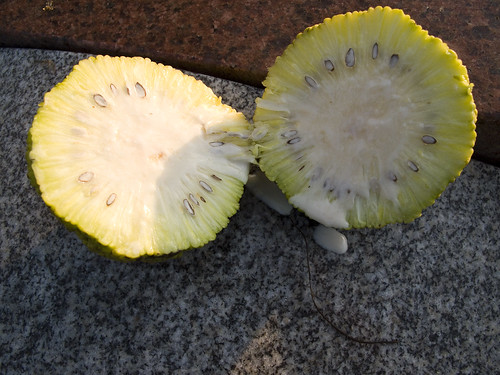
St. Michael’s Cemetery, Maclura pomifera, or Osage Orange fruit – photo by Mitch Waxman
Like all fruiting plants, an animal conspirator is required to complete the life cycle of the Osage Orange, expanding its range via the digestive processes of a ranging forager. Ever efficient, nature would not waste its time producing an energy rich fruit that attracts no living animal to it. Theories abound as to the identity of this partner organism, and an extinct equine is one of the evolutionary vectors theorized to have played this role for the Osage (thought likely due to the browsing preferences of modern Horse and Mule), but an intriguing notion is put forth by Connie Barlow of Harvard’s Arnold Arboretum who offers the theory that the anachronistic fruit of the Osage Orange’s partner animal was in fact a long extinct North American Elephant- the Mammoth.
Practicers of the left handed path of forbidden knowledge prize Osage wood for usage in wands, believing it to be useful when invoking mysterious spirits emanating from the bowels of the earth- those never human elemental intelligences, and the spirit animal guides associated with Native American Shamanic beliefs.
Osage-Orange is a native tree coming from a relatively small area in eastern Oklahoma, portions of Missouri, Texas and Arkansas. While used for centuries by native Americans in its original area for war clubs and bows, it was the first tree Lewis and Clark sent back east from St. Louis in 1804. Yet, with that modest beginning, the Osage-Orange probably has been planted in greater numbers throughout the United States in the 19th and early 20th century than almost any other tree species in North America. Because of its value as a natural hedgerow fence, it made agricultural settlement of the prairies possible, it then led directly to the invention of barbed wire in 1874, and then provided most of the posts for the wire that fenced the West. It is still considered the best wood for making archer’s bows. The Osage-Orange is one of America’s more interesting natives. It has at least two Internet web sites dedicated to keeping Osage-Orange enthusiasts informed (see www.osageorange.com and www.hedgeapple.com).
Happy Thanksgiving.


 The Newtown Pentacle