Archive for the ‘Things to do’ Category
Greenwood Cemetery Photos

– photo by Mitch Waxman
Happy Halloween, major post coming later today, meanwhile- enjoy some eerie shots from the macabre Greenwood Cemetery in Brooklyn.
Click here for the full set, click here for the cool slideshow.

– photo by Mitch Waxman
All Business- linkage, feed, and community

The considerable deductive powers of the unstoppable Forgotten-NY team are applied to the farthest extant of the Newtown Creek’s rusty borderlands. Check out scenes and scrying from the far, far east here
Our friend and colleague, Bob Singleton (of Greater Astoria Historical Society fame) is presenting a lecture tonight on the history and construction of the Queensboro Bridge in Middle Village. This lecture is the first in a series being presented by the burgeoning and recently organized Newtown Historic Society.

Tonight, part 3 of our Masonic lodge series will go live, but I came across someone on Flickr who did an amazing job of commenting on her gorgeous photos (with a lot of detail that I missed) – check out ChristiNYC’s photos from the Masonic Lodge tour sponsored by Open House New York at flickr.
Over at bigskybrooklyn, Adam E. shares the products of his poetic ambles around the former Dutch colony. Check him out, and don’t miss his story about Triangle 54.
I’m still gathering info on the Newtown Creek superfund story, but am not ready to talk about it. Recent missives from the Newtown Creek Alliance suggest that the Federal Government’s redoubtable EPA will be holding a public meeting on November 5th at 7PM in Greenpoint, Brooklyn.
Quoth: The US Environmental Protection Agency will be holding a community information session regarding the nomination of Newtown Creek to the Federal Superfund Program.
Where: St Cecilia’s Auditorium, Located on North Henry St midway between Herbert and Richardson
When: Thursday November 5th at 7:00 pm
Halloween week is here, and I would be remiss if I didn’t shill for the Greater Astoria Historical Society Halloween tour, led by its president Richard Melnick. I’ll be there, and Our Lady of the Pentacle plans on assumption of full holiday regalia for both herself and our little dog.
Also, for the pure Geek of it all, I’ve been playing around with the “rss feed” syndication settings on the Newtown Pentacle. Our feed page is located here. Experimental “mirrors” of the site can be found here, and here. Messing around with different layouts and blog services has been my main desire, and I’m intrigued by the notion of the raw text and code flowing into different layouts automatically (to subscribe to our feed, click the appropriate links on the sidebar). I’m a newbie at programming this sort of thing, if you’re not and there’s something obvious and clever I’m missing, please contact me.
Apple Juice, OHNY 2009
Caveat- What I know about electrical engineering wouldn’t produce enough charge to power an LED. Also, some of the information I’m passing on is sourced back to Open House New York flyers distributed at the event (just for proper attribution), handed out and written by Robert W. Lobenstein– General Superintendent of NYC Transit titled “A Walk Through History”. If I get something wrong, please contact me and we’ll make any appropriate corrections.

This isn’t actually the MTA Substation site- its around a block away and a completely different structure. Its just such good typography…- photo by Mitch Waxman
MTA Substations transmogrify high voltage Alternating Current charges, which flows from a central generator or powerhouse, into the 625 volts Direct Current electrifying the “third rail” which the fleets of Subway cars feed upon to gain their motive action- and fuel the various devices and systems found onboard a modern train (or rapid transit, to be accurate. The term train generally refers to a self actuating mechanism with a mobile locomotive powerplant – or engine- driving the action).
from ohny.org
MTA Substation
225 W 53rd St/ Broadway , New York
neighborhood: Midtown
opendialogue Sat 11 am, 1 pm tours with Robert Lobentstein, General Superintendent Power of Operations of NYC MTA Transit.
Maximum people: 25 per tour
building date: 1901, opened 1904
architect: Heins & LaFarge
other architects/consultants: William Barclay Parsons, McKim, Mead & White

– photo by Mitch Waxman
In the same year that Aleister Crowley wrote his “Book of the Law“, and the General Slocum carried away 1,021 souls at Hells Gate, and Robert Oppenheimer was born- the NYC Subway opened its doors for business (your humble narrator is used to passing the buck on certain subjects- the NYFD for instance- there are REAL experts out there who know far more than me. In the Subway story business, these folks are the tops).
In 1904, the nascent transit system was powered by a vast dynamo mill constructed on west 59th street between 11th and 12th avenues which fed AC current to eight substations (later combinations of IRT below and above shifted the nomen of the units in this group to the “teens”. One became eleven, eight became eighteen) which includes this site.
This is Substation 13.
the Gothamist blog was also here, and they got a great series of photos- lots of stuff I missed or just bungled the shot. Click here for a look.

– photo by Mitch Waxman
Here at Substation 13, “giant red buttons which must never be pushed” abound. A sinister and pervasive electronic hum, the sound of nearby modern solid state rectfier equipment busily converting a pulsating flow of gigajoules uncounted, permeates the dark and dusty building. The old substation rotary works went offline in 1999.
from timeout.com
MTA Substation
What it is: One of the MTA’s original power stations, tucked beneath a midtown street.
Why go? Opened in 1904, this is one of eight original IRT substations that served the subway system (for some perspective, there are now 215). View modern generators, as well as historic rotary converters, the subway’s earliest power source.

– photo by Mitch Waxman
Specialized and redundant armatures of steel are required to support the weight of each of these 50 ton rotary converters, and to withstand the stresses induced by their operation, although the actual truss that supports them is made from hardwoods. Grounded plating is incorporated into the brick and cement clad structure of the substation, vouchsafing neighboring buildings against electrical manifestations and stray voltage.
from joeclipart.com
It opened in 1904, the same year as the first subway. The mayor, governor and, apocryphally, Thomas Edison and Nikola Tesla, among other dignitaries, arrived at the substation-warming party in horse-drawn buggies.
Old #13 has operated continuously since and today powers the 1 line, which old-timers still call the IRT. Although it houses sinister-looking modern equipment, the substation serves as a de facto museum because it contains original machinery, the centerpiece of which is the Westinghouse 1,500 kilowatt rotary converter. Incredibly, this 50-ton wheel didn’t go offline until 1999.

– photo by Mitch Waxman
The converter devices themselves were a constant point of photographic interest for me, the sort of “big” technology that a comic book supervillain might decorate his lair with. On one wall, an animation cel from a Popeye cartoon showed the post Spinach effect of multiple converters spinning within the distaff sailor’s bicep muscle.
from nycsubway.org
Because suitable real estate was difficult to find in the built-up downtown areas, contractor McDonald suggested that some of the sub-stations be placed underground. In February 1901 he requested the aid of the Rapid Transit Commission in acquiring the right to excavate under public lands at City Hall Park, Union Square, and Longacre (Times) Square. McDonald’s contract made him responsible for the purchase of all lands for power facilities and he hoped to cut down his expenses by using city rather than private property. After consulting its lawyers, the Board decided that it lacked authority to grant this request. McDonald had to build his sub-stations above ground.
It was desirable to have the distribution distance to the subway as short as possible after conversion to direct current at the sub-stations. In the downtown areas McDonald obtained sites no more than one-half block from the route. In the far less crowded up-town locations, the Simpson Street and the Hillside Avenue sub-stations were nearly adjacent to the track.
Two adjoining city lots, each 25×100 feet had to be purchased to house sub-station equipment. The resulting 50 foot width allowed installation of eight to ten rotary converters with their sets of transformers. In Sub-station #13 on West 53rd Street, foundations were laid for ten rotaries; the remaining seven were built to receive eight rotaries.
Foundations for eight to ten rotary converters was a provision for the future. The original 1901 Westinghouse contract called for only 26, 1,500-kilowatt rotary converters, or four to five per sub-station. In 1909 Westinghouse responded to a second call, this time for 3,000-kilowatt units. In the plans for the 1916-1918 general system expansion, additional contracts to both Westinghouse and General Electric provided 4,000-kilowatt rotaries, some of which replaced the older 1,500-kilowatt machines. During expansion, [page 330] Sub-station 11 at Park Place was demolished, and its replacement, a half block from the original site was equipped with 4,000-kilowatt units. In 1923 additional 4,000-kilowatt General Electric and Westinghouse units were installed.
The remaining seven of the original eight IRT sub-stations are still standing. Number 19 on West 132nd Street is no longer in use and its equipment has been removed. The others still operate daily [in 1978] with equipment from the earliest installations. [The last of the rotary converter equipment has since been retired.]
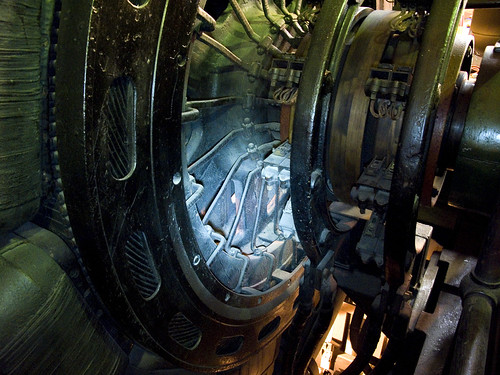
– photo by Mitch Waxman
Notoriously, your humble narrator is almost always “a day late and dollar short”, and the fabled “caving rig” lighting setup I’ve been working on for nearly a year was still incomplete when the OHNY event happened. I was lucky enough to be carrying a powerful LED electric torch by happenstance, which allowed some of these exposures sufficient quality for publication at Newtown Pentacle. Quite dark, Substation 13 awaits a creative application of lighting- perhaps the good folks at Strobist can gain access to the site sometime in the future and construct an application of proper illumination.
also from nycsubway.org
Each rotary converter stood in its own hard-wood frame. The frame was not bolted to the Portland cement foundations; the rotary weight was expected to hold the unit in place. The rotaries were the heaviest equipment of the sub-station. Two hand-operated cranes, at the front of each sub-station on the main floor, were provided for the rotary installation and service.

– photo by Mitch Waxman
Vast banks of machinery, replete with switches and glassed in gauges, line the walls of Substation 13. I’ve avoided posting photos of the more modern equipment, for a variety of reasons- mainly its not as cool looking, and the light was so bad I couldn’t get a non blurry shot.
from wikipedia
When the first subway opened between 1904 and 1908, one of the main service patterns was the West Side Branch, running from Lower Manhattan to Van Cortlandt Park via what is now the IRT Lexington Avenue Line, 42nd Street Shuttle, and IRT Broadway – Seventh Avenue Line. Both local and express trains were operated, with express trains using the express tracks south of 96th Street. Express trains ran through to Atlantic Avenue in Brooklyn during rush hours, while other express trains and all local trains turned around at City Hall or South Ferry.

– photo by Mitch Waxman
A labyrinth of access tunnels and manholes marks the lower level of Substation 13, whose mouldering brick and disintegrating concrete speaks to the infiltration and regular egress of flood waters. Apertures in the roof of the subterranean level look up into the rotary converters, and the walls are lined with empty sockets which once allowed electrical conduits to snake through the masonry.
from mta.info
New York City’s first official subway system opened in Manhattan on October 27, 1904. The Interborough Rapid Transit Company (IRT) operated the 9.1-mile long subway line that consisted of 28 stations from City Hall to 145th Street and Broadway.

– photo by Mitch Waxman
The art practiced by those engineers of the MTA who serve the modern system has -over the years- witnessed installation of 215 solid state converters, which are largely sited in deep underground vaults and inaccessible side tunnels hidden below the streets of New York City. Consolidated Edison– an electrical trust given stewardship over the metropolitan power grid- also used to maintain multitudinous converter substations for its commercial customers, but these too have been abandoned in favor of the more reliable and less labor intensive solid state rectifiers of the type now used by MTA. This room in particular, was original equipment, and was referred to as “the Manhole” where the Direct Current lines from the generator exited the soil and entered Substation 13. The atmosphere literally pulsed with latency.
from wikipedia
Electro Magnetic Fields (EMF) measurements are measurements of the magnetic or electric field taken with particular sensors or probes. These probes can be generally considered as antennas although with different characteristics. In fact probes should not perturb the electromagnetic field and must prevent coupling and reflection as much possible in order to obtain a precise measure. EMF measurements are nowadays becoming important and wide spread in different sectors to assess environmental and human exposure to non-ionizing radiation in many contexts.
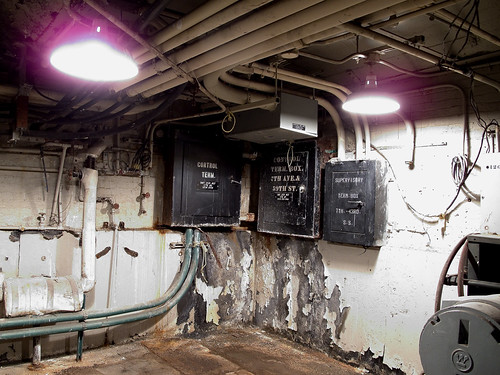
– photo by Mitch Waxman
MTA has sold off many of its relict and offline substation buildings, which have been cross purposed by the modern world to “the needs of the now”. A lumber warehouse, a Chinese noodle factory, an auto repair shop, even a movie theatre- are amongst the modern vocations enjoyed by some of these solidly built structures.
from google books,
a little Congressional Office of Technology Assessment reporting on the effect on Human Physiological Parameters of exposure to high energy power lines (from the New York State Power Line Project).

– photo by Mitch Waxman
Purveyors of the paranormal- who are undergoing a period of intense public interest in recent years due to the influence of several popular television series and a prevailing political fashion that interprets world events through a supernatural lensing of fin de siècle prophecy – speak about arrangements of electrical equipment and their concurrent electromagnetic field fluctuations as creating an environment which alters human perception. If this theory holds water, I would imagine the men and women who worked here might have some stories to share- and probably a union beef against the City.
but seriously…
here’s a map from nycsubway.org of the system in 1904 when it opened. The crane above was one of many hand operated technologies that allowed the early system to come together. Workers would lift the 50 ton converters for maintenance and repairs using it.

– photo by Mitch Waxman
New York Open House is a yearly event wherein the architectural and civil engineering treasures of New York City that are normally off limits to the general public are exhibited by their stewards. For more info, and to sign up for notifications of next year’s event- proceed to OHNY.org.
Newtown Creek Waste Water Treatment Plant
LO… Behold and tremble, for the Newtown Pentacle is back in session.

– photo by Mitch Waxman
A fitting temple has been erected to an ancient goddess by the redoubtable engineers of the DEP, a shining secular cathedral which looms over storied Greenpoint, this is the Newtown Creek Wastewater Treatment Plant (referred to as the NCWWTP from this point on), whose guarded interiors were revealed to an eager public via the auspices of the 2009 Open House New York event.
from polshek.com
Newtown Creek Wastewater Treatment Plant
(in association with Greeley and Hansen, Hazen and Sawyer and Malcolm Pirnie)
Brooklyn, New York
54 acres
Projected Completion: 2010
This waste water treatment plant replaces an outmoded and environmentally unsound facility. Its design and construction are organized in phases over a ten-year period, and the plant is to remain fully operational throughout the process. Perimeter fencing, aerial walkways, bridges, major axes, building forms, materials and color are used as ordering devices throughout the site. Large areas of glass provide natural light in machinery rooms and by displaying the process, demystify it. Perimeter green space buffers the plant from the street. The design, which is subject to elaborate public approvals processes, has a “1% for Art” component. This project has received two Awards for Excellence in Design from the New York City Art Commission for its sensitivity to the challenge of locating a large-scale industrial project within a residential neighborhood.

– photo by Mitch Waxman
Our Lady of the Pentacle and I made the journey from the sun kissed hills of Astoria to the hard reality of Greenpoint and found dozens of people lining up for their chance to participate in this experience- including these three who were directly in front of us. People brought their kids. At the gate, DEP personnel were gathering the visitors into groups and we soon were being heralded to the elevators.
from nyc.gov
(note: the data below relates to the original NCWWTP, not the modern and upgraded gargantua)
Between 1965 and 1979,the Newtown Creek wastewater treatment plant was built in Brooklyn. It was designed to treat 310mgd and was built on a relatively small footprint of 30 acres. Its design lacked primary tanks and, as a result,wastewater traveled from the grit chamber to the aeration tanks to the final tanks without intermediate channels, thereby conserving space and minimizing pumping requirements.
Stats for the original plant read as follows-
Plant in operation: 1967
Design Capacity: 310 MGD
Dewatering: Hunts Point WPCP
Population Served: 1,068,012
Receiving Waterbody: East River
Drainage Area: 15,656 Acres,south and eastern midtown sections of Manhattan,
northeast section of Brooklyn and western section of Queens
Plant Staff: 88 Newtown Creek WPCP

– photo by Mitch Waxman
The tour conducted us across the still active and under construction work site, and our group broke off in the direction of the south east digester egg.
from nyc.gov
New York City has dealt with water pollution problems since the late 1600s by building centralized infrastructure. Many of the early sewers simply collected sanitary sewage and discharged it directly to waterways, a signifi cant improvement in public health that protected people from exposure to pathogens and other pollutants. Combined sewers were a state-of-the-art public health measure that eliminated privies and overfl ow of sewage into streets and groundwater and carried away stormwater, garbage, human waste, animal waste, and other refuse that collected on city streets. Combined sewers made sense then because there was no treatment of wastewater and therefore no reason to separate wastewater from stormwater.
By the late 1800s, water quality conditions in New York Harbor and its branches were very poor because of the volume of untreated sewage discharged during dry weather. To address this problem, in the 1890s and early 1900s New York City began building wastewater treatment near bathing beaches, at the sites of the present 26th Ward and Coney Island WPCPs in Brooklyn and the Jamaica WPCP in Queens. Existing street sewers were tied into these plants through “interceptor” sewers that collected flow at the end of street sewers, generally near the former point of discharge at the waterline. To accommodate a growing population, the City built additional sewers and plants to treat the sewage collected by the combined system. Between 1935 and 1945 three new plants were constructed – Wards Island in Manhattan and Bowery Bay and Tallman Island in Queens. Between 1945 and 1965 fi ve additional plants were built – Hunts Point in the Bronx, Oakwood Beach and Port Richmond in Staten Island, and the Rockaway and Owls Head plants in Brooklyn. The Newtown Creek WPCP was built between 1965 and 1979. By 1968, 12 wastewater plants were treating nearly one billion gallons per day of wastewater. New York City upgraded its plants to full secondary treatment and built two more treatment plants, the Red Hook plant in Brooklyn and the North River plant in Manhattan. The completion of the Red Hook WPCP in 1987 ended the last, permitted dry weather discharges of raw sewage into the harbor.
New York City’s current infrastructure is comprised of an extensive network of over 6,000 miles of residential connections, force mains, and interceptor sewer pipes that collect sanitary sewage and stormwater, and the 14 WPCPs that receive the flow (one of these plants receives fl ows exclusively from a separately sewered area). This network is one of the City’s most significant assets, and has improved the health of generations of New Yorkers. The City’s wastewater plants have the capacity to treat 1,805 million gallons of dry weather wastewater flows every day. The WPCPs are also designed to handle double the normal sewage flow to account for high fl ows during rainstorms. However, the combined fl ow during storms has often been more than the treatment plants could accommodate and treat. The systems were therefore designed to prevent fl ooding of the WPCPs or backup of sewage into streets and buildings through the regulators that shunt excess fl ow to local waterways.
New York City’s experience was not unique. Combined sewer systems are remnants of the country’s early infrastructure and are typically found in older communities. CSOs are a major water pollution concern for approximately 772 cities and 40 million people who are concentrated in the Northeast, Great Lakes, and the Pacifi c Northwest. In New York City, approximately 433 outfalls discharge CSOs during wet-weather to the receiving waters of the New York Harbor complex (Figure 10). These discharges result in localized water quality problems such as periodically high levels of coliform bacteria, nuisance levels of fl oatables, depressed dissolved oxygen, and, in some cases, sediment mounds and unpleasant odors. CSOs are considered to be the largest single source of pathogens to the New York Harbor.
The City began addressing the issue of CSO discharges in the 1950s. In 1972, New York City opened the fi rst CSO control facility in the Harbor Estuary at Spring Creek, Jamaica Bay. This facility stores excess fl ow from CSOs until after the rainfall ends and then pumps it back to the WPCP for treatment. It was one of the fi rst such facilities in the country. Other upgrades to our treatment plants increased wet weather capacity. By 2007, the City’s WPCPs were treating 447 billion gallons of sanitary sewage and 35 billion gallons of stormwater water a year, at an operating cost of $379 million.

– photo by Mitch Waxman
The green bricked structures are the elevator shafts which conducted the group to the steel walkway suspended some 1100 feet above the iridescent soil of Greenpoint. This catwalk afforded a unique perspective, and is clearly designed with adoration of the ancient goddess in mind.
from nyc.gov
The Newtown CReek WPCP upgrade projects are funded in the CIP at a level of approximately $1.59 billion, however additional funding is required for design fees, final site work, Main Building, community amenities, DSNY warehouse and additional funds for the sludge loading docks.

– photo by Mitch Waxman
The glass which contains the walkway was fairly dirty, which was surprising for some unknown reason, and its peculiar color functioned in the manner of a neutral density filter– reducing picture contrast. Luckily, the intrepid urban photographer is practiced in the art of locating holes in fencelines, and several opportune vantages could be gained by careful observation.
from nyc.gov
During a rainstorm, a percentage of this combined flow ends up at our treatment plants, and the remainder of the combined flow is discharged untreated into surrounding waters through outfalls located at the bulkheads. In the case of lower Manhattan, the combined sewers serving that area lead to a very large pumping station at East 13th St in Manhattan. From there, the sewage is pumped to Greenpoint, Brooklyn where it is treated at the Newtown Creek wastewater treatment plant.
DEP routinely samples raw sewage going into the Newtown Creek plant, as well as treated effluent coming out of Newtown Creek, several times each day. We also regularly take samples from open waters at various locations in New York Harbor, including near the Battery. DEP tests these samples for “conventional parameters,” such as temperature, pH, dissolved oxygen, suspended solids and coliform. These conventional parameters have consistently remained within their normal ranges since September 11th.
Using the more sophisticated testing capabilities that EPA has at its disposal, beginning September 11th, their staff immediately began supplying us with results from tests for “unconventional parameters” on samples of run-off from the Trade Center site, harbor waters, and sewage. These unconventional parameters include PCB’s, dioxin, asbestos and other organic chemicals and contaminants for which the City’s harbor water quality laboratories do not routinely test. Initial runoff samples taken near Rector Street showed elevated levels of PCB’s, dioxin, asbestos and metals. Follow-up samples showed concentrations of these substances below levels of concern. Samples of harbor water and samples of effluent from the Newtown Creek plant also show the presence of “unconventional parameters” at levels too low to be of concern.

– photo by Mitch Waxman
A DEP representative began his presentation, explaining a brief history of the DEP and the NCWWTP. The digester eggs, whose apex is crowned by the steel walkway upon which we stood, were in full operation. Displaying the various examples of ingenious and advanced technologies, and pointing to several points of interest in the larger yard of the plant, he directed our attentions to a glass hatch which afforded a view of that churning loathsomeness which the digester egg was processing.
from wikipedia
The New York City Department of Environmental Protection (NYCDEP) manages the city’s water supply, providing more than 1.1 billion gallons of water each day to more than 9 million residents throughout New York State through a complex network of nineteen reservoirs, three controlled lakes and 6,200 miles of water pipes, tunnels and aqueducts. The DEP is also responsible for managing the city’s combined sewer system, which carries both storm water runoff and sanitary waste, and fourteen wastewater treatment plants located throughout the city. The DEP carries out federal Clean Water Act rules and regulations, handles hazardous materials emergencies and toxic site remediation, oversees asbestos monitoring and removal, enforces the city’s air and noise codes, bills and collects on city water and sewer accounts, and manages citywide water conservation programs.

– photo by Mitch Waxman
The machinery controls the movement and circulation of the sludge within the egg, and maintained a constant temperature to facilitate the bacterial action within the steel enclosure. Methane gas, a mephitic byproduct of the digestion process, is reclaimed from the works and recycled into the mechanical works of the vast sewage mill. This foul smelling but clean burning emission is used to help maintain a critical temperature mean which is – disturbingly – the internal temperature of the human body.
from nyc.gov, way back in the year 2000
New York City Department of Environmental Protection Commissioner, Joel A. Miele Sr., P.E. will preside at a groundbreaking ceremony marking the start of construction on the final upgrade to secondary treatment at the Newtown Creek Wastewater Treatment Plant. The project will bring the treatment plant into compliance with secondary treatment requirements mandated by the Clean Water Act pertaining to wastewater that flows to the plant from the surrounding drainage area.
“When the Newtown Creek upgrade upgrade is completed, all of New York City’s fourteen wastewater treatment facilities will be in compliance with federal mandates,” said Commissioner Miele. “It is a far reaching project that will contribute to the continuing improvement of the City’s Harbor environments and water quality. In addition,” continued Commissioner Miele, “this facility has been honored by awards for its commitment to the community through its aesthetic design and will also be complemented by two public art projects that will enhance the plant environs.”
The upgrade will include three new chlorine contact tanks and a chlorination building, which will permit year-round disinfection to meet standards for treated wastewater. The facility will also include seven sodium hypochlorite storage tanks, a truck unloading station, and a multi-story building, which will house personnel facilities, administrative offices, a central lab and a shop area. The designs for the disinfection and administration buildings, created by Polshek Partnership, Architects, received Excellence in Design Awards from the New York City Art Commission for the aesthetic appropriateness of their architecture on City-owned property.
In addition, two artists, Vito Acconci and George Trakas, were commissioned by the City of New York Department of Cultural Affairs,” Percent for Art Program to create public art projects at the site of the plant. Mr. Acconci created a fence treatment surrounding the plant and Mr. Tracas designed a Waterfront Nature Walkway along Newtown Creek and Whale Creek Canal.

– photo by Mitch Waxman
The entire city of New York is connected via its sewer infrastructure in one way or another. Covered sewers running beneath city streets were first innovated by the Indus Valley Civilization in 2600 BCE, and notable moments in sewer history were achieved by the ancient Chinese, Romans, and the considerably less ancient British. The 19th century vintage of sewers in Paris actually have a tourist industry devoted to their exploration.
from nymag.com
…Those bulbous, silver-skinned pods you see in the picture at right are “digester eggs,” and they perform the city’s dirtiest but most essential work, using microbes to reduce sludge (a.k.a. sewage minus water) by half. Most of the design is pure engineering, but the spaceship exterior is the work of the estimable Polshek Partnership, known for the Rose Center at the American Museum of Natural History, among many credits….

– photo by Mitch Waxman
One of the things that we try not to think about, as a culture, is disease. The sewers catch every organism that the sunlit population above contracts. Every flyblown bit of dog poop on the street carries insect eggs into the underworld, and the population of humans excrete pharmaceutical residue as well as an encyclopedic palette of pathogens into the flow. Every affliction, from obvious villains like Cholera and Typhus, to venereal pathogens and flesh eating bacteria can be found in the pathways. Who can guess, what it is, that lurks down there?
from nytimes.com
What goes on inside the digesters is slightly more prosaic, but vital to processing millions of gallons of waste water every day. Sludge, which is removed from sewage, is broken down within the digesters into more stable materials: water, carbon dioxide, methane gas and digested sludge, which can be formed into dry cakes and then, after additional processing, used as fertilizer. The shape of the egg helps concentrate grit in the bottom of the tank and gas concentrations at the top. Each egg holds three million gallons of sludge. Four began operating May 23. The rest should be in service by the end of the year.

– photo by Mitch Waxman
Vast outbreaks of disease in the unheralded urban concentrations of the 19th century forced the creation of what was then called the Dept. of Health, but which has transmogrified over the last century into a sprawling utilitarian bureaucracy which is called the DEP.
from nyc.gov
Digesters play a critical role in the wastewater treatment process. During the wastewater treatment process, organic material called sludge is removed from sewage. Sludge is “digested” and processed for beneficial use. Inside of digesters, bacteria break down this sludge into more stable materials. Heat, lack of oxygen, and time are all needed for this to happen. Much of the sludge is converted into water, carbon dioxide and methane gas. The remaining is called digested sludge. Digested sludge is then dewatered to form a cake, which, after additional processing, can be beneficially used as a fertilizer. The eggs are state of the art in digester design as the shape assists in concentrating grit at the bottom of the tank, mixing for improved digestion and the concentration of gas at the top of the tank. Each egg holds 3 million gallons of sludge.
The Newtown Creek plant is the largest of New York City’s 14 wastewater treatment plants. The plant serves approximately 1 million residents in a drainage area of more than 15,000 acres (25 square miles). The plant began operation in 1967 and currently treats 18% of the City’s wastewater with a capacity of 310 million gallons per day (mgd) during dry weather. Upgrade work began in 1998 and will eventually raise plant capacity to 700 mgd during wet weather storms. The upgraded plant will serve a projected population of 1.33 million residents within the relevant drainage area by 2045.
Last September, DEP opened the Waterfront Nature Walk at the Newtown Creek plant, affording the public their first waterfront access to Newtown Creek in decades and advancing Mayor Bloomberg’s PlaNYC goals, ensuring that the public has broader access to the waterfront and increasing water quality throughout the City’s waterways. The Nature Walk was designed by renowned environmental sculptor George Trakas through the New York City Department of Cultural Affairs Percent for Art program in conjunction with DEP’s ongoing upgrade of the plant. The quarter-mile nature walk offers stunning views of the City and of the nearby industrial landscape, as well as many unique architectural features, plantings and construction techniques that were designed by Trakas to evoke the rich, continually evolving environmental, industrial and cultural histories of the local area.

– photo by Mitch Waxman
From the vantage offered by the walkway suspended over the ovum shaped structures, one can observe the “old cities” of Newtown and Bushwick in the manner of Odin, sitting upon the Hlidsjalf. Huginn and Muninn are absent, of course, their wise council and far seeing observations sorely missed.
from ominy.org
The steel trusses of the catwalks were delivered on site, hoisted into place by three tower cranes,and pinned in place.Above The stainless steel claddingoffers exceptional corrosion resistance,an important quality in a facility thatprocesses 1.8 million gallons of sludge per day.
Though early ESD facilities were constructed of poured-in-place concrete, the difficulty and cost of forming the complex shapes necessary for such construction finalized the DEP’s decision to shift the primary material to steel throughout. At the Newtown Creek facility, Polshek crowned and linked the ESDs with steel and glass aerial walkways and turrets that glow like lanterns at night. Steel’s speed of construction, flexibility, and lighter load weight were pivotal factors in the construction phase, as the congested conditions of the 24-hour site required a constant coordination of logistics between architects, engineers, contractors, and facility technicians. With steel, sections of the aerial walkways could be pre-fabricated and assembled on location with minimalscaffolding and workmanship, allowing connections to be welded and bolted in an efficient and convenient way.
The aerial walkways and turrets are made up of a variety of steel members, including structural tubes of ASTM A500 Grade B steel, structural pipe of ASTM A53 Grade B steel, and other shapes and plates of ASTM A36 U.O.N.steel. The turrets are framed with W10x15, W10x33, and W24x68 wide flange members, while the walkways spanning the distance between them are composed of steel trusses made up of W8x15 diagonal braces, W10x22 crossbeams, and W24x104 main beams. Each truss weighs approximately 30 tons.Originally intended as a pedestrian concourse around the ground floor of the plant, architects chose to elevate the walkway due to security concerns and the impracticality of foot traffic between the wide-bases of the ESD’s. But life at the top is not without its challenges. To equalize air pressure and wind loading, the aerial walkways’ enclosure is composed of a series of independent, non-connecting components; a slight separation between the stunning metal roof and the glass paneled siding creates a kind of vented cladding system that allows sufficient air to move in and out of the enclosure under applied air pressure. “These things we knew from the beginning were going to be structural steel elements; there are movement joints in the aerial walkway system that keeps them from cracking at the ends,” saysPolshek architect Greg Clawson.“They’re bridges, basically.” Each walkway section has a pinned connection at one end and a slidingconnection at the other end. The sliding connection sits on a ž-inchbearing plate with a ź-inch Teflonbearing pad.
The walkways were delivered to the site in mainly pre fabricated, shop welded sections. In some instances, other sections were shipped loose for field welding, then fastened in place with structural grade bolts. The main structural work of the aerial walkways was set in place one month after the completion of the digester tanks,which took 102 weeks to complete,at an average of about three months per egg.With diameters of 84 feet and heights of 90 feet, each of the eight egg digesters is clad in S31600 stainless steel, with a low-reflectivity proprietary finish. Similarly, the aerial walkways are clad in an epoxy finish that offers exceptional resistance to atmospheric corrosion and oxidation—key strengths for a facility meant to process 1.8 million gallons of sludge per day. “All the materials throughout are selected to be incredibly durable because it’s a very corrosive environment.” explains Richard Olcott. “Not only because of the salt air and the river air, but because the materials need to last for hundreds of years. Like any other of the projects that were constructed a hundred years ago, you have to build these things to last.”

– photo by Mitch Waxman
In the not so distant past, when New York was the port of embarkation for the world, mariners would comment on the acres long slicks of sewage and garbage which characterized its harbor- and remark upon the multitudes of animal corpses floating in the rivers. In those days of pack animals and horse carriages, a secondary sewage flow of animal waste tormented the population. In a Newtown Pentacle posting from June 4, 2009, the details of the old Tammany system for disposing of waste in New York City (at Newtown Creek, of course) was explored- check out “The Night Soil and Offal Docks, and Jello“.
from wikipedia
Sludge is a generic term for solids separated from suspension in a liquid. This ‘soupy’ material usually contains significant quantities of ‘interstitial’ water (between the solid particles). Commonly sludge refers to the residual, semi-solid material left from industrial wastewater, or sewage treatment processes. It can also refer to the settled suspension obtained from conventional drinking water treatment, and numerous other industrial processes.
When fresh sewage or wastewater is added to a settling tank, approximately 50% of the suspended solid matter will settle out in an hour and a half. This collection of solids is known as raw sludge or primary solids and is said to be “fresh” before anaerobic processes become active. The sludge will become putrescent in a short time once anaerobic bacteria take over, and must be removed from the sedimentation tank before this happens.
This is accomplished in one of two ways. In an Imhoff tank, fresh sludge is passed through a slot to the lower story or digestion chamber where it is decomposed by anaerobic bacteria, resulting in liquefaction and reduced volume of the sludge. After digesting for an extended period, the result is called “digested” sludge and may be disposed of by drying and then landfilling. More commonly with domestic sewage, the fresh sludge is continuously extracted from the tank mechanically and passed to separate sludge digestion tanks that operate at higher temperatures than the lower story of the Imhoff tank and, as a result, digest much more rapidly and efficiently.
Excess solids from biological processes such as activated sludge may still be referred to as sludge, but the term biosolids, is more commonly used to refer to the material, particularly after further processing such as aerobic composting. Industrial wastewater solids are also referred to as sludge, whether generated from biological or physical-chemical processes. Surface water plants also generate sludge made up of solids removed from the raw water.

– photo by Mitch Waxman
Surprisingly, the expected aroma was absent. The catwalks are well ventilated, and in many places open to the air via strategic apertures. Our Lady of the Pentacle and I once had the opportunity to visit NASA in Florida, and received a behind the scenes- clean suit and hairnet- tour of the Space Shuttle’s maintenance facility. A similar sense memory hung around these Greenpoint catwalks, a sensation that one was in the presence of the highest application of scientific understanding and scientific accumen.
from wikipedia
Sewage is created by residences, institutions, hospitals and commercial and industrial establishments. Raw influent (sewage) includes household waste liquid from toilets, baths, showers, kitchens, sinks, and so forth that is disposed of via sewers. In many areas, sewage also includes liquid waste from industry and commerce.
The separation and draining of household waste into greywater and blackwater is becoming more common in the developed world, with greywater being permitted to be used for watering plants or recycled for flushing toilets. A lot of sewage also includes some surface water from roofs or hard-standing areas. Municipal wastewater therefore includes residential, commercial, and industrial liquid waste discharges, and may include stormwater runoff. Sewage systems capable of handling stormwater are known as combined systems or combined sewers. Such systems are usually avoided since they complicate and thereby reduce the efficiency of sewage treatment plants owing to their seasonality. The variability in flow also leads to often larger than necessary, and subsequently more expensive, treatment facilities. In addition, heavy storms that contribute more flows than the treatment plant can handle may overwhelm the sewage treatment system, causing a spill or overflow (called a combined sewer overflow, or CSO, in the United States). It is preferable to have a separate storm drain system for stormwater in areas that are developed with sewer systems.
As rainfall runs over the surface of roofs and the ground, it may pick up various contaminants including soil particles and other sediment, heavy metals, organic compounds, animal waste, and oil and grease. Some jurisdictions require stormwater to receive some level of treatment before being discharged directly into waterways. Examples of treatment processes used for stormwater include sedimentation basins, wetlands, buried concrete vaults with various kinds of filters, and vortex separators (to remove coarse solids).

– photo by Mitch Waxman
Many in the Greenpoint community have compared the organic curves of the digester eggs to mammalian breasts, using a vernacular phrase too vulgar for those gentle eyes that our Newtown Pentacle readership possesses. Associations of sewer systems with a feminine principle is an ancient tradition, dating back to the Etruscans and brought to maturity by the Romans.
from nyc.gov
…Sewage originating south of E. 73rd Street is conveyed to the Newtown Creek WPCP. Sewage is transferred by combined sewers along E. 70th Street and E. 71st Street, which connect with the combined sewer along York Avenue. The Newtown Creek WPCP, with a rated design capacity of 310 mgd, discharges the effluent into the East River. The 2002 average dry weather flow of the Newtown Creek WPCP is 216 mgd and the average total flow is 229 mgd.
The water quality of the East River and New York Harbor is detrimentally affected by the presence of combined sewers, producing the condition known as combined sewer overflow during storm events. Combined sewers convey sanitary sewage and stormwater in a partially separated pipe, which during a storm event allows for high levels of stormwater to spill over the partition and mix with the sanitary sewage. During such storm events the WPCP is estimated to accommodate the increased flow. The result is the discharge of contaminated stormwater into the East River in the area of HSS. The City has implemented measures to control combined sewer overflow with the installation of combined sewer overflow retention tanks that hold the contaminated stormwater during a storm event and later conveys it to a wastewater treatment plant and with the initiation of the floatables control program which utilizes floating containment barriers at some outfalls and skimmers on the water bodies where the contaminated stormwater has been discharged. The floatables control program has been implemented in the area near HSS, thus reducing the impact of storm event discharge.
The Newtown Creek WPCP, constructed in 1967, was designed with a modified aeration system to reduce biological oxygen demand (BOD) levels and total suspended solids (TSS). The levels of treatment were designed with the intention of maintaining fish health and navigability. The effluent is below the required treatment levels set in the Clean Water Act of 1974 for full secondary wastewater treatment. As a result, the City has implemented interim steps of treatment at the Newtown Creek WPCP until the upgrade of the plant is completed, which is expected by the end of 2007.

– photo by Mitch Waxman
This temple of the goddess, risen over the ancient Newtown Creek, allowed me new and unguessed at perspectives on subjects I’ve only known from the muddy and broken pavement surrounding the relict waterway. Pictured is the span of the LIE as it passes over the Dutch Kills.
from sewerhistory.org
Mankind has routinely sought, through the ages, strength and guidance from the spirit world.
The Romans, during the course of their Empire (650 BCE – 400 AD), worshipped many deities … one of them being the Goddess Cloacina – in whom they placed their faith/trust for the well being of Rome’s sewers (and workers); a facet of Rome’s public works infrastructure that was considered vital to their desired way of life – good health through sanitation.
Cloacina was the patron goddess of the Cloaca Maxima (the main drain of the City) and the city’s overall sewer system. Over time, the Romans came to also think of her in a multitude of other ways including; as the goddess of purity, the goddess of filth and the protector of sexual intercourse in marriage. As such, over the ages, she came to be affiliated with Venus; and, gradually became known to many as the Venus Cloacina.

– photo by Mitch Waxman
I’ve heard through rumor and municipal gossip that upon completion, the lighting of the Digester Eggs will be changed to a purple hue, from its current blue. I stridently hope that this is idle talk, as purple and green are the signature colors of comic book villainy, and this facility would be an ideal lair for some megalomaniac to concoct their schemes.
from thaliatook.com
Cloacina is a very ancient Goddess of Rome Who was originally the Goddess of the stream called the Cloaca which ran through the early Roman Forum. In the earliest times the Forum area was a low marshy place prone to flooding by the Tiber and dotted with springs, and too swampy for human use except in times of drought. The Cloaca stream, which drained into the Tiber, was said to have seven tributary brooks that drained all the valleys of the Esquiline and Quirinal hills. In early times the stream was dredged out and lined with stone to make a drainage canal, most likely by the Tarquins, early Kings of Rome, and in time it was covered over to become the main drain of Rome. The course of the original waterway and tributary streams dictated the layout of the buildings and streets of the Forum, for the Romans were reluctant to alter its course in their conservative superstitious respect for the natural spirits or powers. The name Cloacina means “the Purifier”, and the word cloaca became the word for “drain” or “sewer”; in time Cloacina became the Goddess of Sewers. Which sounds terribly unromantic; remember though that the Romans were a very practical people, and that the complex sewer and drainage system that Rome developed kept the city clean, funnelling refuse and rainwater out and away, as well as draining the potentially malaria-infested swamps of the Forum, all of which helped to keep the populace healthy.
The sewer system that grew out of this drainage scheme in the Forum was called the Cloaca Maxima (“the Great Sewer”) and was eventually made up of great underground vaulted tunnels that were large enough for boats to journey in, and strong enough to withstand floods and great storms. Though much of it ran under the Forum, the Cloaca Maxima was sturdy enough to support the roads and buildings erected over it; even if a building burned (as occasionally happened) and collapsed the Cloaca Maxima held up. Parts of it were as wide as 10′ 6″, and as high as 13′ 9″; or rather are, for it is still in use today in Rome, 2000+ years later.

– photo by Mitch Waxman
The tour over, Our Lady of the Pentacle and myself headed around the plant to visit the Newtown Creek Wastewaster Treatment Facility Nature Walk. I’ll discuss this in another post, but for what it is, its a great little park and suggests where the City planners might be taking the waterfront of Newtown Creek.
from Wikipedia
The Cloaca Maxima was one of the world’s earliest sewage systems. Constructed in ancient Rome in order to drain local marshes and remove the waste of one of the world’s most populous cities, it carried an effluent to the River Tiber, which ran beside the city.
The name literally means Greatest Sewer. According to tradition it may have been initially constructed around 600 BC under the orders of the king of Rome, Tarquinius Priscus.
This public work was largely achieved through the use of Etruscan engineers and large amounts of semi-forced labour from the poorer classes of Roman citizens.
Although Livy describes it as being tunnelled out beneath Rome, he was writing centuries after the event. From other writings and from the path that it takes, it seems more likely that it was originally an open drain, formed from streams from three of the neighbouring hills, that were channelled through the main Forum and then on to the Tiber. This open drain would then have been gradually built over, as building space within the city became more valuable. It is possible that both theories are correct, and certainly some of the lower parts of the system suggest that they would have been below ground level even at the time of the supposed construction.
Manhattan Bridge Centennial Photos
The whole set is up at flickr, here’s a few selects. I’ll be writing this up properly in a few days, but posts are going to still be a little sparse this week, and I don’t want to leave y’all hanging.

– photo by Mitch Waxman

– photo by Mitch Waxman

– photo by Mitch Waxman


– photo by Mitch Waxman


 The Newtown Pentacle