Posts Tagged ‘Blissville’
virgin aether

– photo by Mitch Waxman
“It’s a meat grinder over there” is a phrase and analogous statement often used by modern pundits to describe a past or present war, firefight, or even a less than welcoming part of the Bronx.
Conjuring imagery of familiar butcher tools spewing out hamburger meat, the term means something else entirely to those versed in the lore of that infamous cataract known as the Newtown Creek.
To those who have stared too long at the blasted heaths of Blissville, “It’s a meat grinder over there” refers to a certain spot in DUGABO (Down Under the Greenpoint Avenue Bridge Onramp), the mention of which engenders the sudden display of wan and pale complexions upon the faces of long time area residents merely at the mention of its cursed and shunned name.
Van Iderstine.
from 1875’s “Report of the Department of Health of the City of Brooklyn, N.Y.“, courtesy google books
FAT RENDERING.
In this process animal fat, obtained from the slaughter-houses and butcher-shops, is exposed to sufficient heat to liquefy it The resulting tallow is removed to settling-vats, and finally [tacked in suitable casks to harden. Up to within the past lew years the methods in use were of the most primitive description, the fatty materia) being placed in open kettles and heat applied at the bottom. As during the heating of the mass very offensive odors are given off, consisting of sulphureted and phosphureted hydrogen and ammoniacal gases, repeated complaints were caused, and it became necessary to adopt some method of correcting the evil.
The most improved methods dispose of the noxious goses by combustion or condensation. The latter is the one adopted by the factories in this district, and consists of the following process. The fatty material is placed in a steam-tight tank (Lockwood & Everett’s), capable of holding about ten thousand pounds; the tank is double, being, in fact, a smaller tank within a larger. The fat is contained in the inner compartment, while the outer is used for holding the steam. On applying the steam heat, pressure is originated in the mass, and the offensive gases thereby forced through a condensing-pipe into Newtown creek below low-water mark. The tallow at a certain stage is passed by its proper pipe to a large open vat, from which it is dipped into casks. The residue, known as “scrap,” is subsequently removed through a trap in the bottom of the tank, and being pressed is sold for fertilizing purposes.
By this method all offense appears to be prevented, and the manufacture might be carried on without prejudice in a built-up portion of the city.
In this district there are three rendering factories of any importance, all situated on Newtown Creek, near Greenpoint avenue. The owners are F. A. Van Iderstine, S. Rosenbaeh and John Van Iderstine.

– photo by Mitch Waxman
Chicago’s Phillip Armour, whose industrial methodology was contemporaneously described as “using every part of the pig except the squeal”, set a standard for the industrial exploitation of animals. Inedible parts of farm or food livestock, spoiled meat or rancid chicken eggs, dead animals such as equines, canines, feral cats- even the collected blood from slaughterhouse killing floors was (and is) a valuable commodity.
Rendering companies receive this organic “raw material” from butcher shops, slaughterhouses, dog pounds, and veterinarians.
In the days of horse and Ox drawn carriages, thousands of dead pack animals found their way to the Van Iderstine mills, which seemed to specialize in larger mammals.
I haven’t been able to locate a primary source for this not locked up behind a paywall, yet, but they apparently handled Elephants.
from fire-police-ems.com
In the early days any animal which died on the streets of New York, such as horses that pulled wagons, circus animals, some as huge as elephants, that died when the circus came to town, were taken to the Van Iderstine Factory. There, they were put into a giant funnel set-up that had huge meat grinders at the bottom which ground up their bodies. These smaller more manageable pieces were brought to other buildings on the large factory premises where the fat was rendered to make soap and glue.
Van Iderstine trucks would also go to butchers all over the city to buy their waste fat and bones.

– photo by Mitch Waxman
Some detail will be presented and discussed in later postings of the subject, as the early Van Iderstine story is obscured behind distaste for their long presence in the community, and reviled on both sides of the Creek. An odd thing, considering they were a major employer and- in one corporate guise or another- the operation was in this spot for a little over a century. There’s a Green Asphalt company in the shot above, which is found in modernity at the extreme eastern side of the Van Iderstine property.
A fire in 1964, coupled with a rising tide of community activism, is said to have led to the company’s abandonment of the site and eventual move to Newark, New Jersey.
from wikipedia
The rendering industry is one of the oldest recycling industries, and made possible the development of a large food industry. The industry takes what would otherwise be waste materials and makes useful products such as fuels, soaps, rubber, plastics, etc. At the same time, rendering solves what would otherwise be a major disposal problem. As an example, the USA recycles more than 21 million metric tons annually of highly perishable and noxious organic matter. In 2004, the U.S. industry produced over 8 million metric tons of products, of which 1.6 million metric tons were exported.
Usually, materials used as raw materials in the rendering process are susceptible to spoilage. However, after rendering, the materials are much more resistant to spoiling. This is due to the application of heat either through cooking in the wet rendering process or the extraction of fluid in the dry rendering process. The fat obtained can be used as low-cost raw material in making grease, animal feed, soap, candles, biodiesel, and as a feed-stock for the chemical industry. Tallow, derived from beef waste, is an important raw material in the steel rolling industry providing the required lubrication when compressing steel sheets. The meat and the bones (which are in a dry, ground state) are converted to what is known as meat and bone meal. For many years meat and bone meal were fed to cattle. This practice is now prohibited in developed countries because it is believed to be the main route for the spread of bovine spongiform encephalopathy (mad-cow disease, BSE), which is also fatal to human beings. Meat and bone meal from cattle is, however, fed to non-ruminant animals and meat and bone meal from non-ruminant animals is fed to cattle in the United States. This may not prove to be a solution to the problem due to the resistant nature of the infectious agent of BSE, a misfolded protein (prion). Therefore, even if cattle is fed to non-ruminant animals and vice-versa, it will not prevent BSE from occurring. The underlying cause is that the prion survives within the system of the animal that has been fed with meat and bone meal from different animals including cattle. These animals are then eventually rendered and fed to cattle, which also results in the development of the disease.

– photo by Mitch Waxman
Effluents, miasma, all sorts of ugly “humours”, hung in the air around the Van Iderstine Mill. A complex of buildings, there would have been dozens of dark blue trucks waiting to tip their loads into the yard. Workers would have sorted fester from boil, fat from bone, and would have had to be quick with both saw and hook- along with possessing a startling ability to ignore a blasting and pestilential stink.
The LIRR tracks, of course, run right alongside the property and provided the factory with freight service. These tracks were also used by passenger trains heading east from Hunters Point.
One colorful description of experiencing Van Iderstine in a passenger train advanced that the writer’s first impression of the distant scene was that a series of smoky campfires had been lit at Van Iderstine, with long plumes of black smoke trailing into an evening sky.
When the train came nearer, he realized that the smoke was actually formed by billions of flies descending on the yard from the swampy wetlands found east of the spot, past Haberman and around Maspeth Creek.
from epa.gov
Volatile organic compounds (VOCs) are the primary air pollutants emitted from rendering operations. The major constituents that have been qualitatively identified as potential emissions include organic sulfides, disulfides, C-4 to C-7 aldehydes, trimethylamine, C-4 amines, quinoline, dimethyl pyrazine, other pyrazines, and C-3 to C-6 organic acids. In addition, lesser amounts of C-4 to C-7 alcohols, ketones, aliphatic hydrocarbons, and aromatic compounds are potentially emitted. No quantitative emission data were presented. Historically, the VOCs are considered an odor nuisance in residential areas in close proximity to rendering plants, and emission controls are directed toward odor elimination. The odor detection threshold for many of these compounds is low; some as low as 1 part per billion (ppb). Of the specific constituents listed, only quinoline is classified as a hazardous air pollutant (HAP). In addition to emissions from rendering operations, VOCs may be emitted from the boilers used to generate steam for the operation.

– photo by Mitch Waxman
Sensational hyperbole is what it seems to be.
Nearly every reference to Van Iderstine and the other renderers- or distilleries like Fleischman Yeast- involves a court case or ordinance condemning them. Rest assured that the horror stories, in particular the ones offered by the NY State Board of Health, are likely true. Reports from community members old enough to remember the operation are less than glowing. It’s just odd.
The Board of Health reports, then and now, are considered sworn testimony- but…
This was the golden age of Tammany Hall.
Entirely speculative, this, but: In the 1890’s, the Tammany boys were cooking up the consolidation of the City of Greater New York, and they very well might have needed a villain or two for their political narratives. I’m just getting started on this one, I’ll let you know what can be squirreled out on the subject.
After all- who can guess, all there is, that might be buried down there?
from 1894’s “Public Papers of Roswell P. Flower, Governor” courtesy google books
A continuous nuisance of a serious character is caused, (a) by Hildebrandt’s Works, located on Furman’s Island, just north of Wissel’s offal dock. This is a small wooden structure where blood and animal refuse matter are treated in an open kettle; (b) by the following rendering establishments: Preston’s Fertilizer and Rendering Works; Peter Van Iderstine, Jr.’s Fat Rendering Works; F. A. Van Iderstine’s Rendering Works; Fred. Heffners Fat Rendering Works.
These rendering establishments depend upon the water of the creek for water supply to furnish their condensers. The latter are used to condense the gases and vapors given off during the process of rendering. These gases and vapors, condensed and held in solution and in suspension in the water, are discharged into the creek with the discharge from said condensers. The creek water is utterly unfit for this purpose, and the creek itself is unfit to receive such discharge, which, under the conditions now existing thereat, is a source of nuisance that can only be abated by closing the rendering works named in this section, or by a radical change in the present method of disposing of the gases in question. The latter, under the circumstances, is not practicable.
____________________________________________________________________________
Click for details on Mitch Waxman’s
Upcoming walking and boat tours of Newtown Creek
July 8th, 2012- Atlas Obscura Walking Tour- The Insalubrious Valley
for July 8th tickets, click here for the Atlas Obscura ticketing page
July 22nd, 2012- Working Harbor Committee Newtown Creek Boat Tour

preliminary trials

– photo by Mitch Waxman
A project mentioned last month at this- your Newtown Pentacle, the attempt to gather a larger sampling of night shots, continues unabated. The effort has been aided in recent weeks by the presence of rental lens whose advanced design and capabilities allow usage of a wide aperture which nevertheless provides a startling level of hyper focal sharpness.
Unfortunately, my anemic finances preclude purchase of the magnificent device, at this time, but this would make a great permanent addition to my camera bag.

– photo by Mitch Waxman
All of these shots were hand held, meaning that I just stood there in the twilight and gathering darkness bereft of tripod or other support. Additionally, they were not shot at a particularly high ISO or slow shutter speed. The lens in question is a Canon L series 70-200 II, if you’re wondering, which I rented in order to capture a series of hard to get images.
Lensrentals.com was my choice for vendor on this one, and I will grieve when I have to send this beautiful thing back to them this week. It will be missed, sorely.

– photo by Mitch Waxman
The current meme in photo circles is that “it’s not the gear”, but these are usually the same people walking around with a hasselblad medium format digital back and $20,000 lens who are saying it. Additionally, they’ll have a LEAF system back at the studio to remotely control camera and lighting, and proclaim that they love their iPhone camera for the “day to day” to all their interns and assistants.
Take it from me, you can take a great shot with an iPhone or “point and shoot” mini rig, but gear helps. Doesn’t have to be the most expensive gear (unlike this canon lens), but gear helps.

– photo by Mitch Waxman
I just might start a kickstarter project, or find some other way to beg, to attempt the financing and purchase of this model. One of the big barriers to “doing my thing” and continuing the Newtown Pentacle long term has been financing, and it’s not just camera gear either. Getting from place to place often requires expenditures of cash which I just don’t have, and the canon lenses that allow shots like the one above are pretty darned expensive.
I also burn through sneakers faster than anyone I know.
Also:
June 16th, 2012- Newtown Creek Alliance Dutch Kills walk

– photo by Mitch Waxman
The Newtown Creek Alliance has asked that, in my official capacity as group historian, a tour be conducted on the 16th of June- a Saturday. This walk will follow the Dutch Kills tributary, and will include a couple of guest speakers from the Alliance itself, which will provide welcome relief for tour goers from listening to me rattle on about Michael Degnon, Patrick “Battle Ax” Gleason, and a bunch of bridges that no one has ever heard of.
for June 16th tickets, click here for the Newtown Creek Alliance ticketing page
June 23rd, 2012- Atlas Obscura Thirteen Steps around Dutch Kills walk

– photo by Mitch Waxman
Additionally- the “Obscura Day” Thirteen Steps around Dutch Kills tour proved that the efficacy and charms of the Newtown Creek’s least known tributary, with its myriad points of interest, could cause a large group to overlook my various inadequacies and failings. The folks at Atlas Obscura, which is a fantastic website worthy of your attentions (btw), have asked me to repeat the tour on the 23rd of June- also a Saturday.
for June 23rd tickets, click here for the Atlas Obscura ticketing page
June 30th, 2012- Working Harbor Committee Kill Van Kull walk

– photo by Mitch Waxman
My various interests out on the sixth borough, NY Harbor, have brought me into association with the Working Harbor Committee. A member of the group’s Steering Committee- I also serve as the “official” group photographer, am chairman and principal narrator of their annual Newtown Creek Boat Tour, and occasionally speak on the microphone during other tours (mainly the Brooklyn one). This year, the group has branched out into terrestrial explorations to compliment the intense and extant schedule of boat tours, and I’m going to be leading a Kill Van Kull walking tour that should be a lot of fun.
The Kill Van Kull, or tugboat alley as its known to we harbor rats, is a tidal strait that defines the border of Staten Island and New Jersey. A busy and highly industrialized waterfront, Working Harbor’s popular “Hidden Harbor – Newark Bay” boat tours provide water access to the Kill, but what is it like on the landward side?
Starting at the St. George Staten Island Ferry terminal, join WHC Steering Committee member Mitch Waxman for a walk up the Kill Van Kull via Staten Islands Richmond Terrace. You’ll encounter unrivaled views of the maritime traffic on the Kill itself, as well as the hidden past of the maritime communities which line it’s shores. Surprising and historic neighborhoods, an abandoned railway, and tales of prohibition era bootleggers await.
The tour will start at 11, sharp, and you must be on (at least) the 10:30 AM Staten Island Ferry to meet the group at St. George. Again, plan for transportation changes and unexpected weirdness to be revealed to you at MTA.info.
For June 30th tickets, click here for the Working Harbor Committee ticketing page
maddeningly untransmissible

– photo by Mitch Waxman
A curious thing happens when one exits the former Celtic Park at 43rd street in Queens, and crosses beneath a titan viaduct carrying the Long Island Expressway near its singular junction with the Brooklyn Queens Expressway. First, one realizes the enormity of having entered DUKBO (Down Under the Kosciuszko Bridge Onramp), and secondarily the realization that this is not the safest path for a pedestrian to have chosen becomes readily apparent.

– photo by Mitch Waxman
This is a “back door” to the massive truss bridge, thrice damned, which spans the Newtown Creek and has done so since 1939. Any driver with NY plates on their vehicle, ones worth their salt at least, has several of these short cuts etched into their mind. Taking Hunters Point Avenue to Skillman Avenue when exiting the Pulaski Bridge in order to avoid the traffic at Queens Plaza is another one of the Creek specific ones, but there are hundreds of similar opportunities to shave a few minutes off of a drive found all over the megalopolis.

– photo by Mitch Waxman
Recent announcements by the elites of Albany have made it clear that the Kosciuszko Bridge replacement project has had its timeline amplified, and work will begin on the endeavor in 2013 rather than the following year. Accordingly, your humble narrator has been attempting to spend a whole lot of time in the neighborhood of late, with the goal of recording everything in the place during its final days.

– photo by Mitch Waxman
One of the features here that I will sorely miss is this lovely little footbridge which carries pedestrian traffic from the 43rd street sidewalk over to the head of Laurel Hill Blvd., which runs alongside Calvary Cemetery’s eastern wall. As far as I’ve been able to discern, this structure is unnamed, here is where it might be found on a google map. If anyone reading this post works for an “official” agency and has information on the structure which you can share, please email me here, and let me know if you’d like to stay anonymous.

– photo by Mitch Waxman
As you can see, the foot bridge spirals over the onramp of the Kosciuszko fed by the Long Island Expressway’s “Queens Midtown Expressway” section, and said road channels Brooklyn bound traffic onto the truss bridge. In my estimation, the foot bridge is just wide enough to accommodate an automobile, although the turns would be tricky to negotiate in anything larger than a compact. Perhaps this is what it was originally intended to do, or it might just be a feature designed to allow emergency access to police.
Unlikely, but long have I wondered why the foot bridge is so over built. Look at all that steel.

– photo by Mitch Waxman
An access hatch is visible beneath the brick and mortar abutment which is freestanding from the LIE ramps, and evidence of some regular habitation is readily apparent. Someone is indeed living under, or actually within, this little footbridge.
One can imagine few places less peaceful to exist, at the locus point of the BQE and LIE at the foot of the Kosciuszko, within a masonry cairn.

– photo by Mitch Waxman
Habit and expectations demand that this person be labelled a “troll”, after the mythical creatures which European folklore describe as living beneath bridges. Odds are that this would be a cruel description for whomever it might be that calls this his or her “little hole in the wall”. Of course, this somewhat circular apartment offers one of the finest city views in all of Queens, and easy access to the B24 bus.
What tales might this individual describe, living across the way from Calvary Cemetery?

– photo by Mitch Waxman
All around the Newtown Creek, hidden amongst the bridges and rails tracks and amongst weed choked lots and abandoned industrial buildings, live an undocumented population. The odd thing is that they have jobs, or seem to, and just don’t mind a little discomfort if it means not paying rent. Once, it would have made sense to me to try and help out somehow, but age and experience have taught me to be afraid of people who brave such hardships.
Whoever this troll is, it is probably best to leave them alone, as the NY State DOT will be evicting them before long in any case.
You may think this is callow, or callous, or claim it to be madness.
This is not madness, this is DUKBO.
curiously dissociated

– photo by Mitch Waxman
One presumes that it is merely part of the human condition to remember the bad rather than the good. War and the concurrent homefront is reminisced upon fondly, whereas peaceful spans are oft forgotten. Economic downturn, sickness and loss, even the Black Death are considered romantic. Pity abounds for the reputation of a place like Blissville, once a thriving bucolic community, which is remembered today as one of the darkest sections of the fabled Newtown Creek.
from wikipedia
Blissville is a neighborhood within Long Island City, in the New York City borough of Queens. It is bordered by Calvary Cemetery to the east; the Long Island Expressway to the north; Newtown Creek to the south; and Dutch Kills, a tributary of Newtown Creek, to the west. Blissville was named after Neziah Bliss, who owned most of the land in the 1830s and 1840s.


– photo by Mitch Waxman
Named for Neziah Bliss who -with Eliaphet Nott- founded the community in the early 19th century, Blissville was once what we would call “affordable housing” for the laborers of Newtown Creek. Sure, there were Europeans here since the 1600’s- in Maspeth and Hunters Point and in Brooklyn- but it wasn’t until the period right around the Civil War that things really kicked into gear around here.
from 1921’s Brooklyn Daily Eagle Almanac, Volume 36 – courtesy google books
NEWTOWN CREEK. Although less than four miles from its source, among the oil refineries of Blissville and Greenpoint, L. I., to ita mouth at the East River, Newtown Creek ia known as one of the “world’s busiest waterways.” The Mississippi River, from New Orleans to St. Paul, ia 1,” miles In length and flows through a great industrial and agricultural district. Recent figures show that 5,220,000 tons of cargo are carried annually on the upper and lower reaches of the longest river In the world, while the annual average of tonnage carried on the little four-mile Newtown Creek was 5,620,000.
Note: the bolded character in the quotation above resolves to something like 1,000 miles. the Mississippi has been significantly altered over the years.

– photo by Mitch Waxman
A chance encounter with a local historian of some note resulted in a critique of recent statements made by your humble narrator on this subject, (asserting that industry arrived here in force during the 1870’s) and he reminded me that there were industrial concerns operating in the area far earlier than even the arrival of Neziah Bliss. Tidal Grist mills, Lumber Yards, and the like were in these parts before the American Revolution, I will concede, and it is true that General Chemical, and M. Kalbfleish &Sons, and Peter Coopers Glue Factory were all well established along the Creek by 1840- all of which were early examples of the so called “Second Industrial Revolution” kicking into gear- it all depends on what you mean by “industry”.
from 1876’s Our dumb animals, Volumes 9-14 – courtesy google books
…an account of a visit of Mr. Bergh to certain stables attached to the distillery of Gaff, Fleischman & Co., at a place singularly named Blissville, on Long Island. Within the enclosure he found three immense stables, containing about nine hundred cows There was not a single door or window open, and the tainted atmosphere arrested the progress of all present Many cows were lying down, but the insufficient space necessitated their partly resting on one another. Dr. Raymond, Sanitary Superintendent of Brooklyn, says: “These animals never leave the stables, until, giving no more milk, and being- ‘ fattened,’ they are driven to the slaughter-house, contributing during life to the propagation of disease through their milk, robbing the inlant of its sole chance of life; and, alter death, furnishing diseased meat to nil consumers.”
– photo by Mitch Waxman
Master, apprentice, journeyman, mechanic- all of these terms had far different meaning in the past than they do today. So did the term “industrial”. Before the rail came through, and by rail I mean the Long Island Railroad- operations around the Creek were necessarily small. An employer of a hundred working men in 1800 would have been a tycoon, and the “factory” would have been no larger than a modern day primary school, and even then only the largest and most successful companies would have been so comfortably ensconced. After the rail came, something like Phelps Dodge or the Standard Oil works became possible- vast complexes of multi story structures, connected by rail tracks with bulkheaded docks, and chimneys belching smoke six to seven stories above the ground.
from 1879’s The Analyst, Volume 4 – courtesy google books
Sir,—In the month of February I made an official inspection of some cow stables, at a place called Blissville, on Long Island, which were connected with a distillery. Thinking that my investigations at that time might prove of some interest to yourself and other Public Analysts, I tako the liberty of writing you upon the subject.
At the time of my visit to the above stables there were between 700 and 800 cows in them, crowded into narrow stalls, to which they were fastened by a rope not more than three feet in length, which barely permitted them to lie down, but kept their mouths continually at a trough into which flowed the “swill” from the adjacent distillery in a steaming and fermenting condition.
Most of the animals were emaciated and feverish, and were affected with cough, diarrhoea, and polyuria. Some appeared to have recently arrived, and were in good condition. The temperature of several of the animals was noted, and ranged from 102° to 109°. The stable floors were kept all the time wet and slippery with excrementitious matters, and I did not see how it was possible for the cows to be milked and prevent the surrounding filth from splashing into the milk.
These poor creatures, crowded together within low sheds, with insufficient food, imperfect or no moans of ventilation, no exercise, no pure water to drink, and breathing an atmosphere poisoned by the exhalations from their wretched bodies, their excretions, and the steaming and fermented food, are expected, under these conditions, to secrete milk fit for human consumption.

– photo by Mitch Waxman
The vast populations of the five great cities around the Creek- Williamsburg, Greenpoint, Maspeth, Hunters Point, and New York- were made possible by the vast industrial mills which arrived in the middle and latter half of the 19th century. Those self same mills are what ended up staining the reputation of Blissville in the historic record. Any attempt to describe its homes, schools, and churches is overshadowed by the tales of pneumatic cattle, wormy pigs, bad air, and mountains of rotting offal. Pity poor Blissville, a place whose name brings a wry and ironic smile to the face of modern visitors. It was once a beautiful place to live.
from 1884’s Annual report of the State Board of Health of New York – courtesy google books
The stench nuisance next in the series along the main trunk of the Long Island railroad consists of and is located at and near the old distillery and yeast factory recently known as Gaff & Fleischmann’s, and now controlled by an ownership and superintendent mentioned in the inspector’s list. It has long been an insufferable nuisance because of the “swill-like odor of the mash,” and still more, because of the fact that the cattle stables on the right alongside the railroad track are reeking with semi-liquid filth (see page 12 of report marked C).
The next in the series is Preston’s bone-boiling, bone-burning and fertilizer establishment where the “web scrap,” horse-flesh, entrails and other putrescent matters from numerous fat rendering factories are stored in great quantities, and where bones and refuse flesh and waste “clippings” from the markets and elsewhere are boiled in kettles that are not kept suitably covered, which necessarily pollute the atmosphere to a considerable extent beyond the premises, which are located close along the south side of the Long Island railroad track. The business of calcining the bones obtained in the business just mentioned, and from other sources, is carried on at Preston’s factory, and is a source of very offensive stenches which extend along the line of the railroad for half a mile or more. This factory being a branch of the fertilizer factory owned by the same persons and situated near Keyport, N. J., much of the storage as well as mixing of materials for the latter establishment is carried on at this place in Blissville, and at times is the source of exceptional offensiveness.
Next is the place of John Kehoe, situated near Preston’s and the distillery above described. He boils fat in open kettles.
Reid’s fertilizer factory is next in order as we proceed eastward upon the north bank of Newtown creek. Superphosphate fertilizer is made by the use of sulphuric acid upon scrap and the phosphate rock of South Carolina.
Though the offensive odor does not extend a great distance, and probably is offensive to only railway passengers and along the line of the railway, the business is too offensive to be long permitted to remain close by the side of a great highway like that of the Long Island railroad.
Next in the series is the bone boiling establishment of Fred. Hoffner, who works with open kettles, giving off excessively offensive stenches.
Simon Steinfel’s rendering establishment, which is on Furman’s island in Newtown creek (and within the limits of Newtown), gives off very offensive emanations for a long distance in the course of the railway route. Great quantities of decomposing animal matters were found upon the premises in barrels and otherwise packed in readiness for rendering.
time convulsed

– photo by Mitch Waxman
As mentioned in yesterday’s posting, I spend an atrocious amount of time studying century old publications and journals found on google books. These periodicals, both trade and municipal in nature, often discuss the origins of the Newtown Creek as it exists today. At the beginning of the 20th century, when the Creek was at its arguable worst (environmentally speaking), there was a popular sentiment that engineering could fix all of its problems.
Hindsight suggests that they just made things worse, of course, but there’s the human condition for you. Pictured above is the Greenpoint Avenue Bridge in modernity, while below is the 1910 version.
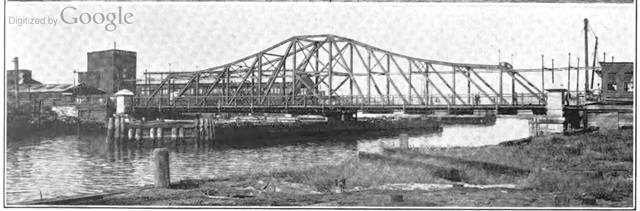
– photo from Engineering magazine, Volume 38, 1910- courtesy google books
This is the bridge that burned away in the 1919 Locust Hill Oil Refinery disaster, a swing bridge not unlike the relict Grand Street Bridge found further up the Creek. Whenever such “Now and then” shots come into my hands, especially images considered to be in the public domain- they will be eagerly shared at this- your Newtown Pentacle.
For more on the history of the Greenpoint Avenue Bridge and its environs, which I call DUGABO- Down Under the Greenpoint Avenue Bridge Onramp- click here
Also:

– photo by Mitch Waxman
An NCA event, which I for one am pretty stoked about:
April NCA meeting hosts Dr. Eric Sanderson
Thursday, April 26, 2012 at 6pm
Ridgewood Democratic Club, 6070 Putnam Avenue, Ridgewood, NY 11385
In addition to important updates from our members – in particular the Bioremedition Workgroup has been very busy! – we will be hosting a special presentation on the “Historical Ecology of Newtown Creek”.
Dr. Eric Sanderson, senior conservation ecologist at the Wildlife Conservation Society and author of “Mannahatta: A Natural History of New York City” (Abrams, 2009), will describe recent studies of the historical ecology of Newtown Creek, describing the original wetlands, creek channels, topography and vegetation of the area. He will show a series of 18th and 19th century maps of the watershed of the creek and discuss the process of synthesizing them into an integrated ecological picture that can be used to inform and inspire natural restoration and cultural appreciation of the Newtown Creek watershed. This work is part of the Welikia Project (welikia.org), an investigation into the historical ecology of the five boroughs of New York City and surrounding waters.
And this Saturday,

Obscura Day 2012, Thirteen Steps around Dutch Kills
Saturday April 28th, 10 a.m.
Your humble narrator will be narrating humbly at this year’s Obscura Day event on April 28th, leading a walking tour of Dutch Kills. There are a few tickets left, so grab them while you can.
“Found less than one mile from the East River, Dutch Kills is home to four movable (and one fixed span) bridges, including one of only two retractible bridges remaining in New York City. Dutch Kills is considered to be the central artery of industrial Long Island City and is ringed with enormous factory buildings, titan rail yards — it’s where the industrial revolution actually happened. Bring your camera, as the tour will be revealing an incredible landscape along this section of the troubled Newtown Creek Watershed.”
For tickets and full details, click here :
obscuraday.com/events/thirteen-steps-dutch-kills-newtown-creek-exploration


 The Newtown Pentacle