Posts Tagged ‘Brooklyn’
grisly forever
A continuing series of colorful images, combatting the SAD reality of January.

– photo by Mitch Waxman
There’s a reason that your summer clothes are always tight when you put them on in June, and it has nothing to do with them getting shrunk by careless laundromat employees. During the cold months, there’s few options open for Queensicans other than to hunker down in their domiciles and blankly stare at a television screen while stuffing food into their mastication orifice. Personally, I’m a big fan of Citrus during the interminable winter months – high in fiber, hydrating, and it delivers a much needed blast of vitamin C.

– photo by Mitch Waxman
Thing is, living in Queens, one has a lot of options which – while not the smartest choice from a dietary point of view – taste real good. A humble narrator is prejudiced towards the selection of an oatmeal raisin cookie while browsing the bakery case, using the rationalization that since its oatmeal – it’s a better choice to make. One entirely omits the fact that these things are full of the “devil’s grease,” which is better known as butter.
Either way, I’m not even thinking about the sugar.

– photo by Mitch Waxman
Speaking of sugar, the shop keeps here in Astoria constantly up their cake game. Often, I wonder if they have struck some sort of deal with Satan itself, committing to slowly murdering as many of us as is possible with baked goods such as the chocolate heart cakes seen above. A true devil’s bargain, and shaped like that which they’re aimed at, these are.
Short term gain indeed, in return for an artery choking case of sclerosis which would send one plummeting to the fiery pit and into the company of the beast.

– photo by Mitch Waxman
There are those who work for us, instead, it should be mentioned. Agricultural bounty is available wherever you choose to seek it out. My team of doctors have passed on a simple coda for interpreting foodstuffs of the vegetative variety – bright greens and dark greens are packed with iron and simple sugars, and red things are anti inflammatory powerhouses. Yellow things are also a good choice, but one should generally avoid white and brown things like potatoes due to the carbohydrate load indicated by their coloration.
They are ambivalent about orange things, my docs, which is good as I’m a carrot guy.

– photo by Mitch Waxman
The coda falls apart when witnessing so called “heirloom” cultivars, of course. There’s a lot of these sorts of vegetable and fruit on the market these days, which are sold with the legend “organic.” Of course, being “Captain Vocabulary” and all – the term has always bothered me as it betrays a lack of knowledge about what words actually mean. My response to the word “organic” is always “oh good, there’s no silicon in this tomato.”
I avoid the purchase of said heirlooms, or hipster fruit as I sometimes call it. If a “regular” tomato was good enough for Harry Truman, it’s good enough for me.

– photo by Mitch Waxman
Wildly verdant, despite the environmental horror of it all, these “sewer berries” can be observed growing in Greenpoint. I would recommend against their consumption, of course.
Legend has it that quaffing a handful of Greenpoint’s sewer berries will lead to bodily transformations and psychological changes. Vampirism might be rampant on the Queens side of Newtown Creek, but apocryphal tales from hoary Greenpoint involving lycanthropy all seem to tie back to some punter tossing back a few feral berries. At least that’s what’s supposed to have happened to McGuniness.
“follow” me on Twitter- @newtownpentacle
with dreams
Constrained and contained.

– photo by Mitch Waxman
The winter blues are upon us all, one fears. Dark skies and so on, combined with recurrent viral infections polluting the local outlook. Not so at this, your Newtown Pentacle. This week it’s not about the blues, rather it’s the purples, and reds, bright green, and lemon yellows. Every image that will greet you this week is chosen not for some narrative purpose, rather it’s a public service whose purpose is to help combat your SAD (seasonal affective disorder) and virus addled days.

– photo by Mitch Waxman
This week you’ll be greeted by a series of shots culled from the archives, accompanied by a bit of text discussing that which is pictured, when warranted. Above, a barbed wire fence line in Blissville, Queens. Behind it rises the former headquarters of the General Electric Vehicle Company, which manufactured electric automobiles and trucks in LIC back at the start of the 20th century. I described the saga of GEVC in this post, which is actually a few years old at this point.

– photo by Mitch Waxman
Williamsburg Bridge is actually the reason that there’s a Municipal Art Society, as the span was considered to be such an abomination when constructed that the gentry of the early 20th century wished to ensure that nothing like it ever occurred again. Personally, I don’t consider it that bad, although I prefer the venerable Manhattan and spectacular Queensboro bridges – speaking from a strictly esthetic point of view.

– photo by Mitch Waxman
It’s at the bottom of the barrel, January, in terms of the wheel of the year. What one such as myself craves is color, saturated and bright. If all I can get is artificiality, I’ll take it.
If this Astoria vending machine, which is the sort designed to tempt a passerby to drop a few coins in pursuance of a stuffed animal which might be obtained via the use of a metallic claw, is all I can get – I’ll take it.

– photo by Mitch Waxman
The former Williamsburgh Savings Bank, over in North Brooklyn, has been laboriously restored to the glories typical of the era of France’s Second Empire. Luxurious detail and slavishly applied color is found on the domed ceilings of the place, both of which are sure to brighten up your wintry malaise.

– photo by Mitch Waxman
Back to LIC’s Blissville, in the shot above, and a religious parade committed by a small army of Bolivians at St. Raphael’s on Greenpoint Avenue. If this quartet of dancers cannot brighten a January day, I don’t know what can.

– photo by Mitch Waxman
Yuyzel on da cruss, as my Grandmother would have described the statuary above, is found at Old St. Patrick’s Cathedral in Lower Manhattan. The cruciform is backed up by stained glass which provides for a bit of color at one of my favorite and most cinematic spots in NYC.

– photo by Mitch Waxman
You can’t go wrong with Times Square if you’re looking to brighten up and color up your mid January. Of course, since it’s actually everything that’s wrong with modern NYC made manifest, a trip there might just backfire. Come to think of it, Times Square has always represented everything that was wrong with NYC, at least in the 20th and 21st centuries.

– photo by Mitch Waxman
FDNY always lights things up when they’re working, come to think of it.
“follow” me on Twitter- @newtownpentacle
refuge open
Street photography, literally, in today’s post.

– photo by Mitch Waxman
A humble narrator has been on a bit of a “notice everything” kick of late, which I imagine would translate into “normal person” as “by Jove, one is surrounded by things which have always been accepted but unquestioned.” Well, I guess that’s how normal people think, I wouldn’t know. One of the things I’ve gotten curious about lately are streets, and more specifically – the roadway itself. This has led me down a bit of a merry path, which has led to the realization that just about every road in NYC, the United States, and in fact the world is paved with industrial waste.
Elucidation follows, but first we need to discuss the development of the thoroughfare.

– photo by Mitch Waxman
Roads were originally created from the compaction of soil along trade routes in prehistoric times, and there were fairly common paths developed in Eurasia and Africa by around 10,000 BCE. The oldest stone paved road known to archaeology was built by the Egyptians, in roughly 2,300 BCE, although there are older “courdoroy” or log roads known (There’s a few in the UK which date back to around 4,000 BCE). Over on the Indian Subcontinent, streets were paved with brick as early as 3,000 BCE.
Famously, the Romans were bloody brilliant at building roads, many of which have lasted into modern times. Their system involved the excavation of a fairly deep trench, followed by the laying and tamping down of several feet of differing grades of stone into it, with the top layer formed from a series of carefully cut paving stones which were quite heavy. The bottom layers allowed for drainage, the top layer armored the structure while using the force of gravity to keep it in place. For about a thousand years, the Roman system (similar technologies were used in China, and amongst the Inca in South America) was the best you could really hope for.
The Europeans who colonized North America used crushed oyster shells and stones to form a road surface, and they mitigated the dust generated by horse and cart by using various forms of oil to hold the stuff in place. It wasn’t until the middle 18th century that roads became “modern” when a Frenchman named Pierre-Marie-Jérôme Trésaguet began working on carefully graded roads around Paris. Trésaguet was followed at the beginning of the 19th century by a Scot named Telford who created what modernity would refer to as “a cobblestone road” wherein the pavers were mortared in place using stone dust and gravel. Unfortunately, these methodologies used a tremendous amount of material, and required an enormous investment to lay the several feet of stone that was required for proper drainage and surface stability.
It was another Scot – John McAdam – who invented the precursor of the modern roadway, and his pavement came to be known as “Macadam.”

– photo by Mitch Waxman
Macadam roads wore tougher under carriage wheels, and were cheaper to build than “Telford’s”. Trial and error taught McAdam that a course of stones, broken up small enough and compacted by a heavy iron roller, would act as a solid mass if given proper drainage. It was perfect for horse and carriage, albeit a bit dusty. The roads of the industrial revolution era were generally paved in Macadam.
In 1902, a Swiss doctor named Ernest Guglielminetti hit upon the novel idea of using tar to coat the roads in Monaco. About twenty years later, an Englishman named Edgar Purnell Hooley patented a formula (in the UK and USA) which combined coal tar and blast furnace slag mixed into gravel and called his new product Tarmac, or Tarred Macadam. Tarmac became quite wide spread by the early days of the automobile, but by the late 1920’s the literal king of the road appeared and Tarmac went out of style.
Also, even by the beginning of the 20th century, physician and politicians alike began to realize that Coal Tar was a particularly unhealthy thing to loose upon the environment. Luckily, nothing bad had ever come out of the nascent petroleum industry.

– photo by Mitch Waxman
There are 42 gallons of crude oil in one of those shipping barrels which you always hear business people referring to. When the distillation process is complete, multitudes of chemicals are wrung out of it. 1.7% of every barrel ends up as a fairly inert form of tar which is referred to as “Asphalt or Road Oil.” Asphalt actually occurs naturally, and when it bubbled up out of the ground in historical settings, it was referred to as “pitch.”
Pitch was used for waterproofing the wooden joins on ships, inside buildings – anywhere you’d need a waterproof seal. It was also used as an incendiary for flaming arrows, and for boiling people you’d want to teach a lesson to. The British, and geologists, refer to naturally occurring Asphalt as “bitumen.” There’s natural lakes of the stuff to be found, notably in Trindidad/Tobago and it’s the tar you’ll find in the LaBrea Tar pits over on the left coast in Los Angeles.
The English were paving with Asphalt as early as the 1830’s, and in 1837 a fellow named Richard Tappin Claridge was granted a patent on a formulation for asphalt paving. Claridge’s company survived until the First World War, when it had just entered into a new venture to manufacture “Asphalted Macadam.”

– photo by Mitch Waxman
In New York City, modern day roads (with the exceptions of historic “Belgian Block” pavement, or the rare brick surface like Stockholm Street in Ridgewood) are paved with asphalted concrete. It’s a layer cake, according to the NYC DOT. There’s a base layer of gravel, which is covered by cement or concrete (which is sometimes reinforced with structural steel, depends of where it is and what the substrate is) which is armored by a top layer of asphalted concrete. Luckily, the roads in Queens are crappy, and on a recently replaced section of Northern Blvd. in Long Island City – you can see two of the layers surrounding a collapsing sewer drain.
It’s actually quite a thin crust, when you get down to it. This PDF at NYC.gov offers the “Materials” chapter of the DOT’s street design manual, and it covers the various approved road surfaces (sidewalks too) which you are encouraged to use in the City of Greater New York. It will tell you that, amongst other things, asphalted concrete is the most highly recycled substance in our municipality.
There is a “Green Asphalt” plant found in Blissville, at my beloved Newtown Creek, which is one of many facilities around the City which perform this sort of service. It seems that there is an economic, and practical, reason for placing these facilities within the City itself. Your “mix” needs to be within a certain distance of where you’re going to be laying it down, otherwise it begins to solidify and degrade in transit.

– photo by Mitch Waxman
Closer to home – my home at least – on Broadway in Astoria, a “trencher” was observed cutting its way through the street. You can see the layer cake of concrete and asphalt, and in the post which originally described the device – this one – your humble narrator reported that several largish chunks of timber were being brought to the surface along with the concrete and asphalt.
Broadway, in this section, is quite a complicated structure. The IND tracks of the R train are found at what’s probably 20-30 feet under the surface, which were constructing using the “cut and cover” method. There’s all kind of other stuff snaking around – sewers, utility tunnels, rat middens, etc. That means that the street is actually the uppermost section of a larger structure, meaning that if you fell down in the crosswalk – you’ve actually just landed on the roof of a building. As I mentioned above, how normal people think is a bit of a mystery to me.

– photo by Mitch Waxman
According to officialdom, 99% of Asphalt is recycled, and that 95% of the roads in the United States are paved with it. Asphalt pavement is rated according to the weather extremes it can withstand, and there are certain formulations designed for different climates. A different mix of tar and concrete is used for roads in Buffalo than those in NYC, for instance, due to climatological factors.
Engineers I’ve checked in with like the stuff – describing it as “easy to work with, and easy to repair.” It seems that a fresh laid bed of asphalted concrete is structurally a single unit – until something goes wrong under the surface or utility access requirements and repairs forces laborers to start cutting holes in it. That’s when the surface starts to flow, and pull, and crack. NYC is basically always working on one street or another – grinding, paving, laying new foundations. Given that a lot of the City sits on former wetlands, it’s a task best described as Sisyphean.

– photo by Mitch Waxman
So – back to the industrial waste part of things – according to a buddy who works as an Enviro-Cop, asphalt is actually a fairly benign substance as far as petroleum goes. Unlike other derivates, it’s environmentally stable once it has set. The recycling industry uses high levels of heat to release the bitumen from the concrete matrix, which allows it to be mixed in with a fresh batch of concrete and applied to a street. There’s all sorts of things which have, and still, get mixed into asphalted concrete. Although NYC claims its has never used the stuff on its roads, some have experimented with mixing in asbestos fibers, and or coal tar. Plastics collected by the recycling industry are often shredded and mixed in with the tar and concrete, as is glass. For a while, automotive tires were considered a good candidate for inclusion in the mix, but the cost of shredding steel belted rubber was too high. Routinely, fly ash from industrial furnaces is mixed in, along with all sorts of other stuff which would otherwise just fill up an ever shrinking square footage of municipal landfills and dumps. By the ton, the singularly largest part of the flow of NYC’s garbage involves the disposition of road construction waste. The fumes emitting from hot and freshly laid asphalt carry some risk, cancer wise, but the injuries most often associated with the material in its malleable form are laborers getting burned while working with it.
Regardless, it’s another one of the many byproducts produced by the petroleum industry. Remember, asphalt – which is found on nearly all of NYC’s 6,074 miles of roads and on 95% of the roads in the United States represents 1.7% of every barrel of crude oil sent to the refinery.
About half of that barrel will become gasoline.
According to the U.S. Energy Information: “In 2014, the United States consumed a total of 6.97 billion barrels of petroleum products, an average of about 19.11 million barrels per day. This total includes about 0.34 billion barrels of biofuels”.
Of course this beggars the question, a paradox actually, which asks: if 99% of asphalt is recycled, where’s all the freshly manufactured stuff going? 1.7% of 6.97 billion barrels of oil would suggest that the U.S.A. produces 118,490,000 barrels of fresh Asphalt (or road oil) per year.
“follow” me on Twitter- @newtownpentacle
sights familiar
Newtown Pentacle’s 2015 Year in review
January, 2015

– photo by Mitch Waxman
This is the Newtown Pentacle “Year in Review” post, which is replete with links to earlier postings. The links were chosen for inclusion based on my own predilection. Either the photos contained in them don’t suck, or they were written to cover something significant that passed in front of my camera. There’s some pretty good stuff contained herein, IMHO. There will be a single image posted on Thursday the 31st and Friday the 1st, and new material will resume on Monday the 4th at this, your Newtown Pentacle.
2015 started off with a bang – and the loss of a dear friend – Captain John Doswell, who was eulogized in this post on January 5th. Out of a desire to escape from existential reality, I went searching for the Vampires that hang around the House of Moses down in Red Hook. Life kept on happening though, and while enduring an excruciating interval in Manhattan’s Gas Light district, a neat relic of tenement New York at a Church on 14th and 1st was described.
February, 2015

– photo by Mitch Waxman
A humble narrator spends a lot of time outdoors and concurrently complains endlessly about the weather. Too hot, too cold, humid, dry, raining, or way windy – I’m a regular complaint department on the subject. This post from February depicts a frozen over Newtown Creek, and what turned out to be creosote oil migrating out of a wooden maritime structure called a “dolphin.” “Other Objects” discusses curious altars and offerings discovered adorning certain corners in Astoria from around the time of the lunar new year. Over at Bushwick Inlet on the East River, in hoary Greenpoint, a spectacular fire at the Citystorage building was observed.
March, 2015
x
– photo by Mitch Waxman
When the Big Little Mayor announced his intentions to deck over the Sunnyside Yards, which is literally “in my back yard,” I was forced to say “not.” As history is ultimately the best weapon in my quiver, the video above was created and disseminated to the web. A dedicated effort to focus in on Queens was made in 2015, after having spent most of 2014 over in Greenpoint. Strange Oceans focused in on “used to be 5ptz” on Davis Street in LIC. Not Permitted continued to discuss the Sunnyside Yards issue, and Very Confines witnessed mystery discharges into the Newtown Creek at the currently undefended border of Brooklyn and Queens.
April, 2015

– photo by Mitch Waxman
One spent quite a bit of time and effort visiting the “House of Moses” in 2015, and “Resting and Brooding” spent a bit of time observing the heart of Robert Moses’s empire here in Astoria – mighty Triborough. On the south end of Steinway Street, a tropical bird was noticed that was suffering from neglect in “Nearby Where,” and “Were Related” revealed where the City government stores a bunch of its gear under the Queensboro Bridge and at North Henry Street in Greenpoint.
May, 2015

– photo by Mitch Waxman
One of my highlights for 2015 was getting invited down into the Second Avenue Subway project, which spawned a series of posts. “Who can guess” “all that there is” “that might be” “buried” and “down there” arrived in Newtown Pentacle subscribers email, Twitter streams, or Facebook feeds in late May of 2015. Earlier in the month, “historical realities” explored DUPBO – Down Under the Pulaski Bridge Onramp – back at Newtown Creek.
June, 2015
– photo by Mitch Waxman
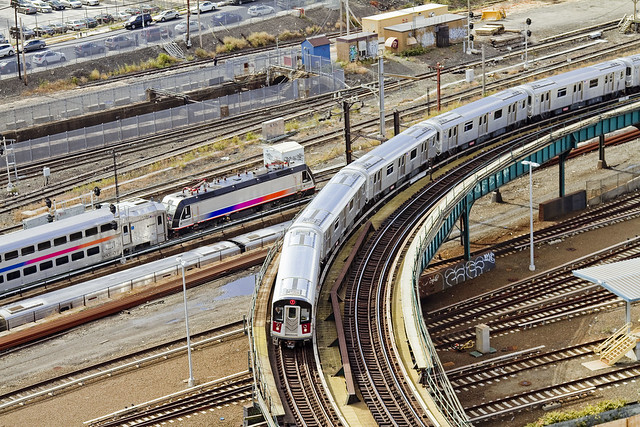
In June of 2015, I was operating at full throttle. Opening about the ridiculous lack of public bathrooms to be found in the greatest City on the planet in “fully inanimate,” discussing the ongoing Superfund situation at Newtown Creek in “arduous details,” and asserting that 7 line Subway is far and away the most photogenic of NYC’s mass transit options in “simple swains,” and I got to bring the camera out with the Working Committee on a tour of Gowanus Bay in “quaint fusion.” The HarborLab group built and delivered a dock to Newtown Creek’s Dutch Kills tributary for the usage of LaGuardia Community College’s science programs, and I tagged along to document the effort in “jouncing descent,” “grim facade,” “listless drooping,” and “stinking shallows.”
July, 2015

– photo by Mitch Waxman
“Amidst Glare” showcased the last photos my old camera ever took, before an accident destroyed the thing. A call out to Newtown Pentacle’s readers for financial aid in replacing it was answered handsomely, which warmed the calcified vesicle which passes for my heart. “Racing Ahead” returned to the House of Moses, and wished the Marine Parkway Bridge a happy birthday. An uncharacteristic post explored the macroscopic world of an Astoria cucumber patch in “vine encumbered,” whereas “Portal Guardians” brought me right back home to the gutter.
August, 2015

– photo by Mitch Waxman
Walking from Astoria to lower Manhattan one sunny day, via the Williamsburg Bridge, was discussed in “victoriously swept,” and led to another visit to the House of Moses in “pale vapors.” The House of Moses is citywide, and Greenpoint’s iteration was explored a bit in “staves and axes.” Over at Staten Island’s own Kill Van Kull waterway, a pretty significant bridge rebuilding project is underway at the Bayonne Bridge, which was detailed in “decadent element.” Calvary Cemetery in LIC’s Blissville neighborhood was profiled in “ordinary interpretation.” Closer to home, Astoria’s Broadway was invaded this summer by an army of drunks which the 114th Precinct refused to notice. I forced them to notice in a flurry of posts and social media efforts, starting with “unknown things,” and “parched and terrible.” My efforts at documenting the neighborhood and its issues continued with “later civilizations.”
September, 2015

– photo by Mitch Waxman
In September, like every other idiot with a camera and tripod in North America, I was up on the roof photographing the so called “super blood moon” in “khephrens gateway.” The battle of the Borrachos continued here in Astoria, in “another city.” “Drifting Sand” visited Astoria’s Steinway Mansion and offered a shout out to Newtown Pentacle’s most frequent commenter – George the Atheist – for his tireless documentation of the sinful manner in which the cultural heritage of Queens is treated. At Newtown Creek, the area I refer to as DUGABO – Down Under the Greenpoint Avenue Bridge – was discussed in “horrors and marvels.” I got to gather some night shots from mid channel on the Newtown Creek in “gorgeous concealment,” and tripod shots of the Dutch Kills tributary of Newtown Creek were offered in “could furnish.”
October, 2015

– photo by Mitch Waxman
With tour season winding down in the late fall, my wandering about the City of Greater New York increased. Over at Newtown Creek’s Unanmed Canal at North Henry Street, a Newtown Creek Alliance event allowed me some purchase to explore the unexpected ossuary found at a semi abandoned DSNY Marine Transfer Dock in “gently heaving.” An Atlas Obscura night time event at Brooklyn’s Greenwood Cemetery provided time and opportunity to provide some fairly surreal “night into day” shots in “breathing marble.” Back in Astoria, “swinging and plunging” showcased some passing maritime action at Hells Gate, and showcase a cool car spotted at the border of old Astoria in “other metals.” Newtown Creek has finally seen MTA re activating its rail presence, albeit for the purpose of shipping trash around, and the garbage trains at the Blissville Yard were described in “viewless aura.”
November, 2015

– photo by Mitch Waxman
Halloween was spent at the corner pub which I refer to as my district office – Doyle’s at the Times Square of Astoria, 42nd and Broadway. Costumed hordes allowed me to photograph them in “rose oddly.” Oddly, my energy levels in November were quite high, whereas Consolidated Edison was busy dealing with low levels of residential supply found in Astoria as detailed in “full joys.” Discussion of manhole covers resumed in “discoursed of,” Mayor de Blasio and his agenda were derided in “mountain folk,” and LIC’s Montauk Cutoff was discussed in “these views.” The Montauk Cutoff post explored my growing interest and fascination with low light photography, and a series of posts about a pre dawn walk from Astoria to industrial Maspeth – “grotesque night,” “betraying myself,” “duplicate and exceed,” and “ultimate effect” displayed what I saw on an uncharacteristically warm November night. Finally, DUKBO – Down Under the Kosciuszko Bridge(s) Onramp(s) – and the NYS DOT construction project, was visited in “brought up,” and “leftward fork.”
December, 2015

– photo by Mitch Waxman
The close of 2015 began as it started, with the death of a good friend – Kill Van Kull chronicler and Photographer John Skelson, who was eulogized in “Marine Things.” The forbidden north coast of Queens, and Luyster Creek, was visited in “known specie,” and the Queens side of DUKBO described in “cyclopean endeavor.” A boat trip on Newtown Creek found a Hindu god lurking along the bulkheads in “systemic horror,” and an encounter with some cheeky monkeys in Central Park was described in “urge primal.”
“follow” me on Twitter- @newtownpentacle
hunched servitor
Breaking windows, on the Newtown Creek.
– photo by Mitch Waxman
Recent controversy, and there’s always controversy, revolving around the Newtown Creek Superfund project has been swirling. Here’s the situation, which requires a bit of prologue for the uninitiated.
The Federal EPA has listed Newtown Creek as a Superfund site, which makes them the executive power responsible for its cleanup according to a bit of legislation called CERCLA. The EPA named several corporate entities as “PRP’s” or “Potentially Responisble Parties” who are culpable for the despoilment of the environment hereabouts. These PRP’s are the usual suspects – Oil companies, Gas Companies, a refinery. There are five of them, all conglomerate entities which absorbed one historic property or another over the years – ExxonMobil, National Grid, etc. There’s a sixth party which hasn’t been “officially” designated a PRP, which is the NYC DEP, a governmental entity responsible for (amongst other things) the sewer system of New York City.

– photo by Mitch Waxman
As you’d expect, every one of the PRP’s wants to get out of this Superfund thing having spent as little as is possible on the cleanup. This is normal, and logical. The Corporations have an army of lawyers, and so does the DEP. Finger pointing is also normal in a situation like this, just as it would be for children who broke a school window while playing baseball. The corporate PRP’s are in the position of having to protect their shareholders from undue costs, as is the DEP in the case of taxpayers. Again, broken school window, baseball. The difference between government and corporation, however… well, the corporate manager will accept the fact that he’s cooked for breaking the pane and that it’s cheaper to just fix the window and get on with the business of earning money, while the government will try and tell you that the window shouldn’t have been there in the first place but the school they built needed windows by law so you just have to accept the broken window until next spring when the “new and better placed window bill” will be heroically sent to an indifferent Albany… and that after a sixteen year period of committee hearings… and… terrorists… and… Basically, they pass the buck down to the next election cycle. I’m prejudiced, I guess, as I always worked corporate and understand the internal processes a lot better than the intentionally Byzantine workings of government officialdom.
This is where the Federal EPA comes in, in their executive function. All of the PRP’s have contracted with environmental testing firms to perform the schedule of analysis which EPA requires in order to design a remedy for the environmental situation on the Newtown Creek. When the remedy is codified, it will be contractors hired by those self same PRP’s which will do the actual work, under Federal oversight. Meantime, everybody is blaming everybody else for whatever they can, hoping the other guy gets stuck with paying to fix the busted window.
A recent presentation offered by the NYC DEP discussed a process called “Ebullition.”

– photo by Mitch Waxman
Coal Tar Sludge is pretty ugly stuff, if you’re alive. It’s a by product of the gasification of coal, a product of what was once called “pneumatic chemistry.” National Grid is a multinational conglomerate that owns the holdings of what was once Brooklyn Union Gas in New York City. BUG had a massive manufactured gas plant at the border of Bushwick, Williamsburg, and Greenpoint. In the waters of Newtown Creek found off the National Grid bulkheads, NYC DEP’s environmental contractors observed an astounding 18 feet of coal tar sludge in the sediments of Newtown Creek. Natural processes – springs and ground water entering the bed of the waterway from below, for instance – cause bits of this coal tar sludge to migrate out of the sediment bed, which is called “Black Mayonnaise.”
The environmental types refer to this sort of thing as NAPL, or Non Aqueous Phase Liquid. That’s a fancy way of indicating that oil and water don’t mix, as the coal tar sludge – like petroleum – remains distinct from the water column surrounding it.

– photo by Mitch Waxman
Pictured above is one of those bubbles of NAPL, or Coal Tar sludge which found its way to the surface of the water via the ebullition process. Surface tension breaks the bubble and begins to spread it into a disc. Presuming it doesn’t end up coating a bulkhead or rock somewhere between here and the East River, by the time this coal tar sludge reaches the east river it will just look like a bit of oil spread out over an area of several feet.
The NYC DEP, and their contractors, presented findings which suggested that as much as 5,000 KG of this stuff migrates up from the bottom sediments annually. They offered that in comparison, the combined sewers operated by DEP (which along Newtown Creek are amongst the largest in NYC) only deposit 27 KG of solute into the water. They also spent quite a bit of time critiquing the corporate PRP’s Contractor’s methodologies and procedures. After the presentation, it was time for questions and I asked a few pointed ones.

– photo by Mitch Waxman
Is this 18 feet of coal tar sludge an ongoing or historic event?
“Good question” was the answer.
Given the fact that DEP has been paying fines on the combined sewers to the Feds since 1983, coincidentally the same year that DEP was created, you must have good records of what’s been flowing out of your pipes since then. That 27 KG number, how does it compare historically with those records?
“We’ll have to get back to you.”
I’m certain that – historically – some of that coal tar and petroleum in the sediment bed must have been carried into the water from upland sources via your pipes, when you observed this 18 foot high wall of coal tar sludge, did you notice if any of your out falls were nearby?
“The sewers have never carried oil, it’s illegal”
But what about the 1950’s when Greenpoint’s aquifer was on fire, and the sixties when manhole covers were erupting on gouts of flame, and the 80’s when it was discovered that petroleum fumes in the sewer pipes were above the upper explosive limit?
“Sir, I don’t know what you think the DEP has done to you, but on behalf of the Agency I’d like to apologize”
That’s called “crackpotting” btw. and that pissed me off.

– photo by Mitch Waxman
Are the folks who run oil companies a bunch of bastards? You bet. Global Gas conglomerates are not operated by nice guys either, nor copper refineries. Know how Rockefeller made his money? Wasn’t by being a cool guy. Anybody in a position of real power is by definition “kind of a dick.” Obama would pull your tongue out and strangle you with it if he had to, but he doesn’t because there’s thousands of people who work for him that are specially trained to do so. Just because you work for the Government it doesn’t mean you’re some sort of altruist.
I cannot count the number of lies I’ve been told by employees of the NYC DEP over the years. Promises made last only as long as a Commissioner’s term, or a Mayor’s. Saying that, this is just one tiny sliver – the political and managerial department of the Agency – of an enormous 6,000 person organization which manages and polices the reservoirs, runs 14 sewer plants, possesses a small navy, handles air and noise environmental issues citywide, and has a $1.2 Billion budget. I’ve known people who work for the DEP that are amazing, and I’ve also met the political gasbags.
This is not some little mom and pop operation, the DEP.

– photo by Mitch Waxman
Thing is, what the DEP management team is trying to do is to reduce their exposure to having to pay out for the cleaning up of the so called “Black Mayonnaise” which sits 20-30 feet deep in the Newtown Creek, and I can’t say I blame them. Like any entity, corporate or otherwise, they will have to pass the costs of this operation on to their customers.
Unlike a corporation, which would be put into a competitive advantage should it be forced to raise prices and drive customers to a competitor’s cheaper products, there is unfortunately only one City government to be found and you just have to pay the taxes that they inflict. There is no political will to raise water taxes in NYC after a roughly 400% rise in rates which occurred during the 12 years of Michael Bloomberg’s administration… so… do the math. The DEP people will say and do anything to avoid culpability, or delay the inevitable as long as they can and pass the buck to some new Mayor or Commisioner.
Crackpot me? Don’t piss off the photographer, doc, I’ve got pictures to back my side up.

– photo by Mitch Waxman
There’s a saying which was passed down to me by my Dad and Uncles who had served in the military – “It’s a big shit sandwich and we all have to take a bite, so grab a napkin.”
Since the Superfund listing for Newtown Creek was made public, a humble narrator has been prophesying that the most interesting part of this story wasn’t going to be the oil companies trying to snake out of town and deny responsibility. Simply put, that’s the expensive way to go for them, as the courts and Feds will just stack fines up on them which they’ll have to pay IN ADDITION to the costs of the cleanup. It’s simpler, and cheaper, to cooperate. Nope, since the beginning of this tale I’ve been saying that “the fascinating part of this story will be watching the vertical silos of power in NYC’s government struggle and writhe against a higher authority.” Local authority, even that juggernaut in lower Manhattan, legally collapses before that of the Federal Government.
The EPA said that they’re willing to consider DEP’s Ebullitions study, and it’s data, but won’t be basing their decisions on either local government or corporate side’s assertions. The same DEP official who “crack potted” me in the earlier discussion mentioned above, upon hearing the EPA pronounce the substance of this statement, announced to a room full of people that DEP’s data “is just as good, if not better, or far better than EPA’s.” This is from the same official who claimed that it wasn’t going to be Superfund that cleans the Creek, rather DEP’s Long Term Control Plan – which is being designed by the same “ass coverers” and bureaucrats who haven’t done squat about it since the agency was created in 1983 by merging several smaller municipal entities which were responsible in the first place for dumping raw sewage into the waterway every time it rains.
Anyway, that’s the whole Ebullition thing for you, and a bunch of PRP’s who broke a window while playing ball. The one who threw the ball, the one who hit the ball, and the rest of the field. Meanwhile the window is hanging wide open and it’s raining into the school.
“follow” me on Twitter- @newtownpentacle


 The Newtown Pentacle