Posts Tagged ‘Brooklyn’
peopled with
Today’s post is for the birds.

– photo by Mitch Waxman
One remembers that time when the world was not frozen, an era when water ran freely, and there were wholesome creatures which existed in the open air. Some of these entities were classified as birds, holdovers and descendants of the mega saurians who ruled the planet in antiquity, and these bird things were actually capable of flight. This was, of course, before Ithaqua was given regency over the planet, and before New York City began to resemble the Plateau of Leng.
from wikipedia
Ithaqua is one of the Great Old Ones and appears as a horrifying giant with a roughly human shape and glowing red eyes. He has been reported from as far north as the Arctic to the Sub-Arctic, where Native Americans first encountered him. He is believed to prowl the Arctic waste, hunting down unwary travelers and slaying them gruesomely, and is said to have inspired the Native American legend of the Wendigo and possibly the Yeti.
Ithaqua’s cult is small, but he is greatly feared in the far north. Fearful denizens of Siberia and Alaska often leave sacrifices for Ithaqua—not as worship but as appeasement. Those who join his cult will gain the ability to be completely unaffected by cold. He often uses Shantaks, a dragon-like “lesser race”, as servitors. A race of subhuman cannibals, the Gnophkehs, also worshiped him, along with Rhan-Tegoth and Aphoom-Zhah.

– photo by Mitch Waxman
We dwell within now, building walls thickened by ice, cowering in the glow of electrical lights – and the burning thermonuclear eye of god itself occluded by frozen clouds. In the gloom and slush outside, shapes move about. Some are huddled masses of textiles wrapped around stiffly articulated ape things, others are vast encrustations of sodium with metallic endoskeletons and four robustly cylindrical rubber feet. The latter spews noxious gas which paints the ice black, and the former have been observed attacking the precipitants with curious tools and devices.
Remember the birds, remember the birds.
from hplovecraft.com
Searchers after horror haunt strange, far places. For them are the catacombs of Ptolemais, and the carven mausolea of the nightmare countries. They climb to the moonlit towers of ruined Rhine castles, and falter down black cobwebbed steps beneath the scattered stones of forgotten cities in Asia. The haunted wood and the desolate mountain are their shrines, and they linger around the sinister monoliths on uninhabited islands. But the true epicure in the terrible, to whom a new thrill of unutterable ghastliness is the chief end and justification of existence, esteems most of all the ancient, lonely farmhouses of backwoods New England; for there the dark elements of strength, solitude, grotesqueness, and ignorance combine to form the perfection of the hideous.

– photo by Mitch Waxman
Televisual news and information services operate in a fever pitch, describing roof collapses and downed power lines, informing and feeding a populace anxious for elevated states of emotion and experience. A new dark age is upon us, perhaps, and the foolish notion that the titans retreated out of weakness is proven out. Woe to you, mankind, for the great old ones of primal myth – those towering, all conquering masses that once ruled this planet have been awoken from their icy tombs and are on the move. The birds have survived them before, and likely will again, what of humanity however?
Leviathan, Jörmungandr, Tiamat – whatever your culture describes them as – these frozen giants whose very body can swell to continental levels – the Glaciers are returning. Lament!
also from hplovecraft.com
It is absolutely necessary, for the peace and safety of mankind, that some of earth’s dark, dead corners and unplumbed depths be let alone; lest sleeping abnormalities wake to resurgent life, and blasphemously surviving nightmares squirm and splash out of their black lairs to newer and wider conquests.
“follow” me on Twitter- @newtownpentacle
marching things
Infrastructure geekery today.

– photo by Mitch Waxman
The center of the Williamsburg Bridge span offers a clearance to river going vessels of about 135 feet.
A building story is conventionally calculated as being around 10-12 feet, so that makes the Williamsburg Bridge tall enough to fit a roughly 11-12 story building under the apogee of its arc, water towers notwithstanding. That gives us a bit of an idea about the sort and size of maritime vessels which used the mercantile river during the late 19th and early 20th century. Remember that engineers always work around restrictions, and inadvertently create standards when they do.
from wikipedia
Construction on the bridge, the second to cross this river, began in 1896, with Leffert L. Buck as chief engineer, Henry Hornbostel as architect and Holton D. Robinson as assistant engineer, and the bridge opened on December 19, 1903 at a cost of $24,200,000

– photo by Mitch Waxman
A 75,000 ton pile of steel, we call it Queensboro, and this deck is around 130 feet over the water. When it went up in 1909, there were still concerns about navigability for warships and other large ocean going vessels moving between the Navy Yard in Williamsburg and Long Island Sound (via Hells Gate). This has never been the front door for NY Harbor though, most mariners prefer the shallow but safer route which carries them through Gerritsen Bay and the Narrows, which we call the Ambrose Channel, to Jamaica Bay and the open ocean.
from wikipedia
Serious proposals for a bridge linking Manhattan to Long Island City were first made as early as 1838 and attempts to finance such a bridge were made by a private company beginning in 1867. Its efforts never came to fruition and the company went bankrupt in the 1890s. Successful plans finally came about in 1903 under the city’s new Department of Bridges, led by Gustav Lindenthal (who was appointed to the new position of Commissioner of Bridges in 1902), in collaboration with Leffert L. Buck and Henry Hornbostel, designers of the Williamsburg Bridge.

– photo by Mitch Waxman
149 feet over the water, Manhattan Bridge offers a significant amount of clearance to shipping, nearly 20 feet more than its northern brethren. Admittedly, this has always been a busier part of the river than that spanned by Queensboro and Williamsburg, but I’ve always wondered why East River Bridge 2 (MB) was built higher than 3 (WB) and 4 (QB). I’m sure the answer is pedantic, and will likely be depressing.
from wikipedia
The bridge was opened to traffic on December 31, 1909 and was designed by Leon Moisseiff, who later designed the infamous original Tacoma Narrows Bridge that opened and collapsed in 1940. It has four vehicle lanes on the upper level (split between two roadways). The lower level has three lanes, four subway tracks, a walkway and a bikeway. The upper level, originally used for streetcars, has two lanes in each direction, and the lower level is one-way and has three lanes in peak direction. It once carried New York State Route 27 and later was planned to carry Interstate 478. No tolls are charged for motor vehicles to use the Manhattan Bridge.
“follow” me on Twitter- @newtownpentacle
leading corridor
What’s good for the goose is good for the gander.

– photo by Mitch Waxman
As mentioned in posts last week, a couple of trips to coastal Brooklyn popped onto my schedule. In the case of today’s post, I was in South Brooklyn at the angle found twixt Red Hook and Cobble Hill, and crossing the street beneath the extremely drippy Gowanus Expressway.
from wikipedia
After the Verrazano Narrows Bridge, I-278 continues into Brooklyn on the Gowanus Expressway. Immediately after the bridge, the freeway comes to an eastbound exit and westbound entrance for the Belt Parkway. After this, a full interchange serves 92nd Street at which point I-278 becomes a single-level six-lane freeway. Along this road, one of the eastbound lanes serves as a high-occupancy vehicle lane. The Gowanus Expressway continues northeast into urban residential neighborhoods and reaches an eastbound interchange at Fort Hamilton Parkway and a westbound interchange at 86th Street. Turning more to the north, I-278 comes to a partial interchange at 65th Street, with an exit eastbound and entrance westbound. The road curves northwest at this point and comes to a directional interchange providing access to 3rd Avenue and the Belt Parkway.

– photo by Mitch Waxman
A confession, seldom do I actually pay attention to the minute details when photographing an area with which I’m not overly familiar. Instead, I go for the big shot, and use my lens at its widest angles. In the street, I have a lot to worry about – traffic, criminal underclasses and malign manifestations of the street culture, and so on. Often, when I’m at my desk and examining the shot qualitatively (focus and exposure rather than composition and esthetics etc.), something will jump out at me. Notice the blue van, which I didn’t until I was back at HQ.
from nyc.gov
…standing on a street, walkway of a bridge, sidewalk, or other pedestrian passageway while using a handheld device and not otherwise asserting exclusive use by any means, including physical or verbal, is not activity that requires a permit.

– photo by Mitch Waxman
So, there I stood, dirty black raincoat flapping about in the slipstream of truck and traffic and waving the camera about during a red light interval. Obviously, this registered in the mind of the driver of the blue van as suspicious activity, and he began to photograph me right back. The panopticon at work, lords and ladies, he saw something. Wonder if he said something?
from securetransit.org
Whether you’re following your regular commute route or on your way to a movie or meet up with friends, public transit is a key part of your day. You know public transit, and no one can spot something suspicious or out of place better than you.

– photo by Mitch Waxman
The 1984 scenario offered by Orwell has only come partially true in 2014. The State is indeed watching, and listening. Unfortunately, its usually “Little Brother” (as Cory Doctorow coined it) who is watching. This is all good though, as what is good for the goose is literally good for the gander, and the Brooklyn way is to keep an eye on the neighborhood. On this day, under the Gowanus Expressway, there were at least two surveillance devices active and pointing at each other. Mine and his. Mine was bigger.
from wikipedia
Big Brother is a fictional character in George Orwell’s novel Nineteen Eighty-Four. He is the enigmatic dictator of Oceania, a totalitarian state taken to its utmost logical consequence – where the ruling Party wields total power for its own sake over the inhabitants.
In the society that Orwell describes, everyone is under complete surveillance by the authorities, mainly by telescreens. The people are constantly reminded of this by the phrase “Big Brother is watching you”, which is the core “truth” of the propaganda system in this state.
Since the publication of Nineteen Eighty-Four, the term “Big Brother” has entered the lexicon as a synonym for abuse of government power, particularly in respect to civil liberties, often specifically related to mass surveillance.
“follow” me on Twitter- @newtownpentacle
constantly feeling
A walkabout in Red Hook, by the Gowanus.

– photo by Mitch Waxman
An assignment carried me out to the ancient harbor of South Brooklyn, Red Hook. After my business was concluded, a walkabout was conducted. Nothing “formal,” as I wasn’t looking for anything in particular, just poking around a bit while walking back to the train. Can’t have my beloved Creek think I’m cheating on her, especially not with her sister of the superfund.
– photo by Mitch Waxman
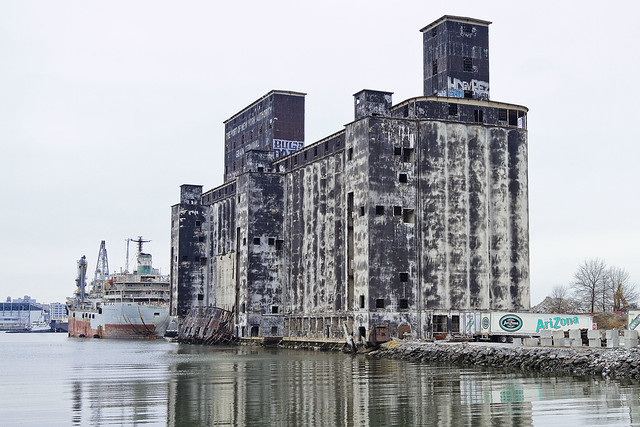
The Gowanus Canal, of which I know little. That’s something I say all the time, and I’m being a bit disingenuous. By the standards of the average person, I know a lot about Gowanus, but not enough to satisfactorily describe it. Recently, I attended a lecture by Joseph Alexiou, and that young man knows about the Gowanus.
The structure pictured above was formerly a grain terminal, by the way.

– photo by Mitch Waxman
Unfortunately, much of the story here at Gowanus is the same as it is on Newtown Creek. Oil companies and chemical factories and manufactured gas plants and centuries of industrial activity, coupled with the City running open sewers directly into the water. Abandon all hope, ye huddled masses.
“follow” me on Twitter- @newtownpentacle
minute glimpses
One last stop at the Brooklyn Navy Yard, this time with FDNY.

– photo by Mitch Waxman
Over the years, there have been plenty of shots offered at this – your Newtown Pentacle – of the Marine 1 unit (and their boats) here at the Navy Yard, but all of those photos have been shot from the deck of a boat. For today’s post, here’s what you can see from the landward side.
from marine1fdny.com
Marine 1 was the first Marine Company formed in the City of New York. We have moved several times over the years (find out more on our history page). We are on call and respond to 560 miles of waterfront surrounding the City of New York. These waterways are among the busiest in the world, used for both shipping and enjoyment. Along with the other two fireboats and a total of four small rapid response boats, we protect the people of New York as well as those visitors who are just passing through.
Marine 1 is manned by a crew of seven; an officer, a pilot, two engineers, and two firefighters.

– photo by Mitch Waxman
Like all boat yards, the winter is a great time to see what their “rolling stock” looks like, as a significant number of their boats are up on blocks awaiting the attention and repairs of ship wrights and mechanics. The large steel structure at the right of the shot is a boat crane, used for lifting vessels in and out of the water. Notice the fact that it’s in Fire Department red, and you’ll know who owns the thing.
from wikipedia
On the eve of World War II, the yard contained more than five miles (8 km) of paved streets, four drydocks ranging in length from 326 to 700 feet (99 to 213 meters), two steel shipways, and six pontoons and cylindrical floats for salvage work, barracks for marines, a power plant, a large radio station, and a railroad spur, as well as the expected foundries, machine shops, and warehouses. In 1937 the battleship North Carolina was laid down. In 1938, the yard employed about ten thousand men, of whom one-third were Works Progress Administration (WPA) workers. The battleship Iowa was completed in 1942 followed by the Missouri which became the site of the Surrender of Japan 2 September 1945. On 12 January 1953, test operations began on Antietam, which emerged in December 1952 from the yard as America’s first angled-deck aircraft carrier.
The US Navy took possession of PT 109 on 10 July 1942, and the boat was delivered to the Brooklyn Navy Yard for fitting.
This boat was sunk in the Pacific in August 1943 and became famous years later when its young commander, Lt. John F. Kennedy, entered politics.
At its peak, during World War II, the yard employed 70,000 people, 24 hours a day.

– photo by Mitch Waxman
There was more than one SAFE boat on display at the pier, and these are vessels that I am just fascinated by. Every one of the “services” (Coast Guard, NYPD, even Park Police) has a version of this boat. It adheres to the modern procurement system followed by Federal authorities which describes individual vehicles as all purpose “weapons platforms” that can modified or customized, on a task specific basis, for a particular agency or entity. The Coast Guard has an M60 machine gun mount on theirs, NYPD has a towing system, the FDNY a water monitor (a fire hose).
from uscg.mil
Developed in a direct response to the need for additional Homeland Security assets in the wake of the September 11th terrorist attacks, the Defender Class boats were procured under an emergency acquisition authority. With a contract for up to 700 standard response boats, the Defender Class acquisition is one of the largest boat buys of its type in the world. The 100 boat Defender A Class (RB-HS) fleet began arriving at units in MAY 2002 and continued through AUG 2003. After several configuration changes, most notably a longer cabin and shock mitigating rear seats, the Defender B Class (RB-S) boats were born. This fleet was first delivered to the field in OCT 2003, and there are currently 357 RB-S boats in operation.
The 457 Defender Class boats currently in operation are assigned to the Coast Guards Maritime Safety and Security Teams (MSST), Maritime Security Response Team (MSRT), Marine Safety Units (MSU), and Small Boat Stations throughout the Coast Guard. With an overall length of 25 feet, two 225 horsepower outboard engines, unique turning radius, and gun mounts boat forward and aft, the Defender Class boats are the ultimate waterborne assets for conducting fast and high speed maneuvering tactics in a small deployable package. This is evidenced in the fact that several Defender Class boats are already in operation by other Homeland Security Department agencies as well as foreign military services for their homeland security missions.

– photo by Mitch Waxman
Apologies are offered for the late posting today, for it seems that the heavy snowfall has affected the Time Warner Cable infrastructure which allows them to deliver Internet access to Newtown Pentacle HQ. The signal has been fading in and out for the last twelve hours or so, which I guess is kind of understandable given conditions here in the frozen zone.
Tomorrow, we go to the edge of the known world, see you then.
from wikipedia
The Yard has three piers and a total of 10 berths ranging from 350 to 890 feet (270 m) long, with ten-foot deck height and 25 to 40 feet (7 to 12 meters) of depth alongside. The drydocks are now operated by GMD Shipyard Corp. A federal project maintains a channel depth of 35 feet (10 m) from Throggs Neck to the yard, about two miles (3 km) from the western entrance, and thence 40 feet (12 m) of depth to the deep water in the Upper Bay. Currents in the East River can be strong, and congestion heavy. Access to the piers requires passage under the Manhattan Bridge (a suspension span with a clearance of 134 feet (41 m) and the Brooklyn Bridge (a suspension span with a clearance of 127 feet (39 m).
“follow” me on Twitter- @newtownpentacle


 The Newtown Pentacle